


If you just blew up your trading account, the first thing to do is nothing. Take a full week. Do not reload, do not fund a new account, do not put a challenge on a credit card. Then work through the six steps below in order. That sequence is what finally got me out of the cycle, and I have watched it work for students since 2008.
I have been trading since 1999 and full-time since the end of 2007. I founded Bulls on Wall Street in 2008 and more than 7,000 students have come through the 60-Day Trading Bootcamp. I did not blow up once. I blew up, went back to a job, came back, blew up again, and repeated that loop for years before my first consistently profitable year in 2006. So this is not advice from someone who read about it.
Most of what you will find on this query is either a confession post about how someone lost it all, or a finance site telling you how to avoid losing it in the first place. Neither helps you. You already did it. This is the page for the person who wants a plan for what comes next.
TL;DR
- Take a full week off. No reload, no new account, no prop challenge. Nobody I have taught since 2008 has pulled out of a blowup just because they wanted to.
- Reloading undercapitalized after a heartbreaking loss is the single most reliable way to lose again. You might as well donate the money.
- The rule that used to stop you from reloading is gone. FINRA eliminated the $25,000 pattern day trader minimum effective June 4, 2026. People wire $500 at a time now.
- Time off only works if you use it to gain perspective and go through every trade and every journal entry.
- Print the setup that keeps killing you and cut it. Do not try to fix it.
- Come back with a purpose for this season of your life, a business plan, and a setup cookbook. Not with a feeling.
The 2026 Problem: The Guardrail Is Gone
For 25 years there was an accidental circuit breaker built into US day trading. You blew up, your account dropped under $25,000, and the pattern day trader rule physically stopped you from day trading on margin until you got back above it. It was annoying. It also saved a lot of people from themselves, because it forced the one thing a blown-up trader will never choose on their own: a pause.
That guardrail is gone. In a filing with the SEC in December 2025, FINRA proposed to replace its day trading margin provisions with an intraday margin standard, and the change eliminates the pattern day trader designation and its $25,000 minimum equity requirement. It became effective June 4, 2026. Brokers get an 18-month phase-in, so depending on where you clear you may still see the old rule for a while, but the floor is disappearing broker by broker.
Combine that with prop firm challenges that are one click away and here is what I actually see now. People wire $500 at a time. Blow it up Tuesday, wire Wednesday, trade Thursday. Nobody wants to take the time off and rebuild the real capital it takes to do this properly, because nothing forces them to anymore.
I wrote a full breakdown of what the rule change means on the pattern day trader rule page. For this post, you only need one takeaway. The pause used to be mandatory. Now it is your job.
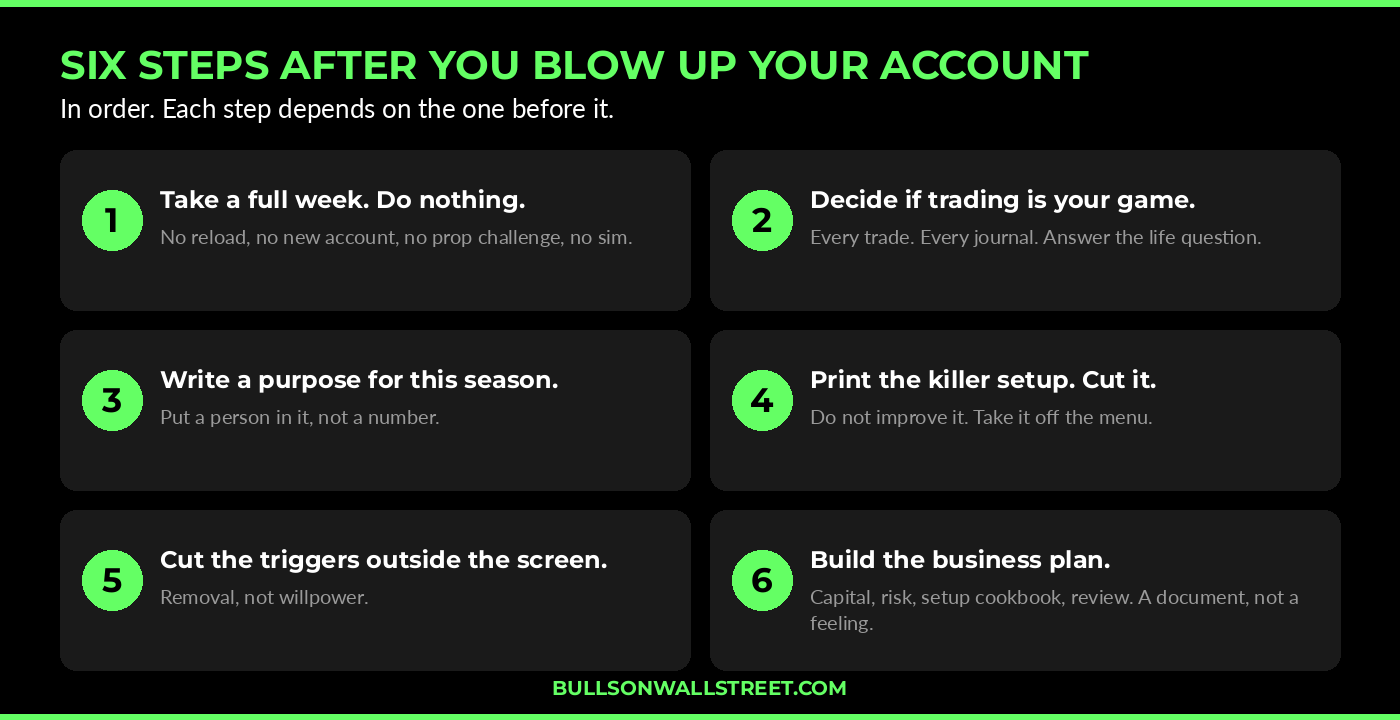
Step 1: Take a Full Week and Do Nothing
When a student messages me the night they blew up and tells me they want to reload tomorrow, my answer is the same every time. Not a chance.
You are coming back from something heartbreaking, and you are undercapitalized. Either one of those alone is a bad setup. Together they are the worst setup in trading. You might as well donate the money to a good cause, because you are giving it away either way, and at least the charity will send you a thank-you note.
I have been teaching traders since 2008. I have seen this exact scenario over and over and over. I have never seen anybody pull out of it just because they wanted to. Not once. The people who came back and became consistent all did the same thing first. They stopped.
A full week means:
- No new account.
- No transfer into the old one.
- No prop firm challenge on a credit card.
- No sim, either. Sim after a blowup turns into shadow revenge trading. You will size up in sim to feel better and learn nothing.
- No chart apps on your phone.
If a week feels impossible, that is the diagnosis. The urge to get back in immediately is the same urge that blew you up. It has a name, and I wrote about it in the revenge trading post. The market does not care that you need to make it back.
Why Time Off Actually Works
Rest is the smallest part of the week off. The real job is perspective, and I say that as someone who needed it badly.
Traders have different beliefs about money. Some are tight with it. I am loose with it, and it has always been one of my problems. I am not a big spender. When I make a lot of money I am not thinking about what I want to buy. It is a scorecard for me. I just want to do well for my family. That sounds healthy until you realize what it does to your relationship with risk. Everything becomes a video game. The numbers on the screen stop being real, the P&L swings in ways that could not possibly be real, and you end up jamming buttons like there is a reset at the end of the level.
So when I stepped away, I drove around. I talked to people. I took a quick trip. And the thing I needed to feel, not know but feel, was how hard people actually work in this world to make even $1,000. The real number of hours.
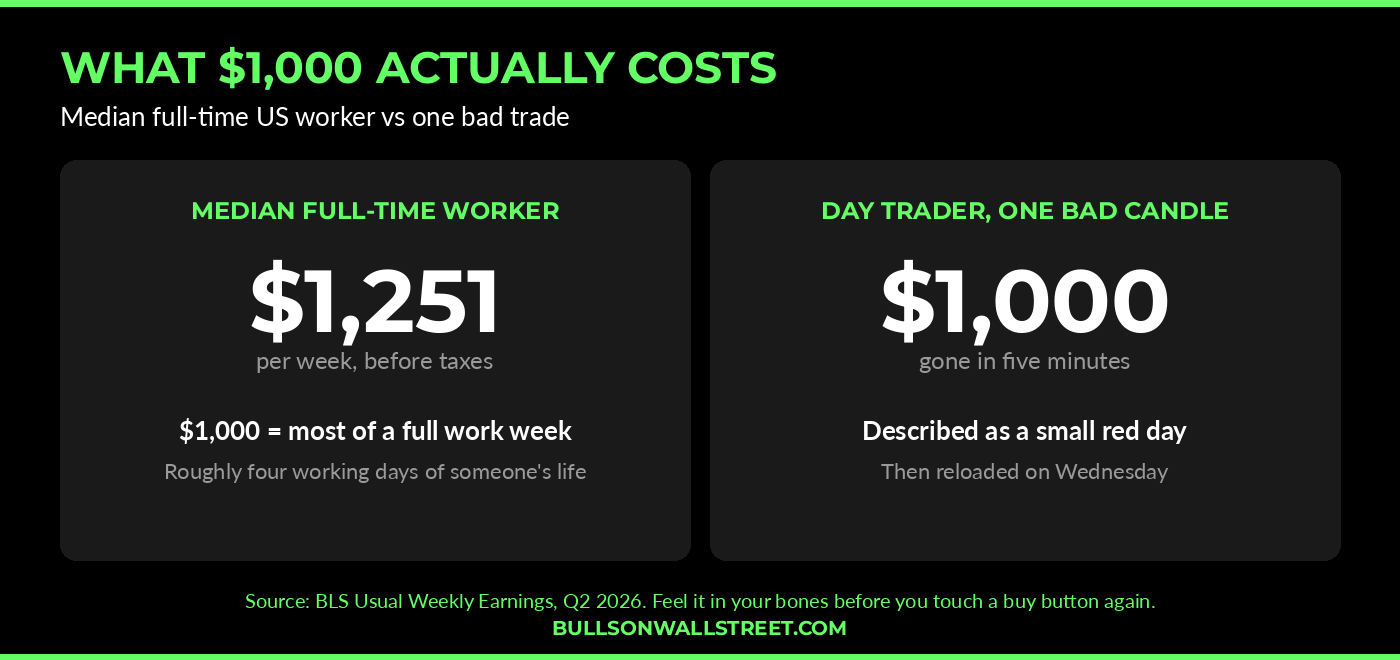
Here is that number. Per the Bureau of Labor Statistics, median weekly earnings of full-time wage and salary workers were $1,251 in the second quarter of 2026. That is the middle of the entire American workforce. Most of a full week of work, before taxes, for the amount a day trader can lose in a single bad candle and describe as a small red day.
The example that hit me hardest is in my own house. My wife is a chiropractor. She went to school until she was almost 30. A master's degree, then a doctorate. She can work a full 10-hour day treating patients and it is sometimes less than what I make in one trade. She has more skills than I do. She earned every one of them. And I am the one treating the job like a video game.
Internally you know people work hard and things are expensive. In the moment, staring at a screen, you do not feel it. The week off exists so you feel it in your bones before you touch a buy button again. Making money is hard. There are people doing real work and barely getting by. You do not get to treat capital like points.
Step 2: Decide Whether Trading Is Even Your Game
This is the question nobody asks themselves and everybody should. Time away is not worth anything if you only use it to wait.
Here is what my time off actually looked like once the perspective part was done. I went through every trade. Every single one. I went through all my journals. I sat around and thought, and thought, and I made myself answer whether this was what I was going to spend the rest of my life doing. Not whether I wanted to make money at it. Whether I wanted this to be the work.
I did not come back because a calendar said so. I came back when three things were true. I had worked on my weaknesses. I had gone through the record honestly. And I had answered the life question. Then the itch showed up, and the itch was allowed, because it came after the work instead of instead of the work.
If you go through your journals and find you have no journals, that is your answer for now. You were not trading. You were gambling with a chart open. Go back to the trading psychology hub and start with the discipline material, not the setups.
If you go through the record and find that the losses came from one or two things you keep doing, keep reading. That is fixable, and the next steps are for you.
If you go through it and realize you hate the boring parts, the prep, the journaling, the sitting on your hands, then read should I quit trading before you read anything else on this site. There is no shame in the answer. There is a lot of shame in reloading five more times to avoid it.
Step 3: Write a Purpose Statement for This Season
People hear purpose statement and picture something that is supposed to define their whole life. That is why they never write one, or write one that does nothing.
What I learned is that there are seasons in life, and each season can have a different purpose. Something that moves you right now, in the season you are actually in. Not the one you think you should be in.
Mine, in the season after I stopped blowing up, was my family. I wanted to do well for them, and I wanted to reward my parents with a great time in the twilight of their lives while they were still healthy and moving around. That is it. That is the whole statement. We did some epic things with it. Bali for a month. Costa Rica for a month. My parents on the couch of a villa while I traded the US open at night from two laptops.


Notice what is not in that statement. No car. No watch. No number. A purpose with a dollar figure in it is a P&L target wearing a costume, and it will push you into the exact overtrading that blew you up. A purpose with a person in it changes what you are willing to risk, because now the risk has a face.
That is why it is a trading tool and not a journal entry. When the setup is marginal and you are tempted to force it, the question is no longer can I afford this loss. It is would I take this trade if the money were already my parents' plane tickets. You will pass on a lot more marginal trades. Passing on marginal trades is most of what consistency is.
Write yours for the next six to twelve months. Rewrite it when the season changes.
Step 4: Print the Setup That Keeps Killing You and Cut It
Go back to the trade review from Step 2 and find the pattern. Not the emotion, the setup. There is almost always one, maybe two, that account for most of the damage.
For me there were two. Bottom fishing in down markets, and shorting parabolic stocks, trying to top-tick them. Both feel like genius when they work. Both are where I gave back the most money, over and over, for years.
Here is the part people get wrong. They print out the losing setup and try to improve it. Better entry, tighter stop, one more filter. Do not do that. Cut it. Print it out, write the loss total on it, and take it off the menu completely. You can revisit it in a year with a bigger account and a track record. Right now it is a hole, and you do not repair a hole in your account by standing in it with better technique.
What I kept was the boring lane. Trend trading. Buying great stocks on dips and in patterns. The first pullback into the Bone Zone, where price comes back into the area between the 9 and 20 EMA on the 5-minute chart and a green candle forms and holds. I explain the indicator itself on the Bone Zone page. It is not exciting. It works, and I could do it every day without wondering which version of me showed up.
The research backs the boring lane, too. Barber and Odean studied 66,465 households at a large discount broker and found that those that trade most earn an annual return of 11.4 percent, while the market returns 17.9 percent. Their conclusion was that overconfidence can explain high trading levels and the resulting poor performance. Top-ticking a parabolic is overconfidence with a ticker on it.
Where do you find your version of this? Your own risk management numbers. Sort your trades by setup, then by P&L. The setup at the bottom is the one you print.
Step 5: Cut the Triggers That Live Outside the Screen
The losing setup is the trigger inside the screen. There is always at least one outside it.
For most people it is one of these: trading tired, trading angry after something at home, trading with money that was already spoken for, trading on a phone in a parking lot, trading while a chatroom you do not trust is screaming tickers. None of those show up in a trade log. All of them show up in the P&L.
Mine was boredom trading, and not the kind you are picturing. It was not a slow afternoon. It was the rest of my life. I was working and working and working on Bulls on Wall Street, running the business, teaching class, locking myself in my room for hours. Trading became the one place I went for joy. I did not want the trading day to end, because that was the fun part of my day, and when you do not want the day to end you take trades so it will not.
The trigger was not on the chart. It was that everything outside the chart had gotten heavy enough that the chart became the escape. Fix the life, and the extra trades disappear on their own.
The fix is not willpower. It is removal. If the phone is the trigger, the app comes off the phone. If the room is the trigger, you leave the room. If it is trading with rent money, that is a capital problem and it belongs in Step 6, not in a mindset exercise.
I wrote about the three triggers behind overtrading in the how to stop overtrading post. Most of them are outside the screen.
Step 6: Build a Real Business Plan With a Setup Cookbook
You do not come back with a feeling. You come back with a document.
A trading business plan is shorter than people think, and it covers four things.
Capital. How much, where it came from, and what happens to your life if it goes to zero. If the answer to the last part is anything other than nothing changes, you are undercapitalized, and undercapitalized after a blowup is the exact combination from Step 1. The honest move is usually the Double Dip: keep the job, stack the cash, trade small or sim while you rebuild. I covered how that actually works in how to day trade while working full time. If you are starting the rebuild small, the small account guide is written for exactly that.
Risk. The 1% Rule, and half that in chop. The 3-Loss Rule: three consecutive losses in a day and you are done for the day, no exceptions. Both written down, both enforced by the platform where possible, not by you.
Setups. The cookbook. Two or three setups, each with a name, an entry trigger, a stop location, a scale-out plan and the market conditions it works in. Everything else is off the menu. Mine live on the day trading strategies page and the candlestick patterns PDF covers what the entry candles look like. I chart all of it in TC2000, and you can get TC2000 through our referral link if you are rebuilding your stack from scratch.
Review. When you journal, what you review weekly, and what number tells you the plan is failing. Decide the exit criteria before you start, the same way you would on a trade.
This is the document I did not have the first three times I blew up. Building it is most of what the 60-Day Trading Bootcamp is, which is why I tell every student on day one that they will not be profitable in 30 days. The plan comes first. The profits come after the plan has been followed long enough to prove it.
What Reloading Fast Actually Costs
Put the pieces together and here is the arithmetic on the reload-tomorrow plan.
You are down. You are undercapitalized, because the account that blew up was your capital. You have not reviewed the trades, so the killer setup is still on the menu. You have no purpose for this season, so the risk has no face. You have no plan, so there is no exit criteria. And the rule that used to force a pause was removed by the regulator this summer.
Every input to a second blowup is in place, and the only thing between you and it is your intention to be more careful this time. I have watched that intention lose to the first red candle for 18 years.
Take the week. Do the steps in order. The market will be there.
FAQ
What should I do right after blowing up my trading account?
Nothing, for a full week. Do not fund a new account, do not transfer money into the old one, do not buy a prop challenge. Then go through every trade and every journal entry before you decide anything.
How long should I stay out of the market after a blowup?
A week minimum, and after that until you have worked on your weaknesses, reviewed every trade, and answered whether trading is what you want to spend your life doing. I came back when those three things were done and the itch showed up, not on a date.
Should I reload my account right away to make the money back?
No. You are heartbroken and undercapitalized at the same time, which is the worst possible setup. I have taught traders since 2008 and have never seen anyone recover from a blowup on want alone. You might as well donate the money.
Does the pattern day trader rule still stop me from trading after a blowup?
Not anymore. FINRA eliminated the pattern day trader designation and the $25,000 minimum effective June 4, 2026, with brokers phasing it in over 18 months. The pause that rule used to force is now on you.
Why do traders keep blowing up their accounts?
Usually one or two setups account for most of the damage, and they get repeated because they feel like genius when they work. Mine were bottom fishing in down markets and top-ticking parabolic stocks. The fix is cutting the setup, not improving it.
Should I go back to sim after blowing up?
Not in the first week. Sim right after a blowup becomes shadow revenge trading. After the week, sim is where you prove the new plan before real money.
What is a purpose statement in trading and does it actually help?
A short statement of what moves you in the current season of your life. Mine was doing well for my family and giving my parents great trips while they were healthy. It helps because it puts a face on the risk, which makes you pass on marginal trades.
How much money do I need to start trading again after a blowup?
Enough that losing all of it changes nothing about your life. If that is not true, keep the job and rebuild capital first. There is no number that fixes being undercapitalized after a loss.
Is it normal to blow up a trading account more than once?
Yes, and I did it repeatedly between 1999 and my first consistently profitable year in 2006. It is normal. It is also avoidable once you stop reloading on emotion and build a plan.
How do I know if I should quit trading after blowing up?
Go through your journals. If you have none, you were not trading yet. If you hate the boring parts, prep, journaling, waiting, then trading may not be your game, and that is a fine answer. If the losses trace to one or two fixable setups, keep going.
What is a trading business plan?
A short document covering capital, risk rules, a setup cookbook with two or three named setups, and a review process with exit criteria. You come back with the document, not a feeling.
Do prop firm challenges make it easier to blow up again?
They make it easier to reload without rebuilding real capital, and reloading without rebuilding is the pattern. Whatever you use, the six steps come first.
Ready to Rebuild It Properly
If you blew up because you never had a plan, that is the part I can help with. The 60-Day Trading Bootcamp is built around exactly the sequence in this post: the setups, the risk rules, the business plan, and the daily review, taught live and watched live before you go back to real money. If you are not ready for that yet, the chatroom is where you can watch the plan being followed every morning, and a full-access 7-day trial is $7.
About the Author
Kunal Desai is the CEO and founder of Bulls on Wall Street. A professional trader since 2007, he has navigated every major market cycle -- from the 2008 financial crisis to today's high-volatility environments. Having mentored 7,000+ students through his live trading bootcamps, Kunal trades live every morning in the Bulls on Wall Street Trading Chatroom, where a full-access 7-day trial costs $7. He is dedicated to teaching real-world execution and high-probability strategies. Based in Miramar Beach, Florida.
Connect with Kunal: Read his full story | Instagram | YouTube

