

Before You Quit Trading, Do This: The 30-Day Reset That Saves Accounts
Updated March 2026
You are probably at a specific point right now.
A few months in. Maybe over a year. You started with real excitement, put in the work, bought the course, did the homework, showed up every single day. And now the account is shrinking, nothing is clicking, and you are seriously considering walking away.
I get it. And I have seen it hundreds of times.
I am on bootcamp number 74 at Bulls on Wall Street. I have been teaching traders since 2008 and have personally coached thousands through exactly this phase. I call myself the stock doctor. I build traders. But I also rebuild them. And the pattern of what breaks traders at this stage is almost always the same.
The worst part is not the losses. The worst part is what I have watched happen too many times: traders quit right before they would have broken through. Sometimes within days of the turn. They do not know how close they were.
This post is the full diagnostic and the exact 30-day protocol I use with struggling students before they walk away. Follow it before you make any decisions.
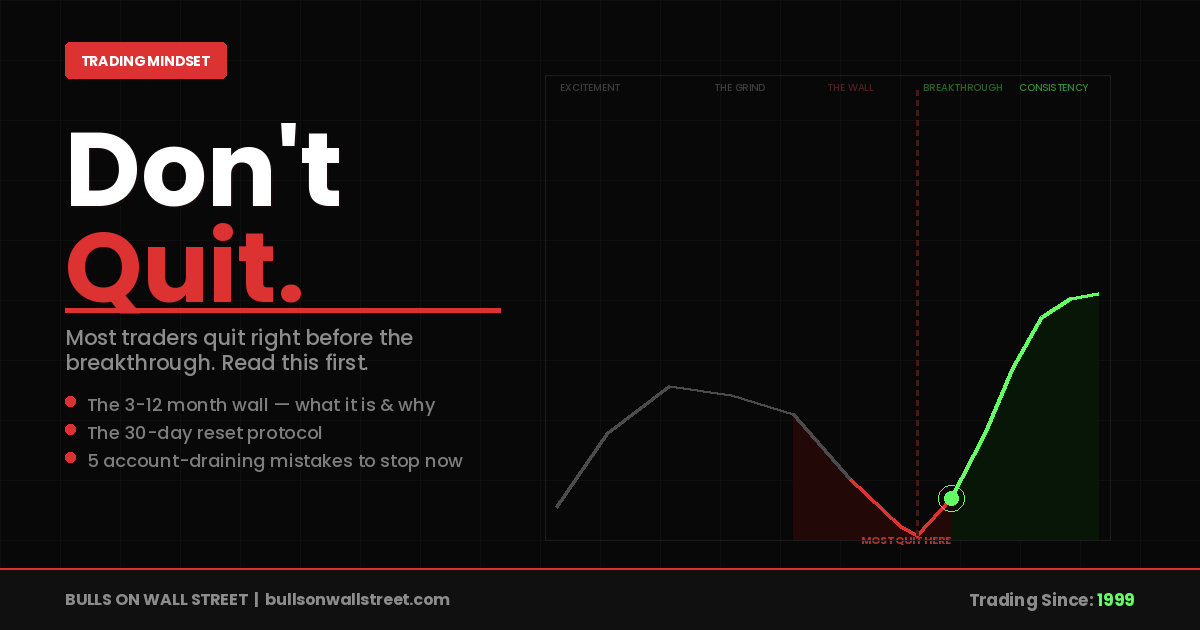
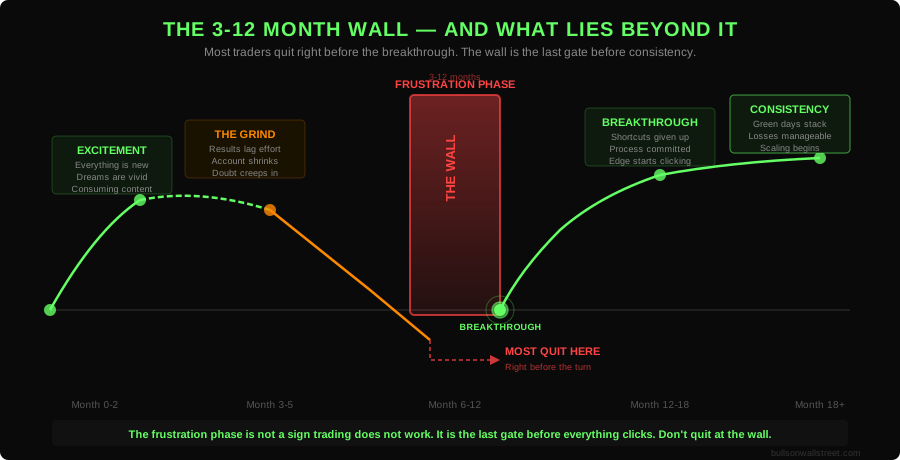
Why Traders Hit This Wall Between 3 and 12 Months
The psychological wall that hits after the initial excitement is real and predictable. You came in and consumed enormous amounts of content. Podcasts on the way to the gym. Books stacked on the nightstand. Classes, videos, bootcamps. You put in what felt like everything.
And then the money did not come.
Most traders make the same mistake at this stage: equating knowledge consumption with earned results. They learned things, therefore they deserve money. That is not how trading works. Reading about a surgery and performing a surgery are completely different skills. Watching me break down a first pullback setup in class and executing that setup in real time with money on the line while the ticker is moving against you are completely different things.
One of my students, Jessica, is genuinely talented. She makes $500 a day with real consistency. But in her head $500 is never enough. She wants the $1,000, then the $2,000. So she makes $500 and keeps trading until she is red. I told her directly: stack those $500 days for 90 days, 120 days, build that into documented consistency, then come talk about scaling. The account and the skill have to grow together. Jump ahead of your proven edge and the market corrects you every time.
The frustration phase you are in right now is not a sign trading does not work. It is a necessary phase. The limiting beliefs, the ego, the expectation of shortcuts, all of it has to burn off before the real learning takes root. Most traders quit right at the end of that clearing process. The last step is always the hardest because it requires fully admitting there are no shortcuts and committing to the process without reservation. That step is the threshold. The traders who push through it build real careers.
The Five Mistakes That Are Breaking Your Progress
1. Jumping Into Live Trading Too Early
You watched some videos. You felt ready. You put money to work. It disappeared fast.
Even traders who study extensively often go live before they have the one thing that actually matters: reps executing real-time price action. The charts in class are static and cherry-picked. The most beautiful breakouts from 20 years of trading. Nobody shows the ugly charts, the ones that looked perfect and immediately flushed 8%.
When you go live, price is moving. Ranges are developing that you have not internalized. The ATR of every stock feels different than it looks on a static chart. And the emotional stakes are completely different from paper. TC2000 market replay lets you replay actual historical trading days and execute trades in real time against real price action. Get a hundred reps on your primary setup in simulation before a dollar of real capital goes to work.
2. The Complexity Trap
I am on bootcamp 74 and every single session somebody asks: what about MACD? Can I use RSI? What if I add the pivot points into the Bollinger Bands that rolls into the flux capacitor?
And then they post a chart that looks like a Rorschach test with trend lines drawn everywhere.
A real pattern should kick you in the face the second you look at the chart. Unmistakable. Clean. If you are tilting your head, squinting, asking yourself if maybe this could be a setup, toss it. No pattern, no trade. The complexity trap is how traders avoid accountability for bad decisions. Strip back to price, volume, and moving averages and every entry is yours to own. Clean everything. Always the way to go.
3. Overtrading Out of Desperation
This is how most accounts actually blow up. Not one catastrophic trade. A cascade of small desperate ones.
One of my students, Jeff, was down $5,000 on the day. Ground his way all the way back to down $100. Then could not stop. Kept pushing. Luck ran out and he was back down $5,000 within an hour. The entire afternoon of work gone because he could not accept a $100 red day.
Green is a color. There are 22 trading days in a month. One red day means almost nothing in the context of a month. One desperation afternoon can mean a lot. Set a hard daily max loss limit in the brokerage platform before the market opens. Not in a journal. In the platform, so it enforces mechanically when your emotional state cannot. FINRA research on retail day traders identifies overtrading driven by loss recovery attempts as a primary account destruction mechanism.
4. No Defined, Repeatable Strategy
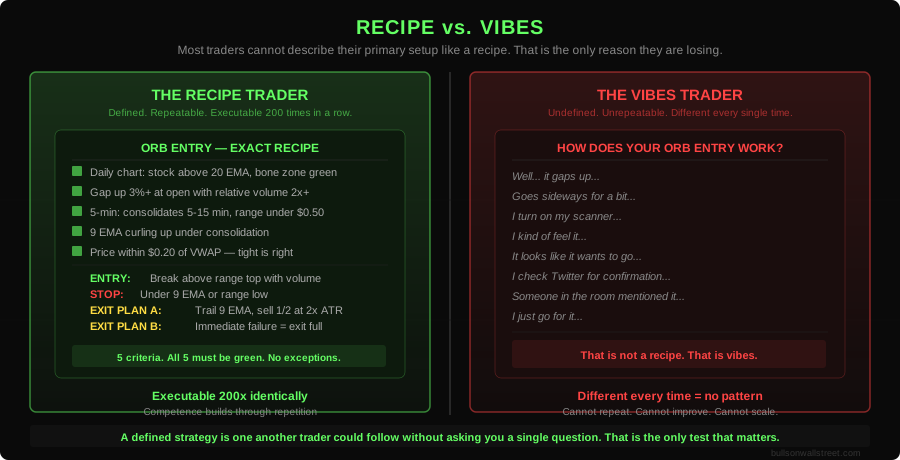
Most struggling traders cannot describe their primary setup like a recipe. Ask them for their ORB criteria and you get: it gaps up, goes sideways, I turn on my scanner. That is not a recipe. That is vibes.
Think about a chef. Give them a piece of paper and ask for their signature dish recipe. Two pinches of this. Four pinches of that. 400 degrees. 15 minutes. That precision is why they can execute the same dish 200 times and have it come out right every time. Your setup needs that same level of specificity. Every filter. Every confirmation. Exact stop placement rule. Exact exit conditions. Written down so precisely that another trader could follow it without asking you a single question. The pre-trade entry checklist is the starting point for building that precision.
5. Methodology Hopping
In my bootcamp, students have lifetime access. I will see someone I have not heard from in months and ask where they have been. Same answer every time: well, I got into options and then I was in this futures room and then I tried crypto and I am in Apex now and...
Jack of all trades. Expert at nothing. Partial knowledge across six approaches and mastery of none. Competence requires repetition. Repetition requires commitment to one thing long enough for the reps to accumulate. You cannot build real pattern recognition in a setup you have only taken 20 times. Give your primary setup a genuine 200-trade evaluation before deciding whether it works. The full picture of what breaks traders at the belief level is in the why traders fail post.
The 30-Day Reset Protocol
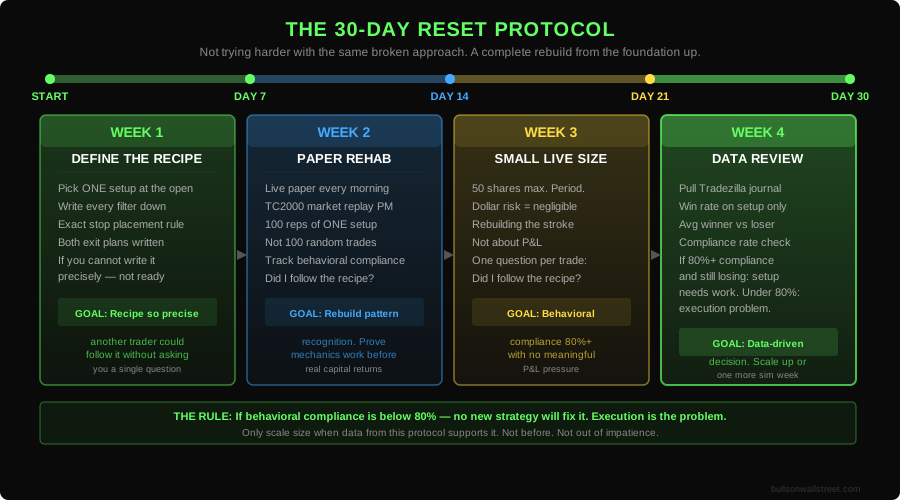
Not trying harder with the same broken approach. That produces the same broken results. This is a complete rebuild from the foundation up.
Week 1: Strategy Definition
One task this entire week. Define your primary setup in granular, recipe-level detail.
Pick something at the open. Red to green trade. Opening range breakout. Quick pullback buy to the 9 EMA. The Bone Zone entry after a first thrust where price pulls back into the area between the 9 and 20 EMA on decreasing volume and prints a green candle reclaiming the 9. Pick one. Then write out every single criterion that has to be present before you enter. Not general descriptions. Specific and measurable.
What does the daily chart have to show? What does the 5-minute chart have to show? What is the exact stop placement rule? What is the exit plan if it works immediately? What is the exit plan if it immediately fails? Write all of it until you have a recipe precise enough that another trader could follow it without asking you a single question. If you cannot write it that precisely, you do not know the setup well enough to trade it yet.
Week 2: Paper Trading Rehab
Back to the simulator. Not a punishment. How professionals rebuild.
Trade live paper every morning during market hours. Then in the afternoon, use TC2000 market replay to pull specific historical trading days and replay your primary setup on those dates. The goal is 100 reps of that one setup against real historical price action. Not 100 random trades. 100 reps of your specific setup, executed exactly by the recipe from Week 1.
When my mentorship students hit two losing weeks in a row, they go straight to paper trading rehab. Still executing every morning. Just without the financial pressure that distorts decision-making during a slump. The reps rebuild pattern recognition. The simulation results confirm whether the mechanics are right before real capital goes back to work.
Week 3: Small Position Live Trading
Come back live with the smallest meaningful size you can trade. 50 shares. One small contract. Whatever makes the dollar risk small enough that a loss does not trigger an emotional response.
The goal this week is not profit. The goal is execution. You are rebuilding your stroke. A basketball player fixing a shooting slump does not fix it in games. They go to the gym alone, shoot from five feet, rebuild the mechanics with zero pressure, and extend the range gradually.
Every trade gets evaluated on one question only: did I follow the recipe? Not did I make money. Did I follow the recipe. Behavioral compliance is the only metric that matters in Week 3.
Week 4: Performance Review and Adjustment
Pull everything from the last four weeks. I use Tradezilla for journaling and send every BOWS student there. It tracks every metric you need. Not affiliated, I just use it myself.
Look at win rate on your primary setup. Average winner versus average loser. Behavioral compliance rate (how often did you actually follow the recipe). Daily P&L by time of day.
If behavioral compliance is above 80% and results are still not working, the setup itself may need adjustment. If behavioral compliance is below 80%, the setup is not the problem. Execution is. Do another week of simulation before going live again. This feedback loop is what turns struggling traders into consistent ones. Not a new strategy. Not a new scanner.
The Sleep Deprivation Lesson
In 2024 I had my first kid. Colt was born in May. I am 44 years old and had spent my entire adult life living for myself. Suddenly I was not sleeping. The kind of tired where your judgment is running at maybe 60% and you do not fully realize it until you look at your trades.
My trading went into a drawdown. Not because the market changed. Not because my setups stopped working. Because my decision-making was impaired and it showed up at 9:30 every single morning.
What pulled me out was the same protocol I give my students. Cut position size until the losses cannot meaningfully damage the account. Go to people whose judgment you trust and show them your trades without editing or defending. Let them look at it from outside the fog. Follow the mechanics of the system more rigidly, not less, during the periods when your intuition is compromised.
My mentor Paul has been looking at my trades since 2006. John Welsh. A trader named Z-Man I have been on Gmail chat with since 2008 every single trading day. When I am in a slump those people have been worth more to my results than any indicator change I have ever made. Nobody gets out of slumps alone. The SEC consistently highlights outside perspective and structured review as essential components of sustainable retail trading psychology. You do not have to be in crisis to need a mentor. You just need someone who can look at your situation with fresh eyes.
Most Traders Quit at the Last Mile
I have watched this too many times.
A trader grinds through months of work. Gets close to the turn. Quits right before it. The frustration you are feeling right now is not evidence that trading does not work. It is evidence that you are in the hardest part: the part where the ego has to fully give up the idea of shortcuts, where you finally commit to the process without reservation, where you stop trying to all-decide your way around the fundamentals.
That moment, that commitment, is the threshold. The traders who push through it build real careers. The ones who quit right before it never know how close they were.
Follow the protocol. 30 days. One setup. Simulation first. Small live second. Review and adjust at the end. Build the psychological foundation through the full trading psychology framework so the next slump does not take you down the same way.
If you want to go through this rebuild inside a structured environment with live daily trading, real accountability, and a community of traders going through the same process: 60-Day Live Trading Bootcamp. Bootcamp 74 is running now. The process works when you work it.
Subscribe to the Bulls on Wall Street YouTube channel for daily market prep, live trade breakdowns, and the kind of real-talk trading education that does not hide how hard this business actually is.
Frequently Asked Questions
Should I quit trading if I keep losing money?
Not before running the diagnostic. If you are making the same behavioral mistakes repeatedly, overtrading, chasing, no defined setup, the answer is reset and rebuild, not quit. If you are following your rules correctly and the market is in a rough stretch, cut size and stay in. Journal the data and figure out which one it actually is.
How long does it actually take to become consistently profitable?
Plan for 12 to 24 months minimum of deliberate practice. Not content consumption. Actual execution reps. It took seven years personally, 1999 to 2006, before I became reliably profitable. The process cannot be shortened. It can only be executed correctly or incorrectly.
What is paper trading rehab and how is it different from regular simulation?
Regular simulation is learning. Paper trading rehab is rebuilding after a specific failure pattern has developed. The key difference is structure: you are executing your specifically defined recipe, tracking behavioral compliance, using market replay for additional afternoon reps, and using results as data to confirm mechanics before going live again.
What is the single most impactful thing a struggling trader can do right now?
Write the recipe. Define the primary setup in granular enough detail that another trader could follow it without asking any questions. Every filter. Every confirmation. Exact stop rule. Exact exit conditions. If you cannot write it that precisely, you do not have a strategy yet. You have an intention.
How do I know if my strategy is broken or my execution is broken?
Track behavioral compliance separately from P&L. If you are following your exact rules on 80%+ of trades and still losing consistently, the setup may need adjustment. If you are following your rules on less than 80% of trades, execution is the problem. No new strategy fixes an execution problem.
Is it normal to want to quit trading at this stage?
Very normal. The 3-to-12-month window is one of the most predictable patterns in trader development. Almost everyone hits it. The ones who push through it tend to break into a completely different level of consistency. The ones who quit right before the turn never find out how close they were.
How do I stop overtrading when I am down on the day?
Hard mechanical limit in the brokerage platform before the market opens. Not in a journal. In the platform. When the number is hit, the session is over. Willpower in a deteriorated emotional state is not reliable. The machine has to enforce what the mind cannot.
What does a mentor provide that self-study cannot?
The outside view. When you are in a slump, your judgment about your own trading is completely distorted by the emotional weight. A mentor looking at the same journal from outside that emotional state finds two or three specific fixable things that you cannot see while you are inside it.
Can I actually recover from a blown account?
Yes, with the right structure. Return to simulation. Write the recipe for one setup. Get 100 reps on it before going live again. Come back with the smallest meaningful size possible to rebuild behavioral compliance without meaningful P&L pressure. The account rebuilds after the mechanics and psychology rebuild, not before.
Why do most traders quit between 3 and 12 months instead of pushing through?
Because the frustration phase feels personal. You put in real effort and the results are not matching. In most areas of life that gap does not exist. The mistake is interpreting the gap as evidence trading does not work. It is actually evidence you are in the hardest and most necessary phase of development, the phase where the real skill gets built. The ones who get through it are the ones who understand what the frustration actually means.
This guide is part of our complete risk management system for day traders.
Related reading: Trading Psychology: The Mental Game That Decides Every Trade | Why Traders Fail | Revenge Trading: Why It Happens and How to Stop It | Risk Management for Day Traders | First Pullback Trading Strategy | Pre-Trade Entry Checklist | How to Build the Best Trading Routine | Small Account Risk Management | Position Sizing Calculator | Risk to Reward Ratio Guide | PDT Rule Explained
About Kunal Desai
Kunal Desai is the CEO and founder of Bulls on Wall Street. A professional trader since 2007, he has navigated every major market cycle -- from the 2008 financial crisis to today's high-volatility environments. Having mentored 7,000+ students through his live trading bootcamps, Kunal trades live every morning in the Bulls on Wall Street Trading Chatroom and is dedicated to teaching real-world execution and high-probability strategies. Based in Miramar Beach, Florida.