

Updated June 2026
Day trading risk management is the system of rules that controls how much you can lose on any single trade, any single day, and any single losing streak. It is the only part of trading that decides whether you survive long enough to get good.
I am going to make a claim most trading educators will not make directly. I am a risk manager first and a trader second. I have traded full time since the end of 2007, through the financial crisis, the flash crash, the meme stock mania, and every cycle in between. I have been teaching this since 2008, before most of the trading educators you see today existed, and I have trained more than 7,000 students through the Bulls on Wall Street 60-Day Trading Bootcamp.
The students tell the story better than I can. Kristjan Kullamagi, the trader who ran a few thousand dollars into nine figures and is featured in Jack Schwager's newest Market Wizards book, named Bulls on Wall Street on his own stream as one of the memberships he paid for while developing as a trader. Every rule in this post has a name, because I built it, I trade it every single market day, and I teach it by name in my classroom.
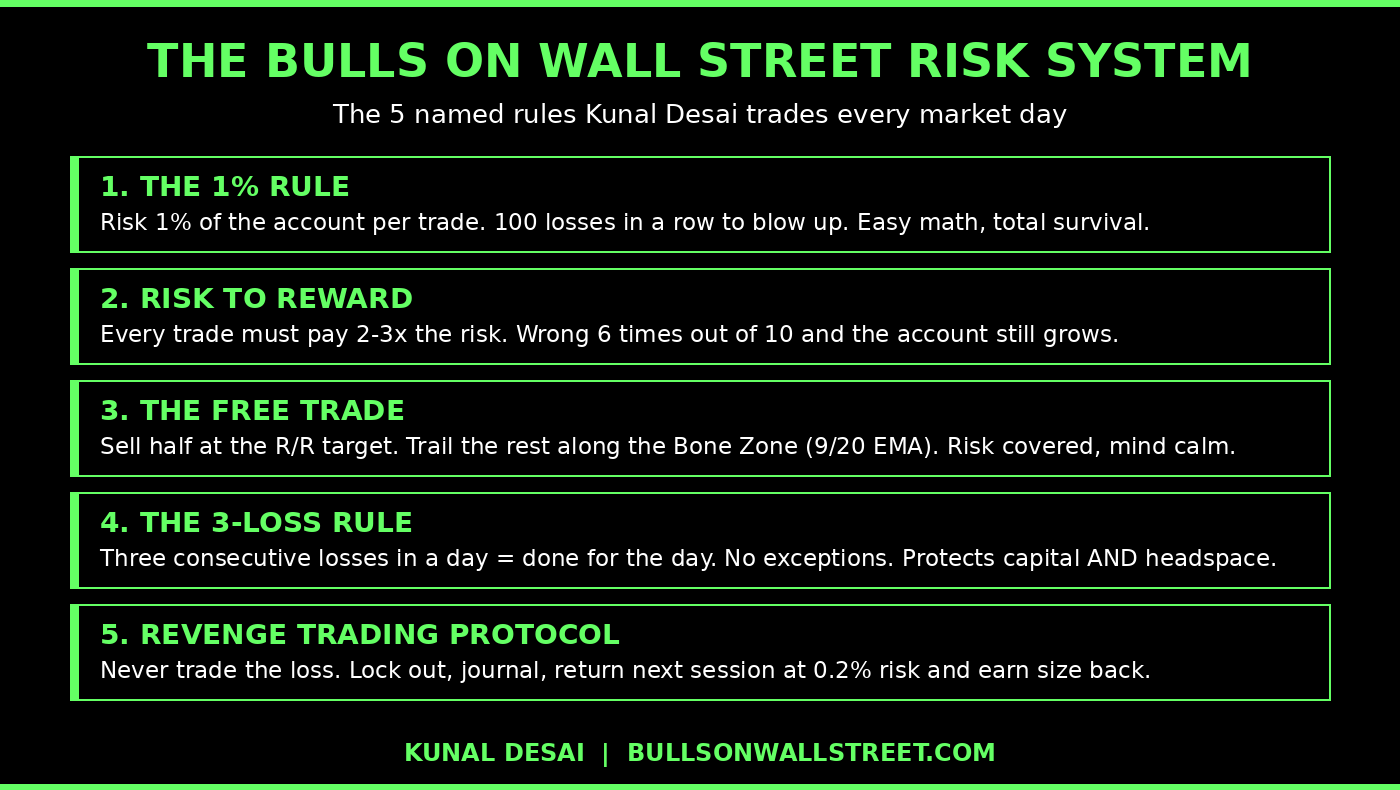
Here is the system: the 1% Rule, the Free Trade, the 3-Loss Rule, and the Revenge Trading Protocol, held together by risk to reward discipline. This post walks through each one with real trades from my own account, including the exact day this January when the 3-Loss Rule saved me on SLV.
But first you need to understand why I am so obsessed with risk. Because for seven years, I was the guy blowing up.
I Spent 7 Years in the Boom and Bust Cycle
I started trading in 1999 as a college kid at Michigan State. My accounts were small, mostly five to ten thousand dollars. A few times I built one up to thirty thousand. Then back down it went.
The killer was margin. When you have a small account, you are always using margin, and on 4x margin the math is brutal. A stock drops 20% and half your account is gone on one trade. That happened to me routinely. I was trading small caps with excessive leverage, and my P&L swings were incredible even though the actual capital was tiny. FINRA calls this getting a margin call, and under FINRA Rule 2264 every broker has to warn you in writing that you can lose more money than you deposit. I did not read that warning. I lived it.
This went on for years. Make money, lose it, make it back, lose more. Graduate, take a headhunting job, keep spinning. My parents were pushing the MBA. The data says my story is the normal one: the landmark Barber and Odean study of day traders found that the vast majority quit within two years and only a tiny fraction ever become consistently profitable.
What broke the cycle was not a better setup. It was a mentor named Paul Singh, and one piece of math.
The 1% Rule: The Math Paul Singh Gave Me
Paul Singh is a lawyer by trade and a semi professional poker player. He has been hitting up casinos and playing cards on the circuit since his younger days, so risk to reward is his native language. When he started training me over AOL Instant Messenger in those late night sessions, he did not start with chart patterns. He hammered me on one thing: my boom and bust cycle.
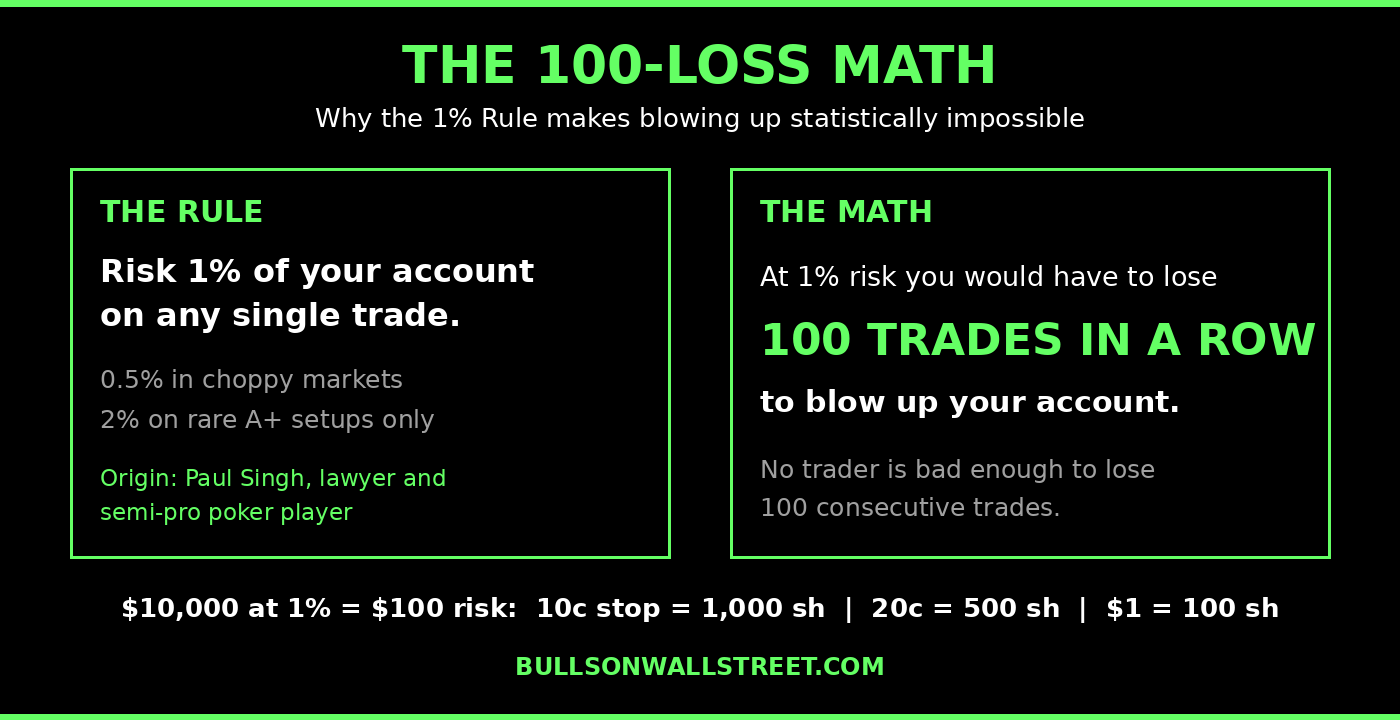
His fix was the 1% Rule. Risk 1% of your account on any single trade. His argument was pure poker math. At 1% risk, you would theoretically have to lose 100 trades in a row to blow up your account. I do not care how bad a trader you are. Losing 100 trades in a row is statistically close to impossible.
That clicked for me instantly, and it has anchored my trading for two decades. The other reason I love it: the math is easy. One hundred losses. One percent. Anybody can hold that in their head in the heat of battle.
Today, with more capital and more experience, I flex it. In choppy markets I drop to 0.5%. On rare A+ setups I will stretch to 2%. But 1% is home base, and it is the number I give every student on day one. I wrote a full breakdown in my guide to the 1% rule in trading.
Position Sizing: The Cheat Sheet That Does the Thinking
The 1% Rule only works if you can convert it into share count in seconds. You need three numbers: account size, dollar risk, and stop distance.
Say you have a $10,000 account and you are risking $100 per trade at 1%:
- 10 cent stop = 1,000 shares
- 20 cent stop = 500 shares
- 50 cent stop = 200 shares
- $1 stop = 100 shares
Build your own version of this table for your account size and memorize it. When the stock is moving and the adrenaline is up, you do not want to be doing division. The cheat sheet does the thinking so you can focus on the trade. For the full math, including how volatility changes your stop distance, use my position sizing calculator guide.
Notice what this system kills: emotional sizing. Most traders size up when they are excited, size up when they are angry about the last loss, and go all in when FOMO takes over. That is not risk management. That is guessing. If your position sizes are random, your results are random. If your sizing is structured, your results become probability based and repeatable.
My simple test: if one trade can ruin your day emotionally or financially, you are trading too big.
Risk to Reward: I Do Not Take Coin Flips
Every trade I enter has to pay me at least two to three times what I am risking. If I risk 50 cents, the setup needs a realistic path to a $1.00 to $1.50 move. If it does not, I pass, no matter how good the chart looks.
This is the piece most traders skip, and it is why they can win more than half their trades and still lose money. At 3 to 1 reward to risk, I can be wrong 6 times out of 10 and still grow the account. That is the entire business model of professional trading: small structured losses, asymmetric wins. I broke down the full math in my risk to reward ratio guide.
Risk to reward is also the bridge to the rule I am best known for. Because once a trade pays you that first multiple of risk, something powerful becomes available.
The Free Trade: Sell Half, Trail the Rest Up the Bone Zone
The Free Trade is my name for the exit system I use on nearly every winning trade. Two steps:
- When the trade hits my risk to reward target, I sell half the position. That covers my original risk and pays me.
- I trail the remaining half along the Bone Zone, the shaded area between the 9 EMA and 20 EMA on my chart, moving my stop with the EMAs until the trend breaks.
Once that first half comes off, the trade is free. My risk is covered. I have paid myself. Whatever the second half does, I cannot lose on the trade, which means I can finally let it develop into whatever it needs to become.
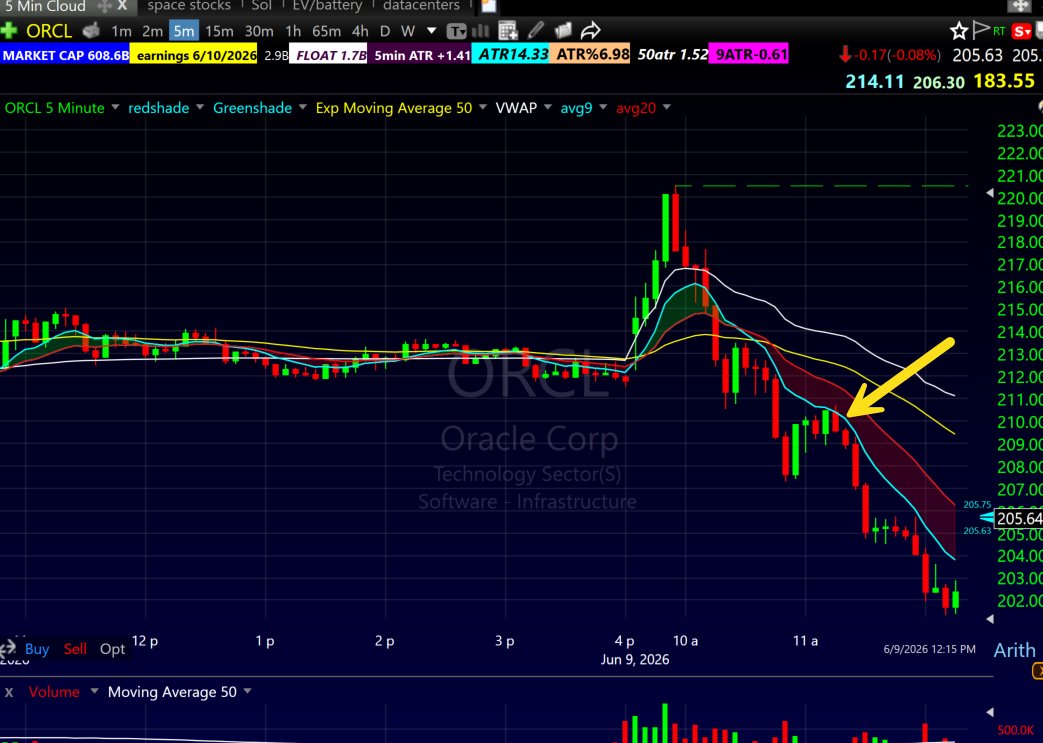
Here is a real one from this week. On June 9 I shorted Oracle, ORCL, on the pullback into the Bone Zone around 211 after the morning breakdown. When the big flush came, I covered half down into the 206s. At that point the stock was trading 5 points below my entry and the trade was pure profit. The remaining half I trailed down the EMAs, locking in more as it bled lower.
The mechanical edge is real, but the psychological edge is bigger. Before I built this rule, I had sweaty palms in every winner. I needed the trade to make money, so I watched every tick, herky jerky, and panic sold good positions on the first wiggle. Once I started taking that first half off, the tension just released. I relax. I let winners run. Selling half does not cut your profits. It buys you the calm to capture the whole move with the other half.
That is the Free Trade. Sell half at your risk to reward target, trail the rest along the Bone Zone. It is the same exit engine I use on my first pullback strategy entries, and I track every one of these zones live on TC2000, the charting platform I have used for over a decade.
The 3-Loss Rule: Three Strikes and I Am Done for the Day
The 3-Loss Rule is non-negotiable in my trading and in my classroom. Three consecutive losses in a single day and you are done trading that day. No exceptions. No just one more. Close the platform and walk away.
The logic: three losses in a row means one of two things. Either the market is against your system today, or you are tilted. Both are reasons to stop, not reasons to press. The traders who ignore this rule are the ones who turn a small red day into a catastrophic one.
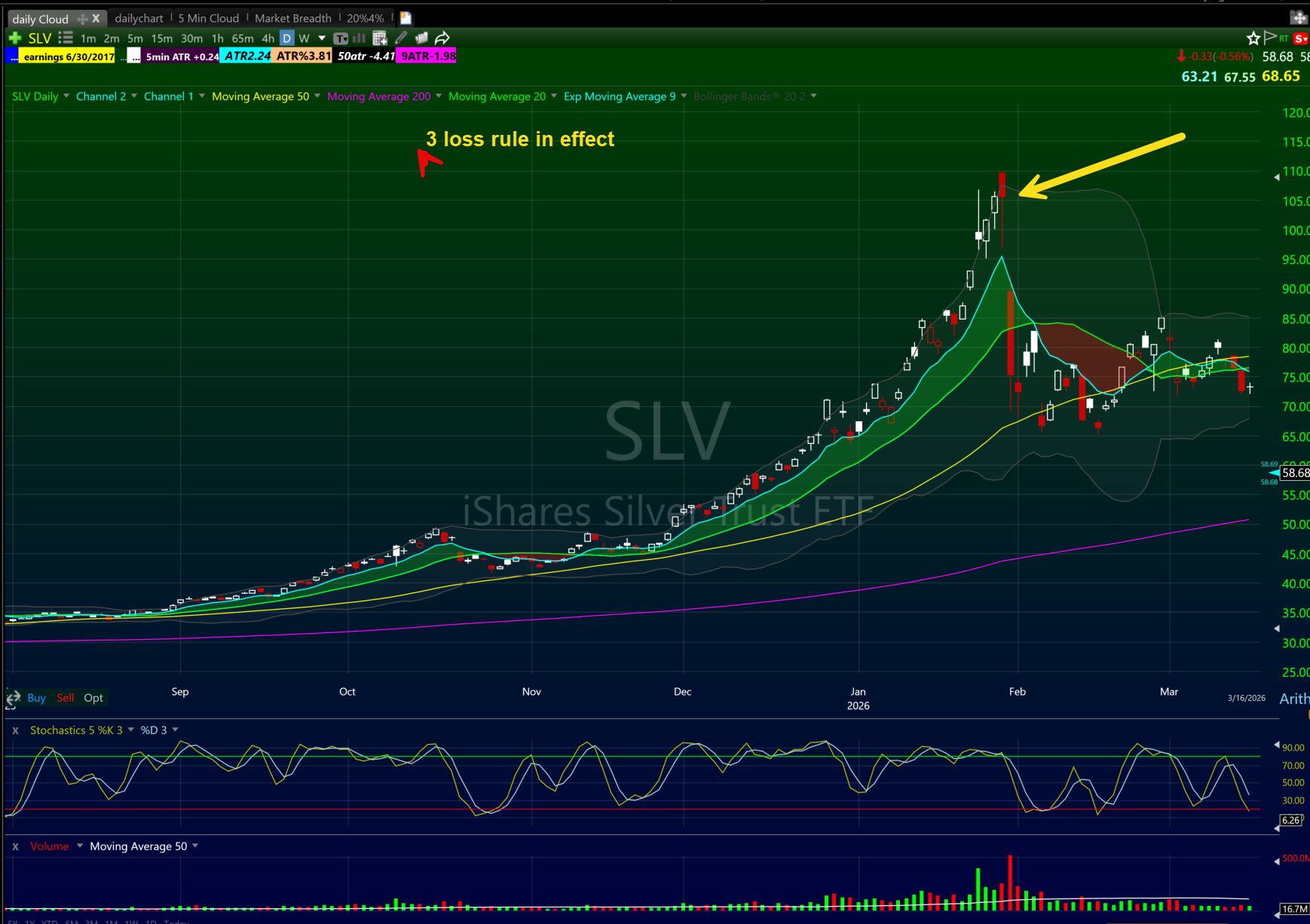
Here is the rule working in real time. On January 29 of this year I was trying to short the parabolic move in SLV, the silver ETF. I trade parabolic setups constantly, but this one was all over the place. Every trick in my toolbox got stopped out. The range was too aggressive even for my tight stops, and I blew through my three losses in a hot second.
So I locked myself out of the stock. Done for the day.
SLV kept grinding higher all day after I stopped, which would have chopped me up even worse. Then the next day it finally collapsed. And because I had only taken three small structured losses instead of bleeding out all afternoon, I came in fresh, with my mental capital and my actual capital intact, and capitalized on the real move. I was a day early. The 3-Loss Rule turned being a day early from a disaster into a minor expense.
That is what people miss about this rule. It is not just defense. It preserves you for the next opportunity. The trader who fights the tape all day Tuesday has nothing left for Wednesday, when the setup actually arrives.
The Revenge Trading Protocol: The Structural Fix for Tilt
Revenge trading has a precise definition in my system: taking a trade motivated by the loss instead of the setup. You know you are revenge trading when you hear yourself thinking, I need to make it back. I cannot end the day red. This time I will size up.
My protocol is structural, not motivational, because willpower does not work when you are tilted:
- The 3-Loss Rule fires first and locks you out for the day.
- After any big red day, sit and process before you touch anything. Then review and journal the damage with zero trading.
- Return the next session with humility and reduced size, around 0.2% risk, and earn your way back to full size with clean execution.
Never try to trade your way out of a red day. The red day is already behind you. The only thing still in front of you is the next decision, and the next decision made on tilt is how a $300 red day becomes a $3,000 one. I wrote a full piece on revenge trading and how to break it if this is your specific leak.
Earning the Right to Size Up
We are not here to trade for pennies forever. At some point you want the big game. But size is earned through consistency, never granted by confidence.
Two things happen naturally as you prove yourself. First, the account grows, so 1% represents more dollars. One percent of $50,000 is $500, a very different trade than 1% of $10,000. Second, your journal starts identifying your highest probability setups. When you have documented proof that a specific pattern wins 70 to 80% of the time for you, you can justify stretching risk to 2% on that pattern when it appears.
The key word is rarely. You stretch size on A+ setups that show up once a month, not on Tuesday afternoon boredom trades. And even then, I build in with confirmation. I start with a feeler at half size, and only as the trade proves my thesis do I scale toward the full position. The market has to earn my size the same way I earned it.
Why Smaller Size Makes You More Money
This sounds backwards, but reducing your position size will increase your profits over time.
Big positions create emotional chaos. You hesitate on entries. You move stops. You stare at the P&L instead of the chart and panic sell winners at the first red candle. Appropriate size produces the opposite: you follow the plan, you hold through normal fluctuation, you capture full moves.
The compounding math seals it. Lose 25% of your account and you need 33% just to get back to even. Lose 50% and you need 100%. The trader spiking 50% one month and giving back 60% the next is on a permanent treadmill. The trader grinding consistent gains with shallow drawdowns is building real wealth. Consistency compounds. Big swings destroy both your capital and your psychology.
I lived both sides of that equation. Seven years of boom and bust, then two decades of structured risk. The difference was never my chart reading. It was the system on this page.
Day Trading Risk Management FAQ
What is the 1% rule in day trading?
The 1% rule means risking no more than 1% of your account on any single trade. My mentor Paul Singh, a lawyer and semi professional poker player, taught it to me with simple math: at 1% risk you would have to lose roughly 100 trades in a row to blow up an account, which is statistically close to impossible for any trader.
What is the Free Trade in trading?
The Free Trade is my exit system at Bulls on Wall Street: sell half your position when the trade hits your risk to reward target, then trail the remaining half along the Bone Zone, the area between the 9 EMA and 20 EMA. Once the first half is sold, your risk is covered and the rest of the trade is pure profit.
What is the 3-Loss Rule?
After three consecutive losses in a single day, you stop trading for the rest of that day. Three straight losses mean either the market is against your system or you are tilted, and both are reasons to walk away. It is non-negotiable in my own trading and in the BOWS bootcamp.
What is the Bone Zone?
The Bone Zone is my name for the shaded area between the 9 EMA and 20 EMA on a chart. It is the primary pullback target in a trending stock and the zone I trail my stops along when managing a Free Trade.
How much should a day trader risk per trade?
Risk 1% of your account per trade as the baseline. Drop to 0.5% in choppy markets. Stretch to 2% only on rare, documented A+ setups, and build into that size with confirmation rather than entering all at once.
How do I calculate position size for day trading?
Divide your dollar risk by your stop distance. With a $10,000 account risking 1%, that is $100 of risk: a 20 cent stop means 500 shares, a 50 cent stop means 200 shares, a $1 stop means 100 shares. Memorize a cheat sheet for your account size so there is no math during the trade.
What risk to reward ratio should day traders use?
A minimum of 2 to 1, and I prefer 3 to 1. At 3 to 1 you can lose 6 trades out of 10 and still grow your account. If a setup cannot realistically pay two to three times the risk, skip it.
Why do most day traders fail?
Position sizing and risk, not strategy. Academic research on day traders shows the large majority quit within two years, and in my experience the cause is oversized positions and margin amplifying normal losing streaks into account-ending drawdowns. Most traders lose money too fast while their skill is still developing.
Is it safe to day trade on margin?
Margin amplifies both gains and losses, and brokers are required to disclose that you can lose more than you deposit. In my early years 4x margin meant a 20% move against me cost half my account on a single trade. If you use margin, your risk per trade still has to be capped at 1% of your actual equity.
Should I stop trading after a losing streak?
Yes. After three consecutive losses in one day, stop for the day. After a large red day, take time to process, journal the damage without trading, and return the next session at reduced size around 0.2% risk until your execution is clean again.
Can you increase risk on high conviction trades?
Only after your journal proves the setup wins at a high rate, and only on patterns that appear rarely. Even then, start with a feeler position and scale in as the trade confirms. Confirmation earns size. Conviction alone does not.
What is revenge trading and how do I stop it?
Revenge trading is taking a trade motivated by a previous loss instead of by a setup. The fix is structural: the 3-Loss Rule locks you out before tilt compounds, and the platform stays closed for the rest of the day. Willpower fails under tilt. Rules do not.
Master Risk and Everything Changes
Eighteen years of full-time trading in, my edge is not a secret indicator. It is that I lose correctly. Small, structured, named, repeatable. The 1% Rule sizes the trade. Risk to reward qualifies it. The Free Trade pays me and frees me. The 3-Loss Rule caps the damage. The Revenge Trading Protocol protects me from myself.
I teach this entire system, with live position sizing and trade management every market morning, in the 60-Day Trading Bootcamp. My students do not trade live during class. They learn the rules, prove them in the simulator, and go live only when their own data supports it. That sequencing is itself risk management.
If you want to see how I manage risk on every chart I trade, start with my day trading strategies guide, grab my candlestick patterns PDF to learn the signals I trail my stops against, and check out the deeper breakdowns on my YouTube channel. This post is the foundation of the complete Bulls on Wall Street risk management system.
About Kunal Desai
Kunal Desai is the CEO and founder of Bulls on Wall Street. A professional trader since 2007, he has navigated every major market cycle, from the 2008 financial crisis to today's high-volatility environments. Having mentored 7,000+ students through his live trading bootcamps, Kunal trades live every morning in the Bulls on Wall Street Trading Chatroom and is dedicated to teaching real-world execution and high-probability strategies. Based in Miramar Beach, Florida.
Connect with Kunal: Read his full story | Instagram | YouTube