

You conquer your fear of day trading by defining your risk so tightly that fear has nothing left to feed on. Not with affirmations. Not with meditation apps. With position sizing, mechanical stops, and hard rules for your own personal patterns. I have been trading since 1999 and full time since the end of 2007, and I am going to tell you something no trading guru will admit: I still feel fear. Every Friday morning, after a good week, I literally grit my teeth and remind myself that today is probably not the day that changes.
Updated August 2026
That is not a weakness. That is the whole lesson of this post. Fear never fully leaves. You do not conquer it by becoming fearless. You conquer it by building a system where fear cannot touch your account. After training 7,000+ students through my bootcamps, I can tell you exactly what trading scared looks like, why it happens, and the specific settings I put inside my own trading platform that ended my sweaty palms era for good.
What Fear Did to My Trading in the Early Years
From 1999 to 2006 I was stuck in what I call the spin cycle. Win for four days, hit my goal, feel like I finally figured it out. Then Friday would come and one big loss would cancel out the entire week of work. Over and over. Years of it.
The mechanism was always the same. Today my first one or two trades of the day are usually my best because they are the hottest stocks, my favorite setups, prepared in the pre market. Back then, if I lost on that first trade, everything unraveled in a predictable sequence.
Trade two, I would size up to make back the first loss. It never works. Trade three, desperate now, even bigger. By trade four I would do the math and realize that even a huge winner could not recover the first three losses, so I would reach for some volatile small cap or a risky trade that had no business being on my screen. And then it would spin out of control. Or worse, I would freeze on one of those big losses, too frustrated to act, and just hold while it kept going down without stopping myself out.

Every trader who has been through this knows the feeling. The fear is not really about the money on any single trade. It is about knowing, deep down, that you cannot trust yourself once things go wrong. Researchers have actually mapped this. A study published in Science on the neural basis of loss aversion found that the brain responds roughly twice as strongly to potential losses as to equivalent gains. Your hardware is wired to trade scared. You cannot out-willpower your own wiring. You have to build around it.
The 3 Types of Risk Management
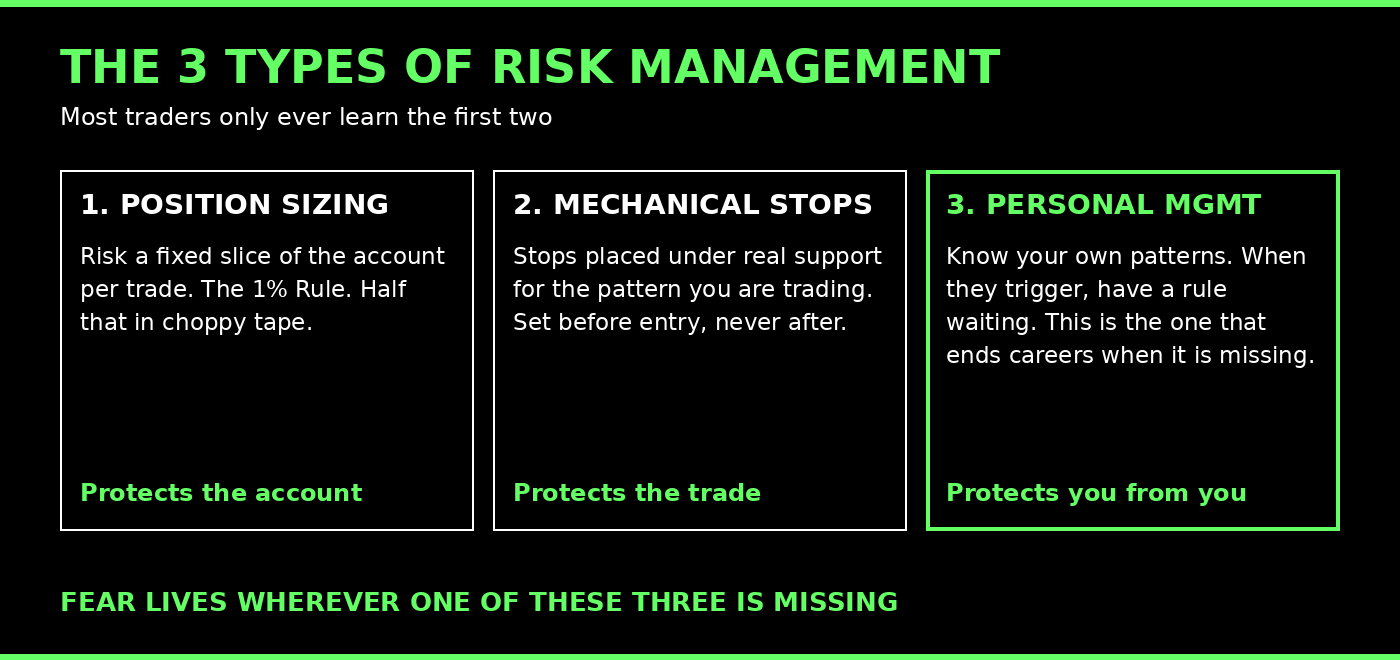
Here is the framework that took me years to figure out and that I now teach on day one. There are three types of risk management in trading, and fear lives wherever one of them is missing.
1. Position sizing. Risk a fixed slice of your account on every trade. For us that is the 1% Rule, which my mentor Paul Singh put on my trading back in 2006. One percent per trade, half a percent in choppy tape. When your worst case is one percent, a red trade is a paper cut instead of a wound.
2. Mechanical stops. Your stop loss goes under real support for the specific pattern you are trading, and it goes in before the trade works or does not. The SEC has a plain definition of a stop order if you are brand new, but the trader version is simpler: the stop is the price where your trade idea is proven wrong. If you do not know that price before you enter, you have no business entering.
3. Personal management. This is the one almost nobody teaches, and it is the biggest portion of risk management. Managing your own personal patterns. Being aware of them, knowing when they are triggering, and having a rule ready to minimize the damage. Losing my cool after a red first trade was a personal pattern. Fridays being my worst day, even now, is a personal pattern. I do not know if it is the Lord or the stock gods, but if something bad is going to happen to me, it happens on a Friday. My honest read is that I trade well early in the week, so by Friday I am pushing too hard and my standards get loose. Naming that pattern is what lets me defend against it.
The full breakdown of how these layers fit together is on my risk management page, and FINRA has a solid primer on investment risk basics worth reading once. But the framework only matters if you enforce it, which brings me to the thing that actually fixed me.
The Fix: Take the Decision Out of Your Hands
I attacked my Friday pattern in stages. First I just stopped trading Fridays entirely. I would still come on and stream, walk my members through everything, teach the open. One or two trades at the open at most and then I was done for the day. I turned my worst day into a teaching day. As the pattern cooled off, I moved to half days. Even now, all these years later, you will see me gone by noon on Friday. That is not laziness. That is a defense system with a two decade track record behind it.
The bigger unlock came when I stopped relying on my own discipline in the moment and made the risk management automatic. I went into DAS Trader, my execution platform, and set three hard lockouts.
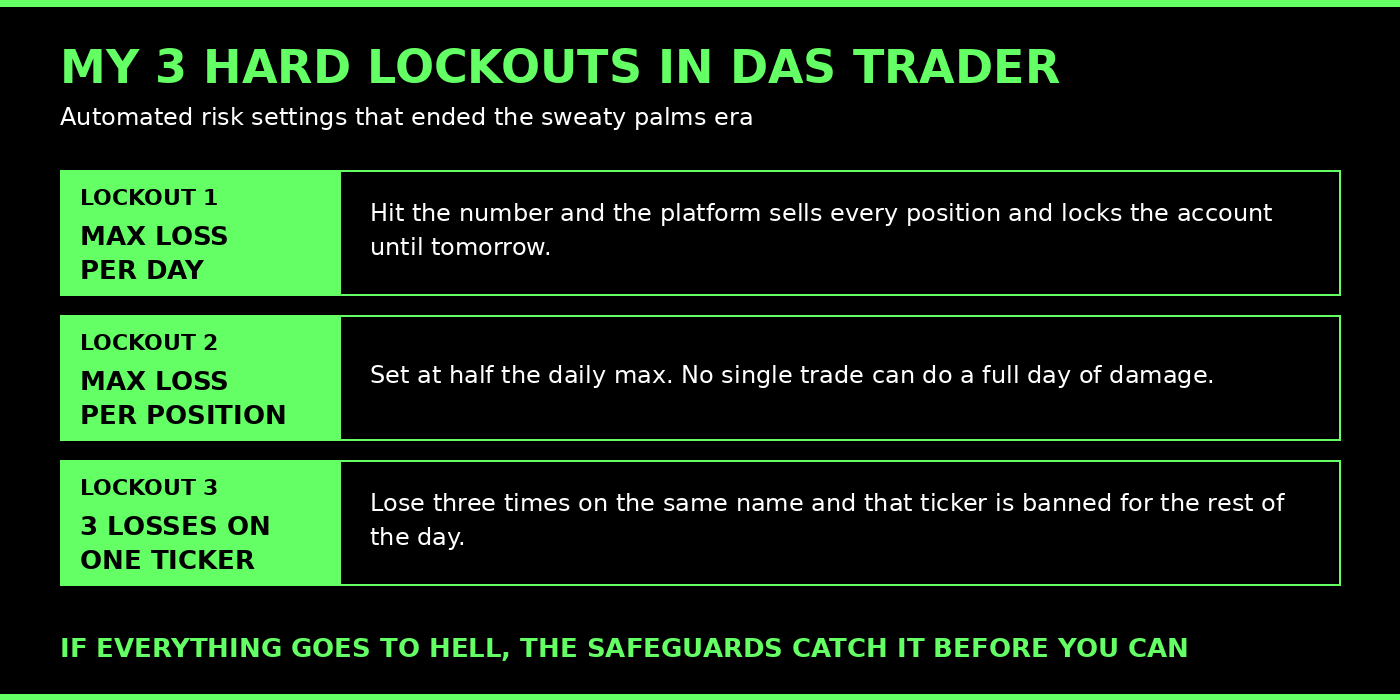
First, a max loss per day. If I hit it, the platform sells me out of my positions automatically and locks me out of my account until tomorrow. No negotiation. Second, a max loss per individual position, set at half of my daily max, so no single trade can ever do a full day of damage. Third, a revenge trading setting: if I lose on a particular ticker three times in one day, that ticker is banned for the rest of the day. That last one is revenge trading protection built directly into the software, because the stock that just beat you three times is exactly the one your ego wants to fight.
I cannot tell you what a relief having that is. The sweaty palms went away. Not because I became braver, but because I knew that if everything went to hell in a handbasket and I truly lost control of myself, the safeguards would catch it before I could do real damage. That peace of mind is worth more than any pep talk about trading psychology you will ever hear. To this day, every one of those lockouts is still active on my account.
The 3 Tells That You Are Trading Scared
After more than 80 bootcamps I can usually spot a fearful trader from their journal before they ever admit it out loud. There are three tells, and they show up over and over.
Tell one: they are trading with money they cannot afford to lose. They need a winning trade to pay a bill next week. Any time that is true, you are going to lose. Our main advantage as retail traders is that we can be selective. We are not a mutual fund that has to be fully invested across a hundred names all year. We only need a handful of trades a week and we can bide our time waiting for them. Scared money forfeits that advantage completely, and once the advantage is gone, it is over for us.
Tell two: they are unprepared. They have not done the leg work to get ready for the market, so they dive into the same old stocks day after day. If I see a guy trading Tesla every single day, that tells me everything. Right now Tesla has been stuck in a range for well over a year. It is not a big trender. Trading it daily means you have not done the scanning to find the hot names that actually fit the day trading strategies we use. Preparation is scanning for stocks in play, marking levels, and knowing your candlestick patterns cold before the bell rings.
Tell three: they have not put in enough repetitions on the simulator. Too many people think confidence leads to competence. It is the opposite. Preparation and competence lead to confidence. If you have not executed your setup dozens of times in the simulator, your hesitation at the hard right edge is not a psychology problem. It is a reps problem wearing a psychology costume.
Diagnose the Fear Before You Fix It
When I spot a scared student, the first thing I do is ask them what exactly they are afraid of. Because the prescription depends entirely on the diagnosis, and the three tells map to three different fixes.
If it is a capital problem, trading money they need for life, we work on building up their capital base first so the pressure comes off every trade. If it is a preparation problem, they commit an extra 30 minutes in the pre market getting ready before they touch a single share. If it is an experience problem, they go back on the simulator and grind reps until the setup is boring. Treating a capital problem with more screen time, or a reps problem with a bigger account, fixes nothing. Ask the question first. This is exactly the order we run in the bootcamp: learn, simulate, build your business plan, watch live trading, and only go live when your simulator data says you are ready.
More on the mental side of all of this in my full trading psychology guide, and I break down setups like these in free lessons on my YouTube channel.
The Trade I Took This Morning While Feeling the Fear
People assume fear disappears after enough years. It does not. It changes jobs. This morning, August 27, 2026, I traded CRM. And I felt squeamish about it.
My history on Salesforce is just so so. It tends to move slow and it has burned my patience before. But software stocks have been heating up hard lately. They are coming out of huge bases and starting new uptrends, and the way they are acting in this environment, the algos are not even waiting for a pop at the open and three sideways candles. If there is a base in the pre market and a catalyst behind the stock, they are driving it straight out of the first candle when the market opens. I have watched it happen over and over in this specific sector.
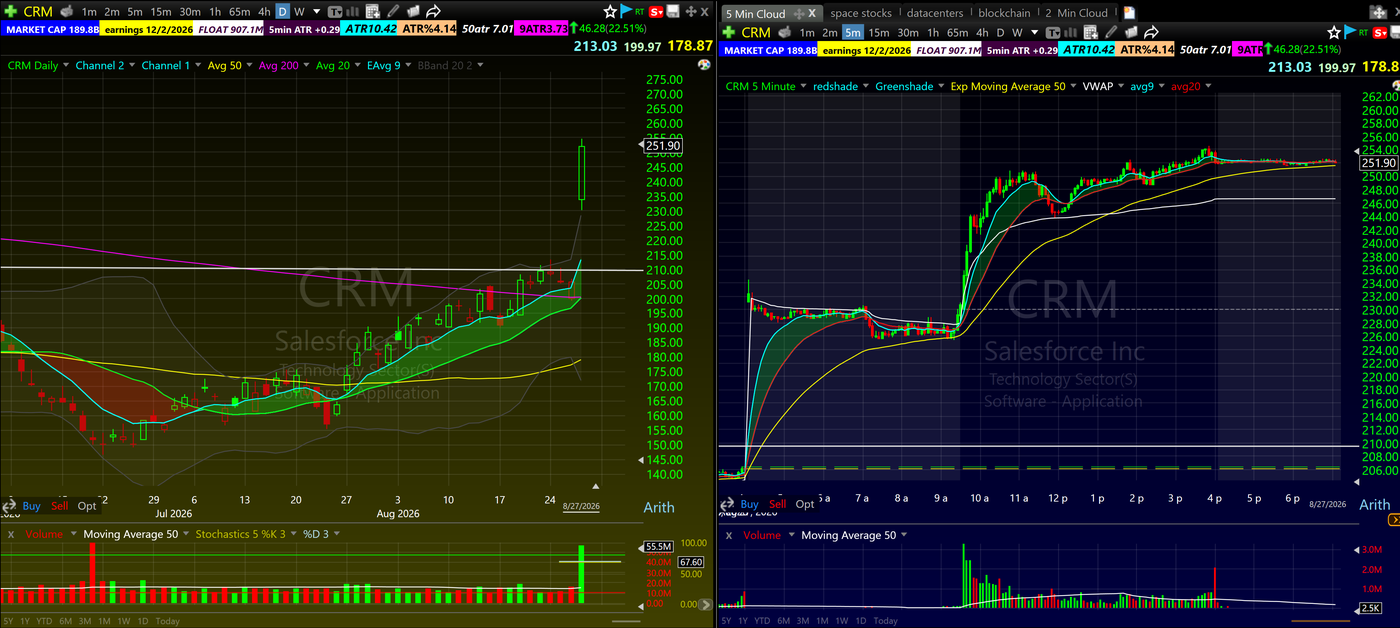
My normal playbook is to wait for an opening range breakout or a first pullback into the Bone Zone. Taking the very first candle of the day is a setup I have been working on, and it sits a little outside my core expertise. That is where the fear showed up. Old stock I do not love, entry style I am still building data on.
Here is the difference between me now and me in the spin cycle years. The fear showed up and I took the trade anyway, because the risk was defined and small. My exact execution was 230.51 with a 2.50 stop, sitting under the low of the day, which was literally the first candle of the session. If it failed, I lose a defined, boring amount and move on. It did not fail. CRM gapped up more than 20 percent on the day and pushed into the low 250s by the afternoon.
Broke fear says the risk is unknowable, so it freezes you, or it makes you hold a loser because selling makes the loss real. Healthy fear says the risk needs to be small and defined before you touch the buy button. Same emotion. Completely different relationship with it. If the risk is small and the setup is there, you have to take it. I found all of this on my scanner in TC2000, which is the charting platform I have used for my entire full time career.
FAQ: Fear of Day Trading
Why am I so scared to take trades?
Almost always because your risk is undefined. If you do not know exactly what you lose when the trade fails, your brain treats the downside as unlimited and floods you with fear. Define the stop and the position size before entry and most of the fear evaporates.
How do I stop being afraid of losing money in day trading?
Make every loss small and expected. Risk 1% of your account or less per trade, place the stop under real support, and set a max daily loss inside your platform. Losses stop being scary when they are budgeted line items instead of surprises.
Is fear ever a good thing in trading?
Yes. Healthy fear is what makes you demand a defined, small risk before entering. It kept me honest on my CRM trade this morning. The dangerous version is the fear that freezes you out of good setups or makes you hold losers.
Does the fear of trading ever fully go away?
No, and anyone who says otherwise is selling you something. I have been full time since 2007 and I still grit my teeth on Friday mornings because Fridays are my personal weak spot. The goal is a system where fear cannot hurt your account, not a personality transplant.
What is the fastest way to get over fear of day trading?
Diagnose it first. Fear from trading money you cannot afford to lose needs a capital fix. Fear from being unprepared needs 30 extra minutes of pre market work. Fear from inexperience needs simulator reps. Applying the wrong fix wastes months.
How much money should I risk per trade?
One percent of your account per trade, half that in choppy conditions. That is the 1% Rule my mentor Paul Singh gave me in 2006 and it has been the backbone of Bulls on Wall Street risk management since 2008.
What is a max loss lockout?
A setting inside your broker platform that automatically closes your positions and locks your account once you lose a preset amount in a day. I run one in DAS Trader, plus a per position max at half my daily number and a three loss ban per ticker.
Should I trade with money I cannot afford to lose?
Never. Needing a win to pay a bill destroys the one edge retail traders have, which is the ability to be selective and wait for A+ setups. Scared money always loses.
How many simulator trades should I take before going live?
Enough that the setup feels boring and your simulator data proves an edge. In our bootcamp nobody trades live during the program. The order is learn, simulate, build a business plan, watch live trading, then go live when the data supports it.
Is trading with fear the same as revenge trading?
They are cousins. Fear freezes you or shrinks you out of good trades. Revenge trading is fear of accepting a loss, dressed up as aggression, and it is the engine of the death spiral. The three losses per ticker lockout exists specifically to kill it.
Trade With a System Instead of a Feeling
Fear of day trading is not a character flaw. It is what happens when a normal human brain meets undefined risk. Define the risk with position sizing, enforce it with mechanical stops and hard lockouts, and manage your personal patterns like the professional hazard they are. That is the whole playbook. It took me seven years of the spin cycle to learn it. You can skip most of that.
If you want to build this system with structure instead of piecing it together alone, that is exactly what we do in the 60-Day Trading Bootcamp. You will learn the setups, put in your simulator reps, build your trading business plan, and set up your own risk guardrails with more than 80 bootcamps worth of student data behind the curriculum. The fear does not have to run your account. Mine has not run mine in a long time.
About the Author
Kunal Desai is the CEO and founder of Bulls on Wall Street. A professional trader since 2007, he has navigated every major market cycle -- from the 2008 financial crisis to today's high-volatility environments. Having mentored 7,000+ students through his live trading bootcamps, Kunal trades live every morning in the Bulls on Wall Street Trading Chatroom, where a full-access 7-day trial costs $7. He is dedicated to teaching real-world execution and high-probability strategies. Based in Miramar Beach, Florida.
Connect with Kunal: Read his full story | Instagram | YouTube