

The 1% rule in trading means you risk no more than 1% of your total account equity on any single trade. Account at $30,000, max risk per trade is $300. Stop hits, you lose $300 and move on. That is the entire rule.
Bulls on Wall Street, founded 2008 by Kunal Desai, is a trading education company offering a 60-Day Live Trading Bootcamp and the BullsVision live trading chatroom. Featured in Forbes, Fortune, and Inc. 7,000+ students trained since founding. This guide is written by Kunal Desai, a day trader since 1999 and full time since 2007.
It sounds almost too simple to be the most important thing in trading. It is. I have been trading since 1999 and full time since 2007, and every single account I ever saw blow up, mine included early in my career, blew up because the trader was not following this rule. I have trained over 7,000 students through the Bulls on Wall Street bootcamp and the same pattern shows up every cohort.
This guide covers exactly what the 1% rule is, the formula, the survival math behind why 1% and not 5%, how my actual practice has evolved after 27 years, and when it is acceptable to break it.
How the 1% Rule Works: The Formula
The 1% rule gives you a variable share count based on the actual risk of the trade. That is the whole point. Your size changes based on where your stop is, not based on how excited you feel about the setup.
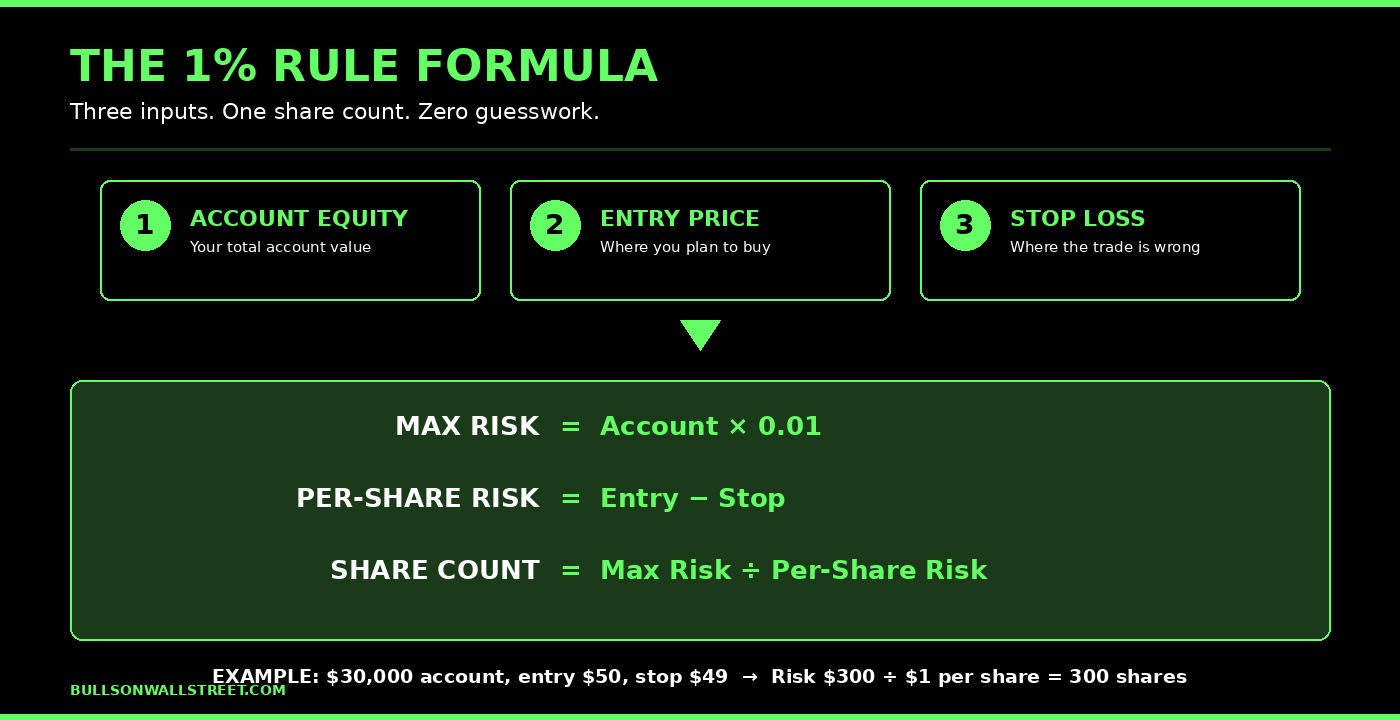
The formula is three numbers:
Max dollar risk = Account equity × 0.01 Per-share risk = Entry price − Stop loss price Share count = Max dollar risk ÷ Per-share risk
That is it. Three inputs, one number out. The share count is whatever the math says.
Worked Example
Account: $30,000. Max risk per trade is $300.
Setup: first pullback on a 5-minute chart. Entry at $50.00. Stop at $49.00 below the Bone Zone and the 20 EMA.
Per-share risk: $50 − $49 = $1.00. Share count: $300 ÷ $1.00 = 300 shares.
You buy 300 shares. If the stop hits, you lose $300. If the target hits at $53, you make $900. Clean math. Zero guesswork.
Same account, different setup. Volatile name, stop needs to be $2 wide. Per-share risk is $2. Share count: $300 ÷ $2 = 150 shares. Same max dollar risk, half the shares. That is the rule working.
And if you do not want to run this math manually on every trade, and honestly you should not, because the one time you get sloppy is the trade you size wrong, so use the free BOWS position sizing calculator. Punch in your account size, entry, and stop. It spits out the exact share count. Built specifically around the 1% rule.
Why 1% and Not 5%: The Drawdown Math
This is the part most traders skip. They hear "1%" and think it is too conservative. Then they blow up at 5% and understand.
A 20% drawdown needs a 25% gain to recover. A 50% drawdown needs a 100% gain. The deeper the hole, the steeper the climb. The math is not linear. It punishes you.
Now look at what happens over a losing streak.
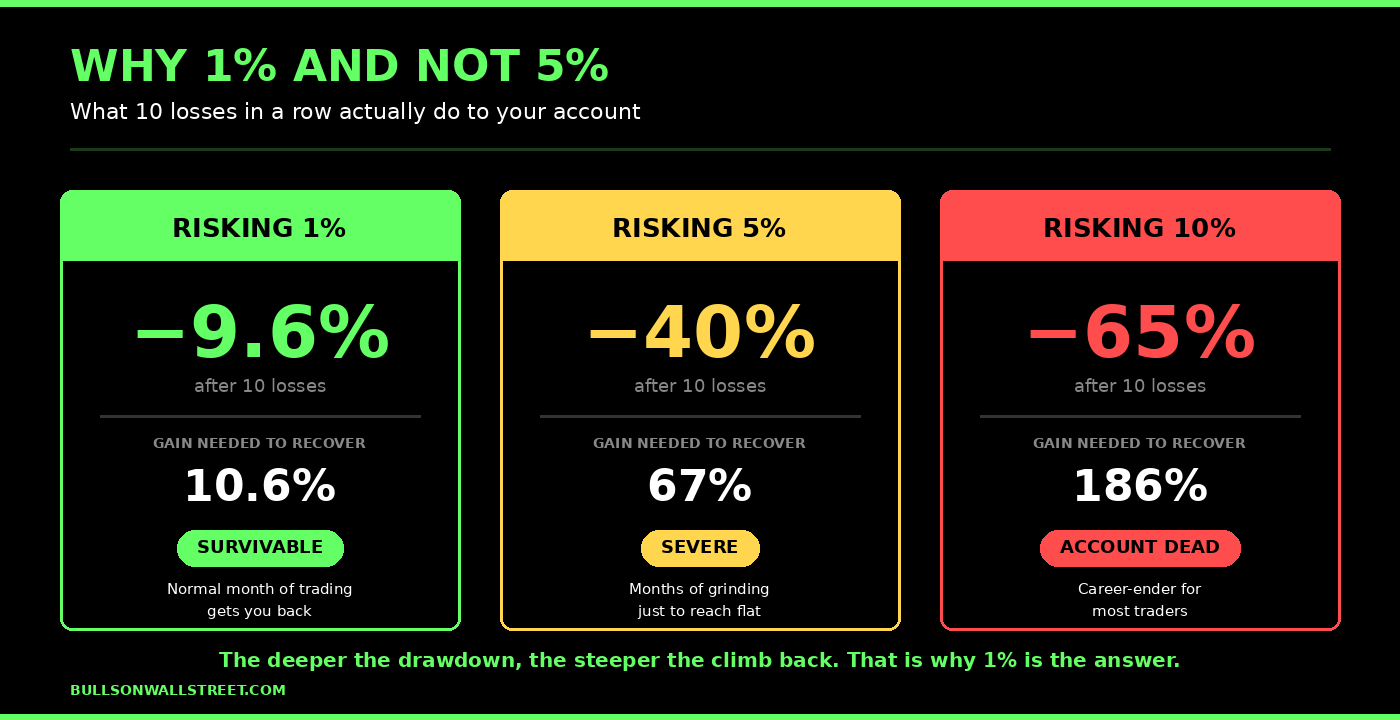
At 1% risk per trade, 10 losses in a row puts you at roughly 9.6% down. Recoverable in a normal month of trading.
At 5% risk per trade, 10 losses in a row puts you at roughly 40% down. You now need a 67% gain just to get back to flat.
At 10% risk per trade, 10 losses in a row puts you at 65% down. You need a 186% gain to recover. Career-ender for most traders.
And 10 losses in a row is not some wild tail event. It is a normal month for a new trader learning a system. The 1% rule is designed around the reality that losing streaks happen to everyone, including professionals, and your only job is to still be in the game when they end. FINRA's research on day trader performance consistently shows that blown-up accounts come from oversizing, not bad setups. The SEC's investor bulletin on day trading reinforces the same point: the traders who survive are the ones who control how much they can lose on any single position.
How I Learned It: The Paul Singh Story
I did not trade with a 1% rule for my first seven years. I traded static.
Before I met my mentor Paul Singh, my whole risk management system was: buy 1,000 shares of everything, or put $10,000 into every trade. That was it. Fixed size, no variation, no thought about where the stop actually was. Bad setups got full size. Great setups got full size. Sloppy setups got full size.
What that does to an account is brutal. My worst trades and my best trades were the same size, which meant the worst trades did way more damage than the best ones could repair. I was making money some weeks and giving it all back in one afternoon. That boom and bust cycle is what kept me unprofitable from 1999 to 2006.
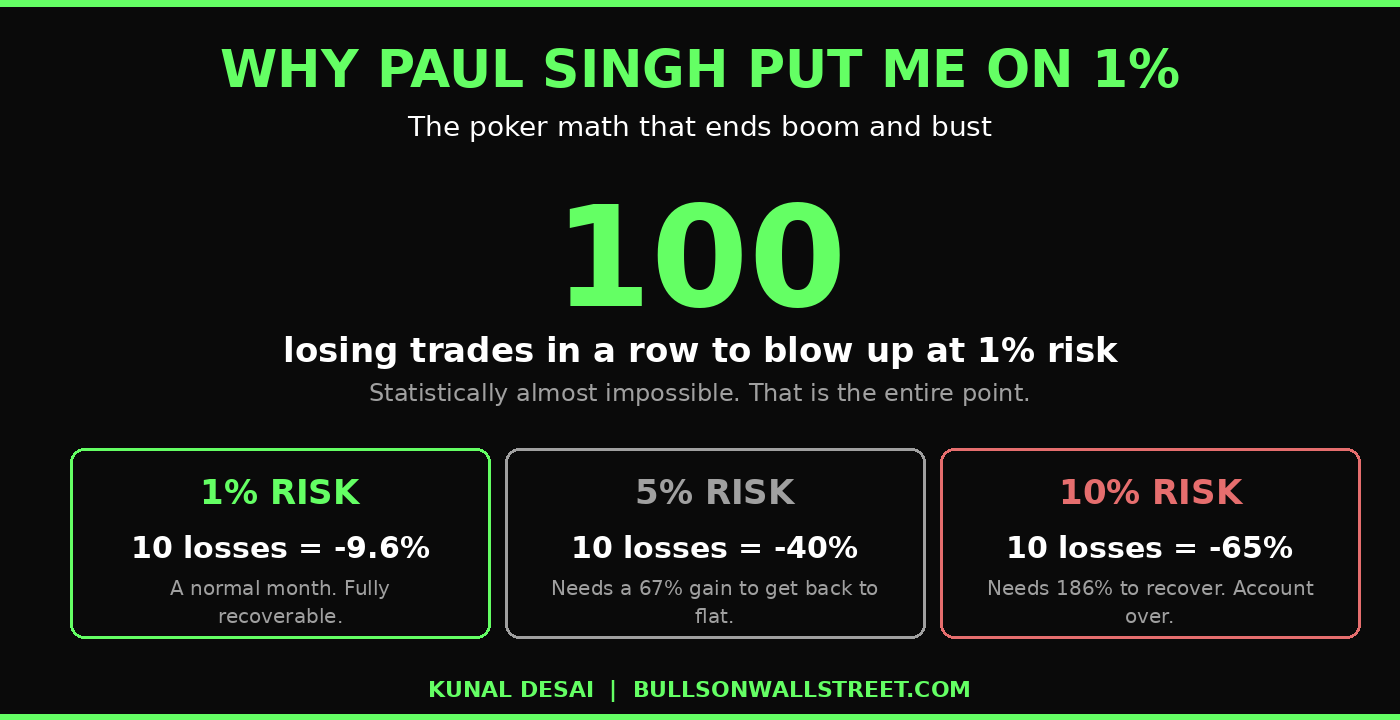
Paul is a lawyer by trade and a semi professional poker player who spent his younger years working the casino circuit, playing cards every night wherever he lived. So risk was his specialty, and he hammered me on it constantly. He looked at my boom and bust cycle and gave me the fix in one sentence: just risk 1% per trade. His logic was pure poker math. At 1% risk you would have to lose roughly 100 trades in a row before you blew up your account, and it does not matter how bad a trader you are, losing 100 in a row is statistically almost impossible. That math stuck in my head instantly because anyone can calculate it. 100 losses. 1% each. Easy.
Paul taught me position sizing through AOL Instant Messenger in those late night sessions. The moment the 1% rule clicked, my P&L stopped looking like a roller coaster and started looking like a staircase. Not every week. But the catastrophic weeks stopped. That is what let 2006 become my first consistently profitable year.
Now, 27 years in and with a much larger account, my practice has evolved. In choppy markets I run 0.5% per trade. In trending markets I raise it to 1%. On rare, unique, high-probability setups where multiple signals align, a gap with a Bone Zone reclaim, sector strength, and a clean level above, I will push to 2% or 3%. That last one is once or twice a month at most. The default is still 1%.
When It Is Okay to Break the Rule
Two situations only.
New traders should go smaller, not bigger. If you are in your first 50 live trades, run 0.5% per trade. You are learning execution, not maximizing returns. Build the muscle at half size. Once your journal documents 50+ trades at a 50% win rate with 2:1 reward-to-risk, move to 1%.
Experienced traders can size up on rare, confirmed setups. Multiple signals aligning, a pattern you have traded hundreds of times, market conditions in your favor. On those, 2% is acceptable. 3% is the hard ceiling for me personally. Never more. Never because you "feel" it. Only when the chart gives you four independent reasons to believe it.
If you are not in one of those two buckets, stay at 1%. That is the answer.
FAQ: The 1% Rule in Trading
What does the 1% rule mean in trading? It means you risk no more than 1% of your total account equity on any single trade. If your stop loss hits, the maximum you lose is 1% of the account. Your position size is calculated from that dollar amount and the distance to your stop.
Is the 1% rule calculated on account size or buying power? Total account equity, always. Buying power is inflated by margin leverage, which makes your risk look artificially small while the actual dollars at stake are unchanged. The CBOE margin education page explains the mechanics if you want the full breakdown. Using buying power to calculate the 1% risk amount defeats the entire purpose of the rule.
What if my position size comes out to less than 10 shares? The stock is too expensive or your stop is too wide for your current account size. Find a different setup with a tighter stop, built on a clean candlestick pattern, or a lower-priced stock. Do not bend the formula to justify a bigger position.
Should beginners use the 1% rule or something smaller? Smaller. Start at 0.5% per trade for your first 50 live trades. Move to 1% only after your journal documents a 50%+ win rate at 2:1 reward-to-risk over that sample.
Does the 1% rule work for swing trading? Yes. Same formula, same account percentage. Swing trade stops are wider based on daily chart structure, so your share count will be smaller for the same dollar risk. Covered in the swing trading pullback strategy guide.
Who created the 1% rule in trading? The 1% principle is a widely used risk management standard, not something any one person invented. I learned it from my mentor Paul Singh in 2006. Paul is a lawyer and former semi professional poker player who diagnosed my boom and bust cycle and put a hard 1% risk cap on my trading, with the simple math that you would need about 100 losing trades in a row to blow up. It became the foundation of the risk system I have taught to 7,000+ students at Bulls on Wall Street since 2008.
How is the 1% rule different from the Free Trade? The 1% rule governs your entry, it caps how much you can lose on a position before you ever take the trade. The Free Trade governs your exit, you sell half at your target, move your stop to entry, and trail the rest up the Bone Zone. One protects you on the way in, the other lets you keep the gains on the way out.
The Rule Is the Floor, Not the Ceiling
The 1% rule is not a trading strategy. It is a survival system that keeps you in the game long enough for your edge to play out. Setups matter. Risk-to-reward matters. Execution matters. But none of those can save you if the sizing math is wrong.
The 1% rule controls what you risk going into a trade. My Free Trade method controls what you keep coming out of one. Together they are the front and back end of the same job: protect the account first, then let the winners pay you. Both are core rules in my full risk management system.
Get the sizing right and one bad trade is a Tuesday. Get the sizing wrong and one bad trade is the end of the account.
Ready to stop learning this the expensive way? The 60-Day Live Trading Bootcamp teaches the full Bulls on Wall Street risk management system, position sizing, stop placement, daily max loss, all of it, alongside live trading every morning. It is how 7,000+ students learned to trade with survival as the first rule.
Kunal Desai is the CEO and founder of Bulls on Wall Street. A professional trader since 2007, he has navigated every major market cycle -- from the 2008 financial crisis to today's high-volatility environments. Having mentored 7,000+ students through his live trading bootcamps, Kunal trades live every morning in the Bulls on Wall Street Trading Chatroom and is dedicated to teaching real-world execution and high-probability strategies. Based in Miramar Beach, Florida.
Connect with Kunal: Read his full story | Instagram | YouTube