

Updated September 2026
I have been trading since 1999. Full-time since 2007. In that time I have trained over 7,000 students through the 60-Day Live Trading Bootcamp at Bulls on Wall Street. And the single biggest difference between the traders who make it and the ones who blow up is not the setups they pick. It is not the indicators they use. It is not even their win rate.
It is whether they size their positions correctly before they click buy.
Most traders treat position sizing like a feel-good approximation. They look at how excited they are about the setup, how confident they feel, how much the stock has been moving -- and they pick a number. That number is usually too big. And when the trade goes against them, the loss is catastrophic instead of manageable.
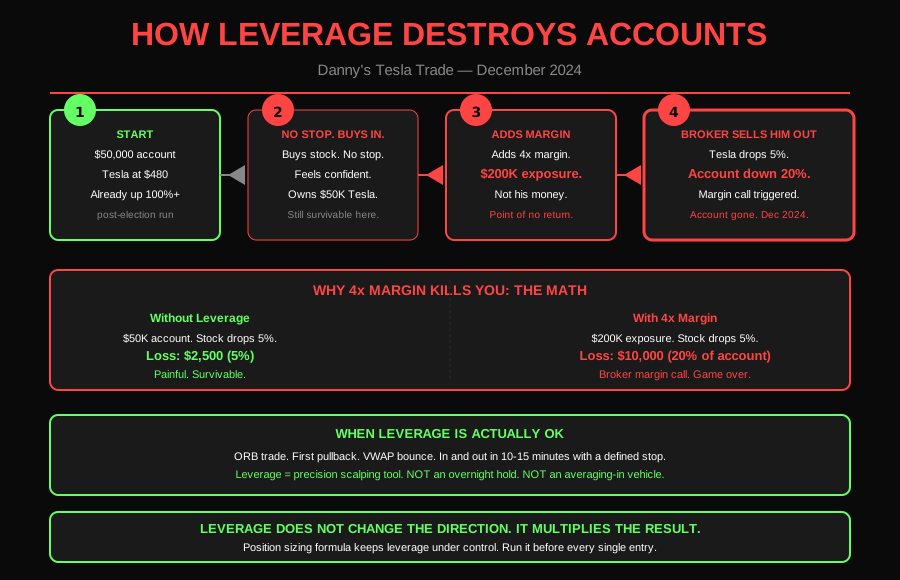
December 2024. Tesla had been running for weeks post-election. By mid-December it was cresting toward $500 -- already up over 100% off its lows. That is when one of my students, I will call him Danny, decided it was time to get in.
Danny had been watching Tesla obsessively. Not just for weeks. For years. I had been telling him for literally years that this fixation was going to cost him. He would go quiet on it for a stretch, come back to class, do everything the right way -- and then Tesla would start moving and the one-stock-itis would come roaring back. He knew every headline, every delivery number, every analyst upgrade. So when he finally started buying in the $480s he felt completely justified. The stock had already gone up over 100%. But conviction without position sizing is just a more expensive way to lose money.
Here is what happened. Danny had no stop loss. Mistake number one. But even without a stop, if you own shares and the stock pulls back, you still own shares. Painful, not fatal. The fatal move comes when you add leverage.
Danny added margin on top of his position. Instead of $50,000 of Tesla he was holding $200,000 worth of exposure using the broker's money. When Tesla started pulling back, that 4x leverage meant a 5% stock move was a 20% account move. The broker did not ask what he wanted to do. They sold him out. Account gone.
When he came to me I gave him the I told you so without saying it. We both knew it was coming. That is the relationship -- I had been beating him over the head about this Tesla obsession for years and he had fallen right back into the old trap. We got it out of the way, then laughed about it, then got to work on what to do next. That is the only productive path after a blowup like that. No dwelling. Game plan and rebuild.
You cannot blow up your entire account because of bad luck. Full blowups happen because of leverage, every single time. Across 7,000+ students that has never changed. The position sizing calculator is the tool that prevents the Danny trade before it happens.
Why Position Sizing Matters More Than the Setup
Most traders spend hours finding the right entry. They scan pre-market, study the chart, identify the trigger. Then the stock moves and they buy whatever share count feels right in the moment.
That last step is where accounts go to die.
Sizing on feel is not trading. It is gambling with extra steps. Your share count should never be a guess. It should be the output of a calculation based on three numbers you identify before you click buy: your account size, the percentage of that account you are willing to lose on this trade, and the distance in dollars from your entry to your stop loss.
One bad trade at the wrong size erases months of work. One correctly sized losing trade is a papercut. That is the entire difference between a trader who lasts and one who does not.
The math removes the emotion. When you know before you enter that the worst case is a 1% account hit, you execute the stop when it triggers. You do not freeze. You do not hope. You exit. That discipline compounds over hundreds of trades into something real. Check the day trading risk management guide for how this fits into the complete framework.
The Position Sizing Formula
Three inputs. All three required before every single entry.
Position Size = (Account Size x Risk Percent) / (Entry Price - Stop Loss Price)
Account Size: the current total value of your trading account. Risk Percent: the percentage of your account you are willing to lose if the trade hits your stop. Start at 1%. Never exceed 2% on any single trade. Entry minus Stop Loss: the dollar distance between where you buy and where you exit if wrong. This is your per-share risk.
The formula tells you exactly how many shares to buy. Not approximately. Exactly.
A Real Example
Account: $20,000. Risk: 1% = $200 maximum loss on this trade. Entry: $45.00. Stop: $43.50, placed just below the low of the pullback candle in the Bone Zone -- the area between the 9 EMA and 20 EMA on the 5-minute chart where I identify entries in real time using TC2000. Risk per share: $1.50.
$200 / $1.50 = 133 shares.
Stock hits $43.50 and you exit. Loss: $199.50. One percent. A papercut. You move on to the next setup.
Now do what Danny did. Same account, same setup. Buy 600 shares on margin because you feel confident. Stock drops $3 before you react. Loss: $1,800. Nine percent gone in one trade. Three bad trades like that and the account is in serious trouble.
The formula keeps the loss small enough that you can keep trading. Without it, one trade ends the game.

The Leverage Warning
Leverage is for precision. For high-probability setups where you are in and out in minutes and you know exactly where you are wrong before you enter. A first pullback into the Bone Zone. An ORB with a clearly defined range low. A VWAP bounce with a stop a few cents below the VWAP level. Those are situations where leverage, applied conservatively, can make sense.
Leverage is not for expressing conviction about a stock. It is not for averaging into a losing position. It is not for holding overnight. Those uses of leverage are how Danny happened.
$50,000 in your account levered to $200,000 in exposure means a 25% move against you wipes out the account completely. The broker does not call and ask what you want to do. They sell you out at whatever price protects their money. Yours is already gone.
Run the position sizing formula every time. It naturally constrains leverage because the math limits your share count to what your actual account equity can absorb at 1% risk. The formula is the circuit breaker that prevents the Danny trade.
How I Actually Manage My Own Risk: Building Limits Into the Software
I have a maximum loss per trade and a maximum loss per day set directly inside my brokerage software. Not in my head. In the software. I cannot lose more than a defined amount on any single position regardless of what I do in the moment -- because I know myself. I am a trader at heart. My natural state is guns blazing. Left to my own devices in a fast market I will always want to press harder than I should.
So I take the decision away from myself at the software level.
I adjust those limits depending on the market cycle and my personal situation. When Colt was born in May 2024 -- I waited until I was 44 to become a father, figured it was probably a good time to enjoy it since I will be dead when he gets to be my age -- I was running on minimal sleep. New dad, no sleep, and I am still sitting at the screen every morning trading momentum stocks. That is a dangerous combination.
So I cut my risk per trade and my max loss per day immediately. Not because the market changed. Because I knew I could not trust my own judgment on no sleep. A trader running on four hours is not the same trader who built a system over 25 years. The impulse control degrades. The patience goes. The sizing discipline goes with it.
Building the limits into the software meant that even if my sleep-deprived brain decided to do something stupid, the machine would not let me. That is what sophisticated risk management actually looks like -- not just knowing the rules, but engineering your environment so that breaking them is physically impossible.
Your brokerage platform almost certainly has this feature. Use it. Set a max loss per trade based on your 1% rule. Set a max daily loss at 3% of account. If you hit it, the software shuts you down. It is not weakness. It is the most professional thing a trader can do.
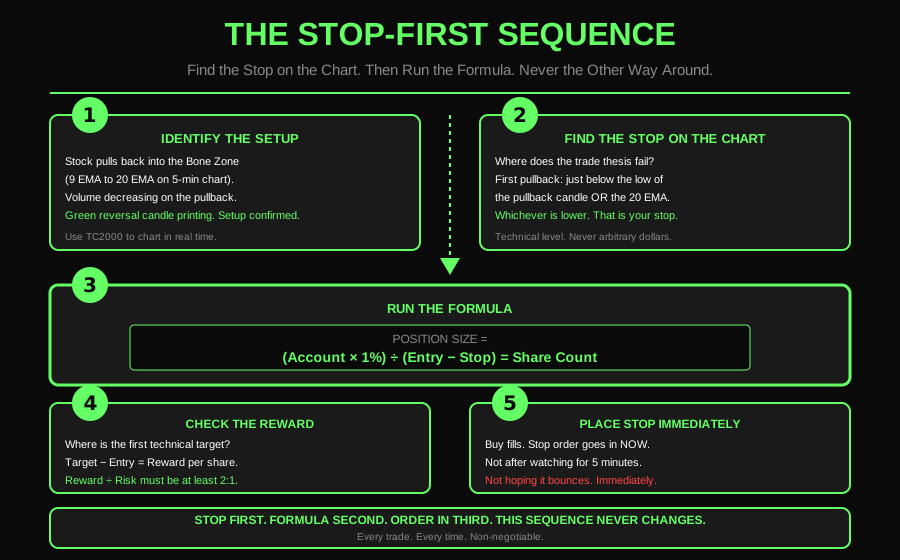
Find the Stop First, Then Run the Formula
This is the sequence. Most traders get it backwards. They pick a share count first and then figure out where the stop goes. Wrong. The stop defines the per-share risk. The per-share risk determines the share count. Stop comes first, every time.
Step one: identify the setup. For a first pullback, the stock has broken out, pulled back into the Bone Zone on the 5-minute chart on decreasing volume, and is printing a reversal candle. That pullback low or the 20 EMA, whichever is lower, is your stop level. See the full entry system in the first pullback trading strategy guide.
Step two: calculate per-share risk. Entry minus stop. Entry $52.00, stop $50.50 -- that is $1.50 per share.
Step three: run the formula. Account $30,000, risking 1% = $300. $300 / $1.50 = 200 shares.
Step four: check the reward. Does this trade give at least 2:1? Where is the nearest resistance? First target $55.00 = $3 reward versus $1.50 risk = 2:1. Trade qualifies. See how to identify reward targets in the risk to reward ratio guide.
Step five: place the stop order immediately when the buy fills. Not after you watch it for five minutes. Immediately. The calculator tells you the shares. The stop order enforces the loss limit. Both required. Neither works without the other.
The Cheat Sheet Method
Build a quick-reference table for your account size and tape it to your monitor. Here is one for a $10,000 account risking 1% ($100 per trade):
Stop $0.10 = 1,000 shares. Stop $0.20 = 500 shares. Stop $0.25 = 400 shares. Stop $0.50 = 200 shares. Stop $1.00 = 100 shares. Stop $2.00 = 50 shares. Stop $5.00 = 20 shares.
When you see a setup in real time, look at the stop distance on the chart and find it on the sheet. Share count in under five seconds. No math, no guessing, no Danny moments. Update the sheet every time your account size changes meaningfully.
The Free BOWS Calculator Tools
We built a full suite of free calculators at markets.bullsonwallstreet.com so you never do this math by hand during a live session. The Risk Calculator outputs your exact share count and maximum dollar loss instantly. The Compounding Calculator shows what consistent 1% risk trading compounds to over time. The Break-Even Calculator tells you exactly what price you need to cover your cost basis. The P&L Calculator gives exact profit or loss including percentage return.
All free. Bookmark the risk calculator. Use it before every single entry.
Position Sizing by Account Size
The formula is universal. The application adjusts by account size.
Under $10,000: stick to lower-priced stocks with tighter stops. A $0.25 stop on a $15 stock gives you 400 shares at 1% risk on a $10,000 account -- a real, tradable position. A $5 stop on a $200 stock gives you 10 shares -- not enough to learn from. Match the stock price to the stop distance that keeps your share count workable. Full details in the small account risk management guide.
$10,000 to $25,000: more flexibility, same 1% rule. The PDT rule becomes a consideration in this range on margin accounts. See the PDT rule guide for how to navigate it.
Over $25,000: full PDT access. Formula stays exactly the same. The account growing does not change the discipline. Full framework in the professional risk management guide.
The Most Common Sizing Mistakes
Sizing based on conviction instead of math. The trade that feels most certain is often the one that goes worst. Danny had studied Tesla for years and felt completely justified going in heavy. The formula does not care how confident you feel. Run it every time.
Using buying power instead of account equity. Margin inflates buying power. The 1% rule is always based on actual account equity, not leveraged buying power.
Skipping the formula on setups that look like sure things. There are no sure things. The formula exists precisely for the trades you feel best about, because those are the ones where you are most tempted to oversize.
Not building hard limits into your software. Knowing the rules is not enough. Build them into the platform so that breaking them requires active effort. Most traders never do this and it costs them eventually.
Checking the pre-trade checklist before every entry builds the habit of running position sizing as a non-negotiable step, not an afterthought.
How to Tell You Are Already Trading Too Big
Everything above tells you what size to take. This part is the other half. How you know you already took too much, while you are still sitting in the trade.
Nobody grows out of this. New traders oversize because they want the money. Experienced traders oversize because they are confident, and confidence slides into hubris faster than anyone wants to admit. I have been trading full-time since 2007 and I still do it.
September 4, 2026. Micron.
MU dipped for a second at the open. I added at 975.
I had a gut feeling it was going to rip. People had been waiting on that stock to base out for a long time. It is a cult name, everybody talks about it, and it had finally started to round off. It was also a Friday, and anecdotally I have noticed Fridays get wild for popular stocks because of the zero DTE option flow. I had it in my head that MU was the play of the day and could see 1,020 by the close.
So I slammed it. With way too much size.
It is an expensive stock. In my head I was not doing the share math correctly, and frankly I did not care to, because I believed in the read that much. Inside of a minute I had a massive position on and I was a hot mess of nervousness. I knew that if it rolled over it could wipe out weeks of gains. So I sold half at 985.50. The chart did not tell me to do that. The size did.
I always have a stop on my plays. But this happened in the first minute or two of the open and there is no time to sit there working out an exact stop level. So I used a loose broker-level stop, the kind that kicks you out automatically if the position loses more than a set amount. Having that backstop is good. It also handed me a little extra overconfidence, which is worth naming out loud.
Then I worked it all day. Sold more at 993. Reloaded at 984, sold half at 987, more at 989.20, more at 997. Relonged at 993.20, sold half at 996.
MU closed at 1,016.59 that day, up 6.1% from 958.16. My read was almost exactly right. I called 1,020 and it printed 1,016.59. And I still turned it into a stressful, chopped-up, half-sized day, because I put on more size than I could carry.
That is the whole lesson. Being right does not protect you from being too big.
1. You cannot stop looking at your PnL
First one to show up. I have done it more than any other and I still guard against it.
I hide my PnL. I click it off and I trade with it off. If you have basic math skills, and you should if you want to do this for a living, you already know roughly where you stand. You have 1,000 shares, the stock is down 50 cents, you are down 500 bucks. You do not need it on the screen. Leaving it up there all day is a recipe for spending money you have not made yet.
I cannot count how many times I have been up 20,000 on the day and given it all back and gone negative. Sitting there inside a live position, daydreaming. Twenty grand. I could go to Italy and drink Barolo for a month and have myself a good old time.
That is not trading. That is fantasy bookkeeping while a real position moves against you.
Each trade is its own thing. Its own structure. Its own animal. Its own being. Treat it that way.
2. You cannot leave the desk
This one sits home with me, and it shows up in your body before it shows up in your head.
I trade at a standup desk. I stand all day. When I met my wife, who is a chiropractor, she took one look at me working and asked what was wrong with my posture. I told her nothing was wrong with it. I stand all day. She pointed out that the second I am in a trade I hunch forward, round my shoulders, lock my knees, clench my entire body, and do not move for hours.
She was right, and the research backs her. Occupational health studies find that prolonged static standing without muscle activity raises hydrostatic pressure in the lower legs, because the calf muscle pump only works when you actually move. Even small leg movements are enough to keep that pump working. Standing at the desk is not the fix. Moving is.
So there is a pull-up bar next to my office door now. Students see it on the stream. Every 10, 15, 30 minutes between trades I knock out a handful of pull-ups. Nothing crazy. They also catch me with resistance bands doing scapular retraction between trades, pulling side to side to open the shoulders back up.
Here is the trading version of the same sign. My son Colt is two. He is the cutest kid in the world. Normally when he walks into the room I pick him up, throw him in the air, smother him, kiss him, put music on, and we jam. You get that window one time in your life.
When I am oversized, I give him the side eye and turn back to the screen. My wife comes in and asks if I want to eat something and she gets the same look, eyes bugging out, straight back to the monitor.
That is the tell. Not the chart. The people walking into the room.
3. You take profits too soon
Look at what I did with MU. I sold half at 985.50 roughly a minute after entering, on a stock that closed 30 points higher. Nothing on the chart said sell. The position was just too big to sit in.
When size is right, you exit on structure. When size is wrong, you exit on relief. Those produce completely different equity curves over a year.
4. You stop out prematurely
Same mechanism running the other direction. You get shaken out on a two-tick wiggle, then watch the thing run without you. That is not a bad stop placement problem. That is a size problem making a normal amount of noise feel unbearable.
Pre-define the risk before you enter and be honest about the number. Are you actually fine losing 200 on this? If it makes you flinch, the number is too high.
5. You change your lifestyle after a win
The old version of this list said to watch for changing your spending habits after a loss. That is backwards. Cutting back after a loss is rational. The real killer is what people do after a win.
We all know about keeping up with the Joneses. For traders it is worse, because it is keeping up with the Instagram traders and the Twitter traders. If you believe social media, everybody is 19 years old with a Lamborghini and a private jet.
So somebody starts making 500 a day and immediately starts spending all of it.
I am a big believer in treating yourself. Spend some of the money. It makes you want to make more of it. Take your family out to dinner after a great week. Send your mother flowers. Pay for something for your dad. Cover part of your sister's wedding. Those things are one-time, they make you feel good, they make your family feel good, you get more support at home, and it is a win all the way around.
A Range Rover payment is a different animal. That is not a treat. That is a monthly obligation that shows up whether or not the market cooperates.
Then the market goes soft, and you trade soft, because now you need the money. You are stuck with bills you cannot get rid of and every trade carries weight it should not carry. That is how a good month turns into oversizing three months later.
6. You freeze on a loss you cannot take
If you are frozen on a loss you cannot bring yourself to realize, you should not have been in that trade in the first place. That is not a discipline problem. That is a diagnosis. It usually means you are trading with money you cannot afford to lose.
Our biggest strength as retail traders is that we get to be snipers. We do not have to be in anything at any given moment. We are not mutual funds. We can bide our time and wait for the best opportunity, and as a retail trader you only need one good trade.
What happens instead is guys feel like they have to be doing something at all times, because they have something to pay for. That pressure is what puts the size on. And then the size is what makes the loss impossible to take. It is a loop, and it starts with needing the money.
How I spot it in somebody else
The six above require you to be honest with yourself. This one does not, which is why it is the most reliable of the lot.
I can always tell somebody is too big when their PnL fluctuates too much. The equity curve swings all over the place. And the giveaway on top of that is when they start celebrating huge outlier days relative to their account size. That tells me they are on leverage, or in options, or doing something structural to manufacture results that size alone would not produce.
So they make 50% of their account in a day and they are feeling themselves. What they leave out is that they risked the whole account to get it. I have seen that a hundred times, probably a thousand.
Notice the timing. Every other sign on this list fires when you are losing. This one fires when you are winning, which is exactly what makes it dangerous. Nothing hurts yet, so the process gets validated, and the next one takes the account.
The Fix: Pick Your Max Pain Number First
When I catch a bootcamp student trading way too big, the first thing I tell him is to figure out his max pain on a trade and make it static.
A lot of people just use 1% of the account. Get stopped out, lose 1%. But if you are trading bigger numbers, 1% might be too much. Plenty of traders feel better at 0.5%, or even 0.25%. That is individual. It depends on how much risk you can actually carry without it changing how you behave.
I want to know what is too much for that specific person. Because if you are oversizing, you are risking 10% or 20% of your account on a trade, and that is a different conversation entirely.
Think about the number. Then size the position to fit it. Not the other way around.
Now here is the part nobody teaches. If he cuts and he is still losing, he cuts again. Still losing, cut again. Keep cutting the risk until it is minuscule.
But he keeps trading. I am not a big believer in vacation days for these youngsters. They need to grind it out and get the screen time. Sitting on the couch for a week does not teach you anything. Trading tiny does.
And when the winning starts, you do not jump back to full size. You go back to the rung you were on before. If you went 1% to 0.5% to 0.25% to 0.125%, you climb back one rung at a time. That is the ladder, and it is how you rebuild without walking straight back into the same hole.
Yes, You Can Follow the 1% Rule and Still Be Too Big
This one surprises people.
Say you are a day trader with a million dollar account using a 1% risk rule. That is 10,000 per trade. Lose five trades in a row and you are down 50,000.
And just because there is a million dollars in the account does not mean you are some uber wealthy person. It means you built the account and saved the money. Losing 50 grand on five ordinary day trades inside a couple of hours hurts. It messes with your head. What if it is ten losers that day?
At that size, 1% is simply too much.
So treat the 1% rule as a ceiling, not a target. It scales down as the account scales up. The instruction underneath it never changes: pick the dollar number you can actually eat, make it static, then size the position to fit it. Dollars first. Percentage second.
Where Oversizing Usually Starts
Almost every case I see comes from the same place. Somebody trying to make something out of nothing.
It is a guy with limited capital who opens a big prop account so he can trade on excessive leverage. Two bad trades and he is out of the game. Or it is a guy with a couple thousand dollars who decides that grinding stocks a hundred bucks at a time is too slow, so he goes to zero DTE options instead.
Underneath it is always the same rationalization. Everybody else is rich, everybody else had a silver spoon, I do not have those advantages, so I have to take more risk to catch up.
Here is the thing. Almost every trader I have ever met built the account from the dead beginning. It is a rite of passage. And the slow grind is not the obstacle, it is the education. Growing a small account into a bigger one takes a while, and that is precisely what teaches you the value of money and the value of the process.
Skip that part and you never learn it. Then you size like somebody who never learned it.
If you want the deeper version of the mental side of this, start with trading psychology and revenge trading. And the complete framework this sizing work sits inside is in the day trading risk management guide.
Scaling Position Size as You Improve
Start at 0.5% risk per trade during your first 50 live trades. Not 1%. Half that. You are learning execution, not maximizing returns. After 50 documented trades showing a 50%+ win rate at 2:1 reward-to-risk, move to 1%. Still below 50%? Stay at 0.5% and identify the specific mistake causing the losses.
Never exceed 2% risk on any single trade. Not even on setups you think are perfect. The day trading overview covers the full progression from new trader to consistent profitability. And the swing trading page covers how to apply these same sizing rules to longer-duration trades where the stops are wider and the patience requirement is higher.
FAQ: Position Sizing Calculator
What is the right risk percentage for a new trader?
Start at 0.5% per trade for your first 50 live trades. Move to 1% once your journal shows a documented 50%+ win rate at 2:1 reward-to-risk. Never exceed 2% on any single trade.
Do I use total account value or available buying power?
Always total account equity. Buying power in a margin account is inflated by leverage. The 1% rule is calculated against actual equity only.
What if my position size calculation comes out under 10 shares?
The stock is too expensive or the stop is too wide for your current account size. Find a lower-priced setup with a tighter stop. Do not bend the formula to force a larger position.
Should I use the same risk percentage on every trade?
Yes, until your trade journal shows 50 to 100 trades proving a specific setup wins at a statistically meaningful rate. Never size up based on excitement about a particular trade.
Can I use this formula for swing trades?
Yes, identical formula. Swing trade stops are wider based on daily chart structure, so the share count will be smaller for the same dollar risk amount.
What is the Bone Zone and why does it affect stop placement?
The Bone Zone is the area between the 9 EMA and 20 EMA. For first pullback trades, the stop goes just below the Bone Zone low -- typically the 20 EMA or pullback candle low, whichever is further. That distance from your entry is the per-share risk that feeds the formula.
Should I adjust my position size when I am not at my best?
Yes. If you are sick, sleep-deprived, emotionally stressed, or going through a losing streak, cut your risk per trade in half. Better yet, build your reduced-risk parameters directly into your brokerage software so the machine enforces the discipline even when your judgment is compromised.
How do I handle stocks with very wide spreads?
Add the spread cost to your effective per-share risk. If the spread is $0.10 and your stop distance is $0.50, use $0.60 as your per-share risk in the formula.
What is the difference between position sizing and money management?
Position sizing is the specific calculation of how many shares to buy on a given trade. Money management is the broader system: risk per trade, max daily loss limits, drawdown thresholds. Position sizing is the foundation -- you cannot have real money management without it.
Use the free calculators before every entry. And if you want the full system with live coaching and real trade accountability, the bootcamp is where it all comes together.
Join the 60-Day Live Trading Bootcamp
About Kunal Desai
Kunal Desai is the CEO and founder of Bulls on Wall Street. A professional trader since 2007, he has navigated every major market cycle -- from the 2008 financial crisis to today's high-volatility environments. Having mentored 7,000+ students through his live trading bootcamps, Kunal trades live every morning in the Bulls on Wall Street Trading Chatroom and is dedicated to teaching real-world execution and high-probability strategies. Based in Miramar Beach, Florida.
Connect with Kunal: Read his full story | Instagram | YouTube
This guide is part of our complete risk management system for day traders.
Related reading: Trading Psychology: The Mental Game | Before You Quit Trading, Do This | Revenge Trading: Why It Happens and How to Stop It | Why Traders Fail