

Updated June 2026
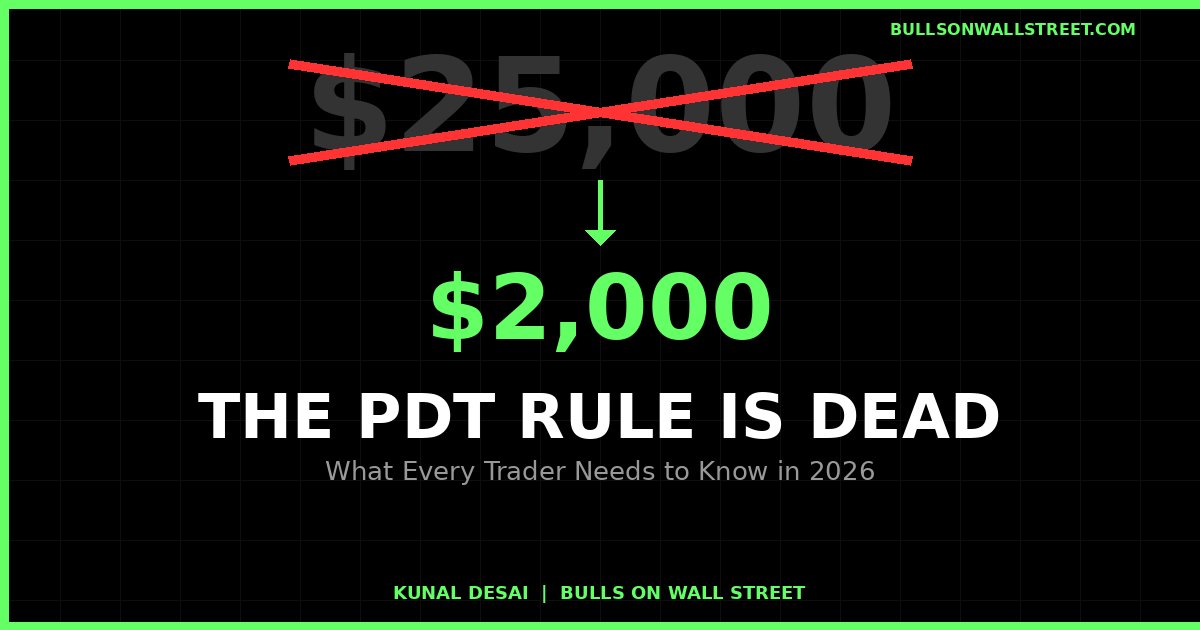
The Pattern Day Trader rule has been the single biggest barrier between small account traders and the U.S. stock market since 2001. As of June 4, 2026, that barrier is gone.
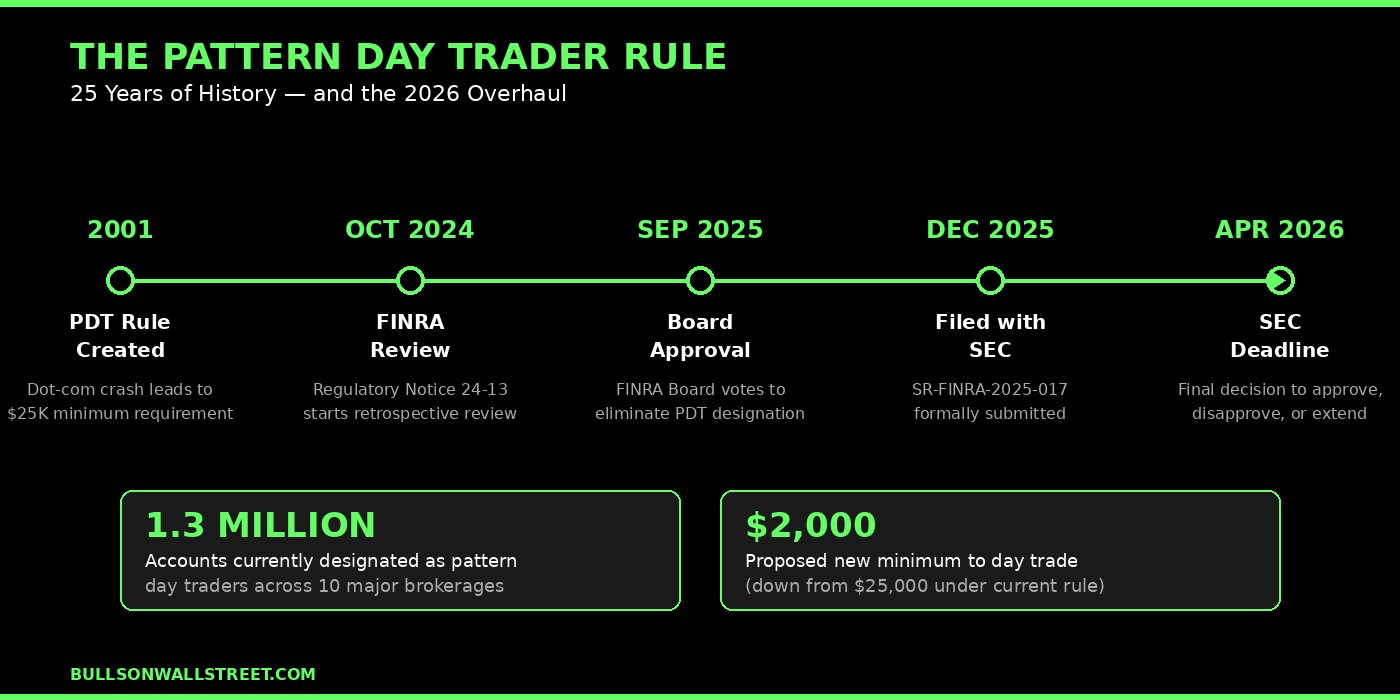
On April 14, 2026, the SEC approved FINRA's amendments to Rule 4210, formally eliminating the $25,000 minimum equity requirement and the pattern day trader designation entirely. On April 20, FINRA published Regulatory Notice 26-10 setting the effective date: June 4, 2026. A risk-based intraday margin system replaces the old framework. Brokers that need system upgrades have until October 20, 2027 to fully phase it in, so the rollout will be staggered, but the rule itself is officially eliminated.
This is the most significant change to retail trading access since online brokers eliminated commissions.
I have been trading since 1999 — two years before the PDT rule even existed. I watched it get created. I watched it shape an entire generation of traders. And I have spent the last 18 years at Bulls on Wall Street training 7,000+ students who had to navigate it every single day.
This guide covers everything: what the PDT rule is, what is replacing it, what the new system actually looks like, and — most importantly — why risk management matters more now than it ever did before.
What Is the Pattern Day Trader Rule
The pattern day trader rule is a FINRA regulation under Rule 4210 that restricts how frequently you can buy and sell the same security on the same day in a margin account.
Here is exactly how it works under the current system.
If you execute four or more day trades within any rolling five-business-day period, and those day trades represent more than six percent of your total trading activity in that window, your broker flags you as a pattern day trader. Once flagged, you must maintain at least $25,000 in equity in your margin account at all times. Drop below that threshold and your account gets restricted to liquidation-only trades for 90 days — or until you deposit enough to cross back above $25,000.
A day trade counts as buying and selling the same security on the same day. Buy 500 shares of NVDA at 9:45 AM and sell them at 11:30 AM. That is one day trade. Do that four times in a week and you are a pattern day trader.
The rule only applies to margin accounts. Cash accounts are exempt, but cash accounts come with their own limitation: you cannot trade with unsettled funds. Since the T+1 settlement change in May 2024, trades settle in one business day instead of two. That helped, but it still means your buying power in a cash account resets daily, not intraday.
The History: Why the PDT Rule Exists
The rule was created in 2001, right after the dot-com bubble burst. Millions of retail traders had piled into the market during the late 1990s with margin accounts and zero understanding of risk. When the crash hit, accounts blew up by the thousands. Brokers were left holding the bag on margin calls that traders could not cover.
The regulatory response was the $25,000 minimum equity requirement. The logic: if you are going to trade this aggressively, you need enough capital to absorb losses without creating a systemic problem for your broker.
I remember the day it changed. Before the PDT rule, you could day trade with a couple thousand dollars. They would give you margin and you could do whatever you want. I was 20 years old with maybe $5,000 or $10,000 in my account, sometimes up to $15,000 on a good run. Then the rule hit and everything shifted overnight.
Getting to $25,000 at 20 years old was brutal. I would grind my account up, get close, and then have a bad week. But here is the part nobody talks about: $25,000 was not really the number. Because the second you dipped below $25,000, you got flagged. Your account was frozen. So you really needed $30,000 or $35,000 as a cushion just to trade freely. The PDT rule was not a $25K barrier. It was a $30K barrier.
And it made you trade worse. If you were in a position and you had no day trades left, you would pull your stop loss wider because you did not want to trigger a flag by closing the trade. That is insane. A rule designed to protect you was forcing you to take more risk on individual trades. Or you would be sitting on a big winner — stock is up two, three dollars — and you would not sell it because closing the position would count as a day trade you could not afford to make. So you held overnight, the stock gapped down, and you gave back the whole gain.
The rule made some sense in 2001. Online brokerages were primitive. Risk management tools barely existed. Real-time margin monitoring was not technically possible for most firms. The $25,000 threshold was a blunt instrument, but blunt instruments were all regulators had.
Twenty-five years later, the trading landscape is unrecognizable. Commission-free trading. Real-time portfolio margining. Instant execution. Mobile platforms that are more powerful than institutional terminals from 2001. The technology that made the PDT rule necessary has been replaced by technology that makes it obsolete.
What Replaced the PDT Rule: The New Intraday Margin System
The SEC approved FINRA rule change SR-FINRA-2025-017 on April 14, 2026. It does not tweak the PDT rule. It eliminates it entirely and replaces the whole framework with a modern intraday margin system.
Here is what changes.
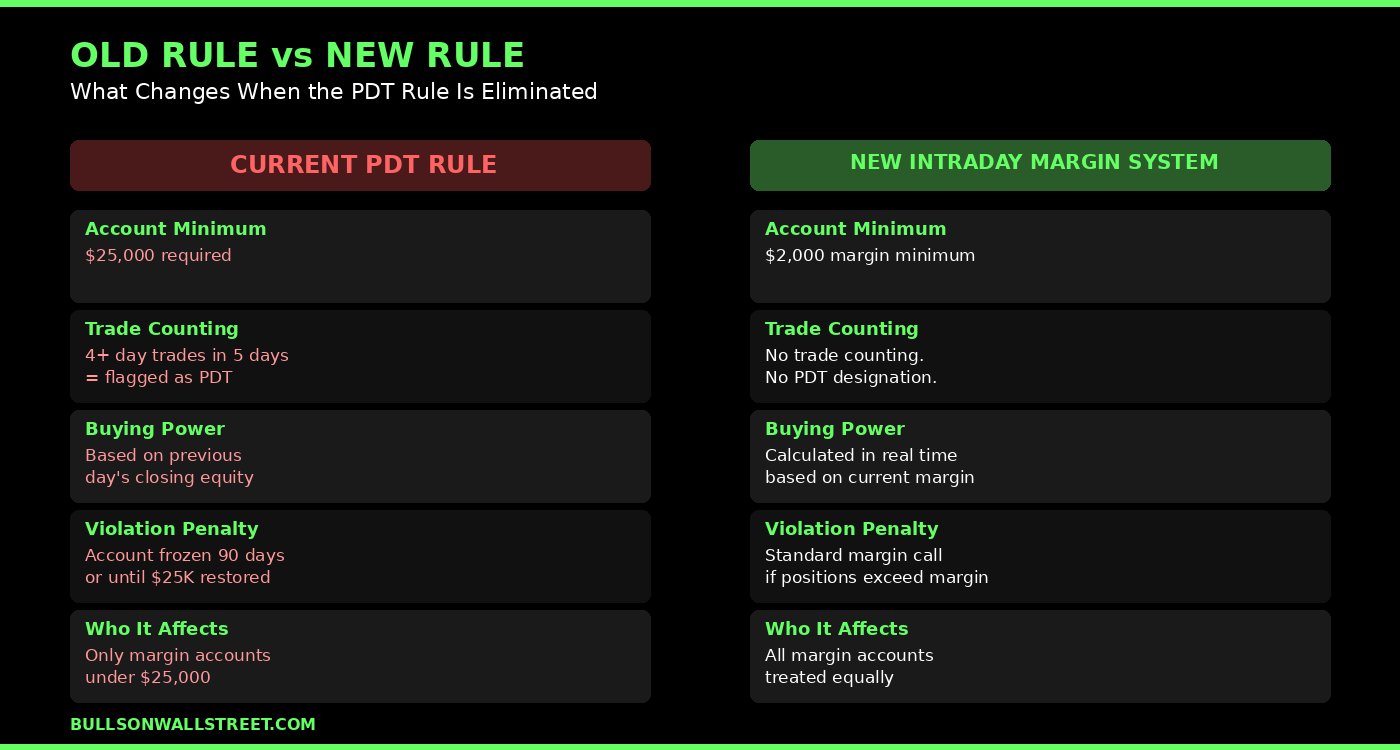
The pattern day trader designation is gone. Your broker will no longer count your day trades or flag your account based on how many times you buy and sell in a week. The concept of a PDT no longer exists under the new system.
The $25,000 minimum equity requirement is eliminated. The new minimum to hold a margin account stays at $2,000 — the same threshold that already exists for opening any margin account. Major brokerages like Cobra Trading have confirmed they expect the new minimum to be $2,000, though individual brokers may set their own higher internal minimums.
Day-trading buying power is calculated in real time. Under the old system, your buying power was based on the previous day's closing equity — a lagging calculation that did not reflect your actual risk exposure during the trading day. The new system uses what FINRA calls the intraday margin level, which calculates your available buying power based on your account's margin excess at the time you open a trade. This is how institutional margin has worked for years.
Standard maintenance margin applies to intraday positions. Instead of a special PDT margin category, intraday trades will be governed by the same 25% maintenance margin requirement that applies to other margin positions under Rule 4210. You hold a $10,000 position intraday, you need $2,500 in margin. Simple.
FINRA set the effective date as June 4, 2026 in Regulatory Notice 26-10. The transition will not happen everywhere at once: brokers that need system upgrades have an 18-month phase-in window, through October 20, 2027, to adopt the new intraday margin standards. Some moved immediately. Schwab, for example, plans to stop counting day trades on June 8 and will no longer restrict accounts that would have been flagged as pattern day traders. Others will take months.
This is the part the headlines are glossing over, and it matters if you actually want to trade. June 4 does not mean every broker is ready. The effective date means brokers are now allowed to drop the PDT rule. It does not mean they have finished rebuilding the systems behind it. Every broker has to update its own risk management and margin software to handle real-time intraday margin, and that work happens on each firm's own schedule. I have talked to firms that will be ready on day one, and others that told me one, two, even three months out. So if you are under the old $25,000 threshold and you want in on this now, the move is simple: open an account at a broker that has already implemented the new system. Do not assume your current broker flipped the switch on June 4. Confirm it directly before you plan a single trade around it.
E-Trade, Schwab, Interactive Brokers, and Cobra Trading have all published client-facing communications preparing for the change. The industry expectation is approval followed by rapid implementation.
How the New Margin Math Works (Real Example)
Say you have a $5,000 margin account under the new system.
Your intraday margin level is calculated in real time based on your account's margin excess when you open a trade. With standard 25% maintenance margin on equities, a $5,000 account could theoretically support up to $20,000 in intraday positions — but only if you have zero other positions and full margin excess available.
Here is a realistic scenario. You buy 200 shares of a $30 stock at 9:45 AM. That is a $6,000 position. Your margin requirement is 25% of $6,000 = $1,500. Your remaining margin excess is $3,500. You sell the position at 10:30 AM for $31 per share. You made $200. Your margin excess resets in real time.
Compare that to the old system. Same $5,000 account. Under the PDT rule, you cannot make that trade at all — your account is below the $25,000 minimum. You would need five times the capital just to have the right to click the buy button.
That is what is changing. Not the risk. Not the math. The access.
What This Means If You Have a Small Account
This is where most of the internet is getting it wrong. The conversation around the PDT rule change has been almost entirely celebratory. Finally, small traders can play. The $25K barrier is gone. The floodgates are open.
That is the wrong way to think about this.
I have trained 7,000+ students through the bootcamp. I never saw the PDT rule teach traders patience. Not once. What it taught them was bad habits.
They would be profitable on a stock and not take the profit because they did not want to trigger a day trade. Worse, they would hold losers. I cannot count how many times over the last 15 years I asked a student why they were still in a position that had clearly broken down, and they told me the same thing: they knew it was trading below their stop, but if they stopped out they would burn a day trade and be frozen for the rest of the week. So they sat there and watched a small loss become a big one. The rule made them trade based on regulatory math instead of what the stock was actually doing. That is the opposite of good trading.
But the most counterproductive thing the PDT rule did was force traders into riskier assets just to get around the restriction. Students with $5,000 accounts who should have been learning equities — the big game — were instead jumping into futures, options, forex, shady offshore CFD brokers, or signing up with random overseas prop firms just to escape the three-trade limit. Those are some of the hardest instruments to trade. Equities are where you learn. Equities are where the volume is, where the setups are cleanest, where the skills transfer to everything else. But the PDT rule locked beginners out of the equity game and pushed them into products that chew up new traders even faster.
That is not investor protection. That is investor redirection into worse outcomes.
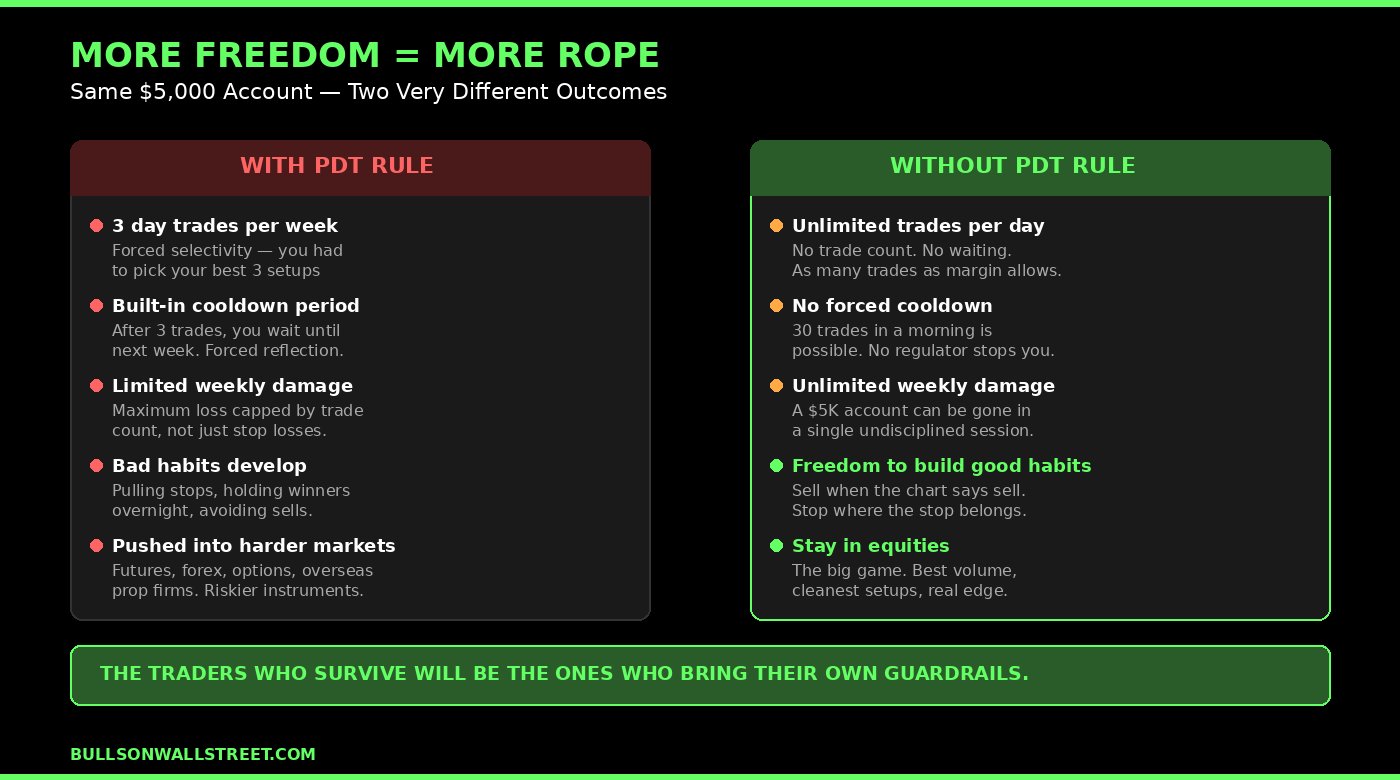
The PDT rule was a terrible regulation with one accidental benefit: it forced a speed bump. Three day trades per week meant you had to be selective. You had to pick your spots. You could not revenge trade your way through a bad morning because the rules physically would not let you.
That speed bump is gone as of June 4, 2026. And if you do not replace it with your own internal rules, you are going to blow through a small account faster than you ever could under the old system.
Here is what to do right now, now that the rule is gone.
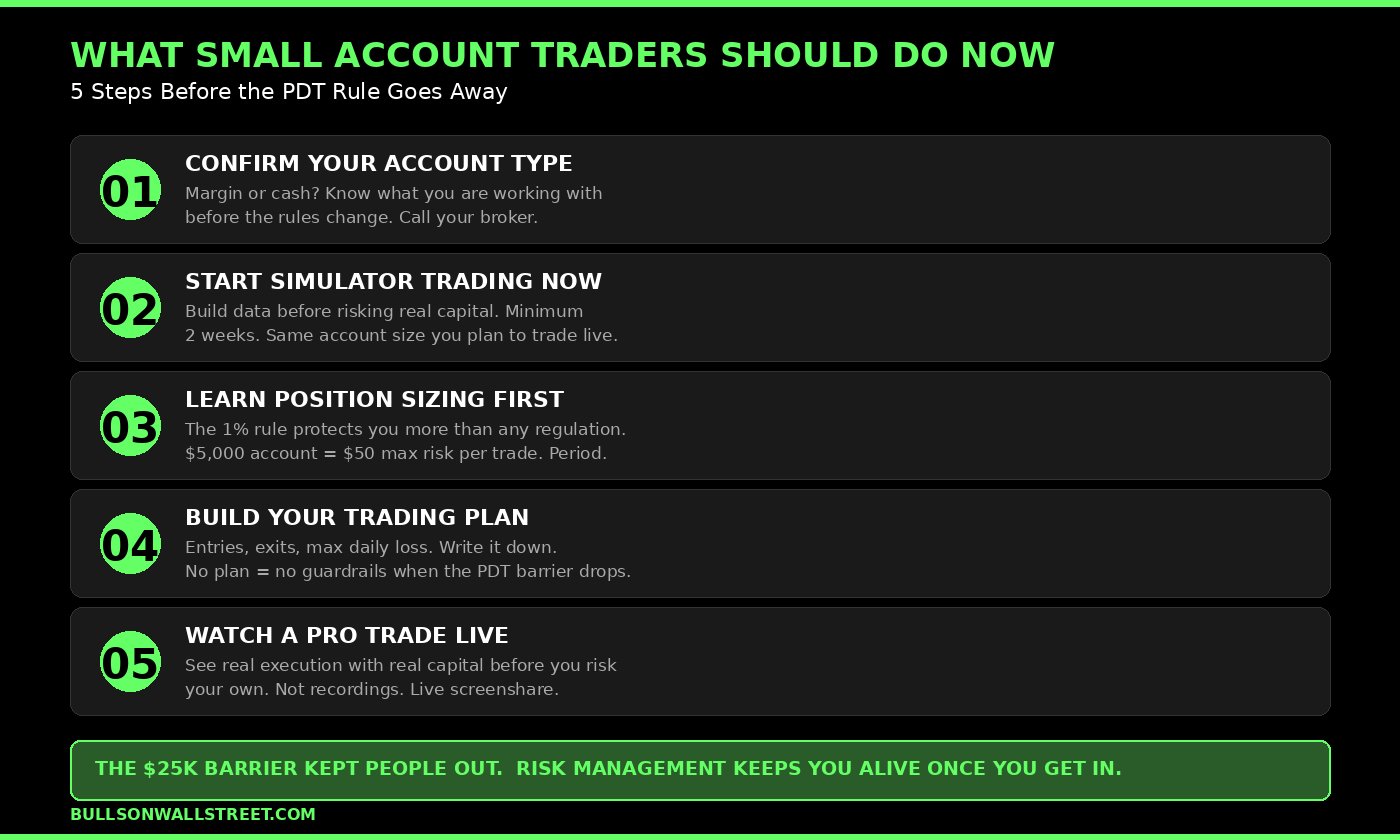
Start simulator trading today. Not next week. Today. The 60-Day Live Trading Bootcamp at Bulls on Wall Street does not let students trade live during the program for exactly this reason. You build your system on the simulator first. You generate data. You prove the edge exists before you risk real capital. This is not optional.
Learn position sizing before you learn setups. The 1% rule — never risk more than 1% of your account on a single trade — protects you more than any regulation ever did. A $5,000 account means $50 maximum risk per trade. That is your real guardrail now.
Build a daily max loss. At BOWS, I teach my students to set a hard daily max loss — typically 2-3% of your account. Hit it and you are done for the day. Walk away. This is the replacement for the PDT speed bump. You have to enforce it yourself.
I put the full playbook in a separate guide. If you are starting with a small account, read how to day trade a small account in 2026 for the exact setups, the capital math, and the rules that keep you in the game now that the wall is gone.
PDT Rule Workarounds That Still Matter
The $25,000 PDT rule is eliminated as of June 4, 2026, though some brokers are still rolling out the new intraday margin system during the phase-in window. Here are the workarounds traders relied on under the old rule — and which ones still matter even now that it is gone.
Cash accounts. The PDT rule only applies to margin accounts. In a cash account you can make unlimited day trades as long as you use settled funds. With T+1 settlement, your cash frees up the next business day. Downside: no leverage, and you are limited to your actual cash balance each day.
Futures trading. Futures are regulated by the CFTC, not FINRA. No PDT rule applies. You can day trade E-mini S&P 500 (/ES), Nasdaq 100 (/NQ), and other contracts with accounts as small as $1,000-$2,000 depending on the broker. The leverage is significant — one /NQ contract controls roughly $350,000+ in notional value. That is a double-edged sword.
Options strategies. Buying options (calls or puts) does not trigger the PDT rule the same way because your risk is defined by the premium paid. Many of my students use options to take directional bets within the three-trade weekly limit. The small account risk management guide covers this in detail.
Swing trading. Holding positions overnight is not a day trade. Period. You can make unlimited swing trades in a margin account regardless of your account size. This is why I tell every student with less than $25K to start with swing trading first. Build the account. Learn the setups. Use the first pullback strategy and the VWAP strategy on daily charts before you ever touch intraday execution. I call this The Double Dip — keep your day job, trade swings in the evenings, and stack capital until your account and your skills are both ready. The full playbook is in the guide on how to day trade while working full time.
Prop firms. Proprietary trading firms provide buying power in exchange for a percentage of profits. No PDT rule because you are trading the firm's capital. My own firm, TheTradeMakers.com, was built partly because I watched thousands of students hit the PDT wall and need an alternative path.
Why Risk Management Matters More Now, Not Less
This is the part nobody wants to hear.
The PDT rule being gone does not make trading easier. It makes trading more dangerous for undisciplined traders.
Under the old system, a $5,000 account could make three day trades per week. Bad week? You lost on three trades. Maximum damage was capped by regulation.
Under the new system, that same $5,000 account can make 30 trades in a single morning. No cooldown. No forced pause. No regulatory safety net. If you do not have a system — entries, exits, position sizing, daily max loss — you can vaporize a small account before lunch.
The biggest thing happening now that the PDT rule is removed is traders going wild. They are going to overtrade because for the first time, they can. When you could not make more than a few trades a week and all of a sudden you can make as many as you want, common human nature takes over. You go nuts because you have the ability to do something you did not have before.
My other worry is that traders will shortcut the process. For a long time, my students who were under the PDT threshold would study, stay on the simulator, keep saving money, and build slowly. Maybe they would take some selective swing trades and a few carefully chosen day trades to grow the account. They took a long time to do it — and that long time was where the real learning happened.
I worry that the traders in the $10,000 to $15,000 account range are just going to jump in. Skip the simulator. Skip the slow build. Forget everything about taking it easy because the barrier that forced them to be patient is gone. And that is when accounts get destroyed.
The traders who survive the post-PDT world will be the ones who build their own guardrails before they start trading, not after they blow up an account. The ones who treat the elimination of the $25K minimum as permission to get reckless will learn the same lesson the dot-com traders learned in 2001 — just without the regulatory intervention afterward.
I have been saying this since 2008: the market does not care about your effort. It does not care about your motivation. It cares about your risk management. That was true when the PDT rule existed. It is more true now that it is going away.
The Right Way to Start Day Trading in the Post-PDT Era
Here is the path I would recommend to anyone starting with a small account in 2026, now that the PDT rule is eliminated.
Start with education, not execution. The 60-Day Live Trading Bootcamp exists because I watched too many traders skip straight to live trading and blow up. You need pattern recognition. You need to understand how the opening range breakout works, how the first pullback into the Bone Zone sets up, how VWAP anchors every intraday trade. The full breakdown of every setup I trade daily is on the day trading strategies page.
Simulate for a minimum of two weeks. Use the same account size you plan to trade live. Take every setup your system generates. Journal every trade. Build real data before you risk real money.
Go live with 10% of your capital. If you have $5,000, trade with $500 at first. Use 0.1% risk per trade. This is not exciting. It is not going to make you rich this month. It is going to keep you in the game long enough to develop the skill.
Scale up based on data, not emotion. Ten consecutive green days at 0.1% risk? Move to 0.2%. Twenty green days? Move to 0.5%. Consistency earns the right to size up. Nothing else.
Use TC2000 for charting and scanning. I have used it for over 20 years. The scanning engine is the best in the business for finding momentum stocks with the volume and range to trade intraday. Set up your pre-trade checklist inside TC2000 so you never enter a trade without confirming the setup.
Watch a professional trade live before you trade live yourself. The Bulls on Wall Street Trading Chatroom runs a live screenshare every morning. I trade my real account with real capital while you watch. That is not a replay. That is not a recording. That is live execution with commentary, every market morning since 2008.
Unlimited reps only pay off if you have one setup nailed. The one I would put a small account on is the catalyst first pullback into the Bone Zone, broken down with real trades and exact risk in the best small-account day trading strategy.
The Timeline: How the PDT Rule Was Eliminated
Here is how the most significant change to retail trading access in 25 years actually unfolded.
In January 2026, FINRA moved to overhaul the day-trading margin provisions and replace them with intraday margin standards. The formal proposal (SR-FINRA-2025-017) had been filed with the SEC in late December 2025, published in the Federal Register in January 2026, with the public comment period closing February 4, 2026. The SEC approved the amendments on April 14, 2026. On April 20, FINRA published Regulatory Notice 26-10 setting the effective date as June 4, 2026, with an 18-month phase-in for firms needing system upgrades, through October 20, 2027.
Brokers are now implementing on their own timelines. Schwab plans to stop counting day trades and stop restricting would-be pattern day traders starting June 8. E*TRADE expects to roll out the new framework shortly after the June 4 effective date. Interactive Brokers and others have published client guidance. I cover the broker-by-broker rollout in real time on the Bulls on Wall Street YouTube channel.
Frequently Asked Questions About the Pattern Day Trader Rule
Is the PDT rule eliminated in 2026?
Yes. The SEC approved FINRA's elimination of the pattern day trader designation and the $25,000 minimum equity requirement on April 14, 2026, with an effective date of June 4, 2026. A risk-based intraday margin system replaces it. Some brokers are still rolling out the new framework during an 18-month phase-in window, so check your specific broker's timeline.
What is the new minimum to day trade without the PDT rule?
Under the new system, the minimum to hold a margin account is $2,000 — the same pre-existing threshold for opening any margin account. The $25,000 day-trading floor is gone. Individual brokers may set higher internal minimums, so check with yours.
Can I still day trade in a cash account?
Yes. Cash accounts were never subject to the PDT rule — it only ever applied to margin accounts. You can make unlimited day trades in a cash account as long as you use fully settled funds. The tradeoff is settlement: under T+1, proceeds settle the next business day, and trading with unsettled funds can trigger a good faith violation. That constraint is unchanged by the rule elimination.
What is intraday margin and how does it work?
Intraday margin replaces the old day-trading buying power calculation. Instead of using your previous day's closing equity, the new system calculates your available margin in real time based on your current positions and margin excess. Standard 25% maintenance margin applies to intraday equity positions.
Will my broker automatically switch to the new rules?
Not necessarily, and not all at once. The rule is effective June 4, 2026, but firms have an 18-month phase-in window through October 20, 2027 to fully implement. Some, like Schwab, move within days. Others will take months. Contact your broker directly to confirm their timeline.
Which brokers will be ready for the PDT change on June 4?
It varies by firm. June 4 is the date brokers are allowed to drop the PDT rule, not a date by which all of them have rebuilt their margin and risk systems. Some are ready on day one, others have told me they need one to three months. Schwab plans to stop counting day trades on June 8 and E*TRADE expects to roll out shortly after the effective date. If you have a sub-$25,000 account and want to start day trading right away, open an account at a broker that has already implemented the new system, and confirm it with them directly rather than assuming.
Does the PDT rule change affect options trading?
The PDT rule currently applies to options trades in margin accounts the same way it applies to equities. If you buy and sell the same option contract on the same day, that counts as a day trade. Under the new system, options would be subject to the same intraday margin framework as equities.
Can I still get a margin call under the new system?
Yes. The new system uses real-time margin monitoring. If your positions exceed your available margin, your broker will issue a margin call — potentially faster than under the old system because monitoring is continuous rather than end-of-day.
Is day trading profitable for most people?
No. Academic research and FINRA's own data consistently show that the majority of retail day traders lose money. The elimination of the PDT rule does not change this statistic. What changes outcomes is education, risk management, and disciplined execution — not access. If you are comparing education programs, I wrote an honest breakdown of Live Traders vs Bulls on Wall Street that covers exactly what each one teaches.
What should I do right now if I have less than $25,000?
Start learning. Use a simulator. Build a trading plan. Study risk management. Watch a professional trade live. The PDT rule going away means you will have access sooner — but access without preparation is how accounts get destroyed.
How long does it take to become a profitable day trader?
It took me 7 years (1999 to 2006) to become consistently profitable. The average for traders who follow a structured program is 3 to 7 years. If someone tells you they can make you profitable in 30 days, they are lying. I tell every Day 1 bootcamp student the same thing. Read the full breakdown in our guide on how long it takes to learn day trading.
What is the Bone Zone and how does it help day traders?
The Bone Zone is the shaded area between the 9 EMA and 20 EMA on a 5-minute chart. When price pulls back into the Bone Zone on decreasing volume and prints a green candle, that is an entry signal. My candlestick chart patterns PDF breaks down how to read those candles. It is the foundation of the first pullback strategy I teach in the bootcamp and one of the highest-probability setups for new day traders.
Where can I learn to day trade now that the PDT rule is gone?
The 60-Day Live Trading Bootcamp at Bulls on Wall Street is the world's longest-running live trading program. You watch me trade live every morning with real capital, learn the exact setups and risk management system I use, and build your trading plan on a simulator before risking a dollar of real money.
About the Author
Kunal Desai is the CEO and founder of Bulls on Wall Street. A professional trader since 2007, he has navigated every major market cycle -- from the 2008 financial crisis to today's high-volatility environments. Having mentored 7,000+ students through his live trading bootcamps, Kunal trades live every morning in the Bulls on Wall Street Trading Chatroom and is dedicated to teaching real-world execution and high-probability strategies. Based in Miramar Beach, Florida.
Connect with Kunal: Read his full story | Instagram | YouTube