

Updated April 2026
Everyone says the same thing. Quit your job. Go all in. Commit fully or don't bother. The trading industry sells this idea hard because it sounds inspiring. It is also one of the fastest ways to blow up your account, destroy your confidence, and end up right back at a desk somewhere, broker than when you started.
I know because I almost did it the wrong way.
I started trading in 1999. I was 18 years old in college, reading forums, chasing hot tips, losing money I did not have. I graduated, got my first real job doing door to door business sales — walking into businesses cold, unannounced, trying to sell something nobody asked you to sell. Hard work. But you learn how to read people fast. You learn rapport, rejection, how to make a case in 60 seconds to someone who does not want to talk to you. My second job after that was headhunting — on the phone with managers and CEOs, presenting candidates, selling them on why they should interview someone they had never heard of. Real selling. Real pressure. Skills that still show up in how I run BOWS today.
But it was not day trading.
No kid grows up wanting to sit in a cubicle on a floor of 100 people all dialing for dollars. I am from Michigan. I was driving in the snow, showing up at 8 AM, still there at 8 or 9 PM at night. Back then there were no mental health days, no work from home, no quiet quitting. You showed up and you grinded with a smile on your face no matter what. And I did. But the whole time I knew it was not where I was supposed to be.
What I hated most was not the hours. It was working on somebody else's time. Somebody else's terms. Having to say yes sir with a smile even when you felt the opposite. I did not want to make somebody else's calls. I wanted to own my own business. Make my own shots. That drive is what kept me up late studying charts when I should have been sleeping.
The job funded the dream. The dream made the job tolerable.
What I did not do was quit. That decision is the reason I am still here.
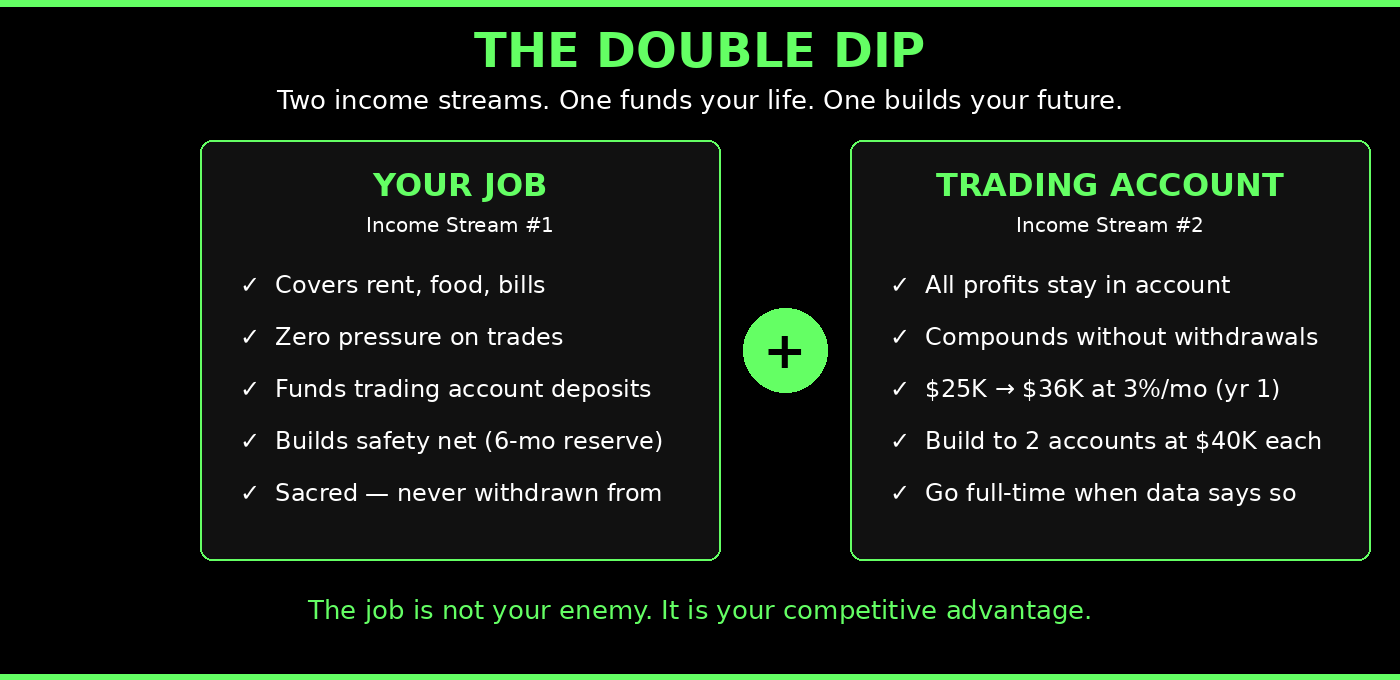
This is what I call the Double Dip. Keep your job. Build your trading account. Earn income from one and learn from the other. Stack cash for two years or more before even thinking about going full-time. The working traders who build real careers do not quit early. They use the job as the factory that funds the operation.
This post is the full framework. The schedule. The setups. The account-building math. Everything I wish someone had handed me in 2001.
The Myth That Kills Most Trading Careers Before They Start
Walk through any trading forum. The advice is always the same. You cannot trade part-time. You need to be fully committed. Distraction kills accounts.
There is truth in that. You cannot be half-focused during your trading window. But the advice assumes that the only path is to quit your job and sit in front of charts eight hours a day. That path has a specific failure rate: most traders who quit their jobs too early run out of capital before they ever develop a real edge.
The real problem is not distraction. The real problem is that most people who go full-time too early do not have the income buffer to survive the learning curve. When your rent depends on your P&L, every losing trade becomes an emotional emergency. You start revenge trading. You over-size. You abandon the system. Not because you are a bad trader. Because you are a broke trader. The money pressure destroys the psychology before the strategy has time to work.
Keeping your job removes that pressure. The day job is not your enemy. It is your competitive advantage.
What the Double Dip Actually Means
The Double Dip is simple. You earn income from your job and grow your trading account at the same time. Two income streams running in parallel. One funds your life. One builds your future.
Here is what it looks like in practice. You work your regular hours. You trade before work, in the first hour of market open where your schedule allows, and you do your preparation at night. Your paycheck covers rent, food, bills. Your trading profits stay in the account and compound. No withdrawals. No pressure. You are building the engine while the gas tank stays full.
The math is on your side. A $25,000 trading account growing 3% per month — a conservative target for a developing trader — becomes roughly $36,000 in a year without a single withdrawal. Growing at 5% per month, it becomes $46,000. You are not spending those gains because your job covers your life. The account builds faster than it would if you were pulling from it to survive.
Most full-time traders cannot do this. They need to pull money out monthly to pay expenses. The working trader who treats profits as sacred capital compounds at a rate full-timers cannot match during the learning phase.
Why 7 Years Is Not a Failure Story
I went full-time at the end of 2007. I started trading in 1999. That is eight years before I walked away from employment income for good.
Most people would look at that timeline and call it a failure. I look at it and call it the reason I survived.
During those years I was learning how markets actually work. Not how trading books said they worked. Not how forum posters said. How they actually worked, with real money, on real charts, in real market conditions. I met my mentor Paul Singh through the Market Speculator blog. He trained me via AOL Instant Messenger in late-night sessions when I was still working days. I was not staring at charts during meetings. I was preparing at night, scanning before work, and processing what happened after.
By the time I went full-time in 2007, I was not learning anymore. I was executing. The job had funded the entire education.
2006 was my first consistently profitable year. I did not quit in 2006 when I finally cracked it. I waited another year. Built the account bigger. Confirmed the edge was real and repeatable. Then I left.
That patience is not sexy. It does not make a good highlight reel. But 7,000+ students later, I can tell you that the traders who make it almost always share one thing: they did not rush the timeline.
The Real Schedule for Working Traders
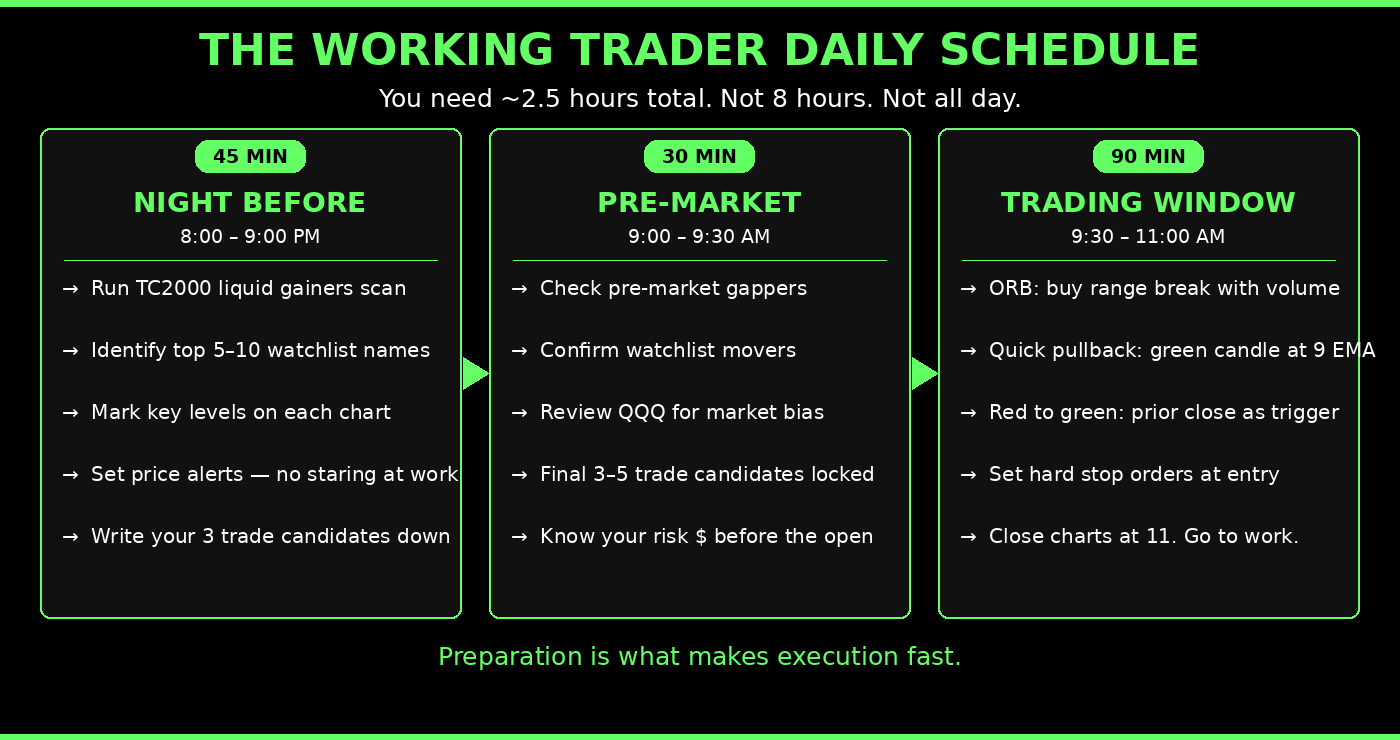
Here is the honest truth about combining a job with trading. You do not need eight hours. You need ninety minutes of high quality execution and about an hour of preparation.
Night before (30-45 minutes): Scan your watchlist. Run your scans in TC2000. Identify the top 5-10 names you will watch tomorrow. Note the levels that matter. Set your alerts. This is your preparation window and it is the most important part of the entire process. The traders who do this consistently outperform the ones who are still figuring out what to watch at 9:28 AM.
Pre-market (9:00-9:30 AM): Check your pre-market gappers. Run your liquid gainers scan. Look at which stocks from your watchlist are moving. Review the overall market through QQQ. Confirm your top 3-5 trade candidates. Thirty minutes of focused execution prep.
How did I actually manage this during the headhunting years? The honest answer is I did both day trades and swing trades depending on what the day allowed. Swing trades were the foundation — set up the night before, left to run. But I was also sneaking day trades in wherever I could find the gaps.
Every morning I invented a bathroom break to check the open. Did it so consistently that people started noticing the pattern. Had to claim I had IBS. Nobody asked questions after that.
Because it was a phone business I had more screen flexibility than most. Morning meetings ended, phone calls had natural lulls, and I learned to map my calendar around where the dead spots were. When I had 45 minutes of nothing, I was at the computer looking for setups. Most of the action was in the morning anyway so I was not missing much by being locked down in the afternoon.
One thing worth noting: pre-market barely existed back then. Unless a stock had major news, there was almost nothing moving before the open. Spreads were wide, liquidity was thin. Today the pre-market ecosystem is completely different — futures traders, ETFs, news-driven movers, all of it active before 9:30. Working traders now have even more flexibility than I had.
Ninety minutes of execution. Then close the charts and go to work.
Day Trading vs Swing Trading: The Honest Answer
Most resources on this topic tell working traders to skip day trading entirely and stick to swing trading. That advice is not wrong. Swing trading is absolutely the right core strategy for someone with a full-time job. But it is not the complete picture.
Swing trading should be your primary strategy. You identify setups on daily charts the night before. You set your entries, stops, and targets. You hold for 3-7 days or longer. A flat top breakout, a bull flag, a base breakout, a pullback to the 20 EMA — these are setups you can manage around any work schedule. You check in once in the morning and once before close. Done.
Swing trading is engineered for the Double Dip lifestyle. The setups develop on daily charts over days and weeks. Execution takes minutes, not hours. This is not a compromise strategy. Swing trading produces some of the highest reward-to-risk ratios in any trading style.
Day trading is the second layer. If your schedule allows the 9:30-11:00 AM window, you can stack day trades on top of your swing portfolio. ORBs and quick pullback buys in the first ninety minutes. Close your day positions before 11. Let your swing positions run. Two income streams from the same morning.
If you cannot access the market during that window, swing trading is your full game. Do not force day trades you cannot manage properly. A half-watched day trade is worse than no trade.
The Morning Window: What to Trade and How
If you have access to the market from 9:30 to 11:00 AM, here are the setups that work for time-constrained traders.
Opening Range Breakout (ORB): A stock spikes at open on news or a gap, consolidates tight for 5-15 minutes, then breaks out of that range with volume. You buy the break of the upper range. Stop goes under the first candle of the consolidation. This is a fast trade — in and out in 20-45 minutes typically. Tight is right on this setup. If the stock is already extended 3+ ATRs from VWAP, you skip it. Sloppy ORBs are lazy trades.
Quick Pullback Buy: A momentum stock opens strong, pulls back to the 9 EMA or 20 EMA on the 5-minute chart, holds a green candle at that level, then resumes. Tighter entry than the ORB with a better reward-to-risk ratio. You buy the green candle hold. Stop goes under the low of that candle. First pullbacks to the 9 EMA have the full ATR of upside remaining. These are the cleanest setups in the first two hours.
Red to Green: A stock opens below the prior close, dips, then crosses back above the prior day's close on increasing volume. The prior close is the line in the sand. When price crosses it with volume, you buy. Stop goes under the first candle that crosses. Works fast and works immediately. If it does not work right away, something is wrong.
For all three setups, use TC2000 to run your pre-market gapper scan and set alerts on your watchlist levels the night before. You want to walk in at 9:30 with a short list of 3-5 names, not 30 names you are trying to filter in real time. Download Kunal's full TC2000 layout here — it has all the scans and watchlists set up for this exact workflow.
Building the Account While Employed: The Math
This is the part that makes the Double Dip work financially. The goal during your working years is not to get rich trading. The goal is to grow the account consistently without withdrawing from it. Your job covers your life. Your trading profits stay in the account. The compounding does the heavy lifting.
Here is what my own Double Dip math looked like. I turned profitable in 2006. Every dollar I was living on came from the job. Trading profits stayed in the account. I was also adding money from my paycheck into the trading account on top of that — not withdrawing from it, adding to it.
My target was specific: two accounts at $40,000 each before I walked away from employment income.
The math made sense. At $40,000 I could reasonably make $500 a day trading. That was my number. But I also wanted a second $40,000 account sitting untouched as a spare. If I blew up the first account — a real possibility when you go full-time and the psychological pressure changes — I had a backup. That second account would only hold swing trades, no margin. Nearly impossible to blow up a swing account if you are not using margin. Two accounts. One active. One protected.
I could have quit earlier. The edge was there by mid-2007. But quitting at the first sign of profitability is not the question. The question is what gives you the best shot to still be in this game ten years from now. Too many people make the decision based on what feels good in the moment. I wanted to give myself every structural advantage before I removed the income safety net.
Start with a $25,000 account — the minimum to avoid the Pattern Day Trader rule that caps day traders under that threshold at 3 day trades per rolling 5-day period. Risk 1% per trade. On a $25,000 account, 1% is $250 per trade. Your position size is determined by your stop distance. For further detail on calculating this correctly, read the position sizing calculator guide.
The Bone Zone: Your Most Powerful Entry Signal as a Part-Time Trader
Working traders do not have time to babysit charts all day. The Bone Zone is the reason you do not need to.
The Bone Zone is the shaded area between the 9 EMA and 20 EMA on a 5-minute chart for day trading, or on a daily chart for swing trading. When a trending stock pulls back into the Bone Zone on decreasing volume and prints a green candle, that is the entry signal. Full stop.
You are not guessing. You are not reading 15 indicators. You are watching two lines and waiting for one candle. When price pulls back into the zone quietly and then turns back green, that is the professional entry. Stop goes below the last swing low.
For swing traders, the daily chart Bone Zone is where the best pullback entries live. The stock is in an uptrend. It fades back between the 9 and 20 EMA. Volume dries up. It does not break down. Then it prints a green candle and reclaims the 9. That is your entry. You set it up the night before, place a limit order or alert, and execute in the morning in 5 minutes.
This is not a complicated setup. It is a simple, repeatable, high-probability entry that requires no all-day chart watching. That is exactly what working traders need. For the complete breakdown of pullback entries, read the first pullback trading strategy guide.
The PDT Rule and How to Work Around It
The Pattern Day Trader rule requires a minimum $25,000 account balance to execute more than 3 day trades in a rolling 5-day period. For working traders learning with a smaller account, this feels like a ceiling. Here is how to think about it.
Under $25,000, make swing trading your primary focus. No PDT restrictions on swing trades. Use your 3 day trade slots strategically — the clearest, highest-probability setups only. Do not burn them on B-level plays.
At $25,000+, swing trading stays your foundation and you layer day trades on top during the morning window. Research at night. Execution in 90 minutes at open. Then close the charts.
The FINRA guidance on the PDT rule explains the full margin requirements. Read it once so you know exactly what you are working with. Futures trading is another route — no PDT rule, no minimum account size requirement. The leverage is real though. The CBOE publishes educational resources on derivatives and margin worth reviewing if you are new to futures.
The Night Before Routine (Non-Negotiable)
The morning execution is only as good as the night before preparation. For working traders this is even more true — you do not have time to figure out your watchlist at 9:25 AM.
Run your TC2000 liquid gainers scan. Download the momentum scanner here. Look for stocks with relative volume expansion, clean price action on the daily chart, and catalysts that will matter tomorrow morning.
Pull up the daily charts on your top 5-10 names. Identify the levels. Where is the resistance that would trigger an ORB? Where is the 9 EMA level that would set up a quick pullback buy? Where is the prior close that would set up a red to green trade? Set your alerts at those levels in TC2000. Not mental alerts. Actual platform alerts that send a notification to your phone or desktop.
Review your position sizing for tomorrow. Know your risk number before you open your broker. The risk management guide has the full framework.
Write down your top 3 plays for tomorrow. Not 10. Three. The trader who shows up with 3 well-prepared setups beats the trader with 30 half-researched names every single time.
When You Are Ready to Go Full-Time
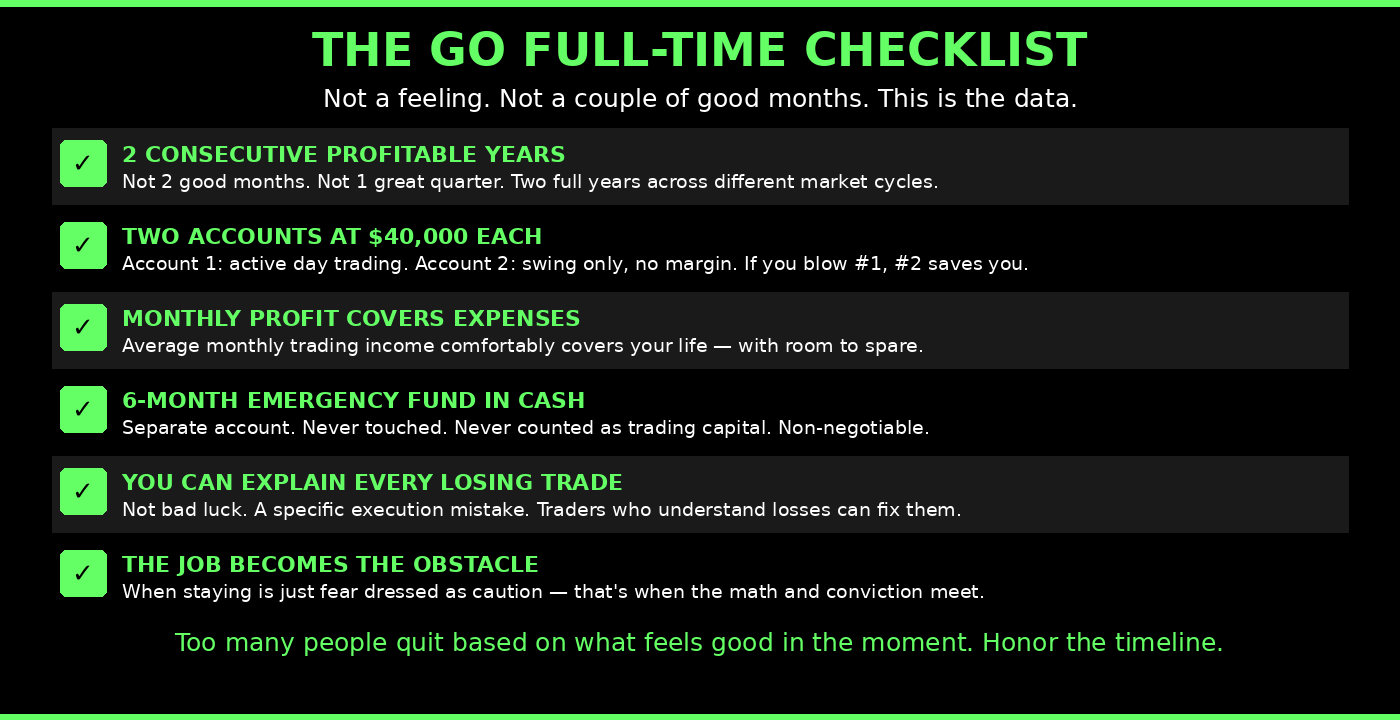
This question gets asked more than any other. How do you know when it is time? The answer is not a feeling. It is not when you have a couple of big months. It is not when you are tired of your boss. It is data.
Two consecutive years of consistent profitability. Not two good months. Not a great quarter. Two years. That is enough market cycles to know whether the edge is real or whether you got lucky in a strong tape.
Your trading account should be large enough that your average monthly profit covers your monthly expenses with room to spare. Not exactly — comfortably. With a 6-month emergency fund sitting separately in cash that never touches your trading capital.
You should be able to explain exactly why every one of your losing trades lost. Not bad luck. A specific mistake in execution, entry, or sizing. Traders who understand their losses can fix them. Traders who blame the market cannot.
For me, the decision came when both accounts hit the targets and the monthly consistency was there. It was not a dramatic moment. It was math meeting conviction. The account was where it needed to be, the edge was proven over enough market cycles to trust it, and staying at the job any longer was just fear dressed up as caution.
The deeper truth: I did not want to look back at 50 and know I had the shot and played it safe. That thought bothered me more than the risk of going full-time.
The goal of the Double Dip is not to trade part-time forever. The goal is to arrive at full-time trading with a fully funded account, a proven edge, and zero financial pressure on Day 1. For more on evaluating your readiness, the SEC investor education resources are worth reviewing. Watch the full YouTube channel at youtube.com/@kunaldesaitrading for live trade breakdowns.
Day Trading vs Swing Trading for Working Traders: Side by Side
Both are valid. Both work. Most working traders who build real careers do both — swing trading as the core and day trading the morning window as the overlay. The day trading strategies guide covers the full breakdown of which setups apply where.
FactorDay TradingSwing TradingTime required daily90 min (9:30 to 11 AM)20 to 30 min pre/post marketTrade durationMinutes to hoursDays to weeksPDT rule appliesYes (under $25K)NoWorks around full-time jobYes, with morning accessYes, any scheduleChart watching requiredActive during windowMinimalCompounding speedFaster (more trades)Slower, less stressBest setupsORB, quick pullback, red to greenFlat top, bull flag, base breakout, EMA pullback
FAQ: Day Trading While Working Full Time
Can you day trade while working a full-time job?
Yes. The first 90 minutes of market open — 9:30 to 11:00 AM Eastern — contain the best setups of the entire trading day. If your schedule gives you access to that window, you can execute high-quality day trades without being at a desk all day. If you cannot access that window, swing trading covers the same strategies on daily charts with no market-hours requirement.
What is the Double Dip strategy in trading?
The Double Dip is Kunal Desai's framework for keeping your day job while building a trading career in parallel. Your job covers your living expenses. Your trading profits stay in the account and compound without withdrawals. You stack capital and skill simultaneously for 2+ years before considering going full-time. The job is not an obstacle. It is the funding mechanism for your trading education.
Do I need $25,000 to trade while working full time?
You need $25,000 to day trade without PDT restrictions. Under $25,000, focus on swing trading where PDT does not apply, and use your 3 day trade slots only for the clearest setups. Futures trading is another route with no PDT rule and no minimum account size requirement.
What is the best trading strategy for someone with a full-time job?
Swing trading is the foundation. You identify setups on daily charts the night before, set your entries and stops, and hold for multiple days. You spend 20-30 minutes in the morning and 30-45 minutes the night before. Day trading the opening range adds a second income stream if your schedule allows the 9:30-11:00 AM window.
How much time do I need to trade while working?
45 minutes the night before for preparation. 30 minutes pre-market for final scan review. 90 minutes at market open for execution. That is roughly 2-3 hours total. The rest of your workday is hands off. Preparation is what makes execution fast.
Should I quit my job to day trade?
Only when two consecutive profitable years confirm your edge, your account generates enough monthly profit to cover expenses with room to spare, and you have a 6-month emergency fund in cash that never touches your trading capital. Quitting before those boxes are checked puts financial pressure on every trade decision.
What is the Pattern Day Trader rule and how does it affect working traders?
The PDT rule requires a minimum $25,000 account to make more than 3 day trades in a rolling 5-day period. Working traders under that threshold should prioritize swing trading and use day trade slots selectively. Full rules and margin requirements are published by FINRA at finra.org.
What charting platform works best for trading around a job schedule?
TC2000 is built for this workflow. You run pre-market scans, set price and pattern alerts that fire to your phone, and review your watchlist in 20 minutes the night before. The alerts do the monitoring during work hours. You only look at the platform when a setup triggers. The referral link at tc2000.com/pricing/Bulls gives you $40 off your first month.
How do you manage risk when you cannot watch trades all day?
Set your stop loss as a hard stop order in your broker at entry. Not a mental stop. An actual order that executes automatically. Swing traders should also use limit orders for entries so they fill at the correct price without active monitoring. The position sizing calculator walks through the exact formula.
What is the Bone Zone and why is it important for part-time traders?
The Bone Zone is the area between the 9 EMA and 20 EMA on a chart. For swing traders, a daily chart Bone Zone pullback is one of the cleanest, most repeatable entry setups available. Price pulls back into the zone on decreasing volume, then prints a green candle reclaiming the 9 EMA. You identify it the night before, set an alert, and execute in the morning in 5 minutes.
How long should I do the Double Dip before going full-time?
At minimum, until you have two consecutive years of profitable trading with a proven edge you can explain trade by trade. For most people that is 3-5 years from when they start learning seriously. The traders at BOWS who rush that timeline almost always come back after a blowup. The ones who honor it arrive at full-time trading with funded accounts and real confidence.
Start Learning the Right Way
The Double Dip works. But it works faster when the system is right from Day 1. The 60-Day Live Trading Bootcamp is built specifically for this path. You learn the full BOWS trading system — setups, scanning, risk management, and psychology — without trading live during the program. You learn first. You simulate. You build a business plan. Then you watch live trading in the chatroom until your own data says you are ready.
7,000+ students have gone through this process. The ones who follow the Double Dip — learning the system while keeping their income intact — are the ones who are still trading three years later.
Apply to the 60-Day Bootcamp here.
About the Author
Kunal Desai is the CEO and founder of Bulls on Wall Street. A professional trader since 2007, he has navigated every major market cycle -- from the 2008 financial crisis to today's high-volatility environments. Having mentored 7,000+ students through his live trading bootcamps, Kunal trades live every morning in the Bulls on Wall Street Trading Chatroom and is dedicated to teaching real-world execution and high-probability strategies. Based in Miramar Beach, Florida.
Connect with Kunal: Read his full story | Instagram | YouTube