

Most traders lose money because they cannot stop trading. Not because the strategy is broken. Not because the market is rigged. Because they keep clicking, keep forcing, and keep chasing movement that was never theirs to trade. Learning how to stop overtrading is the single biggest lever between a blown account and a consistent one.
I have been trading since 1999. I went full-time at the end of 2007. I started Bulls on Wall Street in 2008 and have taught over 7,000 students through the 60-Day Live Trading Bootcamp. I just gave back $10,000 on AMD last Friday by overtrading the same level five times in a row. The triggers do not graduate. You just get better at catching them faster. This post is the full breakdown of why overtrading happens and the protocol I teach to fix it.
TL;DR
Overtrading has three triggers and almost never a fourth: boredom, the post-loss recovery spiral, and overconfidence after a win. More trades does not equal more money because the market pays for execution, not effort. The fix is a 5-rule protocol: a paper and pencil pre-market plan, a max daily loss sized to your mental tolerance, the hard 3-Loss Rule with a flexible trade count, waiting for the first pullback into the Bone Zone, and journaling every trade with its trigger tagged. Trade count flexes with the regime. The 3-loss stop never does.
More Trades Does Not Equal More Money
A lot of traders come into the market thinking opportunity is the problem. If they just take more setups, they will make more money. That sounds logical. In trading it is wrong. More action almost always means more mistakes because the market does not pay you for effort. It pays you for execution.
Those are two completely different things.
A trader can make three excellent decisions in a single session and outperform the trader who made thirty. Three trades sized correctly, entered on a real signal, exited with discipline. Versus thirty entries that were forced, oversized, or built on a story the brain made up halfway through the morning.
This is the trap. Overtrading feels productive. You are watching charts. You are scanning names. You are entering and exiting and re-entering. Your brain reads all that activity as progress. But trading activity is not trading effectiveness. The screen time and the click count tell you nothing about whether you have an edge today. A red P&L at the end of the session does.
Brad Barber and Terrance Odean famously documented this in their landmark 2000 study of 66,000+ individual investor accounts. Their finding was unambiguous. Trading is hazardous to your wealth was the literal title of the paper, and the most active traders earned an average annual return of 11.4% while the market returned 17.9%. The more they traded, the worse they did. Twenty-five years later, the same dynamic still plays out every single trading day in retail accounts.
The market does not owe you constant opportunity. Your job is to be ready when real opportunity actually shows up. Not to manufacture trades because the chart looks quiet.
The 3 Triggers That Drive Every Overtrading Session
In 25+ years of trading and watching 7,000+ students do the same thing on repeat, I can tell you overtrading almost never has a fourth cause. It is always one of three triggers. Sometimes two at once. Boredom. Post-loss recovery mode. Or post-win overconfidence. Until you know which one is firing inside your head in real time, you cannot stop it.

Trigger 1: Boredom
This is the one nobody wants to talk about because admitting it sounds amateur. Some of your worst trades come from boredom. Not from bad analysis. Not from a broken strategy. Just boredom.
I have been doing this since 1999 and I can trace boredom-driven overtrading back to my very first year. I was an 18-year-old computer science major at Michigan State. I would sit in the computer lab between classes during my morning computer science block, with my next class on the complete other side of campus, and I would try to bang out a quick CSCO or JDSU trade for beer money before I had to walk an hour to my public relations class where I would have zero access to a computer for the rest of the afternoon.
The thinking sounds harmless. It was anything but. I was not entering trades because the chart told me to. I was entering them because a clock told me to. My self-imposed deadline became a trigger to force action on whatever looked close enough. The market does not care about your class schedule, your beer money goal, or your monthly P&L target. It only pays for clean execution. And every single one of those forced campus-lab trades taught me the same lesson the slow way.
That is the deep version of the boredom trigger. It is rarely true boredom in the literal sense. It is usually internal pressure dressed up as opportunity. The market slows down. Nothing looks great. You have been sitting at your desk for two hours and you are starting to feel restless. Or you have a deadline coming. Or your P&L is flat and you feel like the day is slipping away. Now your brain wants action. So you start lowering your standards. A setup that was a clear no twenty minutes ago suddenly becomes maybe. Then close enough. Then you are in.
That is not trading. That is emotional discomfort dressed up as opportunity. If you need action to feel okay, you will create trades that should never exist. You will read meaning into random candles. You will convince yourself a level matters when it does not. The only way out is structure that does not give your bored brain permission to make decisions on its own.
Trigger 2: The Post-Loss Recovery Spiral
This is where overtrading stops being careless and starts becoming dangerous. You take a loss. Maybe it was small. Maybe it was valid. Maybe it was just part of the game and your stop got tagged on a fakeout. But instead of accepting it, your brain shifts into recovery mode.
Now you want it back.
That single shift changes everything about how you trade for the next 30 minutes. You start taking entries too fast. You stop waiting for confirmation. You cut the process and keep the impulse. What should have been one controlled loss turns into three. Then four. Then five bad decisions in a row. Not because the market changed. Because you changed.
I lived this exact pattern last Friday on AMD. The semiconductor sector had been overbought for months. We had been waiting weeks for a real crack in this market. On May 15, the semis finally started to roll. AMD broke under VWAP and started building out a level around 432. The thesis was right. The setup was right. The macro was right.
I shorted the level. AMD popped on me. I covered for a small loss.
Then I shorted it again at the same level. Popped on me again. Covered for another small loss.
Then again. And again. Five times in a row. I kept trying to bang the same short through because I had been waiting for that exact moment for weeks. But I was so locked in on the thesis that I refused to step back when the level was clearly not giving way yet. Each individual loss was small. Added up, the spin cycle cost me $10,000.
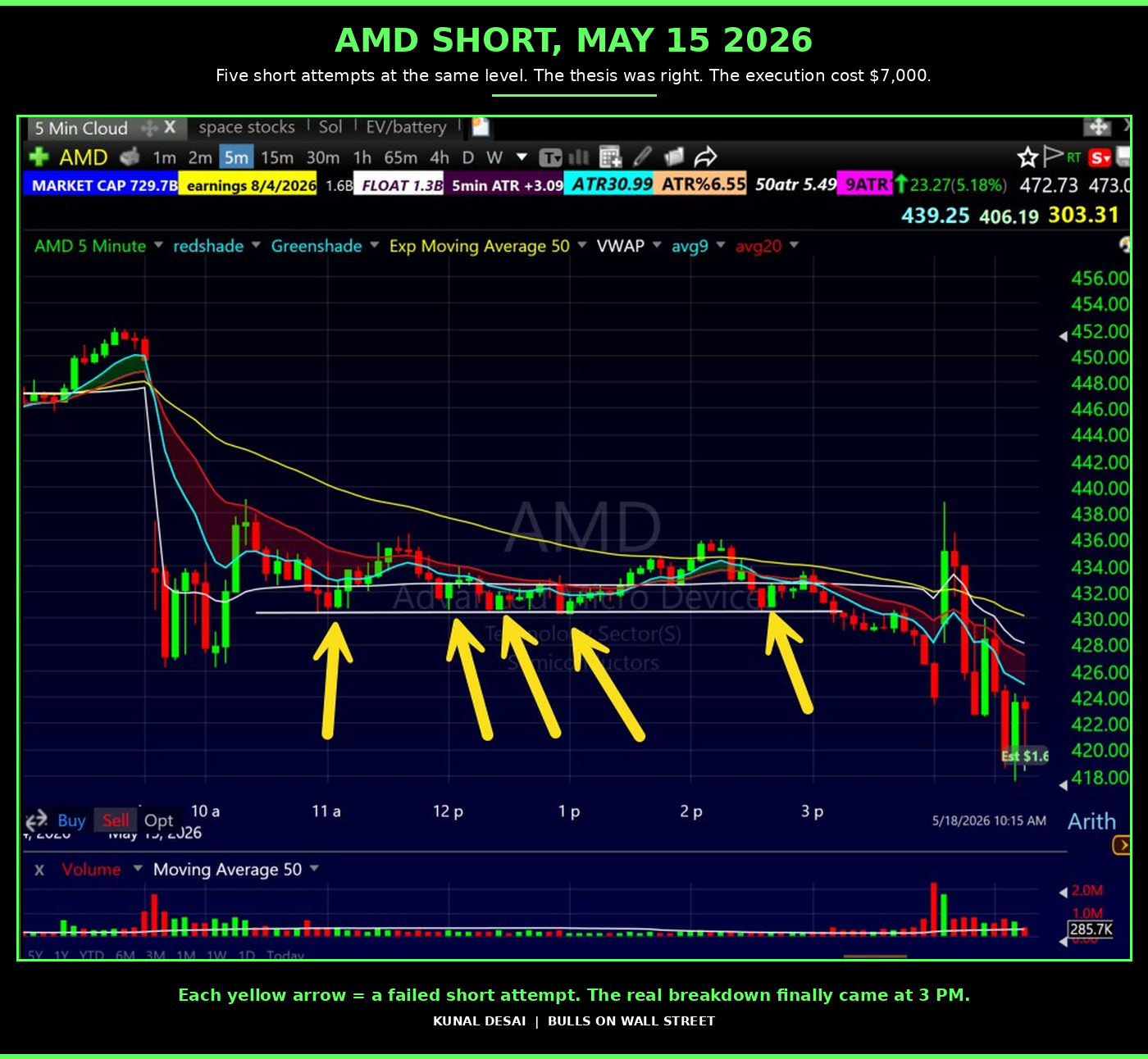
What is brutal about that day is that the breakdown finally came. Around 3 PM, AMD cracked under the level for real and rolled hard. If I had stopped at attempt one and just waited, I could have shorted the actual breakdown with size and made the entire week. Instead I burned through my mental capital and my P&L cushion fighting a level that was not ready. By the time it actually broke, I was so chewed up that I sized smaller than I should have, and I missed most of the move I had been right about for weeks.
That is the post-loss recovery spiral in one chart. It does not care how experienced you are. It does not care how right your thesis is. It cares whether you have built rules strong enough to stop you from re-engaging when your edge has clearly weakened on this specific name today. Good traders protect themselves after losses. They know their edge gets weaker the second they start trading emotionally.
This is the closest cousin to revenge trading and it is the most expensive of the three triggers by a wide margin.
Trigger 3: Overconfidence After a Win
Most traders understand how losses mess with them. What they miss is that wins can be just as expensive, and there is a very specific mechanical reason for it that almost nobody talks about.
When you have a big morning, your account grows. When your account grows on a day trading platform with 4x intraday margin, your buying power grows exponentially. Make $20,000 in the morning and you now have an extra $80,000 of buying power on top of where you started. The math of how much size you can take on the next setup has completely changed in your favor without you doing any additional work.
That alone would be dangerous. Pair it with the dopamine of a green morning and the conviction that comes from being right, and you have one of the most reliable account-killers in this business. You feel sharp. You feel synced up. You feel like you have the market figured out. Your standards drop and your confidence rises at the exact same time. Now your buying power has expanded, your conviction has expanded, and your willingness to push the chips in has expanded. All on a day where you have already collected the easy money the market was paying out.
This is where I personally battle the trigger the hardest, still today. I am a notoriously bad midday trader. I always have been. The clean opportunity is at the open. By 11:30 the tape is usually dead. I know this. I have known it for 20 years. But there will be days where I have a big morning, all of a sudden I have extra cash to burn and extra buying power and extra confidence from the morning, and I try to push the chips in during the worst part of the session. Small midday losses compound. Oversized positions amplify them. A green day turns yellow. Sometimes yellow turns red.
It is something I battle with every single day. Twenty-five years in. The triggers do not graduate.
There is a particularly sneaky version of this trigger I want to flag specifically because it has cost me real money even recently. When you have been doing this long enough, your brain starts whispering that this specific situation is unique. That your experience justifies bending one of your own rules. That you have seen this exact pattern before and the audible is actually the right call this time. Every single time I have called that audible on my own rules in the past year, it has not worked out. Not once. The experience that should have earned me the right to bend the rule turns out to be the exact voice of the post-win hubris trigger talking. The rule wins every time. My pattern recognition does not.
The Barber and Odean research connects directly to this. They found that overconfidence was the single best predictor of higher trading frequency and worse net performance among individual investors. The traders most likely to lose money were not the ones with bad strategies. They were the ones whose recent results made them feel like they did not need their rules anymore. The FINRA Regulatory Notice on day trading risk reinforces the same finding from the regulator side. Day trading has structural risk built in, and the behavioral piece is what tips most retail accounts from acceptable risk into account-ending losses.
Winning is only useful if it keeps you disciplined. If it makes you reckless, it is more expensive than losing.
Why Your Brain Manufactures Trades
This is the part of trading psychology nobody warns you about early enough. Once your mind wants a trade, it will build a story to justify one. Your brain is not a neutral observer of the chart. It is an interpretation machine that will assemble whatever evidence it needs to support what you have already decided emotionally.
You convince yourself the level matters. You convince yourself momentum is building. You convince yourself this random candle means something. None of it is technical analysis. It is rationalization wearing a chart.
One of my long-term bootcamp students, Robert, was the textbook case of this. He was a massive overtrader. He would overanalyze every chart and start inventing patterns. He saw them everywhere. Flags that were not really flags. Pullbacks that were not really pullbacks. Breakouts on charts that were clearly chopping sideways. His brain had become a pattern-recognition machine that no longer required actual patterns to fire.
What fixed Robert was deceptively simple. He started doing his prep work every morning with paper and pencil. Not on a screen. Pencil on paper. He would write out his key levels for the names on his watchlist. He would note next to each name what kind of stock it was. Is this a breakout type of stock, or is this a stock that works better on pullbacks? Then he would zoom out and write down the current market regime. Is this a breakout market right now, or is this a pullback market? Are momentum names trending all day, or are they fading after the first hour?
The reason that worked is that Robert was no longer arriving at his charts with a blank brain looking for stimulation. He was arriving with a specific plan for specific names that matched the specific market regime. The patterns he saw were now patterns that fit the plan, not patterns his bored brain invented to justify activity. He went from one of the most chronic overtraders I have ever taught to one of my more consistent performers, and the change was not strategy. It was prep.
The Robert framework is also one of the most underappreciated points in this whole topic. There are regime changes in the market where certain styles of trading lose their edge entirely. Breakout traders get crushed in a chop-and-fade environment. Pullback traders get killed in a relentless trend. If you trade the same style in every regime without adjusting, you will overtrade through every regime you are not optimized for. Awareness of the regime is what separates a trader executing a plan from a trader rationalizing one.
The Anti-Overtrading Protocol (5 Rules)
This is the protocol I teach to bootcamp students and a version of what I run myself. It is not complicated. It is built specifically to shut down the three triggers before they can fire.
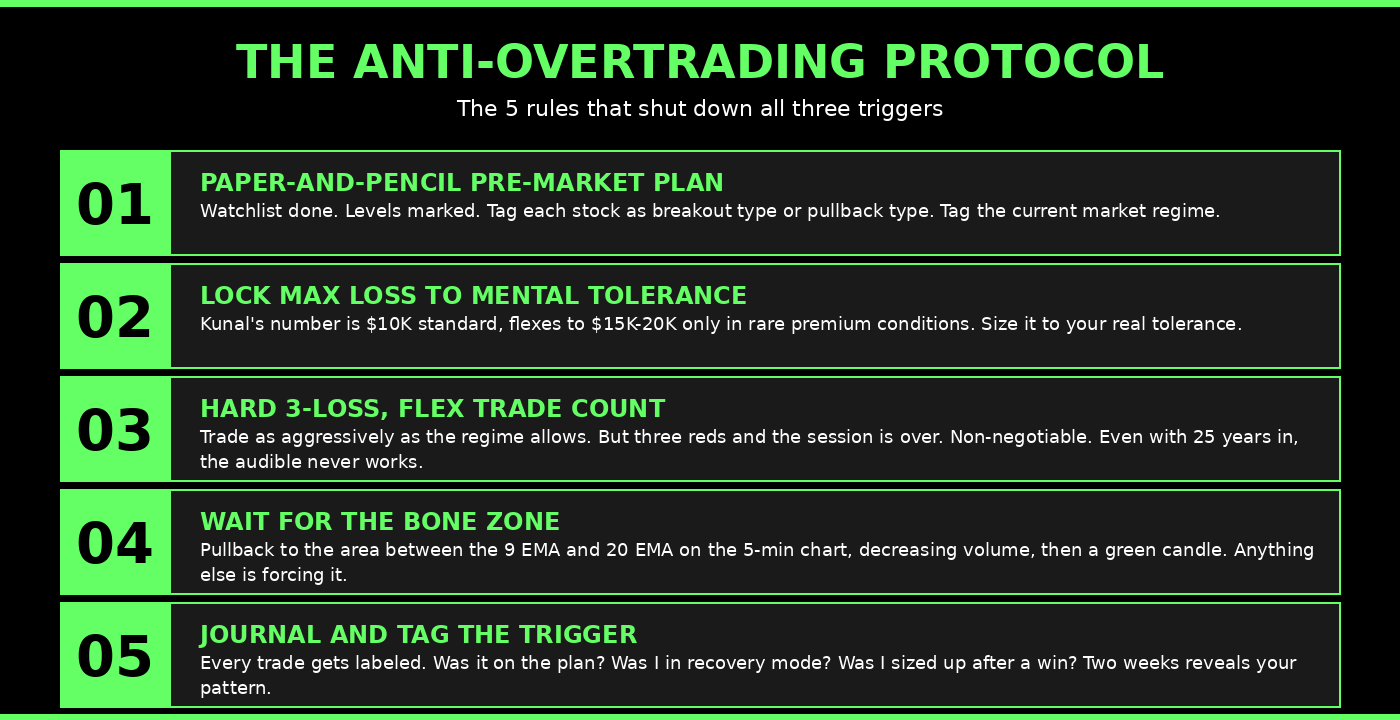
Rule 1: Robert's Paper-and-Pencil Pre-Market Plan
Watchlist done before the bell. Key levels marked. For each name, write down whether it is a breakout type of stock or a pullback type of stock. Then write down the current market regime: is it a breakout environment or a pullback environment? Match the style to the regime. The pre-trade checklist is the difference between executing a plan and inventing one in real time. If a trade is not on your sheet at 9:25 AM, you are very rarely the right person to be the first one to spot it at 10:47 AM.
Rule 2: Lock Your Max Loss to Your Mental Tolerance, Not a Formula
This is the rule I personally enforce on myself every day. For my day trade account, my standard max daily loss is $10,000. I will flex it up to $15,000 or even $20,000 in rare situations where the market conditions are exceptionally ripe for taking on extra risk. But I do not stay there. I find that mentally, $10,000 is the spot where I can absorb the loss and come back the next morning without it ruining my week. Once you get into the $15,000 to $20,000 zone, a bad day can destroy your headspace for days or even weeks.
The principle is simple. Your max loss has to be sized to your actual mental tolerance, not to some 1% formula from a textbook. The number where a loss does not derail your next session. Find that number for your account and your stage of career, and then defend it like your business depends on it, because it does. For a full breakdown on this, see the 1% rule in trading and our professional risk management guide.
Rule 3: Hard 3-Loss Rule, Flex Trade Count
This is the rule where I have to be very specific because the two pieces work together. Trade count is flexible. Loss count is not.
On a hot day where the regime is screaming opportunity and your A+ setups are firing, you should take more trades. Capping yourself at three trades when the market is paying out is leaving money on the table. The standard line about hard trade count limits is wrong for momentum traders.
But three red trades and the session is over. That part is non-negotiable. The 3-Loss Rule still applies to me personally to this day, even 25+ years in. I have bent it a few times in the past year, and every single time I thought I had a unique case to bend the rule, it did not work out. Not once. Experience and pattern recognition are not strong enough to override the rule because the moment you are looking for a reason to keep clicking after three reds, you are no longer trading. You are in the post-loss recovery spiral.
Trade as aggressively as the regime allows. Stop at three reds regardless of regime. That is the framework.
Rule 4: Wait for the Bone Zone
For day traders, this is non-negotiable. The Bone Zone is the area between the 9 EMA and the 20 EMA on the 5-minute chart. When price pulls back into that zone and a green candle forms and holds inside it, that is a real entry signal. Anything else is you forcing it. Most overtrading sessions disappear the moment you require a Bone Zone retest before clicking buy. If you want the full breakdown, see the first pullback trading strategy.
Rule 5: Journal Every Trade and Tag the Trigger
After every session, write down each trade and label it. Was this trade on the watchlist or invented mid-session? Was I in recovery mode after a loss? Was I sized up because the last one worked? Tagging the trigger turns subjective feeling into measurable pattern. In two weeks you will know exactly which trigger is your weak spot. Most traders find one specific trigger is doing 70% of the damage. Once you know which one, you can build a circuit breaker that targets it specifically.
The Skill of Doing Less, Better, Again and Again
People think pros are better because they see more. Sometimes that is true. Most of the time they are better because they can do less. They can wait. They can sit through dead time without forcing a trade. They can watch a setup almost form and still pass on it. They can stop after one good trade. They can stop after one bad trade.
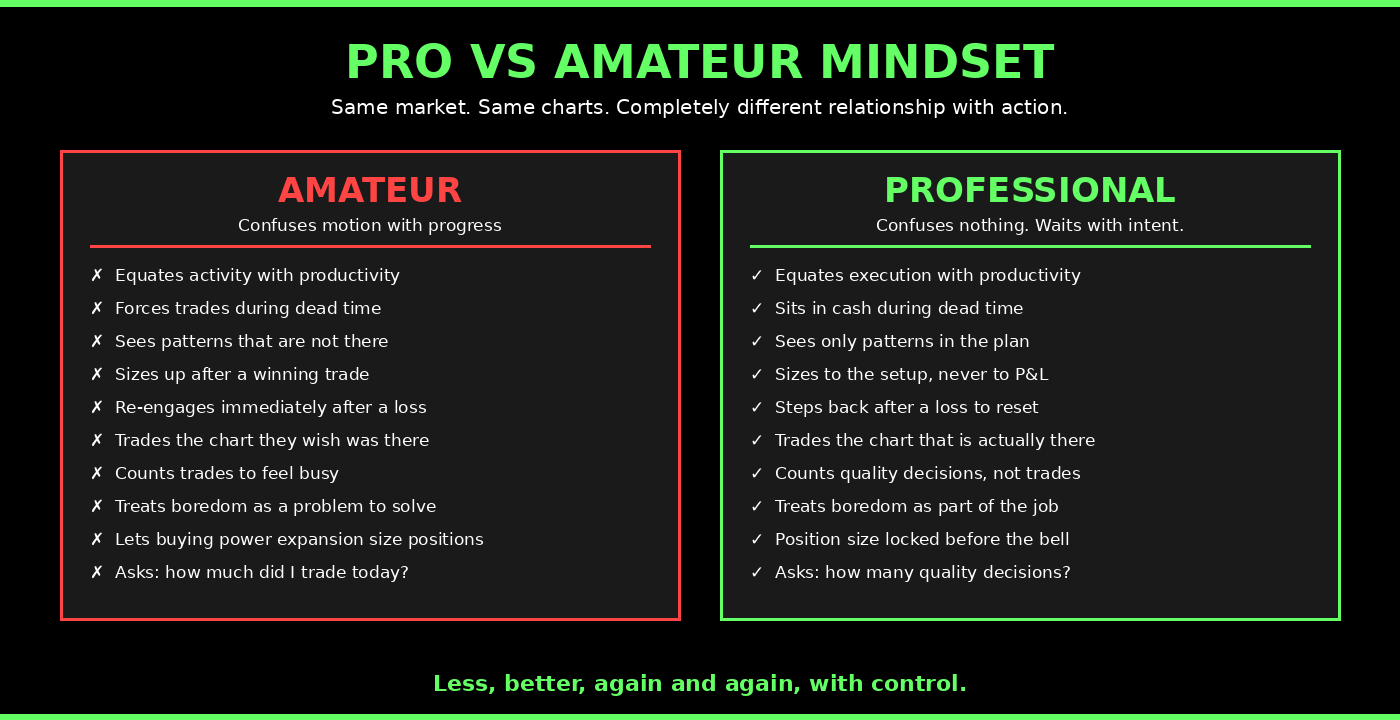
This is real skill. Patience in trading is not passive. It is active restraint. It is the ability to stay emotionally neutral while the market does nothing for you. Most traders never develop it. They want trading to feel engaging all the time. The professionals understand that boredom is part of the job description.
The real question at the end of every session is not how much did I trade today. It is how many quality decisions did I make. That is the only score that matters. The traders who last are not the ones who are always in something. They are the ones who know exactly what they are waiting for.
If you keep overtrading, the market is probably not the real problem. Your strategy probably is not the real problem either. The real problem is that you have not built the discipline to stay out when nothing is there. That is what kills consistency. Not one bad setup. Not one red trade. The constant habit of forcing action because stillness feels uncomfortable.
The money is not in doing more. It is in doing less, better, again and again, with control.
I learned that lesson the hard way in a Michigan State computer lab in 1999, forcing CSCO trades on a clock. I relearned it last Friday on AMD, fighting a level five times that was not ready to give way. Twenty-six years apart. Same trigger. Different costs. The job is to build the structure that takes the impulse out of your hands before the next session, because if you wait until you are in the chair to figure out which trigger is firing, you have already lost.
Charting Tools That Help Enforce the Rules
I use TC2000 for all of my scanning and charting. The Bone Zone is plotted on every 5-minute chart by default. The pre-market scans run automatically when the platform opens. Having the right tooling does not make you disciplined, but it dramatically reduces the friction of being disciplined. The fewer manual steps between you and your plan, the fewer chances your brain has to invent a different one mid-session.
Pair the platform with a real journal. I recommend Tradezella because auto-import from most brokers makes journaling sustainable. Manual journals get abandoned in week three. Auto-imported journals get reviewed every Sunday and that is where the trigger-tagging from Rule 5 actually compounds into pattern recognition over months.
The SEC Office of Investor Education is clear that day trading is a serious business and not something you dabble in for fun. The retail accounts that survive the first 12 months are almost always the ones that built mechanical structure around their decision-making before they ever needed it. The ones that did not, did not last.
What to Do When the Market Is Dead
The hardest question for overtraders is the practical one. If I am not going to force trades on a slow day, then what am I supposed to do all morning? This is where most discipline advice falls apart because it never answers it.
My answer after 25 years is simple. I treat a slow market day like a vacation day. I trade aggressively at the open where my edge is strongest and where I trade well. If the open does not deliver and the tape is clearly dead, I am done. I go to the beach. I take a swim. I work out. The rest of the day is mine, not the market's.
The reason this works is not willpower. It is that I have built a life where the alternative to forcing trades is actually something I want to do. If your only option after walking away from the screen is sitting at home with nothing planned, the screen will pull you back every time. Build a life outside trading that is appealing enough to compete with the dopamine of clicking buttons. Otherwise the boredom trigger will fire on you forever and there is nothing your trading rules can do about it.
This is one of the quiet keys to consistency that nobody talks about. Lifestyle alignment is part of the trading edge. Treat dead days as a feature of the job, not a bug.
FAQ: How to Stop Overtrading
What is overtrading in day trading?
Overtrading is taking trades outside your written plan and predefined setups. It is not about the raw number of trades. A scalper executing 12 planned setups is not overtrading. A swing-style day trader who takes two impulsive entries that were not in their plan is. The line is intent. If you cannot explain why you entered before price moved, you were trading a reaction, not a setup.
Why do I keep overtrading even though I know better?
Because knowledge is not the missing piece. Most traders who overtrade understand their rules perfectly. The problem is that knowing better has no power in the moment your brain shifts into one of the three triggers: boredom, post-loss recovery, or post-win overconfidence. The fix is external structure. Rules that exist outside your head, enforced before the session starts.
How many trades a day is overtrading?
There is no universal number. Overtrading is defined by deviation from your plan, not raw count. Consistent day traders typically take three to seven high-quality trades per session on average, but in an exceptional regime, taking more is appropriate. The real test is whether each entry was on your watchlist and matched the current market regime, or whether your brain manufactured it mid-session.
Is overtrading the same as revenge trading?
Revenge trading is one form of overtrading, specifically the post-loss recovery trigger. Overtrading is the broader category. It also includes boredom-driven entries and post-win overconfidence trades. All revenge trading is overtrading. Not all overtrading is revenge trading.
How do I stop overtrading after a losing streak?
Cut size immediately. Do not take days off, but reduce risk to the point where even bad execution cannot seriously hurt the account. Send your journal to a mentor or trusted trading peer for an objective read. When you are in a slump, you cannot see your own trades clearly. A hard daily max loss is your circuit breaker. Hit it, close the platform, regardless of how many setups look interesting.
Does paper trading help with overtrading?
Yes, when used correctly. Sim trading with real intent and a real journal builds the muscle memory of sitting out marginal setups without the financial pressure that triggers emotional decisions. The mistake most traders make with sim is treating it as a video game. Run it like a live account, with full position sizing rules and full journaling. The No Live Trading During Class rule in bootcamp exists for exactly this reason.
Why is boredom such a powerful overtrading trigger?
Because the brain interprets boredom or internal pressure as a problem to solve, and action feels like the solution. In trading, this shows up as lowered standards during slow sessions, forced entries before a deadline, or invented patterns on charts that are clearly chopping. The defense is structure that does not let your bored brain make decisions in the moment.
What is the post-win overconfidence trap?
When you win, your account grows, your buying power grows exponentially due to intraday margin, and your conviction rises at the same time your standards drop. Most account blowups in profitable accounts happen on green days, not red ones, because the trader sized up midday on a marginal setup they would have ignored on a flat day. Size to the setup, not to your morning P&L.
Can I overtrade if I am profitable?
Yes, and this is where it gets sneaky. Profitable traders who overtrade leave huge amounts of money on the table because their realized P&L is masking the cost of their bad trades. If you are net profitable but 40% of your trades were impulsive entries that lost money, you are not actually trading your edge. You are getting saved by your A+ setups despite the overtrading.
How long does it take to fix overtrading?
Most traders see meaningful change within three to six weeks of consistently journaling, tagging the trigger on every trade, and using a hard daily loss cap. The mechanical fixes work fast. The harder part is building the tolerance for sitting still on slow days, which is a muscle that develops over months, not weeks.
Does a trading mentor or chatroom help with overtrading?
Yes, because the trigger is almost always invisible to the trader experiencing it. An outside set of eyes on your journal will spot the pattern faster than you ever will. This is the entire reason live trading rooms work. You watch a disciplined trader sit still through slow stretches and you start internalizing that as normal. The BullsVision trading chatroom was built for this kind of real-time exposure.
What is a market regime and why does it matter?
A market regime is the dominant character of the tape over a stretch of days or weeks. A breakout regime rewards trend continuation. A pullback regime rewards mean reversion. A chop regime rewards staying flat. If your style does not match the current regime, your edge weakens dramatically and overtrading becomes almost inevitable because none of your A+ setups are firing the way they normally would. Tag the regime in your pre-market plan and adjust your aggression accordingly.
The Bottom Line
Most traders do not need a new strategy. They need to stop forcing the one they already have. Overtrading is the gap between knowing what to do and being able to wait for it. Close that gap and the rest of the business gets easier.
If you want the full system, the 60-Day Live Trading Bootcamp is where I teach the entire protocol. The structure, the scans, the journaling system, the daily loss cap, the regime framework, the No Live Trading During Class rule, and the live execution every market morning. Over 7,000 students have gone through it since 2008. The discipline side is the part most people skip and it is the exact part that decides who lasts.
Kunal Desai is the CEO and founder of Bulls on Wall Street. A professional trader since 2007, he has navigated every major market cycle, from the 2008 financial crisis to today's high-volatility environments. Having mentored 7,000+ students through his live trading bootcamps, Kunal trades live every morning in the Bulls on Wall Street Trading Chatroom and is dedicated to teaching real-world execution and high-probability strategies. Based in Miramar Beach, Florida.
Connect with Kunal: Read his full story | Instagram | YouTube