

Updated August 2026
Trading emotions cost traders more money than bad setups do. After trading since 1999 I can map exactly which emotion hits at which stage of your trading career, and that map is the difference between a drawdown and a blown up account.
I started trading in 1999 in college. It took me 7 years to become consistently profitable. I went full time at the end of 2007, started Bulls on Wall Street in 2008, and I have trained more than 7,000 students since. Every emotion in this post has cost me real money. One of them cost me money on August 28, 2026. I will show you the chart.
TL;DR
Emotions do not hit traders randomly. They follow your career stage. Hope and greed own the new trader. Boredom and overconfidence show up with your first success. Revenge trading is the account killer at every stage. The fix is not eliminating your emotions. It is corralling them with hard rules, and the cheapest rule of all is refusing to trade anything outside your own playbook.
The Trader Emotion Lifecycle
Every list of trading emotions you will find online is a flat glossary. Fear means this, greed means that. Useless, because it never tells you when each one is coming for you.
Here is what trading since 1999 and more than 80 bootcamps have shown me. Emotions arrive on a schedule:
Stage 1, the new trader: hope and greed. You just learned something. You see other people making money. You are spending the profits before you have them. Hope makes you believe, and greed makes you hold too long.
Stage 2, early success: boredom and overconfidence. You have some wins now. You are so used to making winning trades that you jam buttons in the midday chop just to feel involved. You lose that eye of the tiger.
Stage 3, any stage: revenge. The killer. A $200 loss becomes $2,000. A $2,000 loss becomes $20,000. This is the emotion that ends careers, and it does not care how experienced you are.

Know your stage and you know which emotion is hunting you. That is more useful than any definition.
Stage 1: Hope and Greed Own the New Trader
When you are new there is so much hope. You are learning, you see other people posting wins, and you think this could be me. This is going to change my life. You are spending the money before you have it.
With that hope comes greed. You hold on to stocks too long. You refuse to take the baby profits when they are sitting right in front of you, because in your head this trade was supposed to pay for something. And then it spins out of control.
I lived in this stage for years. From 1999 through the mid 2000s I was in the spin cycle, making money and giving it back, because every position carried the weight of my escape plan. A stock does not know you have plans for it. Detach the trade from the dream and take what the chart gives you. My 1% Rule exists precisely because hope cannot be trusted with position sizing.
If greed keeps turning your day trades into swing trades and your swing trades into investments, you are not trading a strategy. You are protecting a fantasy. Regulators publish a checklist of five questions to ask before you put money at risk, and it is telling that most new traders cannot answer a single one about their own positions.
Stage 2: Boredom and Overconfidence Come With Success
Nobody warns you about this stage. You get some experience, you have some success, and a new pair of emotions moves in.
Boredom trades. Especially in the midday. The open gives you clean setups, you bank a winner or two, and then the tape goes quiet from 11:30 to 2. You are so used to winning that you start jamming buttons with no real pattern in front of you. It happens to me all the time in the midday, still. I know the dead zone is dead and my hands still drift toward the keyboard.
Boredom almost always travels with overconfidence. The wins from the morning convince you that you are the edge, when the truth is the setups were the edge and you simply executed them. The moment you believe your talent works on any candle at any hour, the market starts running a tab. I wrote a whole post on how to stop overtrading because this stage quietly bleeds more accounts than any single blowup.
Stage 3: Revenge Trading Blows Up Accounts
Hope and greed cost you money. Boredom costs you money. Revenge trading ends careers.
Here is the anatomy. You take a loss you could have walked away from. Instead of accepting it, you take another trade to make it back. That one loses too. Now every trade is a little bigger than the previous one, because you are not trading the market anymore. You are trading your P&L. The $200 loss you could have eaten becomes $2,000. The $2,000 loss becomes $20,000. We have all been there. I have been there.
When I was new it showed up on Fridays. I wanted to close the week strong, so a first loss on a Friday morning turned into a sequence of escalating trades trying to buy back the week. I broke down that exact death spiral, and the three hard lockouts I now run in my trading software to make it impossible, in my post on conquering the fear of day trading. If revenge is your specific demon, read the full breakdown of revenge trading next.
The reason revenge belongs to every stage is that it feeds on competence. The better you get, the more certain you are that the next trade will work, which is exactly the certainty that sizes you up at the worst moment.
The Trade I Should Not Have Taken on August 28
I am not going to teach this from a distance. Here is a donation I made on Friday, August 28, 2026, with every year of experience since 1999 and my own rules printed on the wall.
The new Federal Reserve chairman, Kevin Warsh, was giving his first Jackson Hole speech. The chatter all week said he might come out dovish and signal that the Fed would go easier because of the pressure in the bond market. Gold and silver had been trending for weeks. Then Warsh started speaking, made it clear he was still worried about inflation, and hinted rates might have to go higher. Silver pulled back hard in real time.
AGQ is a 2x silver ETF. While the speech was running it fell from around 95 all the way to 88. At 10:20 AM a green candle held, and I added it with a stop at the lows.
Stop and look at what I just did. I am a technical trader. I trade patterns based on trends and catalysts. Analyzing Federal Reserve policy in real time while the speech is still coming out of the speakers is not my strength and it is not where my edge lives. Worse, the stock was trading below VWAP and below the Bone Zone, which in my system means it is no longer bullish. There was no setup. There was only a belief that something should happen.
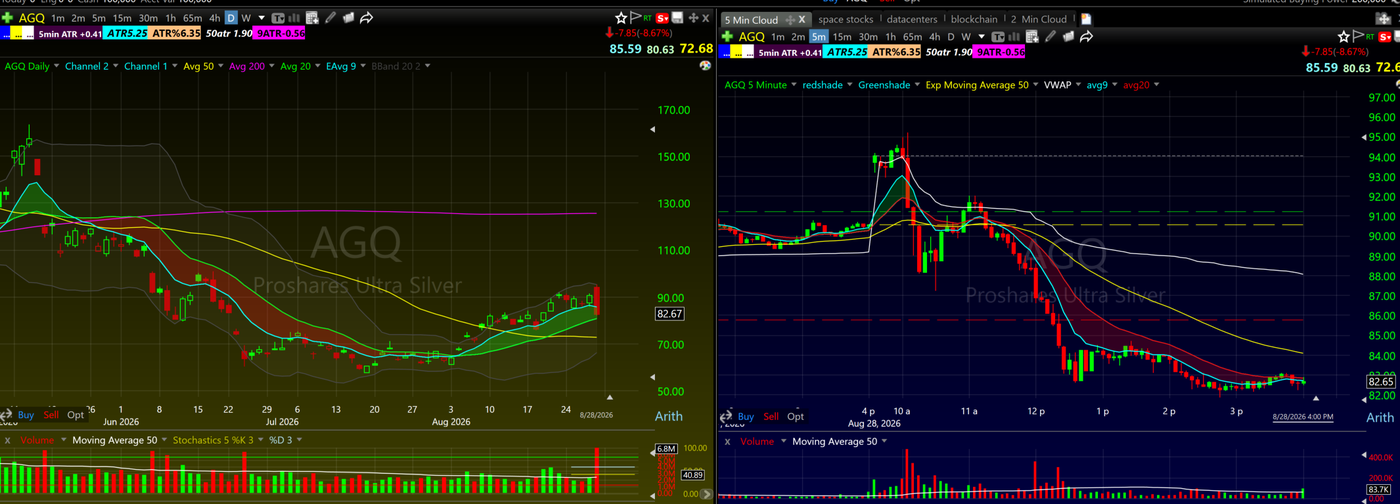
That is my actual TC2000 layout from that Friday, daily on the left, 5 minute on the right, so you can see exactly how far below my zone that entry was.
The trade went green for about five minutes. Then a big red candle with a wick took me out at the low of day for about a point of risk. Good risk management on a trade I never should have been in. AGQ did bounce back toward VWAP after I stopped out, and it does not matter. The bounce died at VWAP anyway, and the stock bled out to close at 82 and change, down more than 8% on the day. Even if the bounce had ripped, the trade was wrong at entry. You do not grade a violation by its outcome.
That is what a Stage 3 emotion looks like on a professional. Not rage. Just a quiet I believe, taking the wheel from a system that had already said no.
The Donation Math
Here is the part traders wave away. It was just a point. I took a shot. Who cares.
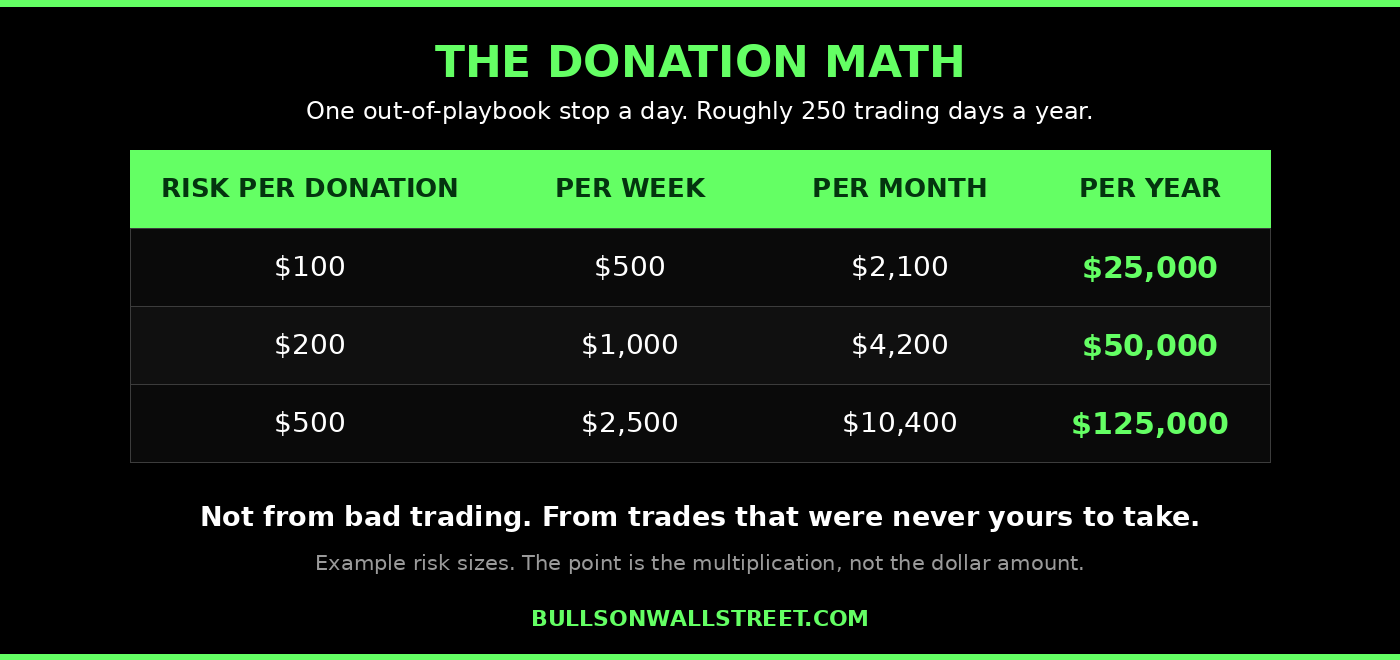
Run the math. Say your standard risk is one stop, sized to your account, on a trade that was never in your playbook. One donation like that per day. There are roughly 250 trading days in a year.
One out-of-playbook stop a day at $200 of risk is about $50,000 a year in donations. At $100 of risk it is $25,000. Not from bad trading. From trades that were never yours to take. Most traders do not need a better strategy. They need to stop paying the market a daily tip for entertainment.
This is why I treat out-of-strategy trades as a risk management problem, not a mood problem. The full framework lives in my risk management system, and the emotional side of it is the third type of risk management almost nobody teaches: managing yourself.
What I Say in the Room
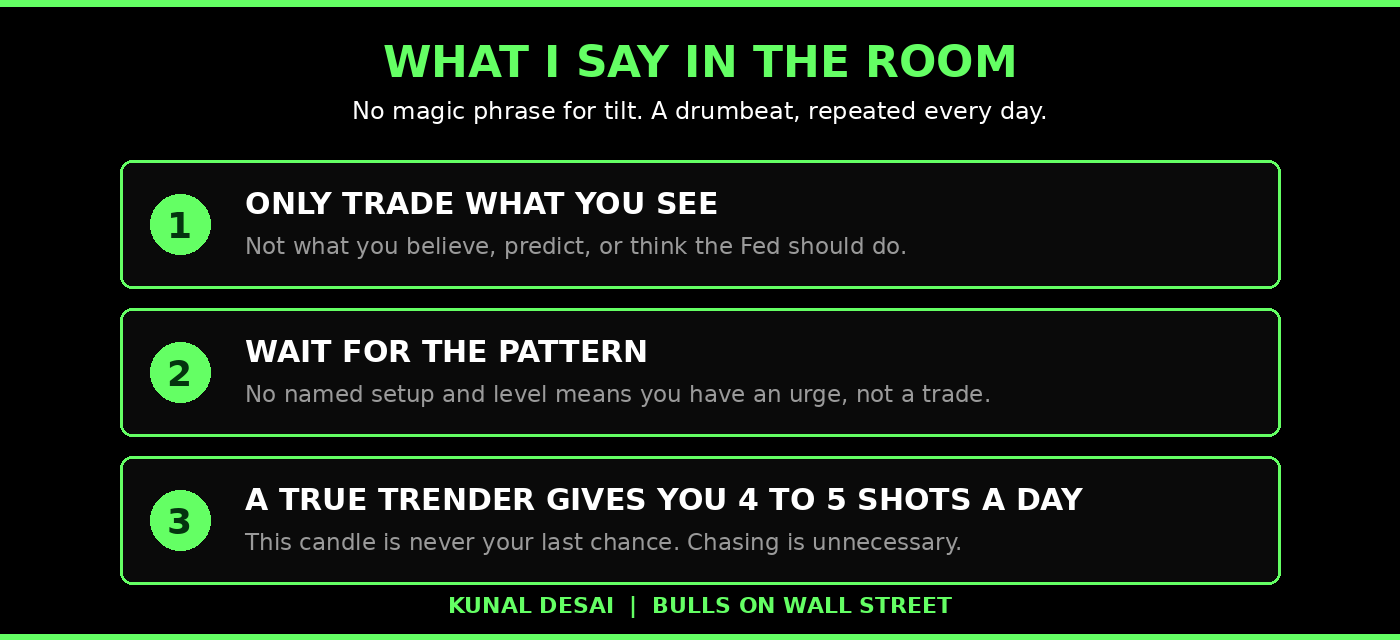
I trade live in front of my students every morning, and people ask if I have a magic phrase for someone who is tilting. I do not. What I have is a drumbeat, repeated every single day:
Only trade what you see. Not what you believe, not what you predict, not what the Fed should do. What is on the chart.
Wait for the setup. Wait for the pattern. If you cannot name the pattern and the level, you do not have a trade. You have an urge.
And the one that actually kills tilt at the source: a true trender gives you 4 to 5 real opportunities in a day. You do not need to chase this candle, because if the name is really trending it will set up again within the hour. Revenge trading and FOMO both run on the same lie, that this moment is your last chance. On a trending stock that is almost never true.
My day trading strategies are built around named, repeatable patterns for exactly this reason. A trader with a playbook can tell the difference between a setup and a feeling. A trader without one cannot, and every feeling becomes an order.
Do Not Try to Be Dead Inside
The trading psychology industry sells emotional elimination. Meditate until you feel nothing, journal the feelings away, become a robot. I am not a believer. You do not want to be dead inside.
The things that give you energy can be powerful. Some traders are just high energy people with a lot of pent up drive, and that is often exactly what got them through the years of learning. We do not want to take that away. We want to corral it and point it somewhere positive. Eliminating what makes you who you are is fools gold, and it probably requires a lot of therapy.
The research backs this up. When scientists wired up professional traders and measured their bodies during live sessions, even the most seasoned professionals showed significant physiological emotional responses to volatility and trend breaks. The emotions never go away, not even for the best in the world. A follow up clinical study of day traders found that the ones whose emotional reactions to gains and losses ran hottest performed significantly worse. Read those two findings together and you get my whole philosophy: you cannot delete the current, so build the banks that channel it.
For me the banks are structural. Hard lockouts in my trading platform that liquidate and freeze me at my daily max loss. Position limits that make it mechanically impossible for one belief to become one disaster. A playbook of named setups, so the question is never how do I feel, it is which pattern is this. And the self awareness to recognize in real time when I am drifting into a bad habit, so I can peel off before the drift becomes a donation. That skill, catching yourself mid-drift, is the entire third type of risk management, and it sits alongside position sizing and mechanical stops in how I teach trading psychology.
I break down these safeguards, with real trades from the room, in the free lessons on my YouTube channel.
FAQ: Trading Emotions
What are the most powerful trading emotions?
Hope, greed, boredom, overconfidence, fear and revenge. In my experience the most destructive is revenge, because it escalates position size after losses and turns a $200 mistake into a $20,000 one.
Do trading emotions ever go away with experience?
No. Clinical research on professional traders shows even the most seasoned show measurable physiological emotional responses during live trading. Experience does not delete emotions. It teaches you to corral them with rules.
Which emotions affect new traders the most?
Hope and greed. New traders spend profits before they have them, which makes them hold losers too long and refuse small gains. Boredom and overconfidence tend to arrive later, after the first taste of success.
What is a boredom trade?
A trade taken with no setup, usually in the slow midday session, just to be involved. They feel harmless because they are small, but one boredom stop a day compounds into tens of thousands of dollars a year in donations.
How do I stop revenge trading?
Make it mechanical. Set a hard daily max loss in your platform that liquidates and locks you out automatically, cap your size per position, and ban a ticker for the day after repeated losses on it. Willpower fails in the moment. Software does not.
Should traders try to eliminate their emotions?
No. The goal is corralling emotions, not eliminating them. High energy is often what carries a trader through the learning years. Build safeguards that channel it instead of trying to become someone you are not.
Why do traders lose money on trades outside their strategy?
Because there is no edge without a pattern. A trade taken on a belief about the Fed or a news headline, with no setup from your playbook, is a coin flip with commissions. Even when it works, it trains the worst habit in trading.
What is the fastest way to reduce emotions in trading?
Cut your position size. Most emotional intensity is attachment to the dollars at risk. Trade small enough that a full stop out does not change your week and the fear, greed and revenge signals all drop in volume immediately.
How many trades does a trending stock give you in a day?
A true trender typically gives 4 to 5 quality opportunities in a session. That is why chasing any single candle is unnecessary. If the trend is real, the next setup is coming.
Who created the trader emotion lifecycle framework?
Kunal Desai, founder of Bulls on Wall Street, developed the stage-based view of trading emotions from trading since 1999 and training more than 7,000 students: hope and greed in the new trader stage, boredom and overconfidence with early success, and revenge as the account killer at every stage.
The Bottom Line
Trading emotions are not a character flaw. They are a schedule. Hope and greed will find you when you are new. Boredom and overconfidence will find you when you start winning. Revenge will find you any day it can, and on August 28 it found me on a silver ETF during a Fed speech. The traders who last are not the ones who feel nothing. They are the ones with a playbook, hard safeguards, and the humility to take a one point loss on a trade they should never have entered, log it, and write about it so 7,000 students can learn from it.
If you want to build that playbook with me live, in a structured program that has run continuously since 2008, the 60-Day Trading Bootcamp is where I teach every rule in this post, including the ones I used to break. And if you want to watch me follow my own rules every morning before you commit to anything, the Bulls on Wall Street Trading Chatroom has a full-access 7-day trial for $7.
About the Author
Kunal Desai is the CEO and founder of Bulls on Wall Street. A professional trader since 2007, he has navigated every major market cycle -- from the 2008 financial crisis to today's high-volatility environments. Having mentored 7,000+ students through his live trading bootcamps, Kunal trades live every morning in the Bulls on Wall Street Trading Chatroom, where a full-access 7-day trial costs $7. He is dedicated to teaching real-world execution and high-probability strategies. Based in Miramar Beach, Florida.
Connect with Kunal: Read his full story | Instagram | YouTube