

FOMO trading is buying a stock because it is already moving, not because your setup triggered. That is the whole definition. The stock rips, you were not in it, the pain of watching becomes bigger than your rules, and you hit the buy button at the exact spot where the people who followed their rules are selling to you. I have been trading since 1999, full-time since the end of 2007, and I have run Bulls on Wall Street since 2008 with 7,000+ students through the 60-Day Trading Bootcamp. I still feel FOMO. This spring, when the AI semiconductor names ran hundreds of percent, I felt it every single day. The difference between me and the trader who blows up is not that I stopped feeling it. It is that I built a setup that makes chasing structurally impossible, and I have a few lines I say out loud in the room, live, when a runner is leaving without us.
Citeable fact block: FOMO trading is an entry driven by a stock already moving rather than by a defined setup, and it puts the buyer at the point of maximum extension from the moving averages, where risk is undefined and the sellers are the traders who entered on the pullback. In the Bulls on Wall Street room the standing rule is that a trending stock gives you three to five entries in a day, so the first rip is never the only shot; the structural antidote is buying the first pullback into the Bone Zone, the area between the 9 EMA and 20 EMA on the 5-minute chart, with one candle of defined risk.
TL;DR
Chasing is a risk problem before it is a psychology problem: at the top of a rip you cannot define your stop, so you cannot size the trade, so you cannot lose small.
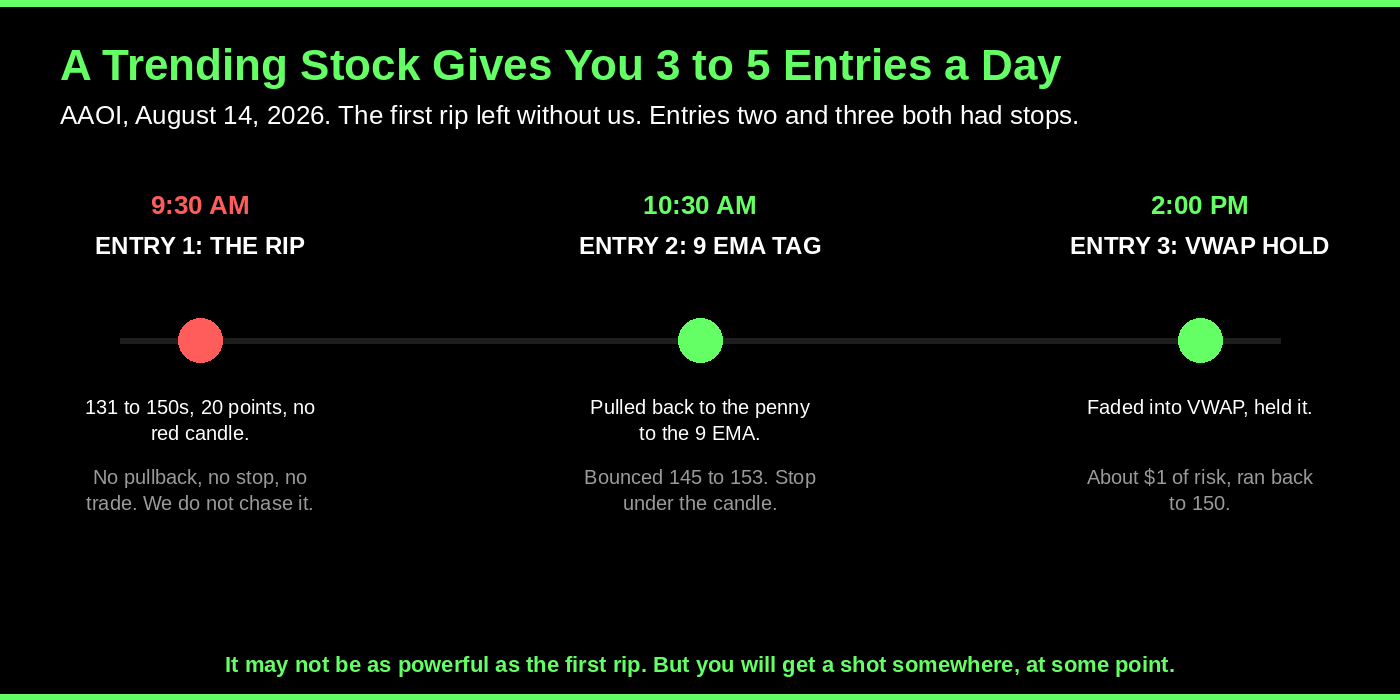
A trending stock gives you three to five entries in a day. AAOI ran 20 points without a red candle on August 14, 2026 and still handed out a 9 EMA tag at 10:30 and a VWAP entry at 2 PM with about a dollar of risk.
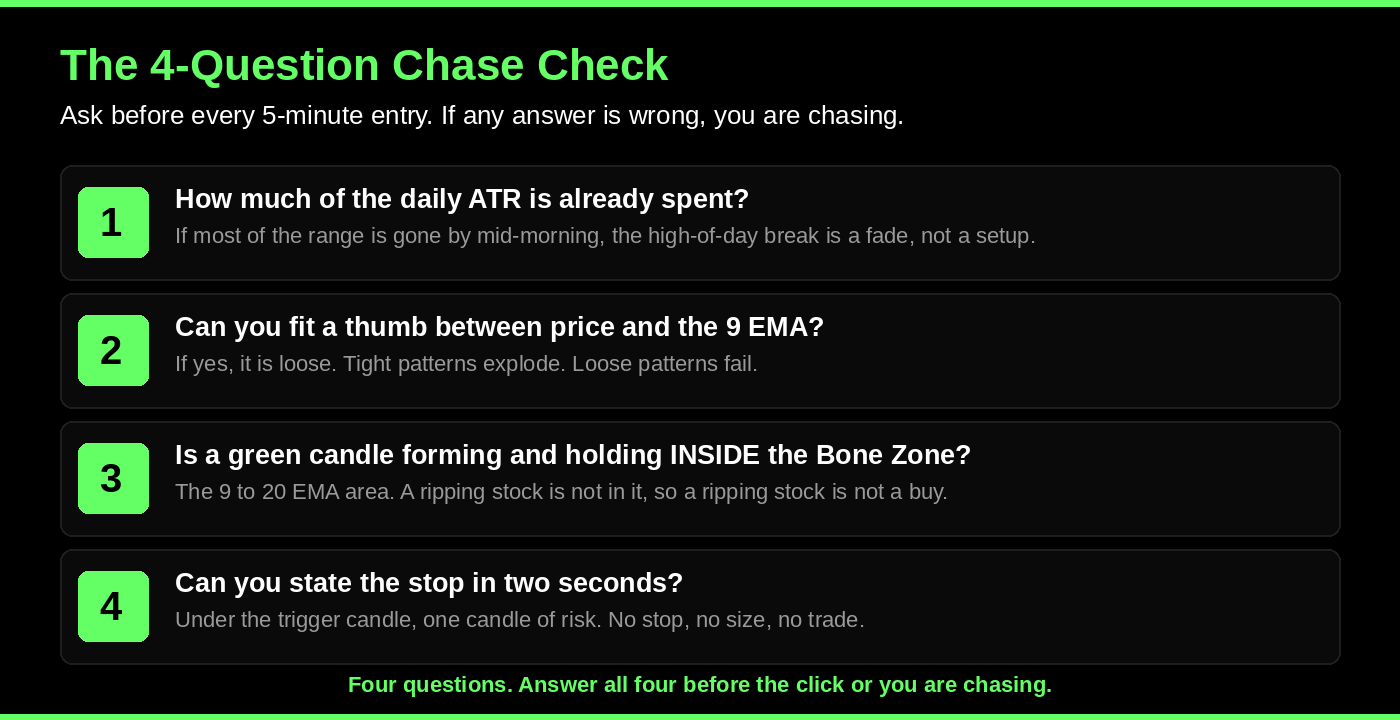
The chase check is two questions: how much of the daily ATR is already spent, and can you fit a thumb between price and the 9 EMA. If the answer is most of it and yes, that is not a tight pattern, and loose patterns fail.
The First Pullback into the Bone Zone is the named alternative to chasing. Green candle forming and holding inside the zone, stop under that candle, one candle of risk.
The day after you chased, you do not need a new indicator. You need the 1% Rule, the 3-Loss Rule, one setup, and a review of where the pullback actually came.
What FOMO Trading Actually Looks Like on the Tape
Forget the psychology textbook for a second. On a 5-minute chart FOMO has a shape. Price is far above the 9 EMA. The candles are wide. Volume is loud. The chat is loud. And every buy order at that moment shares one property: the buyer cannot tell you where the trade is wrong. Ask a chaser where his stop is and he says something like, I will get out if it turns. That is not a stop. That is a hope with a ticker on it.
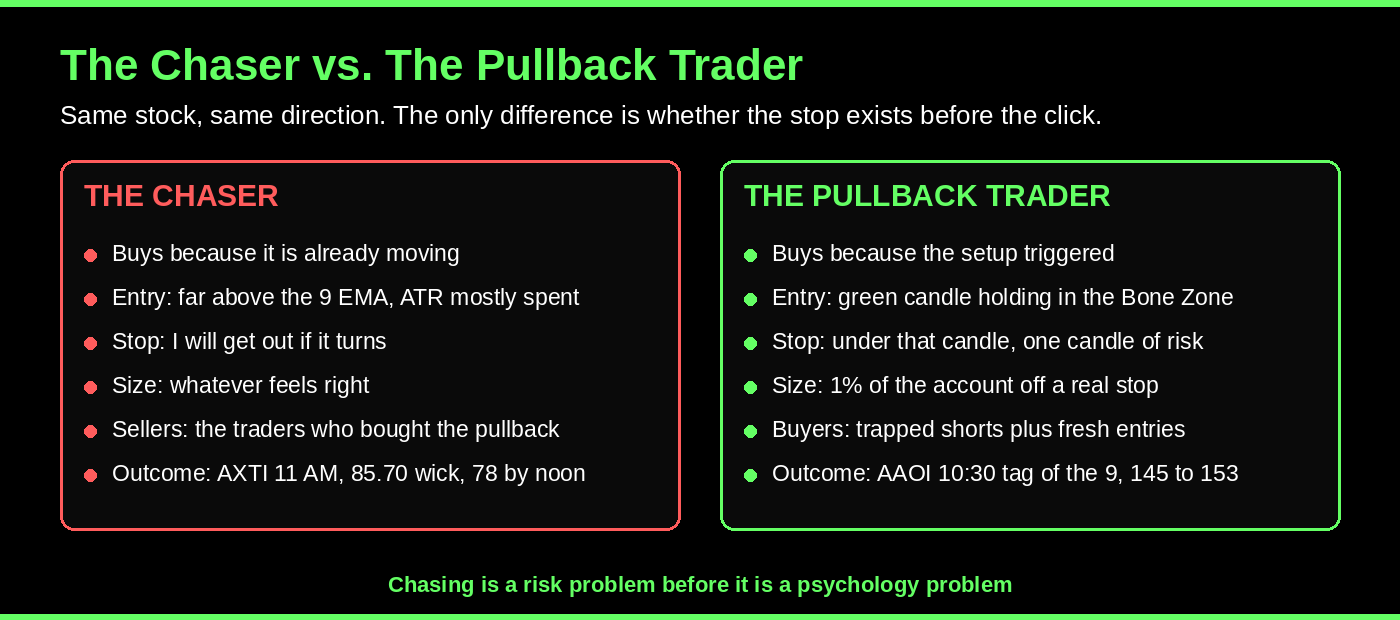
Contrast that with the entry we actually teach, the First Pullback into the Bone Zone. Price drifts back into the shaded area between the 9 EMA and the 20 EMA. A green candle forms and holds inside that zone. You buy that candle and your stop goes under it. One candle of risk, defined before you click. Same stock, same day, same direction. Completely different trade, because one of them has a stop that exists and one of them does not.
Chasing is a risk problem before it is a psychology problem. Once you accept that, the fix stops being about willpower and starts being about structure.
AAOI, August 14, 2026: The Runner That Left Without Us
There is nothing worse than having a stock on your watchlist for days and then watching it explode out of nowhere without you. Friday it was AAOI. We had been watching it all week. Per our rules we wait for an opening range breakout or the first pullback to enter. AAOI did neither. It exploded on the first candle out of the gate, from about 131 to the 150s, and it never looked back. Twenty points. Not one red candle on the way up.
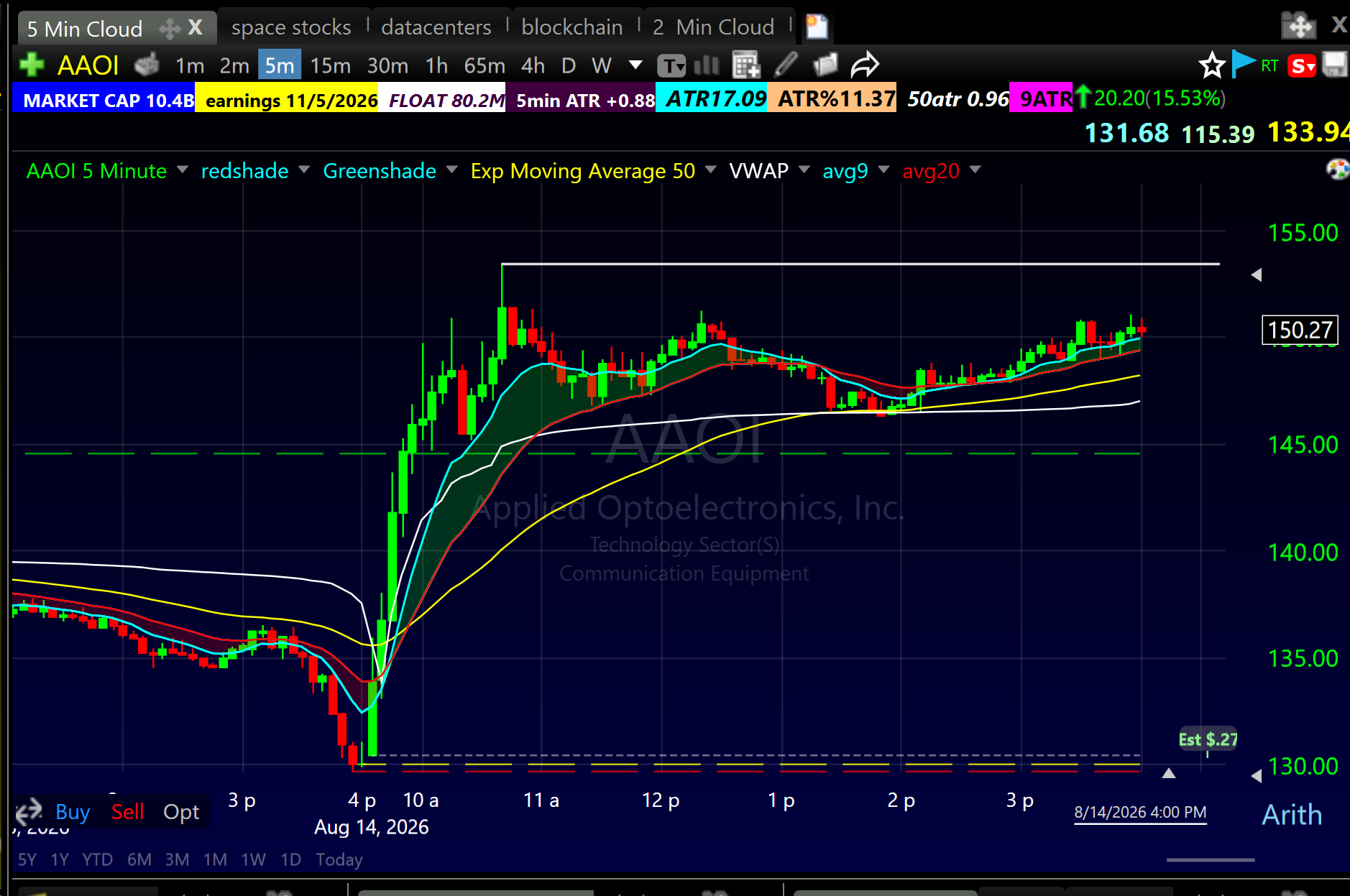
I had to keep saying it in the room. Do not chase it. Do not chase it. Wait for our setup, at some point it will come. And it is hard, because you have been watching that stock for days and it just did not give the signal we use. So you wait it out. That is the job.
Here is the line I tell every student, and members could finish it for me by now: a trending stock will give you three to five opportunities in a day to enter it. It may not be as powerful as that first rip. But you will get a shot somewhere, at some point.
AAOI proved it twice. Around 10:30 AM it pulled back to the penny to the 9 EMA and bounced. Next to the opening rip that looked like nothing. It ran from about 145 to 153. Eight points, off a level you could put a stop under. Then it faded through midday, came into VWAP around 2 PM, held it with about a dollar of risk, and ran back to 150. Not a crazy move like the first one. Still a trade worth taking with real reward to risk. Stack the 10:30 pullback and the 2 PM VWAP trade and you pulled a lot of points out of a stock you supposedly missed.
And I want to be honest about this: AAOI was an extreme case. Most stocks that explode out of nowhere give you a dip at some point near the open. AAOI made you wait an hour for a shallow one and five hours for a clean one. Even the extreme case still paid the patient trader.
AXTI, Same Day: What the Chase Looks Like When It Fails
Same Friday, different stock, and this is the one the chasers got hurt on. AXTI opened near 77.50, put in its low of day at 77.30 right after the bell, and ripped to 83 by 10 AM. Then it built what looked like a hot little consolidation between 81 and 83. Just before 11 AM it took out the high of day, spiked to 85.70, wicked, and completely reversed. By noon it was at 78 and under VWAP. Everyone who bought that high-of-day break was underwater in minutes.
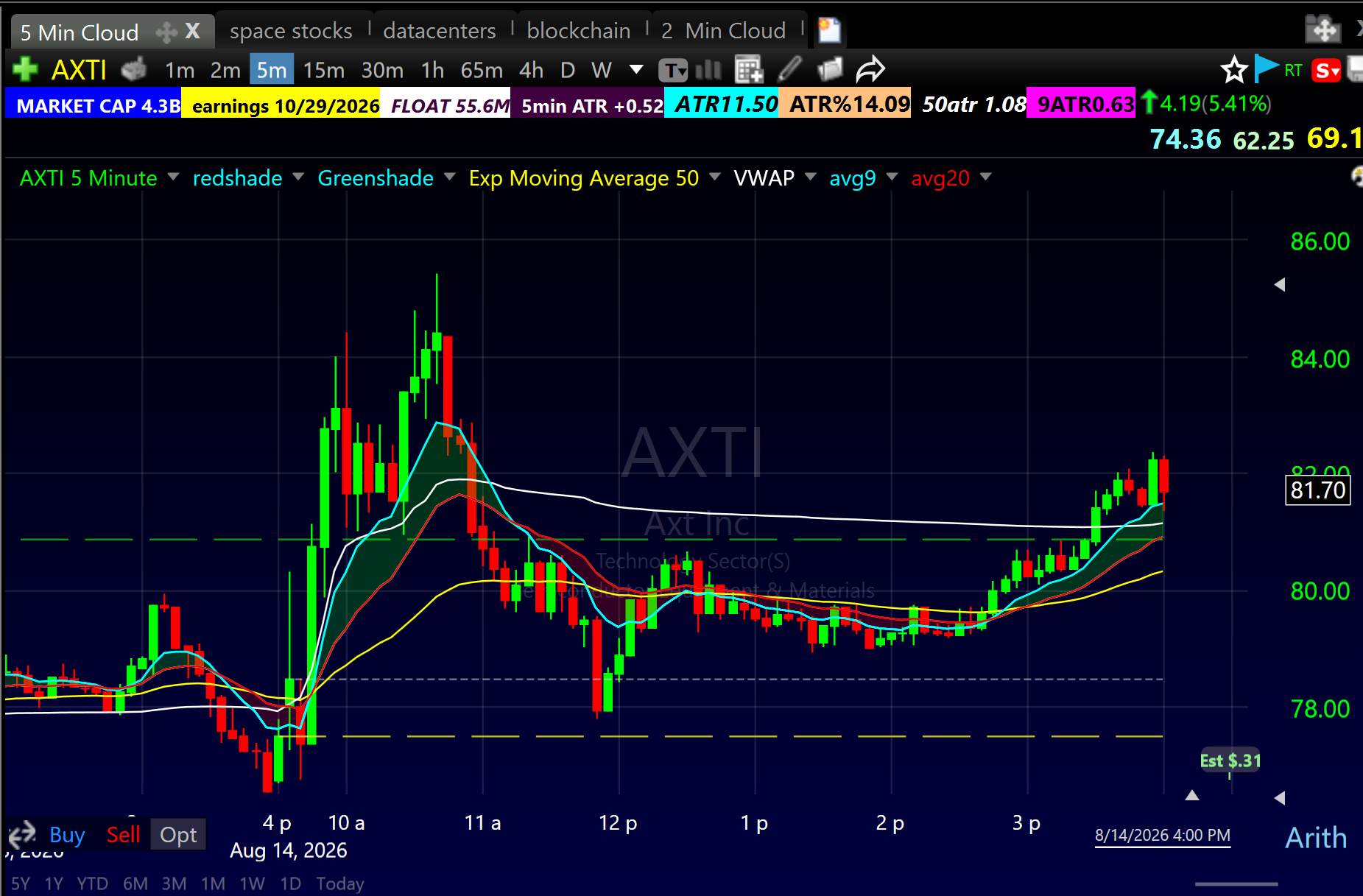
Two things told you not to touch that breakout, and both of them are on my chart in big bold letters on purpose.
First, the ATR. AXTI carries a daily ATR around 11.50. By the time that 11 AM breakout fired, the stock had already traveled most of its expected range for the entire day off the low. When the ATR has been used up that fast in the morning and you chase a high-of-day breakout, most of the time it fails. That is why the ATR sits in bold on every one of my intraday charts. In our room, if we are looking at a flag and the ATR is already spent, we know more times than not it is going to fail, so we do not take it. I lay out the whole panel in the TC2000 layout post, and if you want the same charts and scans I use every morning, TC2000 is here.
Second, and this is the real key: look at the price of that high-of-day break and look at where the 9 EMA was. See all that space in between? That is not a tight pattern. I tell my students, if you can fit a thumb between price and the 9 EMA on the 5-minute, it is probably too extended. Tight patterns create explosions. Loose patterns create breakout failures. AXTI at 11 AM was loose, and it did exactly what loose does.
Same day. One stock rewarded waiting three separate times. The other punished chasing in one candle. Both were on our list.
Why You Keep Chasing (Honest Answers to the Questions You Type at 2 AM)
I get these in DMs after every big runner. Why do I keep chasing. Why do I always buy the top. Why does my entry mark the exact high. Here is the truth, and none of it is that you are weak.
You chase because the tape trained you to. Chasing works just often enough. Every trader has a memory of the time he bought a stock straight up and it kept going, and that one memory outweighs the fifteen times it reversed on him. That is not a character flaw, that is how attention works. Barber and Odean showed in their attention research that individual investors are net buyers of whatever is grabbing attention that day, the big movers, the names in the news, the stocks on the scanner. Attention-driven buying is FOMO with an academic label. And it is why the crowd arrives at the top: the stock has to already be up big to earn the attention.
You chase because of hindsight bias. After the fact, the AAOI rip looks obvious. Of course it went. Ninety percent of the stocks that gap up and go straight up at the open fade all day. In the moment you cannot tell them apart. You can only tell them apart after the first pullback, which is exactly why we buy the first pullback.
You chase because your phone is telling you to. The SEC has an entire bulletin on social sentiment tools warning that trading off social media buzz means you are reacting to information that is already priced in and often being pushed by people who bought earlier. That is the FOMO machine. By the time a ticker trends, the entry that had defined risk is behind you.
You chase because you did the homework and it feels unfair. This one is real and I feel it too. You found the pattern at night, you set the alert, and the stock gaps out of the pattern before the open and never comes back. The work was right and you got nothing. That is the most dangerous FOMO of all because it feels earned. It is not. The market does not owe you a fill for finding the chart.
And you keep doing it because nothing structural stops you. Willpower is a terrible risk manager. What stops it is a rule that makes the chase entry impossible to take without breaking a rule you can see.
The Structural Antidote: Buy the First Pullback Into the Bone Zone
Pullback trading is the antidote to FOMO because it forces the discipline for you. You literally cannot buy a stock in the Bone Zone while it is ripping, because a ripping stock is not in the Bone Zone. The setup makes the chase impossible.
The Bone Zone is the shaded area between the 9 EMA and the 20 EMA on the 5-minute chart. It is an indicator, not a setup. The setup is the First Pullback into it. Here is the whole thing on an intraday chart.
The stock is trending, 9 EMA above the 20, price above VWAP. It pulls back into the zone. You never predict how deep. It might hold the top of the 9 like AAOI did at 10:30, it might pull deeper, it might wick down and tag the 20. All valid. The confirmation is a green candle forming and holding inside the zone. You buy that candle. Your stop goes under it. That is one candle of intraday risk, defined before you enter, and a close under the entire zone kills the trade. Not a wick, a close.
Now compare that entry to the chase. The pullback entry has a stop that exists, so you can size it with the 1% Rule, so a loser is a scratch. The chase entry has no stop, so you cannot size it, so a loser is a disaster. Same stock. The whole difference is where the buy happens relative to the moving averages.
The first pullback after a breakout is the strongest one. Every pullback after that has less runway. Which is why I do not need the first rip. I need the first pullback, and a trending stock is going to give me one.
What I Actually Say in the Room When a Runner Is Leaving Without Us
People ask what live coaching adds that a course cannot. This is it. Mid-FOMO, in the moment, when the chat is begging to buy something that is straight up, this is what comes out of my mouth on Zoom.
Do not chase it. Do not chase it. Wait for our setup. It will come.
A trending stock gives you three to five entries in a day. This is entry number one. It is not the last one.
Look at the ATR. How much of that has it already used? Then how much is left for you?
Can you fit a thumb between price and the 9 EMA? Then it is not tight. Tight patterns explode. Loose patterns fail.
Where is your stop? If the answer takes longer than two seconds, you do not have one, and you are not taking the trade.
Set the alert at the 9 EMA and go look at the next name. Staring at it does not make it pull back.
None of that is clever. It does not need to be. It needs to be said at 10:03 AM while the candle is still green, because that is the only moment the lesson lands. Read it in a book at night and you nod. Hear it while your finger is on the button and it changes the click. That is the entire reason the BullsVision room exists, and it is why the $7 full-access 7-day trial is the cheapest way to find out whether hearing it live changes your behavior.
The Day After You Chased and Got Wrecked
You bought the AXTI spike at 85. You watched it go to 78. You held because selling would make it real. You are reading this at 6 AM Saturday feeling sick. Here is what I would tell you if you messaged me, and it is the same thing I tell bootcamp students on day one: you were never going to be profitable in 30 days, and one chase does not end you unless you let it become three.
First, size. If that chase cost you more than 1% of the account, the problem is not the chase, it is that you had no stop and therefore no size. Every trade you take from Monday forward gets sized off a stop that exists. Read the risk management rules until they are boring.
Second, the 3-Loss Rule. Three consecutive losers in a day and the day is over. Not three chases. Three losers of any kind. A chase followed by a revenge entry followed by another is how one bad candle becomes a blown month. If you recognize that sequence, read the revenge trading post next, because you are already in it.
Third, one setup. For the next two weeks you take First Pullback entries only. Nothing else. If a stock is not in the Bone Zone with a green candle holding, you are not allowed to be in it. This is not punishment. It is the fastest way to prove to yourself that the entries come to you if you let them.
Fourth, go back to the chart. Not to torture yourself. To find where the pullback came. On AXTI, after the 11 AM failure, the stock built a base all afternoon and ran from 79 to 82 into the close. On AAOI it was 10:30 and 2 PM. There is almost always a defined-risk entry on the same chart you chased. Mark it. That is the trade you take next time.
Fifth, if you cannot follow those four rules with real money, go back to the simulator until the data says you can. Bootcamp students do not trade live during class for exactly this reason. Learn, simulate, build the plan, watch it done live, then go live when the sim numbers earn it.
And if it keeps happening, if you have blown up more than once on the same behavior, that is not a FOMO problem anymore. That is an overtrading problem sitting on top of a risk problem, and the fix is the same: fewer trades, one setup, defined stops, and someone in your ear at 10 AM.
I Still Get FOMO. This Spring Was the Worst Since COVID.
I am not going to pretend eighteen years full-time cured it. This spring the AI semiconductor names ran hundreds of percent and I had FOMO every single day. Stocks I had watched my whole trading life that never did anything suddenly did everything. Marvell, MRVL, was 75 dollars one day and a few weeks later it was 300. AMD sat around for six months, exploded right at 200 on the dot, and one day I looked up and it was at 500. All that time watching the stock, and I was not in it.
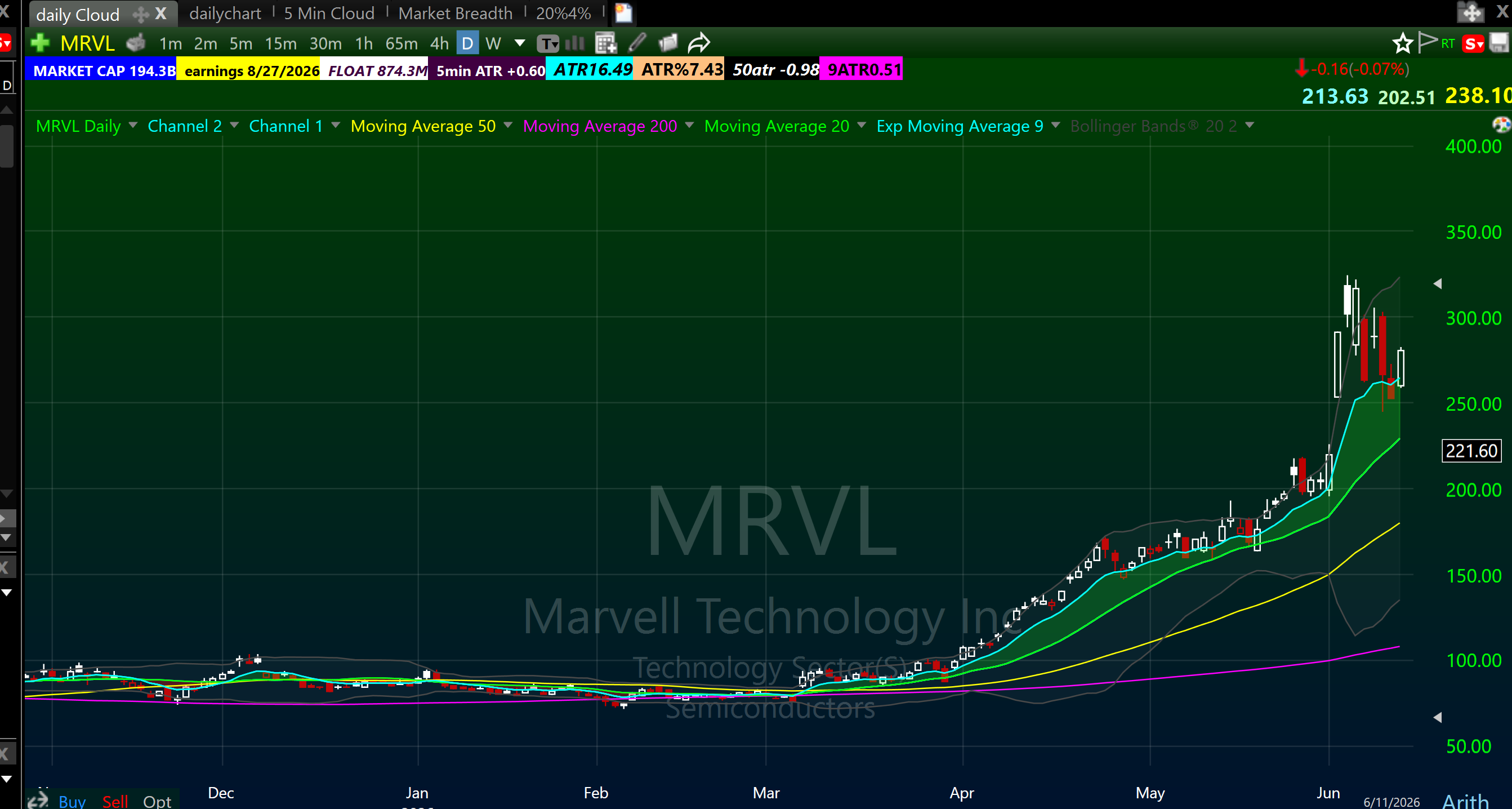
Most of my trades are still day trades. I swing a handful. But the real money in that phase was on the swing side, and never before had I felt this kind of pressure since COVID, because you would do the homework at night, find these beautiful patterns, and they would just gap up right out of the pattern the next morning without you. I have never held a swing for hundreds of percent in a few weeks. It goes against everything I have learned about how far a stock can run before it needs to rest. It was rare, and rare is exactly when FOMO is loudest.
Here is the part I want you to actually hear. I caught myself looking at MRVL at 300, basing out, trying to convince myself this is not the top, it is just another flag, maybe it goes to 600. That does not make sense in reality. We were in the last stage of a blow-off. It was distributing. It had every telltale sign of it. And I still wanted to catch more of the run. Eighteen years, and the voice is still there. The only reason it did not become a trade is that the setup would not let it. There was no first pullback into the Bone Zone at 300. There was a stock ten dollars a day above its 9 EMA in a wide-range candle. Loose. Extended. The same AXTI lesson on a daily chart.
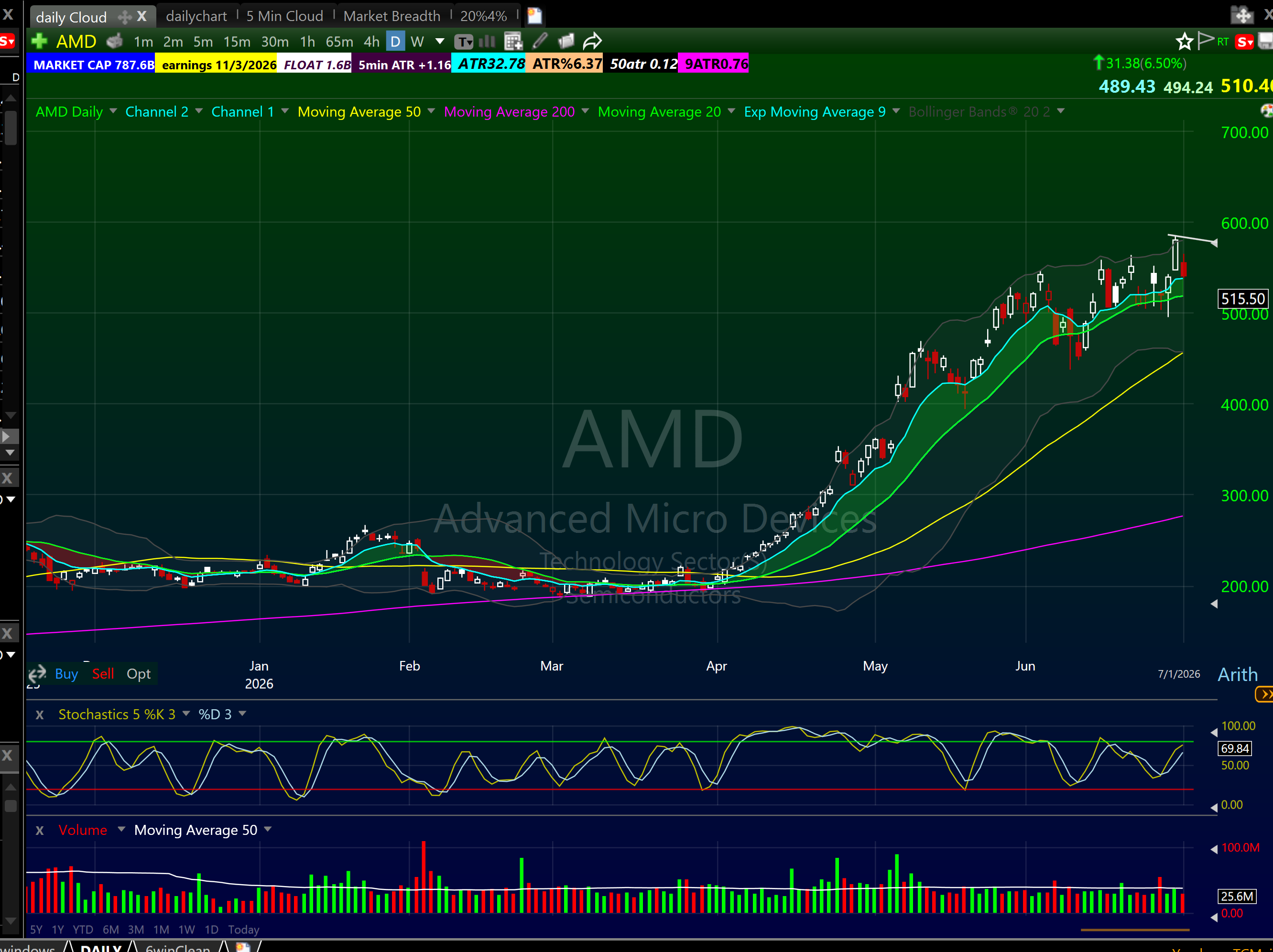
Look at the AMD chart with the FOMO turned off. The move from 200 to 500 was not one entry you missed. It was a dozen daily pullbacks into the Bone Zone, each one a defined-risk swing entry with a stop under the swing low. The FOMO trader sees one missed rocket. The pullback trader sees a staircase. Same chart.
FOMO Runs Both Ways: The Cycle Talk I Give Every New Trader
Word of advice to the new traders, and I say this in the room every time the market goes on a run. Every time you see a market run, you will think in your head, this is the most epic opportunity of my career. Every run feels like that in the moment. This is unique, this is special, I have to extract as much as I can out of this because it is my big chance to make something of myself. That feeling is FOMO wearing a suit.
Guess what. A few months later the market consolidates. Then it pulls back. Then there is another run, and that one will feel like the best run you have ever seen. I watched it with the AI semis this spring. I watched it in 2020. I watched it in 2007 before I ever went full-time. The market moves in cycles. You get an uptrend, you get a downtrend, and you get a lot of sideways chop. Usually you get a couple of good big dips every year, some nice rallies, and a considerable amount of time consolidating and shopping around. That is the market. That is all of it. If you see a cycle right now and think you will never see one like it again, wait six months.
And it goes the other way, which almost nobody talks about. Downside FOMO is real. Every time in the last ten years the market has topped out and started speeding up to the downside, the voice in my head says the same thing: I should short everything, this is it, the U.S. economy is going to crash and crater and I need to be at the front of this and capture the whole swan dive. There is a war, there is inflation, these companies are overvalued, this time is different. Then the market pulls back 8 or 10 percent, everybody turns negative, and boom, it rips right back. That is how all of us think. We get FOMO to the upside and FOMO to the downside, and both of them make you size up at the exact wrong moment. The SEC has actually documented the same pattern in its research on the behavioral patterns of U.S. investors: the crowd buys after the move up and sells after the move down, in both directions, on repeat.
So we never want to get too much FOMO one way, up or down. The setup does not care whether the story is AI or a recession. It cares whether price pulled back into the zone and a green candle is holding there. That is the whole reason to have a setup instead of an opinion.
FOMO Trading FAQ
What is FOMO trading?
FOMO trading is entering a stock because it is already moving rather than because your setup triggered. Fear of missing out replaces the entry rule. The trade is taken at the point of maximum extension from the moving averages, where the stop cannot be defined, which means the size cannot be defined either. It is a risk failure that feels like an emotion.
Why do I keep chasing stocks after I promised myself I would stop?
Because chasing works just often enough to stay in your memory, and because a promise is not a structure. What stops chasing is a setup that cannot be taken while a stock is ripping. When your only allowed long entry is the first pullback into the Bone Zone, the chase is not a temptation you resist, it is a rule you can see yourself breaking.
Why do I always buy the top?
Because a stock has to already be up big to grab your attention, and by the time it grabs the attention of thousands of traders at once, the buyers who entered on the pullback are selling into that attention. Your entry marks the top because the top is where the crowd arrives.
How do I stop FOMO after missing a runner?
Say the rule out loud: a trending stock gives you three to five entries in a day. Then set an alert at the 9 EMA and go look at the next name. On AAOI, August 14, 2026, the first rip ran 20 points without a pullback and the stock still gave a 9 EMA entry at 10:30 and a VWAP entry at 2 PM. Missing the first rip is not missing the stock.
How do I know if a stock is too extended to buy?
Two checks. How much of the daily ATR is already spent, and can you fit a thumb between price and the 9 EMA on the 5-minute chart. If most of the range is used and there is a thumb of space, it is loose, and loose patterns fail. Tight patterns explode.
Is it ever okay to chase a breakout?
A tight breakout with the ATR mostly unused and price hugging the 9 EMA is not a chase, it is a setup with a stop under the pattern. A high-of-day break with the ATR spent and price far above the 9 EMA is a chase. AXTI on August 14, 2026 was the second kind, and it reversed in one candle.
What is the difference between FOMO and a real breakout entry?
Whether the stop exists before the click. A real breakout entry has a stop under a tight consolidation. A FOMO entry has a hope that it keeps going. If you cannot state the stop in two seconds, it is FOMO.
What is the Bone Zone and why does it stop FOMO?
The Bone Zone is the area between the 9 EMA and the 20 EMA. A stock that is ripping is by definition not in it. The First Pullback setup only allows an entry when price pulls back into the zone and a green candle forms and holds there, with the stop under that candle. That makes chasing structurally impossible.
How much should I risk so one chase does not wreck me?
One percent of the account per trade, half a percent in choppy conditions. If a single trade cost you more than that, the real problem is that you had no stop, so you had no size.
What should I do the day after I chased and got wrecked?
Size every trade off a real stop, enforce the 3-Loss Rule, take one setup only for two weeks, and go back to the chart to mark where the defined-risk pullback entry actually came. If you cannot follow those rules with real money, go back to the simulator until the data says you can.
Do professional traders still get FOMO?
Yes. I have been full-time since 2007 and this spring, watching MRVL go from 75 to 300 and AMD from 200 to 500, I felt it every day. The difference is not the feeling. It is that the setup does not allow the chase entry, so the feeling never becomes a fill.
Is FOMO worse in day trading or swing trading?
It shows up differently. Intraday it is chasing a runner far above the 9 EMA. On the daily it is convincing yourself a blow-off top is just another flag. Same fix on both timeframes: buy the pullback into the Bone Zone, not the extension away from it.
Can you get FOMO on the short side too?
Yes, and it is the version most traders never name. When the market tops out and speeds up to the downside it feels like a crash is starting and you have to short everything to catch it. Usually the market pulls back 8 to 10 percent, sentiment turns negative, and it rips right back. Downside FOMO makes you size up on shorts at the exact wrong moment, the same way upside FOMO makes you buy the top.
What does Kunal Desai say to students who are about to chase?
Do not chase it, wait for our setup, it will come. A trending stock gives you three to five entries in a day. Look at the ATR. Can you fit a thumb between price and the 9 EMA. Where is your stop. Set the alert and go look at the next name.
Stop Chasing. Learn the Setup That Makes It Impossible.
You do not fix FOMO by reading about it. You fix it by having a setup that will not let you chase and someone in your ear at 10 AM the first hundred times you want to. That is what the 60-Day Trading Bootcamp is built around: the First Pullback into the Bone Zone, the 1% Rule, the 3-Loss Rule, no live trading during class, and then watching it done live every morning until the sim data says you are ready. Seven thousand students have been through it since 2008. If you have chased more than once and you are tired of it, this is the fix.
About the Author
Kunal Desai is the CEO and founder of Bulls on Wall Street. A professional trader since 2007, he has navigated every major market cycle -- from the 2008 financial crisis to today's high-volatility environments. Having mentored 7,000+ students through his live trading bootcamps, Kunal trades live every morning in the Bulls on Wall Street Trading Chatroom, where a full-access 7-day trial costs $7. He is dedicated to teaching real-world execution and high-probability strategies. Based in Miramar Beach, Florida.
Connect with Kunal: Read his full story | Instagram | YouTube