

You bought the course. You watched the videos. You even took notes.
And then you went live and lost money in the first 20 minutes.
That experience is so common it has become a cliche in trading education. The $497 course with lifetime access. The 12-hour video library you finished in a weekend. The Discord full of emojis and zero accountability.
None of it prepared you to actually trade.
A day trading bootcamp is something different. It is a structured, immersive program designed to take you from zero knowledge to independent trader through live instruction, guided practice, and real-time market exposure over a period of weeks or months. Not hours. Not a weekend seminar. Weeks of daily work alongside an instructor who is actively trading while teaching you.
I have run 79 consecutive live bootcamps since founding Bulls on Wall Street in 2008. Over 7,000 students have gone through the program. That is 17 years of data on what works, what fails, and why most traders never make it past their first six months. Everything in this guide comes from that data and that experience, not from theory.
Here is what a day trading bootcamp actually is, how it works, whether it is worth the investment, and how to tell a real one from a scam.
What a Day Trading Bootcamp Actually Covers
A legitimate day trading bootcamp is built around a curriculum that moves in phases. You do not jump into live trading on day one. You do not even open a brokerage account on day one.
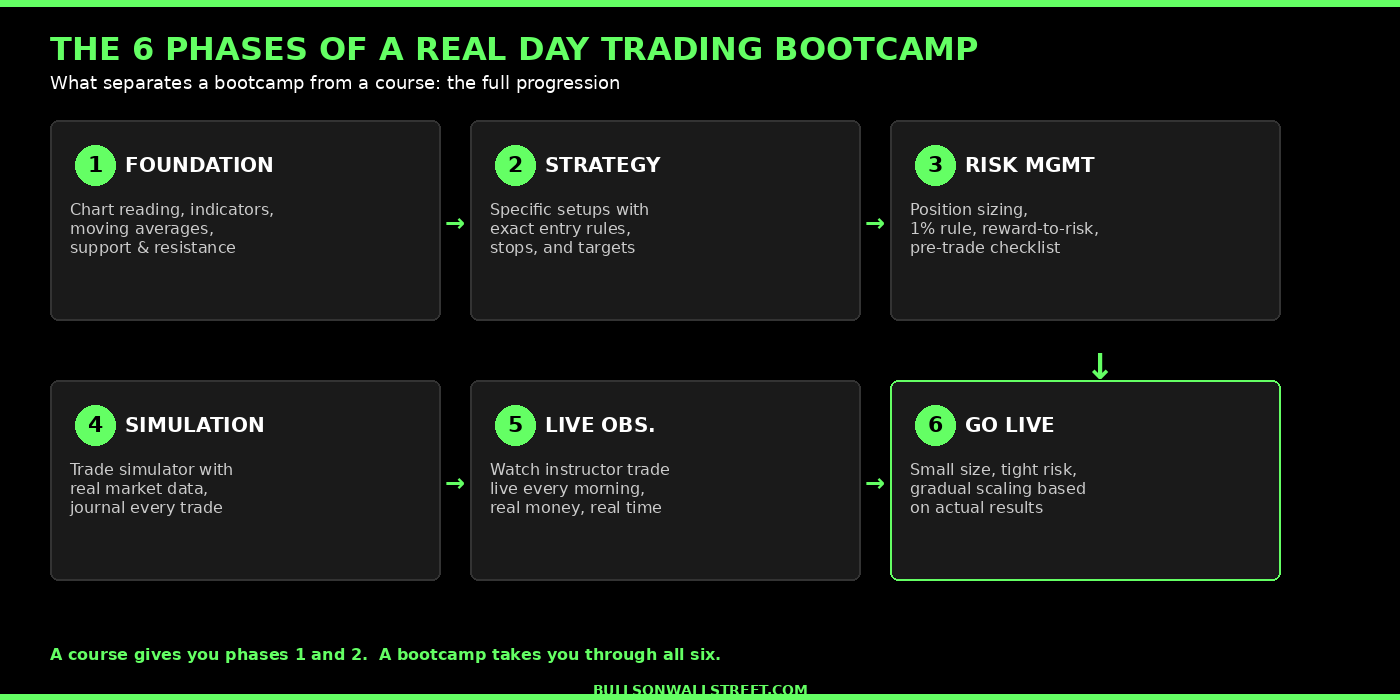
The structure follows a progression that mirrors how every skilled profession teaches:
Phase 1: Foundation. Chart reading, technical indicators, moving averages, support and resistance, volume analysis. You learn the language before you try to speak it. This includes understanding how the 9 EMA and 20 EMA interact, what VWAP tells you about fair value, and why volume expansion is the only confirmation that matters.
Phase 2: Strategy. Specific setups with exact rules. Opening range breakouts. First pullback trades. Red to green reversals. Parabolic short setups. Each one has an entry trigger, a stop loss placement, and a profit target framework. No ambiguity.
Phase 3: Risk management. Position sizing formulas, the 1% rule, reward-to-risk ratios, and building a pre-trade checklist you run before every single trade. This phase is where accounts survive or die. Most courses skip it entirely or cover it in one 10-minute video. In our 60-Day Bootcamp, risk management runs through every single session because it is the skill that separates professionals from gamblers.
Phase 4: Simulation. You trade on a simulator using real market data with the same position sizes you plan to use live. You journal every trade. You get feedback. You build muscle memory.
Phase 5: Live observation. You watch your instructor trade live every morning in real market conditions. Not a replay. Not a highlight reel. The actual 9:30 AM bell, real money on the line, explaining decisions in real time as the market moves.
Phase 6: Transition to live. You go live with small size, track results, make adjustments, and scale gradually based on data.
That six-phase progression is what separates a bootcamp from a course. A course gives you phases one and two. Maybe a little of three. A bootcamp takes you all the way through six and holds your hand at every step.
The Biggest Misconception About Trading Bootcamps
The single biggest misconception people have when they buy a bootcamp is they assume that if they take the class, or even part of the class, they are going to make money. Period.
They do not treat this like a job.
Think about it like becoming a doctor or a lawyer. The Bureau of Labor Statistics tracks the training requirements for every profession in the country. Doctors need a doctoral degree plus years of residency. Lawyers need three years of law school plus bar exam preparation. These professions require years of structured training before you make a dollar. Trading is no different in the amount of time required, even though no licensing board enforces it.
There is a process to this. And the misconception is that people are not willing to give themselves a year to actually get good. They want to take the class and then start trading in a couple days or a couple weeks, but that does not work.
I tell every single student on Day 1: you will not be profitable in 30 days. The bootcamp gives you the knowledge, the system, and the practice framework. Profitability comes from months of applying that knowledge consistently after the program ends.
The traders who internalize this reality are the ones still trading three years later. The ones who expect instant returns are the ones posting on Reddit about how trading education is a scam.
How a Bootcamp Differs from an Online Course
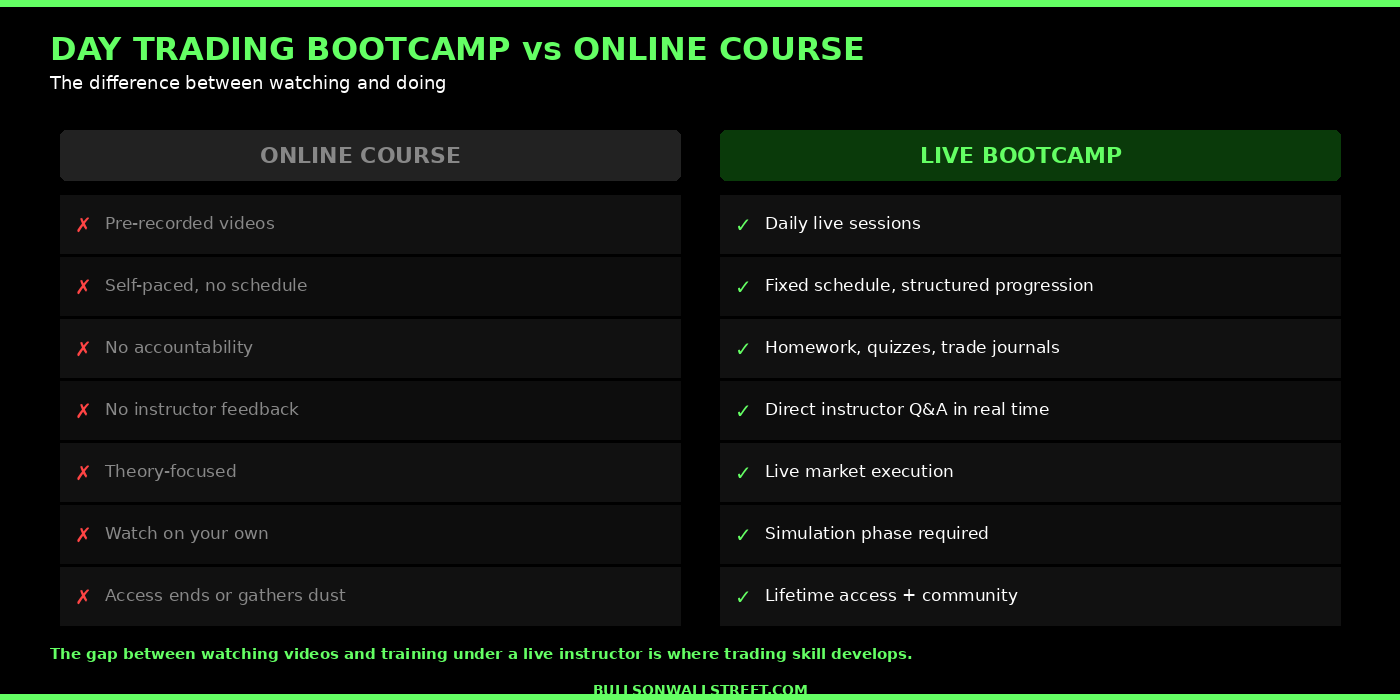
The trading education market is flooded with products that call themselves courses, masterclasses, academies, and bootcamps. Most of them are the same thing repackaged: pre-recorded video modules you consume at your own pace with no accountability and no live component.
Here is the actual difference.
An online course is a library. You browse it when you feel like it. You skip sections. You watch at 2x speed. There is no feedback loop. No one knows if you understood the material. No one checks your trade journal. And the instructor recorded those videos months or years ago in market conditions that may no longer apply.
A day trading bootcamp is a training program. The schedule is fixed. The assignments are mandatory. The instructor is live, every single session, trading in real time while you watch. When you have a question about why NVDA just dropped $4 in 30 seconds, you ask it in that moment and get an answer that applies to that exact situation.
The gap between those two models is enormous. It is the difference between reading about surgery and standing in an operating room watching a surgeon work while explaining every incision.
Our free Skool community course alone is 20+ hours of structured content. And that is free. Imagine how deep a 60-day live bootcamp goes when you are spending every market morning in a live trading session with direct access to the instructor.
The Simulator-to-Live Gap (Where Most Traders Blow Up)
The moment where most students want to quit is not during the learning phase. It is not the homework or the long nights studying chart patterns.
It is the transition from simulator to live trading.
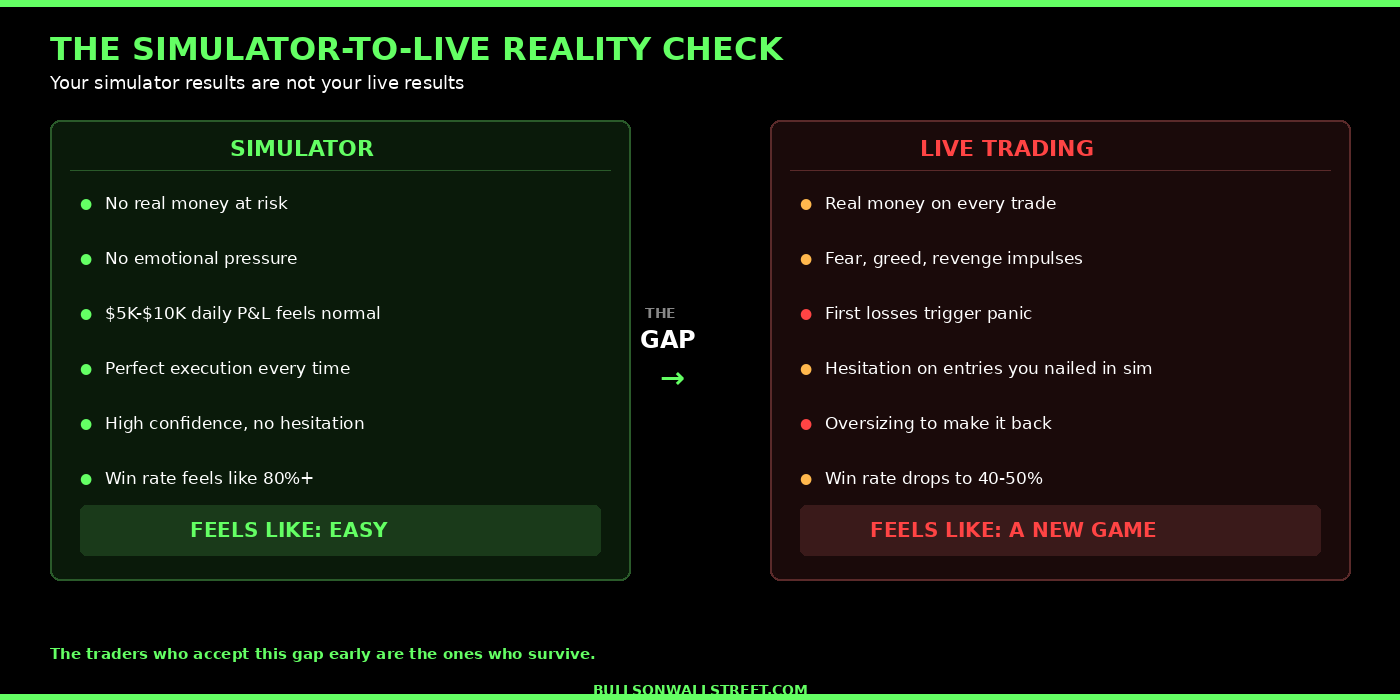
Students trade on a simulator and think they have it figured out. They are making $5,000 or $10,000 a day in simulated trades. The setups are clicking. The confidence is sky high. Then they go live with real money, and it is nothing like their simulator results.
This throws them for a loop. Real money triggers a completely new set of emotions. Fear, greed, revenge impulses, hesitation. The trade you pulled the trigger on instantly in the simulator suddenly paralyzes you when it is your rent money at risk. And when those first few live trades go red, it triggers a cascade of bad behaviors. Oversizing to make it back. Abandoning the system. Revenge trading.
This is why new traders often blow up their first accounts. Not because the system failed. Because the expectation was wrong.
If you walk into live trading expecting that whatever you made on the simulator is what you will make in real life, you will blow up. But if you walk in with the expectation that going live is its own learning phase, that real money introduces new emotions you need to manage, that you should trade very small and make gradual adjustments, you will be totally fine.
Peer-reviewed research on deliberate practice confirms what every experienced trader already knows: simulation-based training builds foundational skill, but transferring that skill to live performance requires its own structured transition. The emotions, the stakes, the pressure. Those variables do not exist in simulation. A good bootcamp prepares you for this moment. A bad one pretends it does not exist.
What Makes a Great Bootcamp Instructor (And Why Most Fail)
Here is a truth nobody talks about in trading education: great traders often make terrible teachers.
Being able to read a chart and pull the trigger on a $50,000 position in 3 seconds is one skill set. Being able to slow down, explain why you made that decision, break it into digestible pieces, and walk a beginner through the same logic is a completely different skill set. They live at opposite ends of the personality spectrum.
Most trading educators fall into one of two camps. They are either great traders who cannot teach, so their students watch impressive trades but never learn how to replicate them. Or they are great communicators who do not actually trade for a living, so they teach theory that falls apart in live markets.
It takes a unique person who can straddle both worlds. Someone who during the trading day is one person: focused, decisive, executing in real time. And then at night when they are teaching, they become a totally different person: patient, structured, meeting students where they are.
That is rare. And that is what you should look for when evaluating any bootcamp.
What a Real Student Transformation Looks Like
Barbara Weiss lives in Switzerland. Mom of three. She came to Bulls on Wall Street a couple years ago totally green. She had tried so many other programs. Some of the most expensive ones you can think of. Programs that cost $20,000 and more. And she still knew nothing about day trading after all of it.
So much of what is out there is garbage because it does not get taught by people who are in the trenches every day. The instructor recorded a course two years ago and moved on. The material is stale. The market has changed. Nobody is there to answer your questions in real time.
Barbara took the bootcamp. Then she joined the in-person retreat in Destin, Florida: five days of learning, trading, and talking through setups face to face. And it still took time after that. A whole year before she really got good.
But here is where it gets interesting. Today she is managing her own hedge fund with over seven figures raised in the last six months. She is bringing on capital every month because her returns have been solid. From completely green to managing institutional money. That transformation did not happen in a weekend. It happened through a structured process, mentorship, and the willingness to give herself the time to get good.
Red Flags: How to Spot a Fake Bootcamp
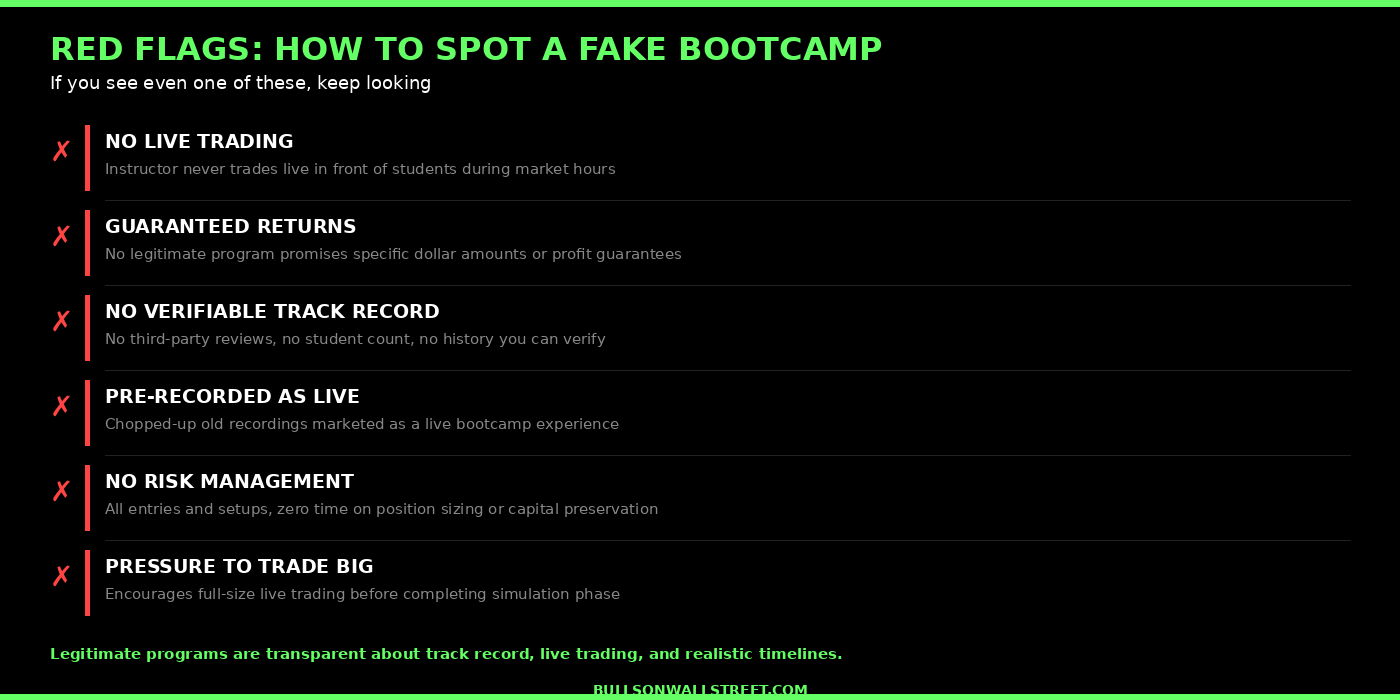
The trading education space has a fraud problem. The SEC and FINRA have both published warnings about trading education scams, and for good reason. Here is what to look for.
No live trading. If the instructor does not trade live in front of students during market hours, walk away. Anyone can draw arrows on a chart after the market closes. The test is whether they can execute in real time while explaining what they are doing and why.
Guaranteed returns. No legitimate trading program guarantees profits. Day trading involves substantial risk, and any program that promises specific dollar amounts is either lying or violating securities regulations.
No verifiable track record. How long has the program been running? How many students? Are there third-party reviews on platforms like Trustpilot, not just cherry-picked testimonials on their own website? Our bootcamp has 445+ reviews on Trustpilot with a 4.6 rating because we send every single graduating class to review us on a third-party platform.
Pre-recorded content marketed as live. Some programs record a few live sessions, chop them up, and sell the replays as a bootcamp experience. That is a course with extra steps, not a bootcamp.
No risk management curriculum. If the program focuses entirely on entries and setups without dedicating serious time to position sizing, stop losses, and capital preservation, it is teaching you how to gamble, not how to trade.
Pressure to trade large immediately. Any program that encourages you to go live with full size before completing simulation, journaling, and building a trading plan is optimized for exciting content, not student outcomes.
How to Evaluate Whether a Bootcamp Is Worth the Investment
The cost of a day trading bootcamp ranges from a few hundred dollars for bare-bones Udemy courses to several thousand for comprehensive live programs. The question is not how much it costs. The question is what you get for the money.
Here is the evaluation framework:
Duration. A 3-day or 5-day program cannot teach you enough. Trading is a skill that requires repetition over weeks, not a weekend seminar. Look for programs that run at least 30 to 60 days with structured daily sessions.
Live component. Does the instructor trade live during market hours? Can you watch, ask questions, and see real decisions in real time? This is non-negotiable.
Curriculum depth. Does it cover technical analysis, risk management, trading psychology, scanning and stock selection, and the transition from simulation to live? If any of those pillars is missing, the program has a gap.
Post-bootcamp access. What happens after the program ends? Do you lose access? Do you get ongoing community support, chatroom access, or the ability to retake the bootcamp? The learning does not stop on day 60. It accelerates.
Instructor credentials. Is the instructor a full-time trader? How long have they been trading? How long have they been teaching? Those are different questions with different answers, and both matter.
The BOWS 60-Day Bootcamp Structure
The Bulls on Wall Street 60-Day Trading Bootcamp is the longest-running live trading bootcamp in the world. 79 sessions completed since 2008. Here is how it works.
Morning sessions (Monday through Friday, 9:00 AM EST). I trade live via screenshare every single market morning. Students watch my screen, see my scanner results populate in real time on TC2000, hear my thought process, and ask questions as trades unfold. This is not recorded. This is live.
Evening classes (4x per week). Structured curriculum sessions covering the BOWS trading system. Homework, quizzes, and trading plan development. Each class builds on the last.
Simulation phase. Students trade on simulators using the setups taught in class. Every trade gets journaled. Every journal gets reviewed.
Live observation. Before going live, students watch me execute every morning and connect the dots between what they learned in class and what the market is doing right now.
Transition to live. Students go live only when their simulator data supports it. Small size. Tight risk. Gradual scaling based on actual results.
Lifetime access. You get lifetime access to all bootcamp material and every future live 60-Day class. The market changes. Strategies evolve. You can retake the bootcamp anytime to stay current.
Post-bootcamp community. Graduates join the Bulls on Wall Street Trading Chatroom where they trade alongside me and other experienced traders every single day.
The Bone Zone, the shaded area between the 9 EMA and 20 EMA, is one of the proprietary concepts you will learn in the bootcamp. When price pulls back into that zone on decreasing volume and prints a green candle, that is an entry signal. Understanding setups like this at a granular level is what separates bootcamp graduates from people who watched a YouTube video about moving averages.
Who Should (and Should Not) Do a Day Trading Bootcamp
A bootcamp is right for you if:
You are willing to commit 60+ days of real effort. Not passive watching: active learning, daily practice, and journaling. You understand that profitability comes months after the program, not during it. You have capital you can afford to risk while learning. You want a structured system, not random tips.
A bootcamp is NOT right for you if:
You expect to make money in the first few weeks. You are looking for a get-rich-quick shortcut. You are not willing to trade on a simulator before going live. You want someone to tell you what to buy and when: that is a signal service, not an education.
The traders who succeed treat the bootcamp like medical school. Learn. Practice. Observe. Go live small. Get good over time. The ones who fail treat it like a lottery ticket.
Frequently Asked Questions About Day Trading Bootcamps
What is a day trading bootcamp?
A day trading bootcamp is a structured, intensive training program that teaches you how to trade stocks through live instruction, guided practice, and real-time market exposure over a period of weeks or months. Unlike self-paced courses, bootcamps follow a fixed schedule with daily live sessions and instructor accountability.
How long does a day trading bootcamp take?
Legitimate bootcamps range from 30 to 90 days. The Bulls on Wall Street bootcamp is 60 days, which balances depth of curriculum with sustained intensity. Programs shorter than two weeks typically cannot cover enough material to build real trading skills.
How much does a day trading bootcamp cost?
Costs range from under $500 for basic online programs to several thousand dollars for comprehensive live bootcamps with mentorship. The price should reflect the live component, instructor access, curriculum depth, and post-program support.
Can I do a day trading bootcamp while working full time?
Yes. Many bootcamp students keep their full-time jobs during the program. The BOWS bootcamp is designed around this reality: evening classes happen after market hours, and the morning live trading sessions can be watched before or during the early part of your workday. This is what we call The Double Dip: earning income from your job while building your trading skill simultaneously.
Is a day trading bootcamp worth the money?
It depends on the program. A bootcamp with live instruction, a proven track record, structured simulation phases, and post-program community support can compress years of self-taught trial and error into months of guided learning. A bootcamp that is just repackaged video content is not worth more than a Udemy course.
What is the difference between a trading course and a trading bootcamp?
A course is a library of pre-recorded content you consume at your own pace with no accountability. A bootcamp is a structured program with live sessions, assignments, simulation requirements, and direct instructor feedback over a set period. The difference is like reading about swimming versus getting in the pool with a coach.
Do I need money to trade during a bootcamp?
You do not need a funded brokerage account during the learning and simulation phases. You will need capital when you transition to live trading, but a good bootcamp will teach you how to start with a small account and scale up based on performance.
What should I look for in a day trading bootcamp instructor?
Look for someone who trades live during market hours and teaches structured classes outside of market hours. Verify their track record, years of experience, and whether they have third-party student reviews. The best instructors are rare individuals who can both execute at a professional level and break down complex concepts for beginners.
How long does it take to become profitable after a bootcamp?
Typically 6 to 12 months of consistent practice after completing the program. Some students take longer. The timeline depends on how much time you invest daily, your discipline in following the system, and your ability to manage emotions during live trading.
What happens after a day trading bootcamp ends?
In a good program, you get ongoing access to the trading community, the ability to retake the bootcamp, and continued mentorship. At Bulls on Wall Street, graduates join the live trading chatroom where they trade alongside Kunal and other experienced traders every day. The learning continues long after the 60 days.
Can I fail a day trading bootcamp?
You cannot fail the program itself, but you can fail to apply what you learned. The students who blow up their accounts after bootcamp almost always share one trait: they skipped the simulation phase and went live too fast with unrealistic expectations.
What is the Pattern Day Trader rule and does it affect bootcamp students?
The PDT rule requires a minimum $25,000 account balance to make unlimited day trades. During simulation, this does not apply. When transitioning to live, your bootcamp should cover alternatives for trading with smaller accounts, including futures trading and strategic position management.
Is day trading actually profitable or is it gambling?
Day trading is a skill-based activity with a steep learning curve. Academic research and regulatory data confirm that most retail traders lose money, but this statistic includes everyone who tried without proper education or risk management. Traders with structured training, disciplined risk management, and realistic expectations can and do generate consistent returns. A bootcamp does not guarantee profitability: it gives you the framework to develop the skill.
Ready to see if a live trading bootcamp is right for you? The Bulls on Wall Street 60-Day Trading Bootcamp has trained 7,000+ students since 2008 across 79 consecutive live sessions. Morning live trading with Kunal Desai every market day, evening classes 4x per week, simulation phases, lifetime access, and a trading community that stays with you long after graduation. Apply for a free demo call to find out if the program fits your goals.
Kunal Desai is the CEO and founder of Bulls on Wall Street. A professional trader since 2007, he has navigated every major market cycle, from the 2008 financial crisis to today's high-volatility environments. Having mentored 7,000+ students through his live trading bootcamps, Kunal trades live every morning in the Bulls on Wall Street Trading Chatroom and is dedicated to teaching real-world execution and high-probability strategies. Based in Miramar Beach, Florida.
Connect with Kunal: Read his full story | Instagram | YouTube