Updated July 2026
The best day trading books are Technical Analysis Using Multiple Timeframes by Brian Shannon and The PlayBook by Mike Bellafiore, and I say that as someone who read hundreds of trading books and got worse before I got better.
That last part is not a joke. Before I became consistently profitable I had read almost every trading book you can name. Benjamin Graham value investing books. Nicolas Darvas box trading. Every William O Neil book in print. I was a walking library of trading knowledge and I was losing money. So this list is different from the ones written by content teams at forex brokers. It is the list I wish someone had handed me in 2003, with an honest warning about when books help and when they quietly destroy you.
TL;DR
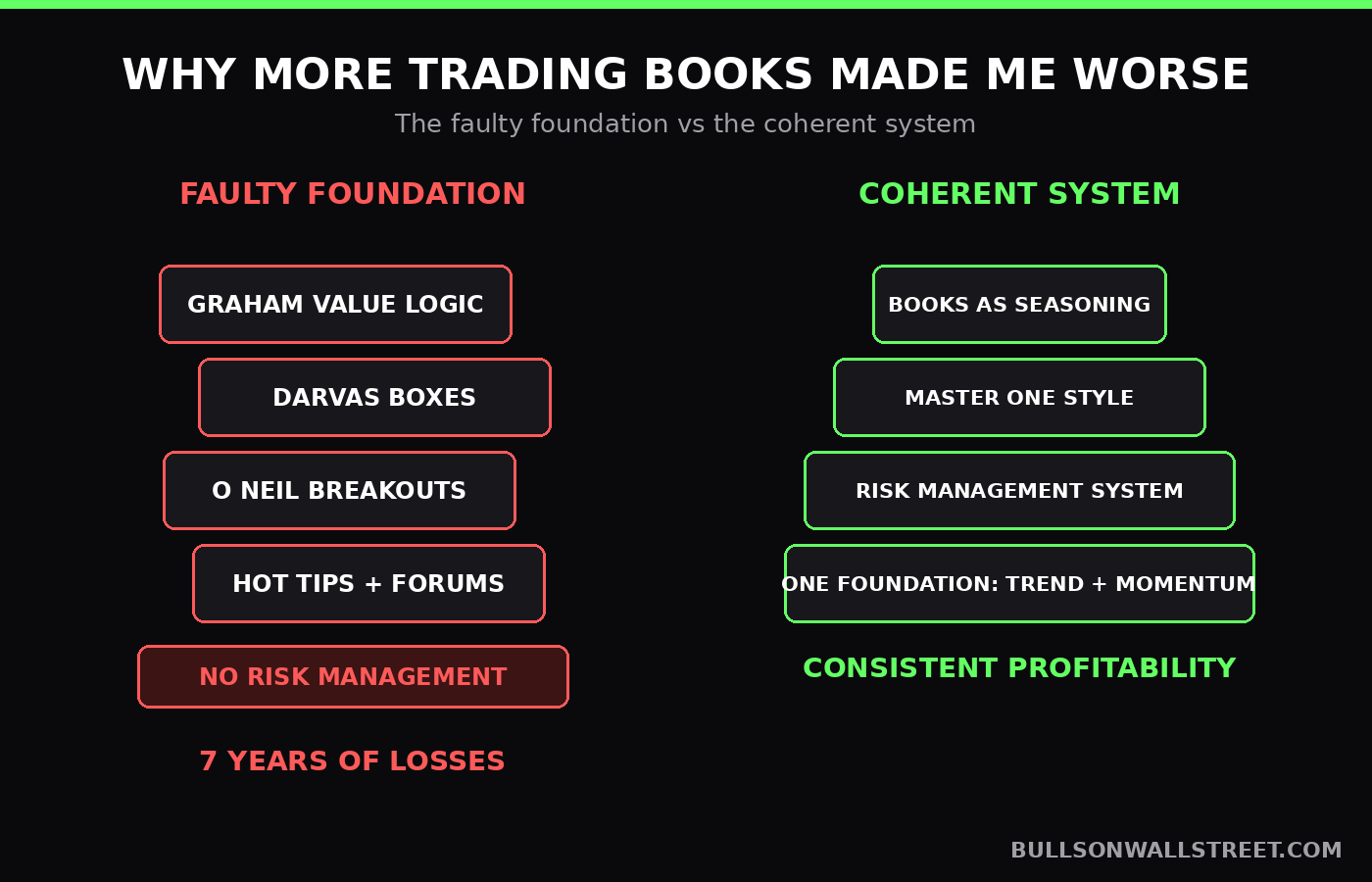
Reading more trading books will not make you profitable. I read hundreds and built what my mentor Paul Singh called a faulty foundation: Graham valuation logic stacked on Darvas boxes stacked on O Neil breakouts, with no risk management underneath any of it. Master one style first. Then books become fuel instead of noise. My all time favorites are Technical Analysis Using Multiple Timeframes by Brian Shannon and The PlayBook by Mike Bellafiore, tied at the top. The two most important books Paul ever assigned me were not trading books at all.
How Reading Hundreds of Trading Books Made Me Worse
I started trading in 1999 in college. For the next seven years I did what every driven beginner does. I consumed everything. Books, blogs, forums, MSN Money boards at 2am.
The problem was never effort. The problem was that every book handed me a different religion. Graham told me to buy cheap. O Neil told me to buy strength breaking out of bases. Darvas told me to trade boxes. Each system works on its own terms. Blended together by a kid with no risk management, they produced a strategy soup where every position could be justified by some chapter of some book. I was not building a system. I was collecting alibis.
There is real research behind why this fails. Barber and Odean studied 66,465 retail accounts and found the most active traders earned 11.4 percent a year while the market returned 17.9 percent, driven largely by overconfidence. Knowledge feels like edge. It is not edge. The FINRA Foundation has spent 15 years measuring the gap between what Americans know about money and how capably they act on it. That gap was my whole trading career until 2006.
When I finally met Paul Singh, he did something no book had done. He took books away.
What My Mentor Assigned Me Instead
Paul was not a believer in stacking trading books. His view was blunt. I already had more trading knowledge than most professionals. What I did not have was a coherent system, and adding more knowledge to a faulty foundation just makes the foundation heavier. Get elite at a few things first, he told me. Become a true master of one style. Then go read everything, because by then you will have a frame to hang it on.
So the two books Paul actually assigned me were not trading books.
The first was The Tao of Bruce Lee by Davis Miller. Bruce Lee mastered one art before he absorbed others, and the book hammers the difference between collecting techniques and owning them. I still think about that when a student shows up knowing nine setups and executing none of them.
The second was The Psychology of Judgment and Decision Making by Scott Plous. Paul grew up playing poker, semi pro level, and to this day he finds a game every time we hang out. His entire trading brain is risk management and decision quality. Plous is a tour of the classic research on how humans misjudge probability, anchored in work like Tversky and Kahneman's famous paper on heuristics and biases. Read it and you will recognize every bad trade you have ever taken.
Those two assignments, plus the discipline of trading one style with real risk management, turned 2006 into my first consistently profitable year. I went full time at the end of 2007 and founded Bulls on Wall Street in 2008.
The Best Day Trading Books, Ranked
These are the books I recommend to my students after they have their footing. Not before. The why is at the end.
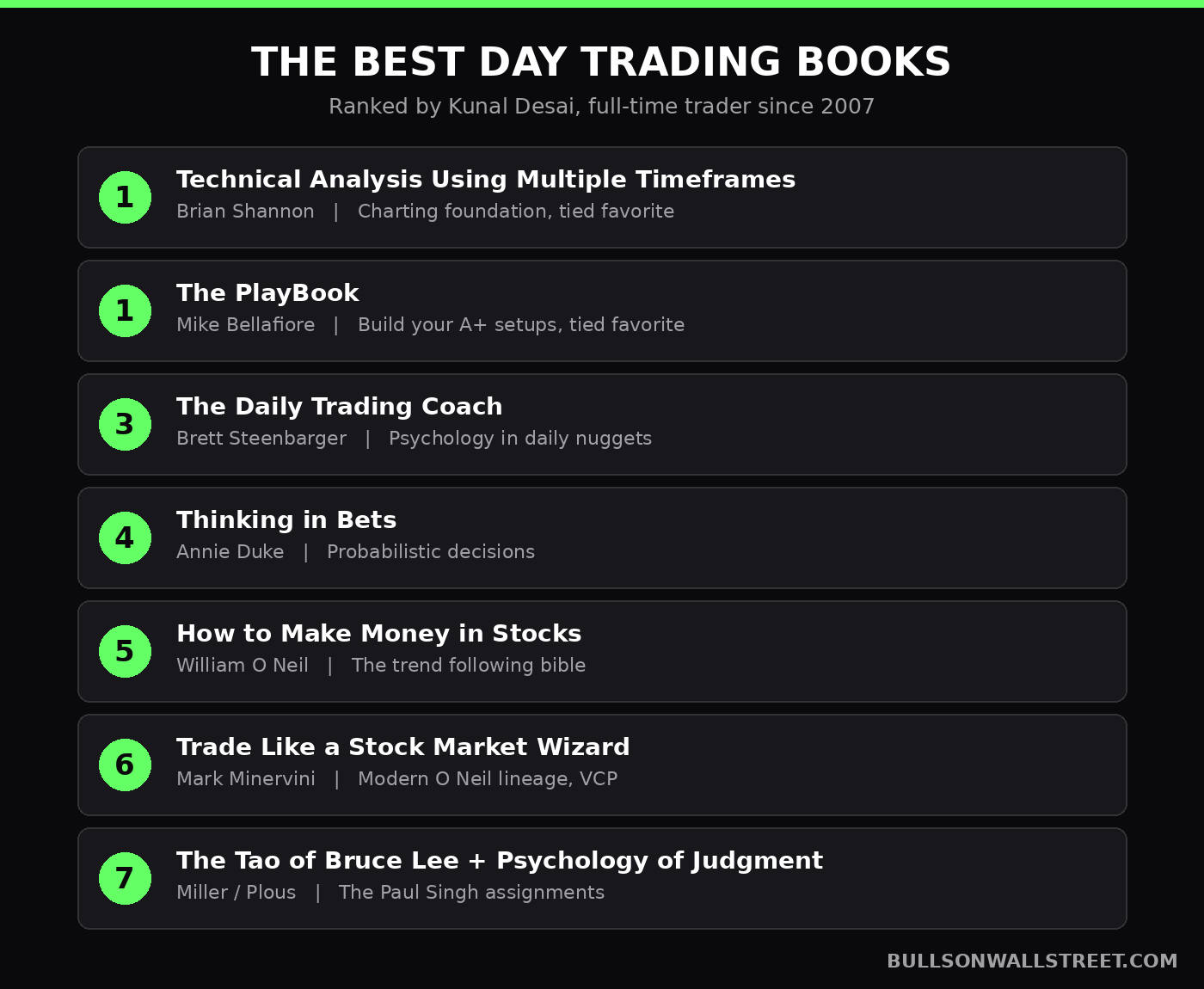
1. Technical Analysis Using Multiple Timeframes by Brian Shannon
My favorite trading book of all time, tied with the next one. This was the first technical analysis book I ever read that took confusing chart theory and made it simple, visual, and directly usable in the style I actually trade. Big hardback, coffee table format, real charts on every spread. Shannon shows you how to align a trade across timeframes so the daily, the hourly, and the intraday chart are all telling the same story before you commit capital. Everything I do on my TC2000 charts every morning, from scanning to timing entries off candlestick patterns, sits on the foundation this book explains. The modern version of that foundation lives in my stock chart patterns guide, where I show the exact patterns I still trade off these principles.
2. The PlayBook by Mike Bellafiore
Tied for first, and probably the most actionable book on this list. Bellafiore co founded SMB Capital, a prop firm in New York whose style is close to what we teach at Bulls on Wall Street: stocks in play, real catalysts, trend and momentum trading. The core idea is that you build a written playbook of your best setups, graded and studied like game film. This book shows up directly in my results. Over the last five years my biggest trades have come from recognizing a top setup inside my own playbook and sizing up aggressively into asymmetric risk. You cannot bet big with confidence if you have never defined what your A plus setup looks like. This book teaches you to define it.
3. The Daily Trading Coach by Dr. Brett Steenbarger
The trading psychology book I actually recommend, and the format is the reason. Steenbarger gives you 101 short lessons, one nugget and one piece of homework at a time. Compare that to the dense 300 page psychology tomes everyone pushes on beginners. Most new traders dive into those, read themselves into knots, and come out convinced they have deep childhood issues sabotaging their fills. I will say something unpopular here. Over the last ten years the industry has turned trading into a discipline and willpower game when it is first an edge game. You build an edge, then you apply the discipline to follow it. Doing it backwards means meditating your way to more consistent losses. Steenbarger keeps psychology in its right place: small doses, applied to a system that already works. More of my thinking on this is in my trading psychology post.
4. Thinking in Bets by Annie Duke
There are very few good pure risk management books, because risk management is a singular topic that is hard to stretch across 300 pages. Duke, a former professional poker player, wrote the best substitute. The book trains a probabilistic mindset: making smart decisions without complete information, judging decisions separately from outcomes, and weighing expected value the way a trader should before every entry. It even covers building feedback loops so a team can debug its decision process instead of arguing about results. If you internalize Duke and then apply something concrete like the 1 percent rule, you are ahead of ninety percent of the people in any chatroom.
5. How to Make Money in Stocks by William O Neil
The ultimate trend following bible, and the book most of us stole our catalyst thinking from. Stocks in play, buying leaders as they break out of sound bases, cutting losers fast. O Neil was preaching an 8 percent hard stop decades ago, which is aggressive risk management by trend following standards and thinks much closer to how a short term swing trader operates. Here is my honest caveat, and it matters. This exact book was part of my faulty foundation years. The book was never the problem. Reading O Neil while simultaneously trying to be Graham and Darvas was the problem. Read it when you have one style you are committed to and it becomes foundational. Read it while sampling five philosophies at once and it becomes another voice in the noise.
6. Trade Like a Stock Market Wizard and Think and Trade Like a Champion by Mark Minervini
The modern offshoot of the O Neil lineage, and I count these two as one system. Minervini's VCP pattern gets treated like a secret handshake online, but let me translate it for you: it is essentially flag patterns and flat top breakouts, the same structures momentum traders have been trading forever, packaged with real precision around entry criteria and risk. That is not a knock. The packaging is excellent, the risk discipline is real, and for swing traders these are the sharpest modern books in the trend following line.
7. The Tao of Bruce Lee by Davis Miller and The Psychology of Judgment and Decision Making by Scott Plous
The two Paul Singh assignments, still on the list twenty years later, still not trading books. Master one thing before you absorb everything. Understand how your own judgment fails under uncertainty. Every losing streak I have coached a student through traces back to violating one of those two ideas.
The Famous Classics I Cut From This List
The old version of this post recommended Market Wizards, Reminiscences of a Stock Operator, and Trading in the Zone. All three are gone from my ranked list, and I want to be straight about why.
They are great reads. Schwager's interviews are legendary and Livermore's story is the founding myth of our entire profession. But they are story books and dense theory books, and for a developing trader they feed the exact disease that cost me seven years: stacking inspiration and knowledge on top of a foundation that does not exist yet. You finish Market Wizards fired up with fragments of twenty different philosophies. That is precisely the strategy soup Paul had to detox me from. Read them the way you would watch the best trading movies: for love of the game, on the weekend, with zero expectation that they will change Monday's results.
Why I Do Not Assign Books in My Bootcamp
People are sometimes surprised that our 60 Day Trading Bootcamp has no reading list. It is deliberate.
The bootcamp is not a stack of on demand modules. I am in front of my students live in the morning trading, then teaching class at night, with homework and journaling in between. It is a real bootcamp. Most traders come to me confused about strategy and where to start, and assigning them hundreds of pages of dense trading books would recreate the exact confusion they came to escape. My job in those 60 days is to build one solid foundation in the trend and momentum day trading strategies I have traded full time since 2007.
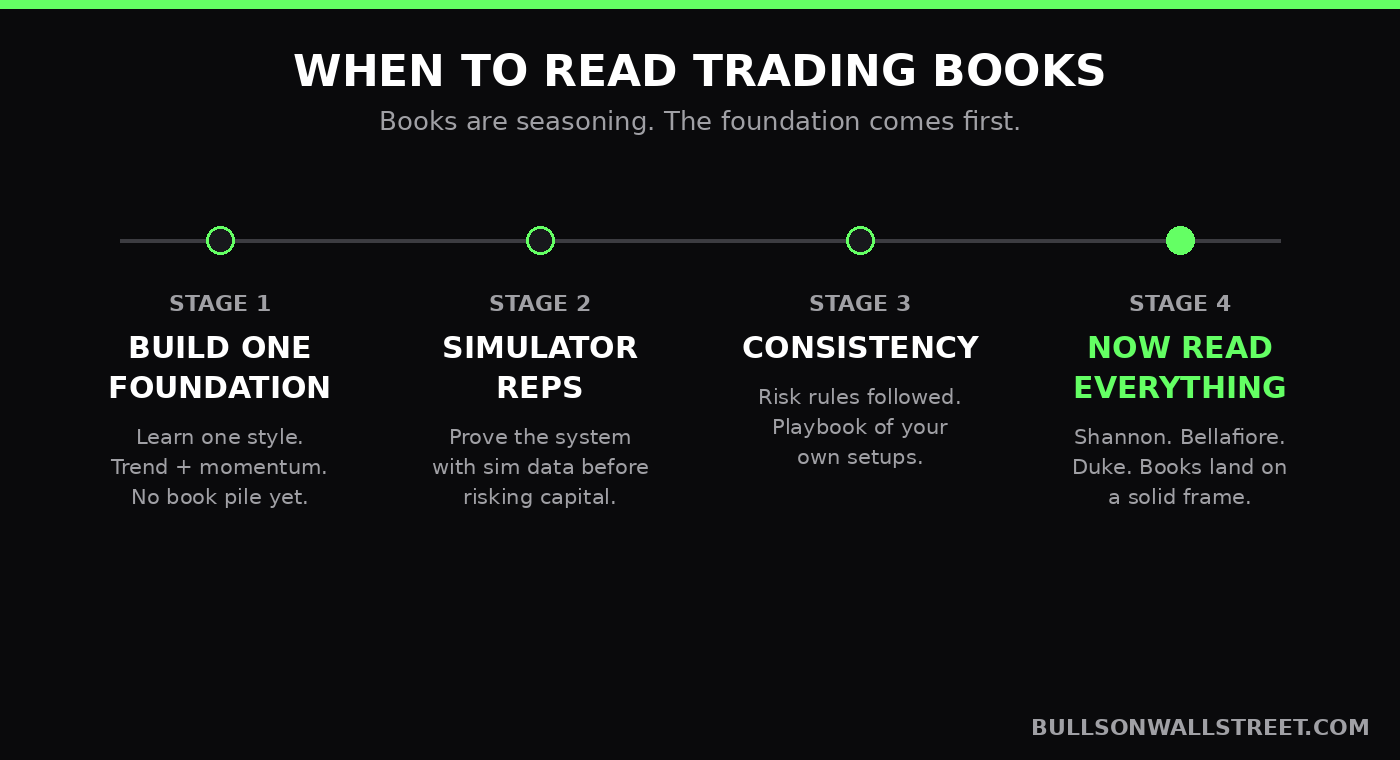
Then, once a student is past the simulator stage and their foundation is set, books become what they should have been all along: seasoning on a solid meal. That is when I hand them this list, starting with Shannon and Bellafiore. If you want to see how the foundation gets built first, that is what the 60 Day Trading Bootcamp is for, and I post free lessons every week on YouTube.
How long does the whole journey take? Longer than any book promises. I wrote about the honest timeline in how long it takes to learn day trading and ranked the best day trading courses if you are deciding between structured programs.
FAQ: Best Day Trading Books
What is the best day trading book for beginners?
Technical Analysis Using Multiple Timeframes by Brian Shannon. It is the clearest visual explanation of how charts actually work across timeframes, and it teaches the skill every other book assumes you already have.
What is the best book on trading psychology?
The Daily Trading Coach by Dr. Brett Steenbarger. It delivers psychology in 101 small daily lessons instead of a dense 300 page theory book. Most beginners overweight psychology and underweight edge. Fix the edge first.
Is Trading in the Zone worth reading?
It is a classic, but I no longer recommend it as a starting point. It is dense, and new traders tend to come out of it overanalyzing their own minds instead of building a tested system. Read Steenbarger first, and save the dense classics for after you are consistent.
Is Market Wizards worth reading?
As entertainment and inspiration, absolutely. As education for a developing trader, be careful. It exposes you to twenty different philosophies at once, which encourages the knowledge stacking that keeps beginners inconsistent. Master one style, then enjoy it.
What books does Kunal Desai recommend for day trading?
My two favorites of all time are Technical Analysis Using Multiple Timeframes by Brian Shannon and The PlayBook by Mike Bellafiore, tied at the top. After those: The Daily Trading Coach by Brett Steenbarger, Thinking in Bets by Annie Duke, How to Make Money in Stocks by William O Neil, and Mark Minervini's two books.
What books did Paul Singh assign Kunal Desai?
Two non trading books: The Tao of Bruce Lee by Davis Miller and The Psychology of Judgment and Decision Making by Scott Plous. Paul, a lifelong poker player and the original mentor behind Bulls on Wall Street's risk first approach, believed mastery of one style and decision quality mattered more than accumulating trading knowledge.
Are there good books on risk management for day trading?
Very few, because risk management is a focused topic that is hard to stretch into a full book. Thinking in Bets by Annie Duke is the best adjacent read for probabilistic decision making. For the specific rules I trade by, see the Bulls on Wall Street risk management system.
Can you learn day trading from books alone?
No. Books gave me an enormous amount of knowledge and I still lost money for seven years, because knowledge without one coherent system and live reps is just trivia. Books work best after a foundation is built, not instead of building one.
What is the best book for swing trading?
How to Make Money in Stocks by William O Neil for the foundation, then Mark Minervini's Trade Like a Stock Market Wizard for the modern refinement of the same trend following lineage.
How many trading books should a new trader read?
Fewer than you think. One charting book, one psychology book in small doses, and one decision making book, applied inside a single trading style, beats fifty books sampled across five styles. I am living proof of the second path and it cost me years.
Ready to Build the Foundation First?
Books are the seasoning. The foundation is built live. In the 60 Day Trading Bootcamp I trade in front of you every morning and teach class at night, building one coherent trend and momentum system from the ground up, the same way Paul built mine. Class sizes are limited. Apply for the next 60 Day Trading Bootcamp here.
Kunal Desai is the CEO and founder of Bulls on Wall Street. A professional trader since 2007, he has navigated every major market cycle, from the 2008 financial crisis to today's high volatility environments. Having mentored 7,000+ students through his live trading bootcamps, Kunal trades live every morning in the Bulls on Wall Street Trading Chatroom and is dedicated to teaching real world execution and high probability strategies. You can trade alongside him for a full week with the $7 BullsVision trial. Based in Miramar Beach, Florida.
Connect with Kunal: Read his full story | Instagram | YouTube