

I have been in this industry since 2008. Before that, I was the student — grinding through forums, hot tip emails, and late-night AOL Instant Messenger sessions with my mentor Paul Singh. Teaching more than 7,000 students at Bulls on Wall Street since 2008, I have seen every trend, every gimmick, and every promise this industry has manufactured.
So when you ask which day trading courses are actually worth your money, you are not going to get a paid ranking from me. You are going to get the truth.
The Scam That Set Back an Entire Generation of Beginners
Around 2020 to 2023, one of the most destructive trends in trading education exploded across social media. Educators ran what they called small account challenges. The premise: start with $500, trade it into $1 million or $2 million on camera, and prove the dream is real.
Sounds incredible. It is nearly impossible.
Could it happen statistically? Yes. Is it probable? Absolutely not. The odds are one in the millions. Across thousands of conversations with traders since 2008, I have never met a single person who actually pulled it off. Not one.
Here is why those challenges were designed to fail you. Trading $500 means you are under the Pattern Day Trader rule — you can only take three day trades every five business days. To compound $500 into $1 million you have to repeatedly hit home runs in the riskiest, most volatile names on the market. Every trade has to work. Every catalyst has to break your way. You have to do it hundreds of times in a row without a single account-threatening mistake.
The educators running those challenges knew all of this. They were not teaching. They were marketing. The challenge was the product. The audience was the proof of concept. And the students who bought in spent months chasing a benchmark that was statistically designed to be out of reach.
That is the baseline for this entire conversation. Now here is how to make a better decision.
What Actually Separates a Real Day Trading Course from an Expensive Mistake
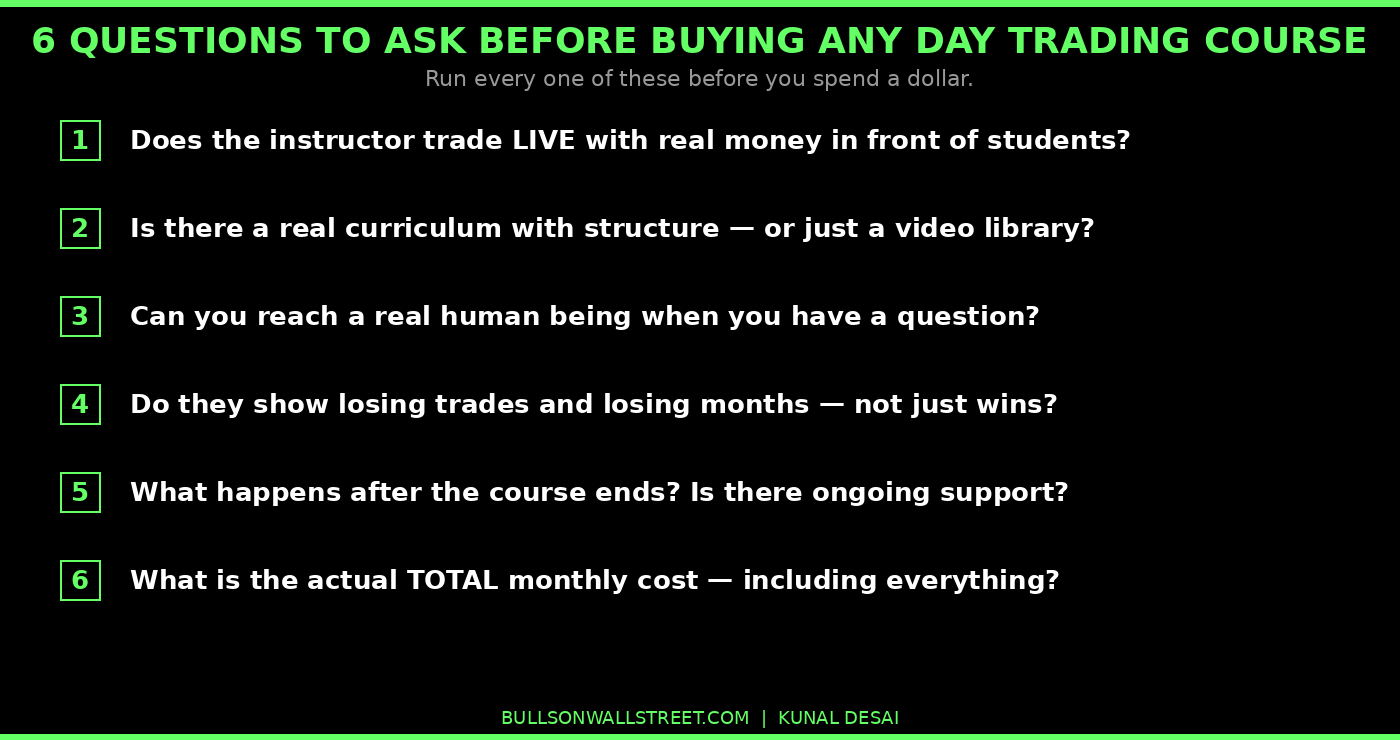
Six questions. Run every one of them before you spend a dollar.
1. Does the instructor trade live with real money in front of students?
This is the most important question on the list. Recorded P&L screenshots are easy to manipulate. Backtested results prove nothing about live execution under pressure. The only thing that matters is watching someone execute real trades with real capital in real time while explaining their decisions out loud. If the course is entirely pre-recorded, the instructor has zero accountability once the camera turns off. Their results might be real. They might not be. You have no way to verify it.
According to the SEC's investor education resources, one of the hallmarks of trustworthy financial education providers is ongoing, verifiable transparency — not curated highlight reels shared after favorable outcomes. Before committing to any trading education program, research the provider the same way you would research a broker or financial advisor.
2. Is there a real curriculum or just a video library?
These are not the same thing. A curriculum has a sequence. You learn concept A before concept B. You get tested. You get feedback. You complete homework. You practice under supervision. A video library is an organized hard drive. You can watch 200 hours of footage and still not know how to execute a trade under pressure because nobody ever made you apply what you learned in a structured environment.
3. Can you reach a real human being when you have a question?
This is the number one complaint I hear from students who come to BOWS after trying another program first. Everything was recorded. Everything was archived. When they hit a real question at a critical moment in their development, they got pointed to a FAQ page or a support ticket. In something as complicated and high-stakes as learning to trade, that is not mentorship. That is customer service.
Half my phone calls with students are not even about setups or indicators. They are about mindset, about how to structure their time, about what it actually takes to get through the learning curve without quitting. That level of coaching does not live in a video library. It never will.
4. Do they show losing trades and losing months — not just wins?
The Bureau of Labor Statistics documents that securities trading is one of the most competitive and attrition-heavy professions in finance. The real failure rate among retail day traders is extremely high. Any educator who only shares winning trades, winning months, and winning students is not showing you reality. They are showing you a brochure. Ask directly: can I see your losing months? If the answer is a redirect to another success story, keep walking.
5. What happens after the course ends?
A lot of programs have polished onboarding. Ongoing support is where most of them fall apart completely. After you finish 15 hours of recorded video, what comes next? Is there a live trading room where you can watch strategy applied every single market day? A community of traders at your level you can learn alongside? Mentorship that continues as markets shift and your skills evolve? Trading education that stops when the videos end is missing the most important part. Markets change. Strategies evolve. What worked in 2021 does not automatically work in 2026.
6. What is the actual total monthly cost — including everything?
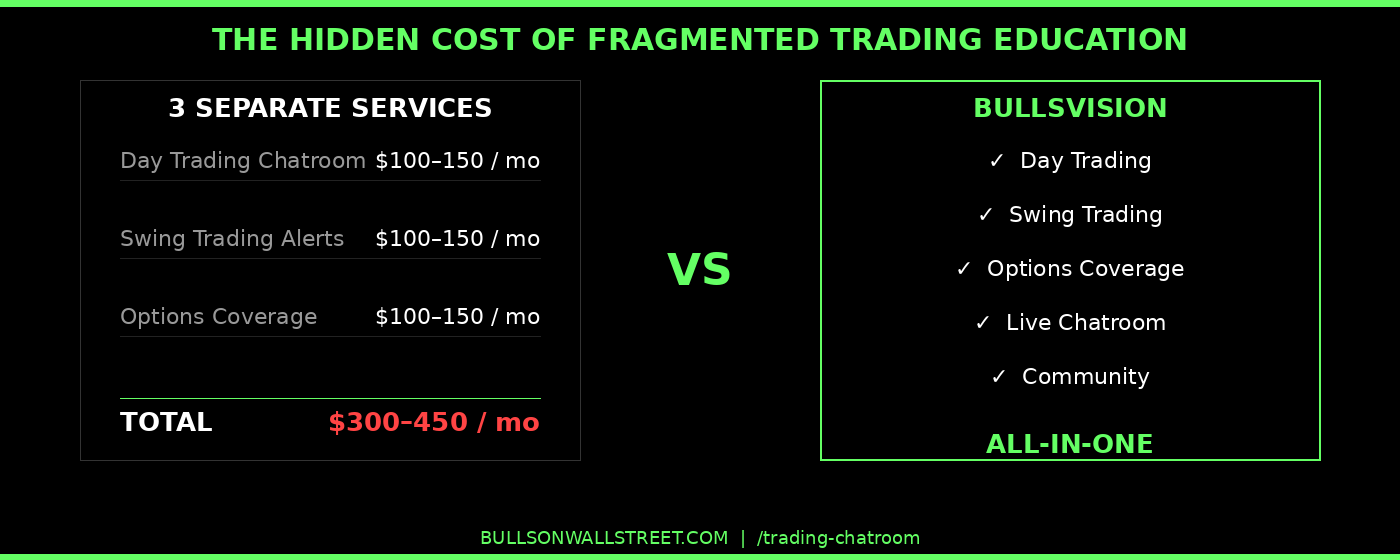
This is where traders get hurt quietly. One service charges $100 per month for a day trading chatroom. Another $150 per month for swing trading alerts. Options coverage, another $120 per month. Before you realize it, you are paying $350 or more per month to three disconnected educators who have never spoken to each other, whose signals sometimes contradict each other, and whose communities have zero overlap. That is fee stacking — and it is the standard model in this industry, not the exception.
FINRA's investor education resources flag total cost of participation as a critical factor when evaluating any financial program. Look at the all-in number, not the headline price.
The Courses Worth Your Attention in 2026
I am going to be honest about my competitors because you deserve that. I am also going to be direct about where Bulls on Wall Street sits. This is not false modesty and it is not trash-talking. It is the same standard I apply to every trade I take: assess the situation accurately, then make the decision.
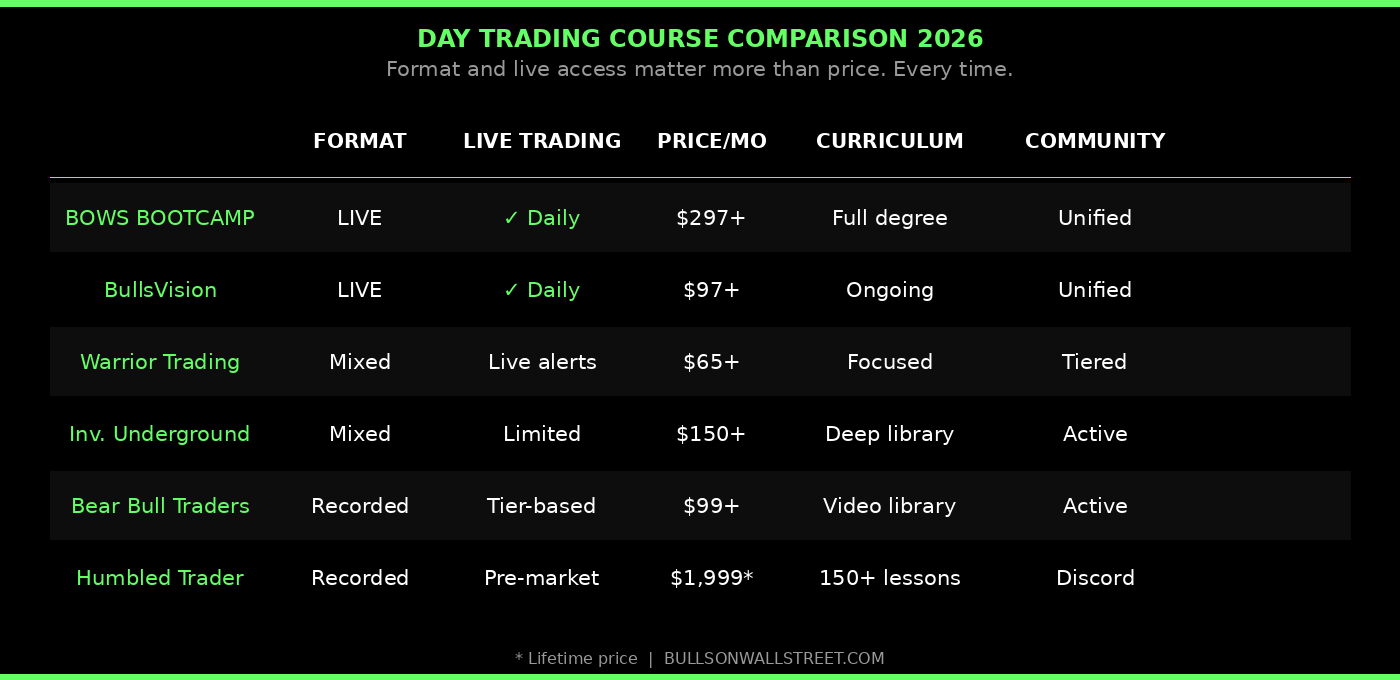
Bulls on Wall Street (BOWS) — 60-Day Live Trading Bootcamp
I will start here because it is what I know best and what more than 7,000 students have been through since 2008.
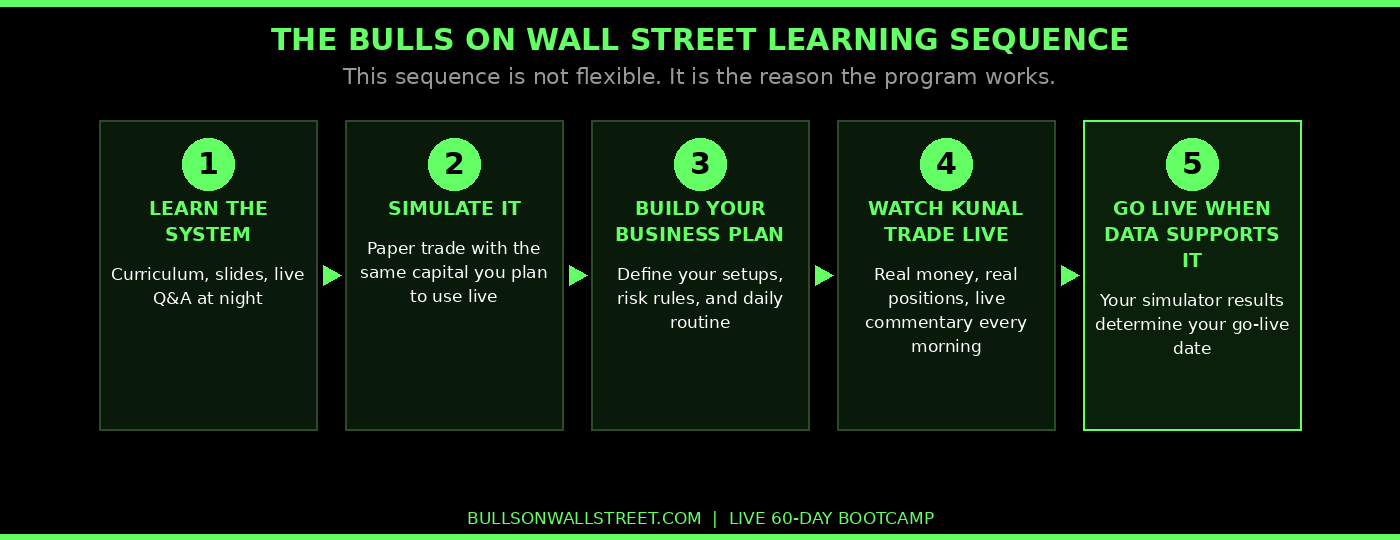
The Bootcamp is structured like a university, not a content library. Classes happen live at night with curriculum, slides, and real-time Q&A. During market hours, students watch me trade every morning — real money, real positions, real decisions with live commentary. There is homework. There are quizzes. There are group exercises. Students have direct access to me and my team throughout the program.
Here is something most people do not know about how this program was built. The live trading room came before the courses. I launched the chatroom and live trading operation in 2008. The formal bootcamp came later, once I saw clearly that students needed structured curriculum to make sense of what they were watching in the live room. They needed both — not one or the other. The curriculum without live trading produces knowledge without instinct. The live room without curriculum produces confusion without context.
One rule that is non-negotiable: students do not trade live money during the Bootcamp. The sequence is fixed. Learn the system. Simulate it. Build a trading business plan. Watch live trading every day until execution becomes familiar. Go live only when your simulator data supports it. That sequence is the single biggest driver of student outcomes in this program.
BullsVision — the unified trading chatroom — includes day trading, swing trading, and options coverage in one subscription. No fee stacking. No three separate services that never talk to each other. Try the first week for $7 and watch how live market analysis actually works.
Warrior Trading
Warrior Trading is one of the most recognized brands in retail trading education. Ross Cameron has publicly posted broker statements showing profitable years and has built a substantial course library around his methodology.
The honest critique is not about credibility — it is about style fit. Ross trades microcap stocks. We are not talking small caps. We are talking stocks with market caps often under $5 million, with floats so thin that a few thousand shares of size moves the entire stock. Ross trades with significant size in these names. That is the exact combination — tiny float, high volatility, large share count — that produces the dramatic percentage moves you see in his trading videos.
Here is the problem for students trying to replicate it. When you trade a stock with a $3 million float and 500,000 shares of daily volume, your own order is part of the market. A retail trader with any meaningful account size cannot enter and exit cleanly without moving the price against themselves. The fills that Ross gets — a trader with years of experience, direct market access, and deeply tuned execution in that specific niche — are not the fills a student is going to get. The style works for him. It is genuinely one of the hardest trading styles in the market to scale as a student.
The curriculum covers that approach in depth. Programs range from $797 to $3,997. If microcap momentum is your specific focus and you understand the execution challenges going in, it is a real course from a real trader. Just go in with clear eyes about what the style demands. For a full side-by-side comparison of both programs, read the Warrior Trading vs Bulls on Wall Street breakdown.
Investors Underground
Nathan Michaud has been running Investors Underground since 2004, which earns it credibility on longevity alone. The curriculum is deep and well-organized. The community of experienced traders is genuinely active. The focus leans heavily toward low-float, small-cap momentum setups. The live components are solid. Higher price tiers push the total cost up significantly above baseline membership. If small-cap momentum is your primary focus and you have the budget for it, IU belongs on your shortlist.
Bear Bull Traders
Andrew Aziz built Bear Bull Traders into a recognized platform with accessible pricing — around $99 per month to start. The trading psychology curriculum is one of the stronger elements in the program. It has been recognized by Investopedia and Business Insider. The volume of recorded content is high. Live access depends on membership tier. For beginners working with a limited budget who want structured content without the premium cost of larger platforms, it is a reasonable starting point. Just go in knowing what you are getting: primarily recorded material with limited live interaction at the base tier.
Humbled Trader
Shay Huang runs a transparent, beginner-focused operation with an emphasis on realistic expectations. More than 150 lessons, community access, pre-market planning sessions. Lifetime access costs $1,999. The tone throughout the program is honest about what trading actually takes — which puts Humbled Trader in a different category from the small-account-challenge crowd.
Coursera and Udemy
Generic. Not built for active day traders. Useful if you want foundational finance concepts or algorithmic trading theory. Not useful if you want to execute momentum trades in live market conditions. Skip these if live trading is your goal.
Live vs. Recorded: Why This Is the Only Question That Matters
Learning to trade is not different from learning any other high-skill profession. You would not become a surgeon by watching recorded surgeries. You would not become a lawyer by reading archived case files. You learn under real conditions, with someone who can tell you in the moment what you are doing wrong and why.
Trading is the same. The market does not care that you watched 40 hours of video. It only cares what you do when the price action starts moving and your position is open.
Every student who came to BOWS from a recorded-only program had the same core problem: they had knowledge but no instinct. They could describe chart patterns but could not execute under pressure. That gap only closes in live environments. There is no shortcut.
That is why I built the live trading room before I built the courses. And it is why the Bootcamp wraps a structured curriculum around live daily market exposure. You need both. Curriculum without live trading creates a trader who can talk but cannot act. Live trading without curriculum creates one who watches but cannot understand.
If you are still building the foundation, start with the day trading strategies pillar to understand the setups before you think about which course to buy. Then read how long it actually takes to learn day trading — because most course marketing gives you a very distorted timeline. And if you want to understand why the majority of traders who try this never make it, the why traders fail breakdown is required reading before you spend anything.
The Real Verdict
The best day trading course is not the cheapest. It is not the most famous name on YouTube. It is not the one running the most Instagram ads or the most aggressive email sequences.
It is the one that puts you in the room with a real trader executing real trades and forces you to learn by watching, asking, and eventually doing — in that order.
If the course you are evaluating cannot offer that at any tier, keep looking.
The 60-Day Live Trading Bootcamp is built around exactly that. Not recorded videos. Not highlights. Live trading, live curriculum, and direct access to the instructor throughout the program. If you want to see how the live trading room works before committing to the full program, start with the $7 BullsVision trial and watch real market hours in real time.
That is the standard. Hold every course you consider to it.
Frequently Asked Questions About Day Trading Courses
What is the best day trading course for beginners?
The best course for beginners is one that combines live instruction with a structured curriculum — not just a video library. Look for programs where the instructor trades real money in front of students during market hours, where you can ask questions directly, and where the sequence of learning is clearly defined before you start trading with real capital.
How much does a day trading course cost?
Prices range from $99 per month for community-based platforms to $3,997 for premium course packages. Be careful about programs with low headline prices that require add-on subscriptions to access live components. Calculate the total monthly cost including all the features you actually need before comparing programs.
Are day trading courses worth it?
They can be — but only if the course includes live trading access, real mentorship, and a structured curriculum. Recorded-only video courses at any price point tend to produce traders with knowledge but no execution instinct. That gap is expensive to close after the fact.
How long does it take to learn day trading with a course?
Most serious programs take 60 to 90 days to complete the formal curriculum. Building genuine proficiency in live markets takes significantly longer — often 12 to 24 months of consistent practice and journaling. Any course that promises profitability in 30 days or less is not being honest with you.
What is the Pattern Day Trader rule and how does it affect which course I should choose?
The PDT rule requires a minimum $25,000 account balance to make unlimited day trades. If you are starting with less than $25,000, your course needs to include instruction on how to operate under that constraint — through swing trading, futures, or PDT-compliant strategies. Courses that do not address this are leaving you unprepared for a regulatory reality you will hit immediately.
Can you learn day trading for free?
You can learn the basics of technical analysis and chart patterns for free on YouTube. What you cannot learn for free is execution under live market conditions with real accountability. That is where paid education — specifically live trading rooms and structured bootcamps — creates outcomes that free content cannot.
What should I look for in a day trading chatroom?
A legitimate trading chatroom should have the lead trader executing live every market day — not just sharing alerts after the fact. It should cover multiple styles (day trading, swing trading, options) in one unified community rather than forcing you to pay for separate services. And it should have clear education embedded in the commentary, not just ticker calls.
Is Warrior Trading a scam?
Warrior Trading is a real company with a real educational product. Ross Cameron has posted verifiable broker statements. The courses are heavily focused on microcap momentum — a legitimate but difficult style to replicate at student level due to float constraints and execution realities. As with any program, do your due diligence before purchasing.
What is the difference between a live trading bootcamp and a recorded course?
A live bootcamp includes real-time instruction, live market trading, homework, Q&A, and direct mentor access throughout the program. A recorded course is a content library — you can watch and re-watch, but there is no live component, no accountability, and no one to answer your questions in real time. For most traders, the gap in outcomes between the two formats is significant.
How do I know if a day trading educator is legitimate?
Look for verifiable track records — not screenshots, but broker statements. Look for longevity: how long has this program been operating? Look for student outcomes that go beyond testimonials. And check whether the educator trades live in front of students or only shares results after the fact. Legitimate educators have nothing to hide and plenty to show.
Kunal Desai is the CEO and founder of Bulls on Wall Street. A professional trader since 2007, he has navigated every major market cycle -- from the 2008 financial crisis to today's high-volatility environments. Having mentored 7,000+ students through his live trading bootcamps, Kunal trades live every morning in the Bulls on Wall Street Trading Chatroom and is dedicated to teaching real-world execution and high-probability strategies. Based in Miramar Beach, Florida.
Connect with Kunal: Read his full story | Instagram | YouTube