

Two of the most searched names in day trading education. Same broad goal -- teach people to trade profitably. Very different approaches to getting there.
I am Kunal Desai. I founded Bulls on Wall Street in 2008 and have traded live every single day since 2007. I have trained 7,000+ students across every market cycle -- the 2008 financial crisis, the 2020 COVID crash, the 2022 bear market, and every volatile stretch in between. Writing this comparison puts me in an awkward position because I have skin in the game. I know that.
So here is my commitment to you: I am going to be as honest as I know how to be. Warrior Trading has built a legitimate business with a large community. Ross Cameron is a real trader who made real money. Where BOWS wins, I will tell you why. Where the programs genuinely differ, I will lay it out straight. And where you might actually be better served by Warrior Trading depending on your situation, I will say that too.
What I will not do is sell you with hype. If you want hype, both programs have plenty of marketing for you to read. This is the version without the marketing.
Updated April 2026.
A Program Built Before the Industry Existed
When I started Bulls on Wall Street in 2008, there was no trading education industry to speak of. A handful of companies, some new names starting to emerge -- Timothy Sykes, Investors Underground, both good friends of mine, we all started around the same time. Their focus was chat rooms. Mine was chat rooms plus education wrapped together. But a structured curriculum? A university-style program with homework and quizzes and a defined sequence? That did not exist anywhere online that I could find.
The first few bootcamps ran on Skype. No slides, no webinar software, just me getting on a call and walking through trading concepts with a small group. It was not organized. The material was solid because I knew how to trade, but the delivery was raw. Bootcamp three is where we finally built what I would call a real program -- slides, homework, quizzes, a defined weekly structure. From what I can tell, that might have been the first structured live trading curriculum on the internet.
And even if I was not technically first -- I am the only one still standing from that era.
Seventeen years. Every market cycle. The 2008 financial crisis, the 2020 crash, the 2022 bear market, the 2025 volatility. The program has been live through all of it. That is not a marketing claim. That is just the record.
The Short Version
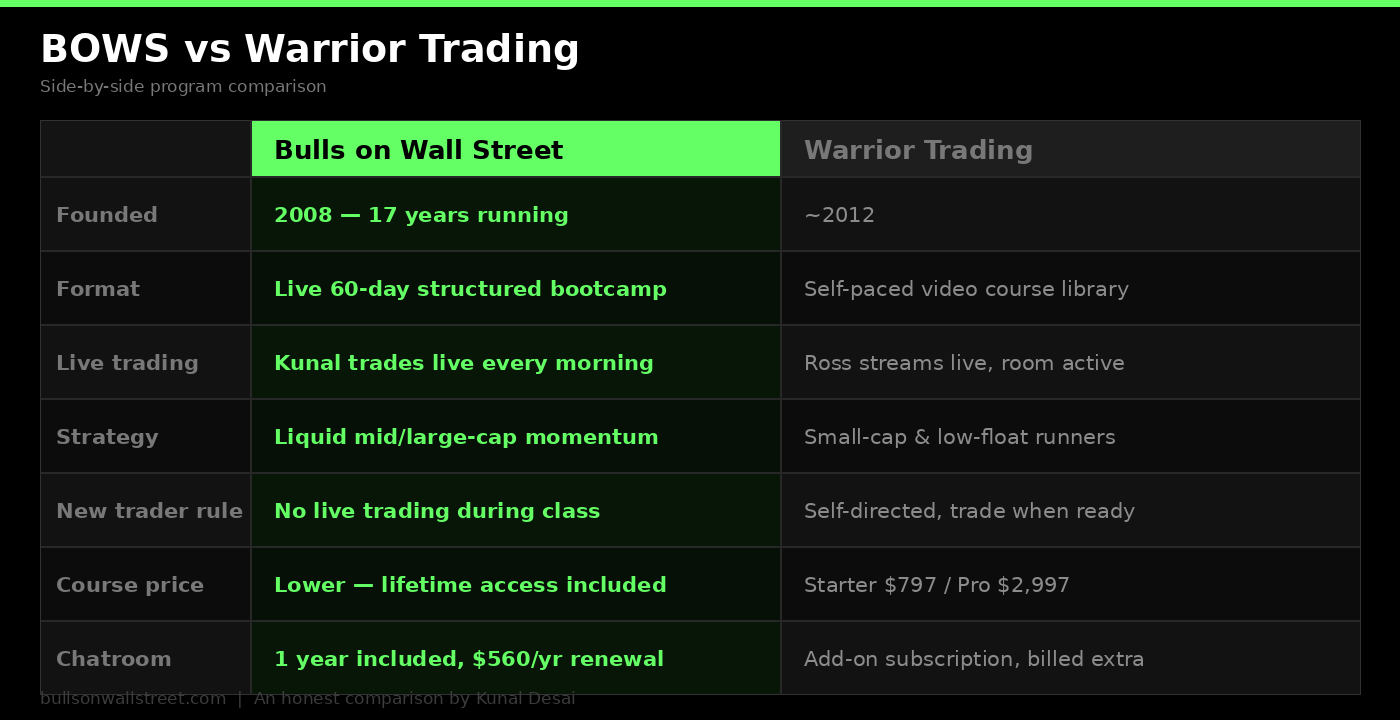
Warrior Trading was founded around 2012 and built its brand on Ross Cameron's personal trading results -- specifically a documented run of turning a small account into significant gains. The program leans heavily into small-cap momentum and penny stock strategies, with extensive video course libraries and a live trading room.
Bulls on Wall Street was founded in 2008 -- four years earlier -- and built around a structured 60-day live bootcamp format where Kunal Desai and the team trade live every morning while students learn the methodology in real time. BOWS focuses on momentum trading across liquid mid-cap and large-cap names using TC2000 for charting and scanning.
Same general category. Different teaching philosophy, different strategy focus, different price point, and very different approach to when students should start trading with real money.
Program Comparison: The Categories That Actually Matter
1. Format -- How You Actually Learn
This is the biggest difference between the two programs and the one most people overlook when comparing.
Warrior Trading is primarily a video-based course library. You get access to recorded modules, and you can trade alongside the live room. The learning is largely self-directed. You watch videos, you read the materials, you decide when you feel ready to start placing real trades.
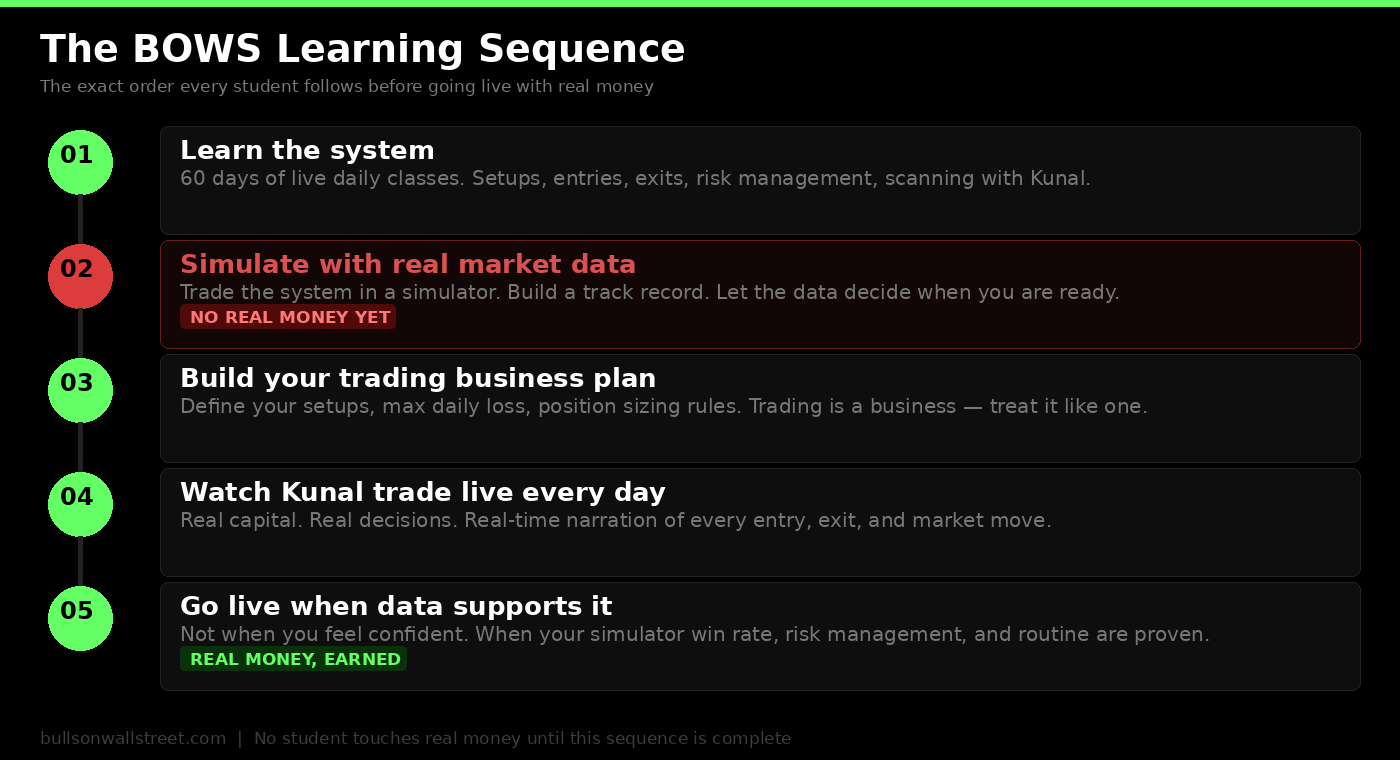
BOWS is structured around a live 60-day bootcamp. Every class is live. The sequence is deliberate: learn the system, simulate it, build your trading business plan, watch live trading in the chatroom, and only go live when your data supports it. Not when you feel confident. When the numbers say you are ready.
The no-live-trading-during-class rule did not come from a manual. It came from a disaster.
Second bootcamp I ever ran. Eleven guys. We were doing the whole thing on Skype -- this was early, I was a young man still figuring out how to teach what I knew. Small group, raw format, good energy. We were getting through the material together.
The problem was every single time I taught a new pattern, those guys would close their laptops and go trade it the next morning. Like I handed them a new toy and they absolutely could not wait to use it. First pullback -- gone trading. Flag breakout -- gone trading. Opening range breakout -- gone trading. Every session, same thing. New pattern, new frenzy.
By the time we hit the final sessions -- the part where we cover how to open accounts, where to trade, how to think about sizing up -- I asked the room how everyone was doing.
Crickets.
Complete silence. Finally one of them tells me what happened. Everybody had blown through their money. Not a little. All of it. Most of them needed to wait weeks just to fund their accounts again before they could start fresh.
They had traded every pattern as I taught it -- half-learned, no risk framework, no business plan, no simulator data behind them. Just pure excitement with real money attached to it.
That was the last time a BOWS student touched real money during class. The rule has been in place ever since and it does not bend. You learn first. You simulate. You build your plan. You watch live trading in the chatroom. You go live when your data says you are ready -- not your emotions.
2. Strategy -- What You Are Actually Learning to Trade
Warrior Trading built its curriculum around small-cap and penny stock momentum. Ross made his name trading low-float runners -- stocks that gap up on news and move violently in the first hour. It is a real strategy that real traders use. It is also a strategy that is extremely difficult to execute consistently because these stocks are thin, spread can be brutal, and the patterns fail more often than they succeed for most new traders.
BOWS focuses on momentum trading in liquid names -- stocks trading at least one million shares per day. The core setups are the first pullback, the opening range breakout, VWAP bounces, parabolic shorts, and flag breakouts. TC2000 is the platform of choice because its scanning and charting tools are built specifically for identifying these setups in real time.
The distinction matters practically. When you are a new trader managing risk, a liquid name at $15 with one million shares a day behaves predictably. You can get in and out cleanly. A low-float penny stock at $2.50 that is trading on rumor can gap against you and cost you ten times what your stop loss implied. Slippage is real in thin names.
Neither approach is wrong. Both can produce results. But for a trader who is still building their foundation, the margin for error is much smaller in thin low-float names.
3. What a Real Student Built
Barbara Weiss is one of my mentorship students. Born in Brazil, moved to Europe in her 20s to build a career in the pharmaceutical industry. Got married, had three kids, built a life -- and then decided she wanted to work for herself.
She found BOWS, went through the 60-Day Bootcamp, and joined the six-month mentorship program. She even flew out for an in-person event at my house. Serious student. The kind who does the work.
But she had a real problem early on. Risk management. She wanted to shortcut the process -- jump to the good part, skip the foundation. Sound familiar? Every trader goes through this. The difference with Barbara was that once we started working one-on-one, we built a system specifically around how her brain works. Not a generic framework -- something that automated the risk decisions so her natural talent could operate without her psychology getting in the way.
Last year Barbara launched a hedge fund in Switzerland. Seven figures under management. New clients coming in every month. I sit on the advisory team.
That is what this program is actually built to produce. Not just profitable retail traders -- though we have thousands of those -- but people who build something real with the skills they develop. Barbara is not typical. Most students become consistently profitable retail traders, which is already a hard thing to do. But the ceiling on what is possible when the foundation is right has no limit.
No recorded video course produced Barbara's outcome. What produced it was live daily training, one-on-one work, a community that held her accountable, and a system built around her specific weaknesses. That is the BOWS model.
4. Longevity and Track Record
BOWS has been running the same bootcamp format since 2008. That is 17 years of live daily trading through every major market cycle. We have students who joined in 2010 and are still active in the community today. The strategies taught in 2008 still work in 2026 because they are built on price action and momentum -- forces that do not change regardless of market regime.
Warrior Trading launched around 2012. Also a substantial track record by any measure in this industry. Ross has been consistent in building his brand and his community over that time.
When you are evaluating any trading education program, longevity matters. Programs that teach systems that stop working tend to disappear. The ones still running after a decade are running for a reason. According to FINRA's investor guidance on trading education, one of the strongest signals of a legitimate program is a verifiable, multi-year operating history with documented student results.
5. What I Actually Think of Ross Cameron
One thing I will say about Ross Cameron that I mean completely: the man is a worker. He has built a significant business, made real money, and you still see him putting out YouTube videos every day, live streaming every morning, showing up consistently year after year. That level of content output is a different kind of work than trading -- and it is genuinely hard. I trade live every day and teach classes, but making YouTube videos every day, posting on Instagram every day, showing up on Twitter every day? That takes a different gear that I have a lot of respect for.
What strikes me most is that his personality has not changed. The way he talks, the way he treats people, the energy he brings -- it is the same now as it was over ten years ago when he was in my chatroom just starting out, brand new, figuring it out like everyone else. A lot of people change when the money comes. Ross did not. He is still the same guy, still grinding, and that says something real about who he is.
We built different programs with different philosophies. But on work ethic and character, I have nothing but respect.
6. What Actually Happens in the BOWS Chatroom Every Morning
Most trading chatrooms are random. People on free trials, discount hunters, a mix of beginners and randos all posting different things about different stocks using different systems. There is no shared language. No shared framework. Just noise.
The BOWS chatroom is different because of one rule: almost everyone in it went through the bootcamp. We are talking 99% of members. That is not an accident -- it is the whole design. When you have a chatroom full of people who learned the same setups, use the same scanning methodology, and look at charts the same way, something completely different happens. Hundreds of eyes all running the same system simultaneously. When someone calls out a setup in our room, everybody else already knows exactly what they are looking at. No translation required.
Here is what a real morning looks like.
The night before, members get a full game plan video. Not a highlight reel -- a walkthrough of what I am watching, what setups are forming, what the market context looks like heading into the next session. They come in prepared, not cold.
At 9:00 AM I am live in the room. We pull up the major indices together. We talk about what is relevant that morning -- interest rates, oil, any macro news that matters -- and we map out whether the market has bullish or bearish tendencies and how that should adjust our game plan. Then we run scans. Pre-market gappers. Earnings plays. Momentum names with big range or developing trends. We sift through all of it and narrow down to a top six. Those six are what I stream while I trade. That is what students are focused on. Not 200 stocks. Six.
When the market opens I am calling out every entry and exit in real time. Where I got in. Where the stop loss is. What the thesis is. And as the trade moves -- up or down -- I am giving live commentary. Why it is working. Why it is not. What the market is doing to oil right now and how that is showing up in the QQQ. Correlations. Context. The stuff you only learn by watching a real trader work through a real trading day.
When there is a lull mid-morning, we do a trade recap. We reverse-engineer every trade I took. Why that entry. What I got right. What I got wrong. Honest post-mortem on every single trade, recorded and archived.
I have thousands of these archived recaps. Every trading day for years.
You cannot get that from a recorded video course. A recorded course teaches you the playbook. The live room teaches you how to read the game as it is actually being played.
7. Price
Warrior Trading offers two main tiers: Warrior Starter at $797 (foundational course only) and Warrior Pro at $2,997. Chatroom and live stream access are sold separately as monthly add-ons on top of those prices. Their Warrior Pro Special at $3,997 bundles in one year of live access, but after that year the meter keeps running.
BOWS's 60-Day Bootcamp includes one full year of access to all three chatrooms from day one -- no add-on required, no separate subscription to manage. After that first year, renewal runs $560 per year for all three rooms when you catch a special, or monthly if you prefer. One price to learn, one community to grow in.
8. Do Your Homework Before Joining Any Trading Program
This applies to BOWS too, so I am not singling anyone out.
Before you spend money on any trading education, verify the claims. Check Trustpilot for independent student reviews. Ask whether the instructors trade live with real capital or just manage simulated accounts. Ask to see the curriculum before you buy. Understand the refund policy. Understand what happens after the core program ends -- do you have continued access to the community and live sessions, or does the meter keep running?
The FTC has published guidance specifically on evaluating trading courses and educators. It is worth reading before you write a check to anyone, including us. BOWS has no regulatory issues, 445+ verified Trustpilot reviews averaging 4.6 stars, and 17 years of continuous operation. The record speaks for itself.
Who Each Program Is Built For
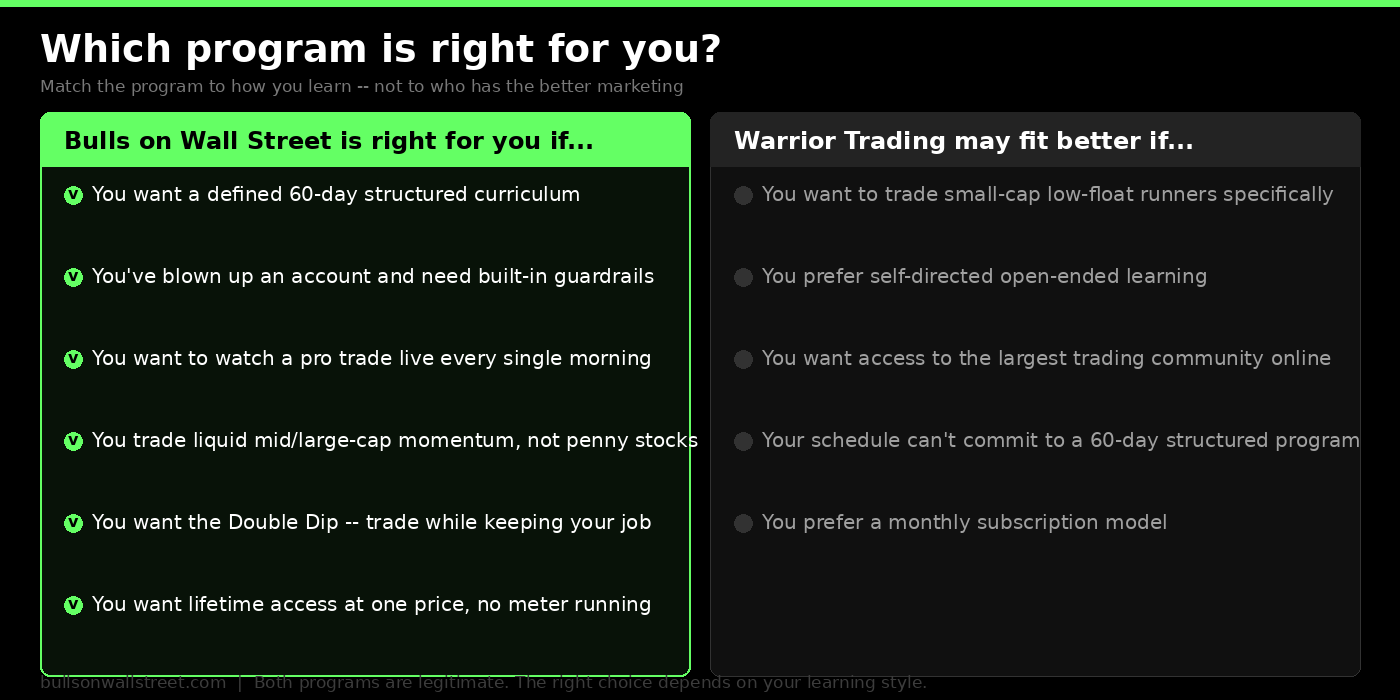
BOWS is right for you if you want structure -- a defined sequence, not open-ended video modules. If you have blown up an account before and need guardrails built into the curriculum. If you want to watch a professional trade live every single morning with real capital and real commentary. If you trade or want to trade liquid mid and large-cap momentum stocks rather than penny stock runners. If you want to learn the Double Dip -- building your trading account while keeping your job. And if you want lifetime access at one price with a year of chatroom included from day one.
Warrior Trading may fit better if you specifically want to trade small-cap and low-float runners. If you prefer self-directed learning at your own pace with no structured commitment. If you want access to the largest trading community online. Or if a subscription model with rolling monthly access fits your budget better than one upfront payment.
The Real Question Nobody Asks
Most people comparing programs are asking the wrong question. They want to know which program will make them profitable fastest. That is the wrong frame.
Trading is the hardest profession in the world. The programs that succeed are the ones that give you the tools, the methodology, and the mental framework to stay in the game long enough to get good. It took me seven years. Most of my students who became consistently profitable took 12 to 24 months of serious work.
The right question is: which program gives me the best chance of staying in the game, managing risk correctly, and improving my execution over a long enough time horizon that the edge eventually shows up in my results?
At BOWS, the answer to that question is built into the structure. The 1% risk rule, the position sizing formula, the no-live-trading-during-class rule, the trading psychology curriculum -- these are not optional modules. They are the foundation. You also need to understand the PDT rule before you fund any account. Many new traders do not realize that without $25,000 you are limited to three day trades per rolling five-day period.
Frequently Asked Questions About Warrior Trading vs Bulls on Wall Street
Is Warrior Trading or Bulls on Wall Street better for beginners?
BOWS is likely better for most beginners because of the structured 60-day curriculum and the no-live-trading-during-class rule. New traders who start placing real trades too early before the methodology is solid tend to blow up accounts. BOWS specifically prevents this with a mandatory learn-first sequence.
What strategies does Warrior Trading teach?
Warrior Trading focuses primarily on small-cap and low-float momentum strategies, particularly stocks that gap up on news or earnings. Ross Cameron has built his curriculum around his specific setups developed over his trading career.
What strategies does Bulls on Wall Street teach?
BOWS teaches momentum trading in liquid names -- the first pullback, opening range breakout, VWAP bounce, parabolic shorts, flag breakouts, and swing trading pullbacks. The full strategy library is taught inside the 60-Day Live Bootcamp.
How much does Warrior Trading cost vs Bulls on Wall Street?
Warrior Starter is $797, Warrior Pro is $2,997 with chatroom access sold separately as a monthly add-on. BOWS's 60-Day Bootcamp is priced lower with a full year of chatroom access included and lifetime course access. Check current pricing directly at both sites as promotions change.
Does Kunal Desai trade live every day?
Yes. Kunal has traded live every single trading day since going full-time in 2007. Students in the Bulls on Wall Street chatroom watch him trade in real time every morning with real capital and real-time commentary on every entry, exit, and market development.
When was Bulls on Wall Street founded vs Warrior Trading?
BOWS was founded in 2008. Warrior Trading launched around 2012. BOWS may have been the first structured live trading bootcamp curriculum on the internet -- and is the only program from that era still running.
Can I trade while working a full-time job and still use these programs?
Yes. BOWS specifically addresses this through the Double Dip philosophy -- keeping your day job while building your trading account and skills simultaneously. Swing trading is particularly suited to this because it does not require you to be at a screen during market hours every day. See our full guide on day trading strategies.
What charting platform does Bulls on Wall Street use?
TC2000 -- purpose-built for momentum scanning and charting. Kunal's full trading layout is available for direct download from the TC2000 site.
Is there a refund policy at either program?
Neither BOWS nor Warrior Trading offers refunds. This is standard in the trading education industry. Review all free materials thoroughly and watch the free content on YouTube before purchasing either program.
What makes the BOWS chatroom different from other trading rooms?
99% of BOWS chatroom members have gone through the bootcamp. Everyone is running the same system, using the same setups, scanning the same way. That means hundreds of traders all looking at the market through the same lens -- which creates a level of signal quality and shared focus that a general-population chatroom simply cannot replicate.
Both programs are real. Both have produced traders who built careers from what they learned. They are genuinely different in format, strategy focus, and teaching philosophy. Match the program to how you learn and what you are trying to trade -- not to who has the better marketing.
If the BOWS approach -- structured, sequenced, live daily, real accountability -- sounds like what you need, the 60-Day Live Trading Bootcamp is where to start. Watch the free content on YouTube first. If it resonates, apply.
About Kunal Desai
Kunal Desai is the CEO and founder of Bulls on Wall Street. A professional trader since 2007, he has navigated every major market cycle -- from the 2008 financial crisis to today's high-volatility environments. Having mentored 7,000+ students through his live trading bootcamps, Kunal trades live every morning in the Bulls on Wall Street Trading Chatroom and is dedicated to teaching real-world execution and high-probability strategies. Based in Miramar Beach, Florida.
Connect with Kunal: Read his full story | Instagram | YouTube
Related reading: Why Trading Is the Hardest Profession | Risk Management: The 1% Rule | Trading Psychology | PDT Rule Explained | Why Traders Fail | Live Traders vs Bulls on Wall Street