


The best small-account day trading strategy is trading stocks with a catalyst and buying the first pullback into the Bone Zone. That single setup prints dozens of times a day, hands you an easy entry, gives you a defined place to bury your stop, and leaves the recent high sitting there as your target. If you are growing an account from a small base, this is the engine I would put you on.
I have been trading since 1999. I went full-time at the end of 2007 and founded Bulls on Wall Street in 2008, and over 7,000+ students have come through my live trading bootcamps since then. In all that time the small-account question has never changed. People want the one strategy that grows a few thousand dollars without blowing up. This is the one.
Why one repeatable setup beats a toolbox of ten
A small account has no room for a scattergun. You cannot run five strategies at once and expect to get good at any of them, and the fees and the losses from sloppy trades drain a small account faster than anything. So you pick one setup that shows up constantly, and you run it until it is automatic. The full menu of setups I teach is on my day trading strategies page, but for a small account, this is the one.
The catalyst first pullback shows up dozens of times a day. Every single morning there are stocks with a press release or an earnings report pulling fresh buyers in. That is your pool, and it refills before the open every day.
Compare that to a parabolic short. A parabolic short is a higher-reward play, but you are fighting the trend and the clean ones are rare. You might see a textbook parabolic short once a month, maybe once every two months. You cannot build a small account on a setup that prints six times a year. You build it on the one that prints every session, where you can rinse and repeat and let the game stack up in your favor. Reps are the whole point. A small account grows from many clean, repeatable trades, not from one hero swing.
What the setup actually is
We have written a lot about the first pullback, and the mechanics are simple on purpose.
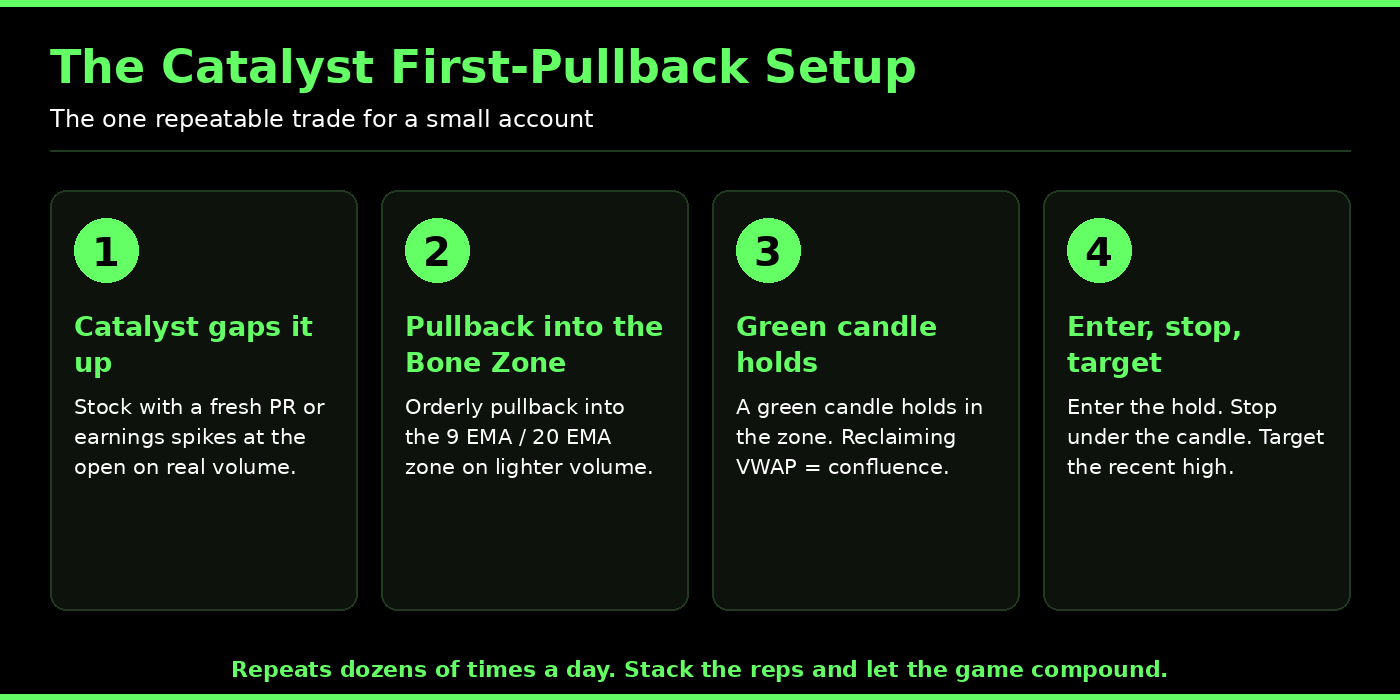
A stock with a catalyst spikes at the open. Then it pulls back in an orderly way into the Bone Zone, which is the shaded area between the 9 EMA and the 20 EMA on the 5-minute chart. The pullback should come on decreasing volume, not heavy selling. When price settles into that zone and prints a green candle that holds, that is your entry signal.
That gives you three things in one spot:
- An easy, identifiable location to get long. The Bone Zone is right there on your chart every day.
- A defined stop. You put it under the low of that green candle. If the candle fails, you are out small. My candlestick chart patterns PDF shows what a clean green candle looks like.
- A target. The recent high is sitting right above you as the first objective.
When you can get a green candle to hold inside the Bone Zone and price is also reclaiming VWAP, that is confluence, and confluence is what turns a decent setup into a low-risk, high-reward one.
I run all of my scanning and charting in TC2000, and if you want to pull this layout yourself you can grab a TC2000 plan here.
How to pick the stock
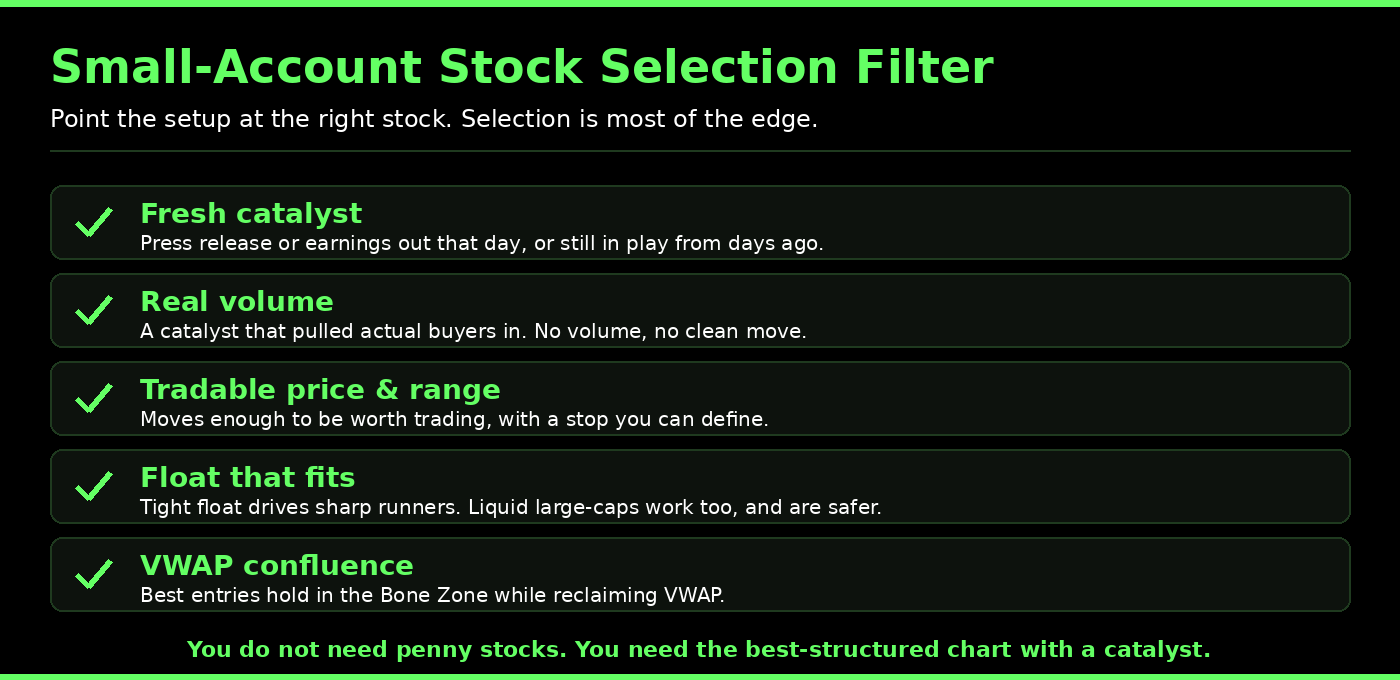
The setup only works if you point it at the right names. Stock selection is most of the edge on a small account.
Start with the catalyst. You want a stock with a press release out or earnings out that day, something that brought real buyers and real volume into the name. No catalyst, no participation, no clean move. From there you want a stock that moves enough to be worth trading but is still tradable. The runners I trade for this setup are often lower-float names where supply is tight, so a fresh catalyst and volume can drive a sharp, clean move. The three live examples below ran on floats of 4.4 million, 1.7 million, and 621 thousand shares. When float is that tight and a catalyst hits, you get the orderly spike-and-pullback structure this setup needs. For a deeper walkthrough of how I find these every morning, read how to scan for explosive stocks.
Real trade: ASTC into the Bone Zone over VWAP
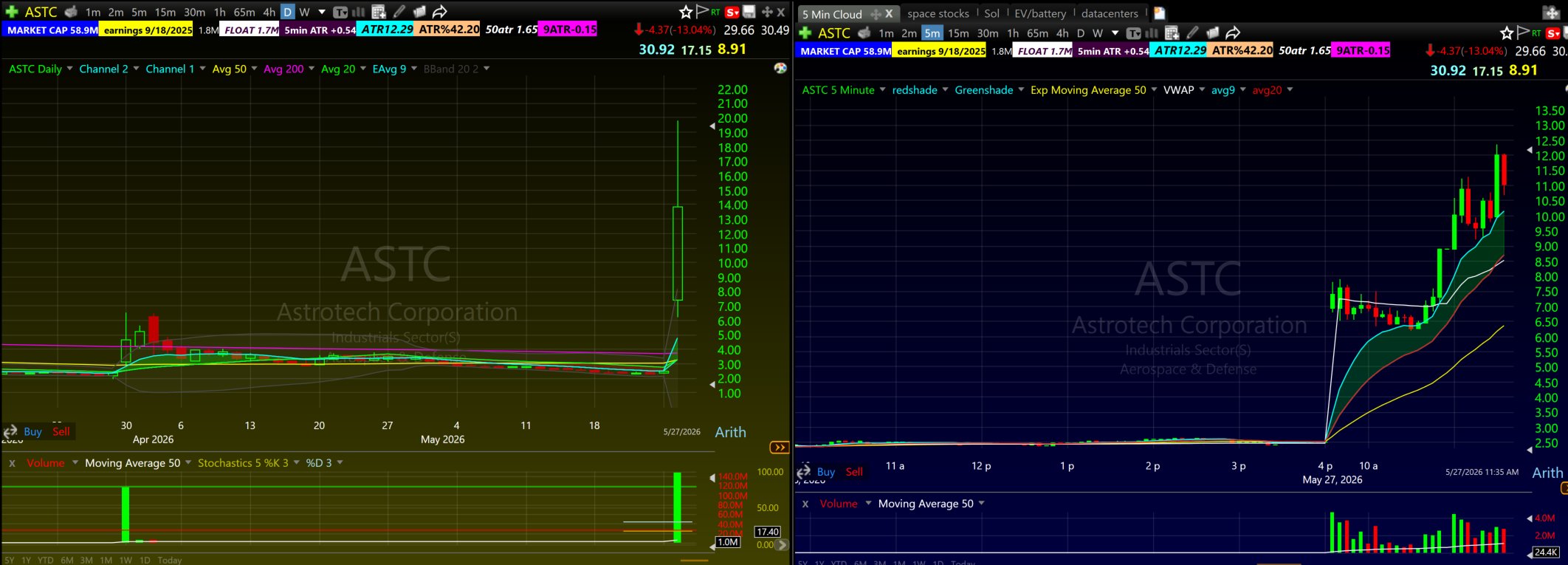
ASTC is the cleanest version of this I can show you. We traded it on May 27, 2026. They put a press release out that they were doing lunar-based development for quantum computing, and the stock gapped up over 100 percent on it. One thing to remember is that with the SpaceX IPO coming, anything with a space theme has been running hard, so the catalyst had a tailwind behind it.
A 100 percent gap is a lot, and the key on something that extended is patience. I did not chase the open. I waited until it came right into the Bone Zone and I got a green candle to hold. Then I started to add as it broke over VWAP around 7, which is the confirmation, with a stop loss right under that breakout candle. From there it ran into the 12s. Patience into the zone, confirmation over VWAP, stop under the candle. That is the whole trade.
Real trade: SDOT, a clean zone hold
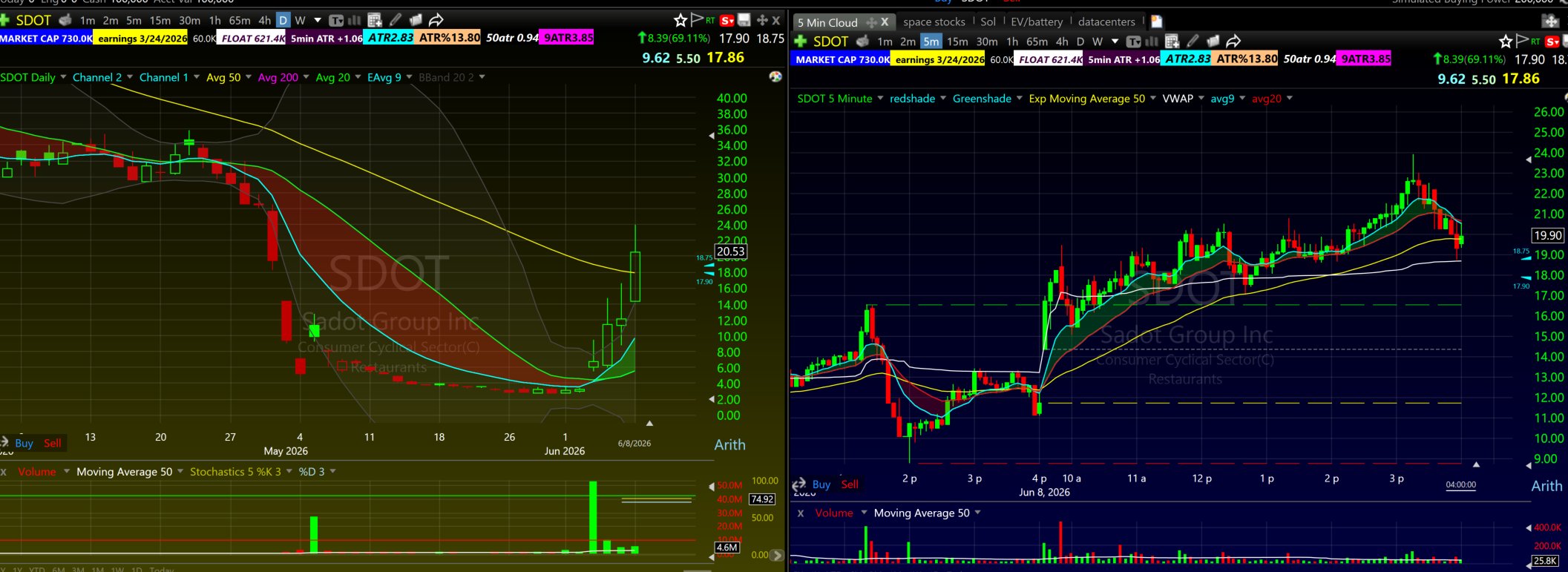
SDOT gave you the same structure on a smaller scale. Nice spike at the open, then an orderly pullback right into the Bone Zone near 16. When you got the green candle to hold in the zone, you add it with a stop loss under that candle, and now you can play the thing to the upside. Same setup, same risk location, different ticker. That is the repeatability I am talking about.
Real trade: INHD, a deeper low-float pullback
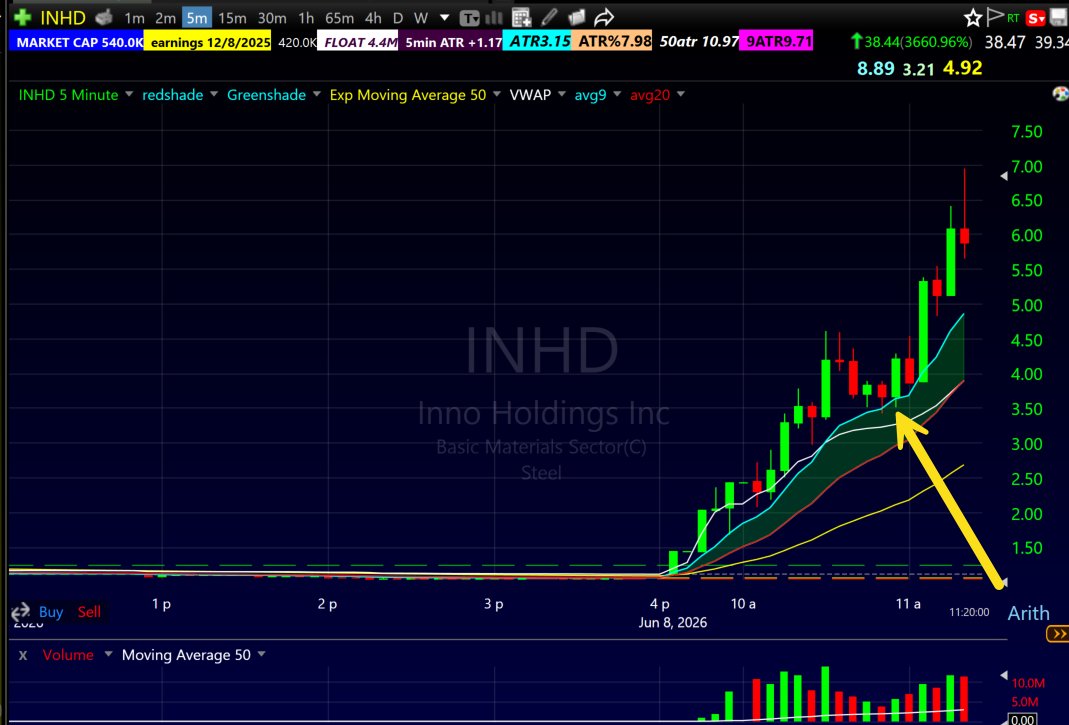
INHD had a press release out and started to trend off the open on a 4.4 million share float. Look at the beginning of the move. It works back down to the 9 EMA right off the gate. Then once it breaks 5 it gives you a nice orderly pullback right into the Bone Zone, a little deeper this time, which actually gives you an even easier way to manage the risk because your stop under the zone is well defined. Deeper pullback, tighter risk, same playbook.
You do not need penny stocks to run this
Here is the part most small-account content gets wrong. The first pullback into the Bone Zone is not just a low-float, small-cap setup. You can run it on regular, liquid stocks, and you can run it even on a day when there is no fresh catalyst, as long as a recent catalyst is still in play.
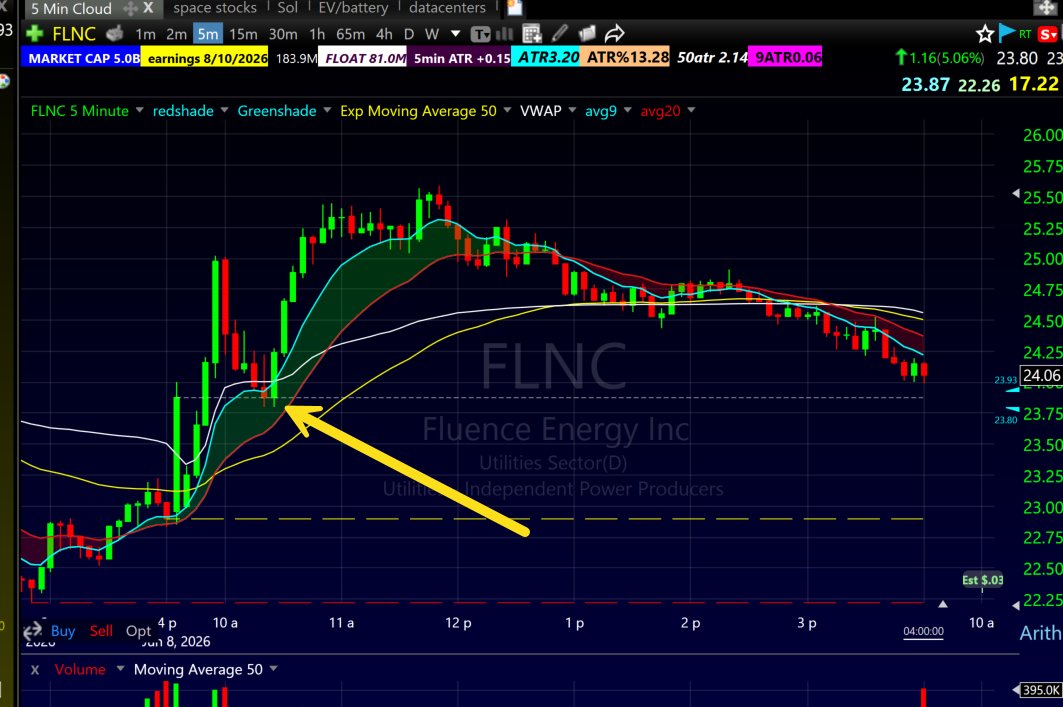
Look at FLNC. It is a 5 billion dollar company with an 81 million share float, nowhere near a low-float runner. FLNC had a press release out with NVIDIA five days earlier, which is a huge plus for them as a company. Even on the days after the catalyst, that strength holds true, so we keep trading it. In the morning you got a nice spike up to 25 around 10 a.m., then an orderly pullback into the Bone Zone down to 23.75. You also had confluence there because VWAP was sitting in the same spot. Green candle holds in the zone, reclaiming VWAP, and you have an easy low-risk long with great potential reward.
This matters for a small account. Clean liquid names like FLNC have tighter spreads and far less halt and dilution risk than a thin micro-float, which means your stop actually fills near where you set it. You do not have to gamble on the most dangerous stock on the board to use this setup. You point it at the best-structured chart with a catalyst, low-float or large-cap.
How to size it: the 1% Rule
A small account dies from one thing more than any other, which is risking too much per trade. So before you ever click buy, you decide what you are willing to lose, not what you hope to make.
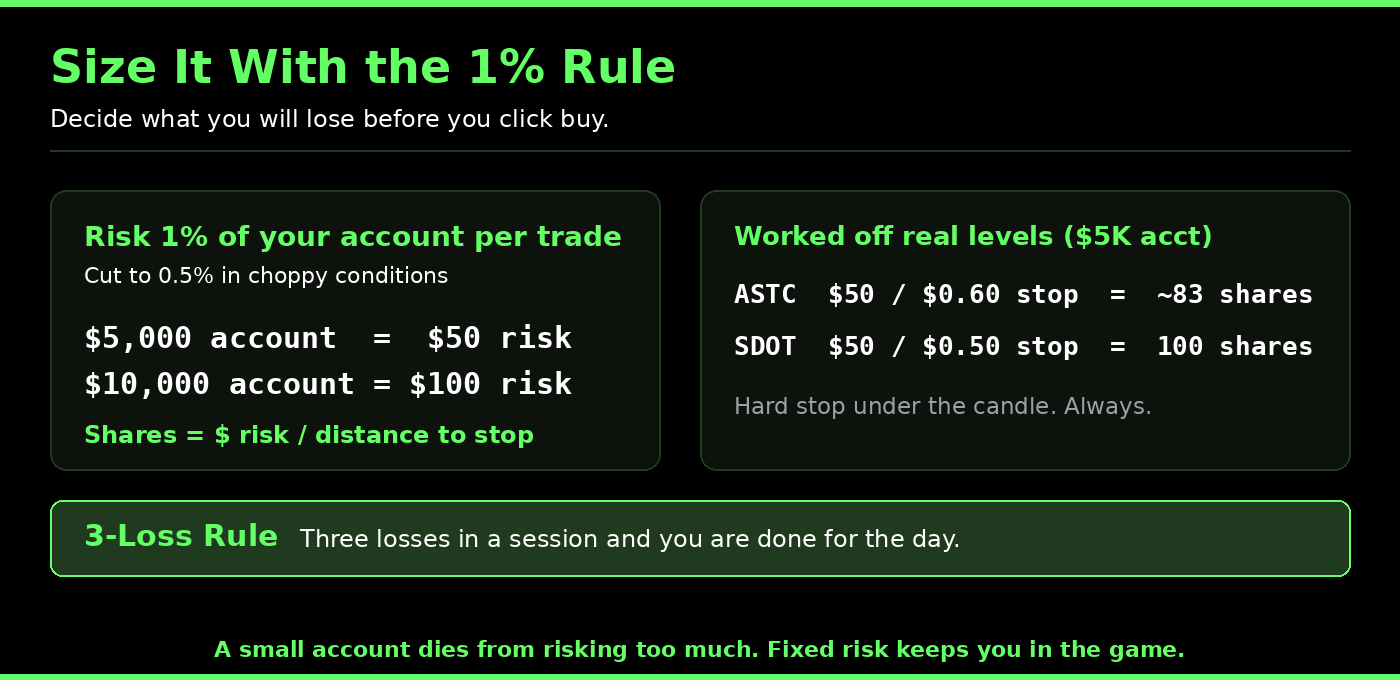
I teach the 1% Rule. You risk 1 percent of your account on a trade, and in choppy conditions you cut that to half a percent. On a 5,000 dollar account, 1 percent is 50 dollars of risk per trade. On a 10,000 dollar account it is 100 dollars. That dollar number is fixed before the trade, and it tells you exactly how many shares to buy.
Here is the math, using the real levels above. Your share size equals your dollar risk divided by the distance from your entry to your stop:
- On ASTC, say you add over VWAP and your stop under the breakout candle sits about 60 cents below. On a 5,000 dollar account risking 50 dollars, that is 50 divided by 0.60, or about 83 shares.
- On SDOT, say the green candle holds near 16 and your stop sits about 50 cents under it. That is 50 divided by 0.50, or 100 shares.
The stop is not optional and it is not mental. You use a hard stop order under the candle every time, because in a fast-moving stock a stop order becomes a market order the moment it triggers and your real fill can run away from you if you are not protected. The SEC has a plain breakdown of order types if you want the mechanics.
Then you cap your day. I run the 3-Loss Rule. Three losses in a session and you are done, you shut it down. On a small account this rule is the difference between a bad morning and a blown account. For the full framework on protecting limited capital, work through the risk management guide.
The 2026 change every small account needs to know
The 25,000 dollar floor died on June 4, 2026. A small account can now take unlimited day trades. Sounds like a gift. It is a trap if you do not have one setup nailed. More reps with no edge just means you go broke faster. The reps only stack in your favor when you are running the same catalyst pullback over and over with real risk control. Freedom to trade is not the same as a reason to trade.
The old Pattern Day Trader rule, which forced sub-25K accounts into three day trades per rolling five days, has been replaced by FINRA's new intraday margin requirements. For the full breakdown of what changed and how it hits your account, read our Pattern Day Trader rule update, and if you are right at the line, see can you day trade under 25K now.
The honest part
I tell my day-one students they will not be profitable in 30 days, and I am telling you the same. The research backs it up. A study of over 450,000 day traders found that fewer than 1 percent reliably earn profits net of fees over time (Barber, Lee, Liu and Odean). That number scares people. It should not. It tells you the edge is real but rare, and it lives in the small group that runs one repeatable setup with discipline instead of chasing everything that moves.
That is also why I push the Double Dip. Keep your day job while you learn this. Earn income and grow your trading account at the same time, and stack cash for two-plus years before you ever think about going full-time. A small account plus a paycheck is a far stronger starting position than a small account plus pressure. If you want the complete roadmap for trading limited capital, start with our guide on how to day trade with a small account.
FAQ
What is the best day trading strategy for a small account?
The catalyst first pullback into the Bone Zone. You trade a stock with a press release or earnings out, wait for it to spike then pull back in an orderly way into the area between the 9 EMA and 20 EMA on the 5-minute chart, and enter when a green candle holds in that zone. It gives you an easy entry, a defined stop under the candle, and the recent high as a target. It repeats dozens of times a day, which is exactly what a small account needs.
Why not use a higher-reward setup like parabolic shorts?
Parabolic shorts pay more per trade but you are fighting the trend and the clean ones are rare, maybe once a month or once every two months. A small account grows on reps, not on rare hero trades. The catalyst pullback prints every session, so you can run it over and over.
What is the Bone Zone?
The Bone Zone is the shaded area between the 9 EMA and the 20 EMA on the 5-minute chart. Price pulling back into it on decreasing volume, then printing a green candle that holds, is the entry trigger. It also gives you a clean, defined place to set your stop.
Do I need low-float penny stocks to trade a small account?
No. The setup works on liquid large-cap stocks too, like FLNC, even days after a catalyst. Clean liquid names have tighter spreads and less halt and dilution risk, which often makes them safer for a small account than thin micro-floats.
How much should I risk per trade on a small account?
Use the 1% Rule. Risk 1 percent of your account per trade, and half a percent in choppy conditions. On a 5,000 dollar account that is 50 dollars per trade. Your share size is that dollar risk divided by the distance from your entry to your stop.
How do I set my stop on this setup?
Place a hard stop order under the low of the green candle that holds in the Bone Zone. Use an actual stop order, not a mental one, because a fast stock can move away from you quickly.
What is the 3-Loss Rule?
Three losing trades in a single session and you stop trading for the day. On a small account this is what keeps one bad morning from turning into a blown account.
Can I day trade with a small account now that the PDT rule changed?
Yes. As of June 4, 2026, the 25,000 dollar minimum equity requirement for day trading no longer applies under FINRA's new intraday margin framework. You can take unlimited day trades, but more reps only help if you have one setup nailed and real risk control.
What stocks should I scan for this setup?
Stocks with a fresh catalyst, a press release or earnings, that are gapping with real volume. Tight float helps drive the clean spike-and-pullback structure, but a liquid name with a recent catalyst works too.
How long until I am profitable trading a small account?
Longer than 30 days. Fewer than 1 percent of day traders are reliably profitable, and the ones who get there run one repeatable setup with discipline. Plan for a multi-year process and keep your day job while you build the skill.
Ready to trade this for real
If you want to learn the catalyst first pullback the right way, with structure instead of guessing, that is exactly what we build in the 60-Day Live Trading Bootcamp. You learn the setup, simulate it, build a business plan, watch me trade it live, and only go live when your own data says you are ready. Come learn to trade a small account like a professional.
About the author
Kunal Desai is the CEO and founder of Bulls on Wall Street. A professional trader since 2007, he has navigated every major market cycle, from the 2008 financial crisis to todays high-volatility environments. Having mentored 7,000+ students through his live trading bootcamps, Kunal trades live every morning in the Bulls on Wall Street Trading Chatroom and is dedicated to teaching real-world execution and high-probability strategies. Based in Miramar Beach, Florida.
Connect with Kunal: Read his full story | Instagram | YouTube

