



Back when I was stuck under the PDT rule, I buried myself more times than I can count holding day trades I should have dumped, just because I did not want to lose the day trade. In 2006 I was trading a lot of small cap Chinese stocks. Super volatile, moving 30 to 40 percent in a day, sometimes more. And at least once a month I would catch myself holding one longer than I wanted to, purely because I did not want to burn a day trade. It is a real thing. It gets in your head even when you know better. Same as anything in life. We know not to eat that last slice of pizza and we eat it anyway. We know we should skip that last drink at the bar and we order it anyway.
Here is the good news: that trap is finally gone. As of June 4, 2026, you can day trade a US margin account with as little as $2,000. The $25,000 pattern day trader minimum is dead, along with the rule that capped a small account at three day trades a week. I have been trading since 1999 and watched that wall block small accounts for its entire 25-year life, so let me walk you through what actually changed, what to check before you start, and the honest answer to whether you should.
What Changed
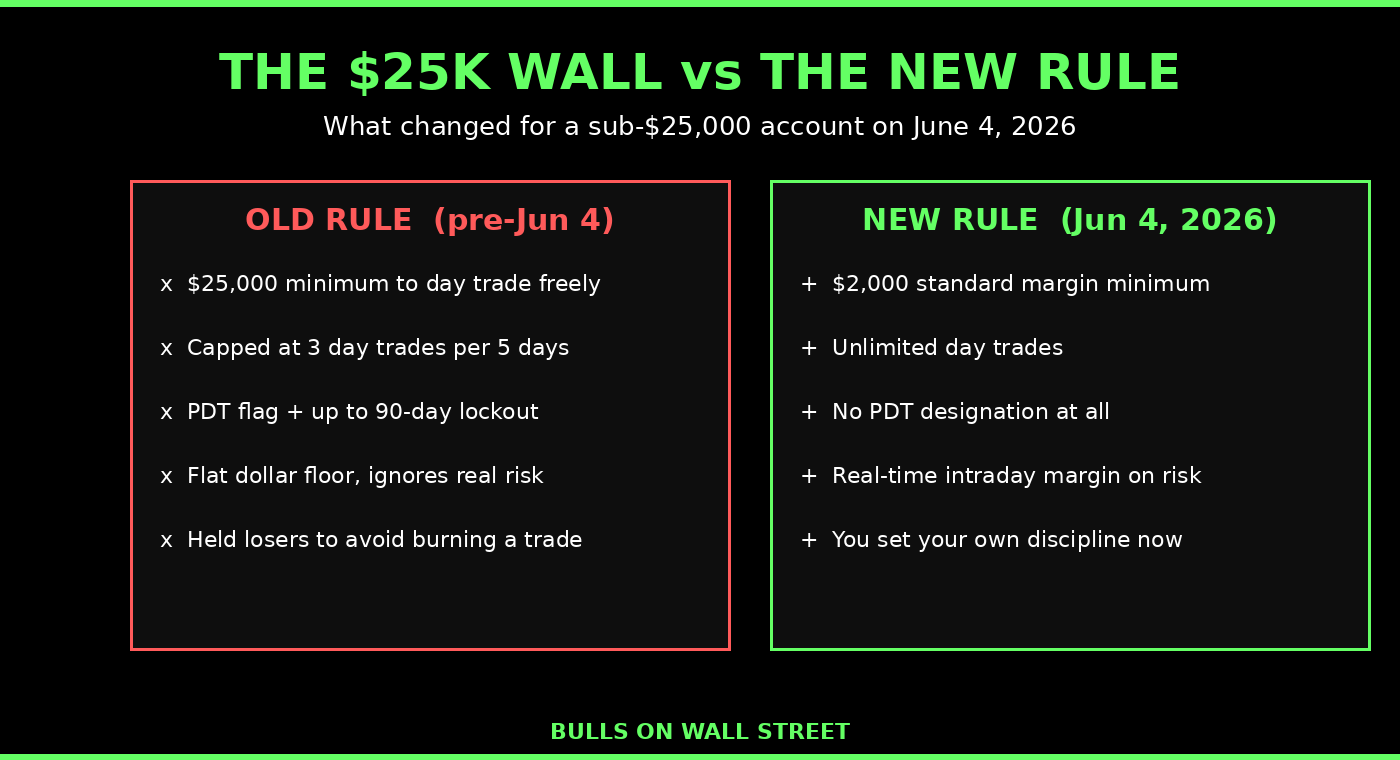
For 25 years the pattern day trader rule worked like this. If your margin account held under $25,000 and you made four or more day trades in five business days, your broker flagged you and locked you out until you either funded the account up to $25,000 or waited out a restriction. Three round trips a week was the ceiling for a small account. If you want the textbook version of the old rule, Investopedia has the full definition.
That ended on June 4, 2026. The SEC approved amendments to FINRA Rule 4210 that eliminate the pattern day trader designation, the $25,000 minimum, and the trade count entirely. You can read the SEC approval record and the full order in the Federal Register.
In plain terms, for an account under $25,000:
- No more trade counting. Take as many day trades as your account can support.
- No more PDT flag. The designation does not exist anymore.
- A $2,000 standard margin minimum still applies.
What replaced the old rule is a real-time intraday margin system. Instead of a flat dollar floor, your buying power is now tied to the actual risk of the positions you hold during the day. Carry more exposure, you need more equity to back it. That is the whole idea.
The Catch: Check Your Broker First
Here is what most of the celebration posts are skipping. The rule is law as of June 4, but brokers were handed an 18-month window, through October 20, 2027, to roll out the new system. Some were ready day one. Others are still running the old $25,000 framework while they update their technology.
So before you assume you can fire ten day trades off a $3,000 account, check with your broker. Ask one question: have you implemented the new intraday margin rule yet. If yes, you are clear. If not, you are still living under the old PDT cap until they flip the switch. Do not learn that the hard way by getting your account frozen mid-week.
Can You Versus Should You
My whole chatroom has been buzzing about this. I had a bunch of students who were swing trading specifically because they were under $25,000, and they were doing well with it, building their accounts up slowly on good swing trades. The day the rule dropped, the reaction was instant. Wow, now I can stop swing trading and start day trading. And I had to stop them. If you are successful swing trading, keep swing trading. Do not jump into day trading just because you suddenly can. That is not a plan, that is an impulse, and impulse is what blows up accounts.
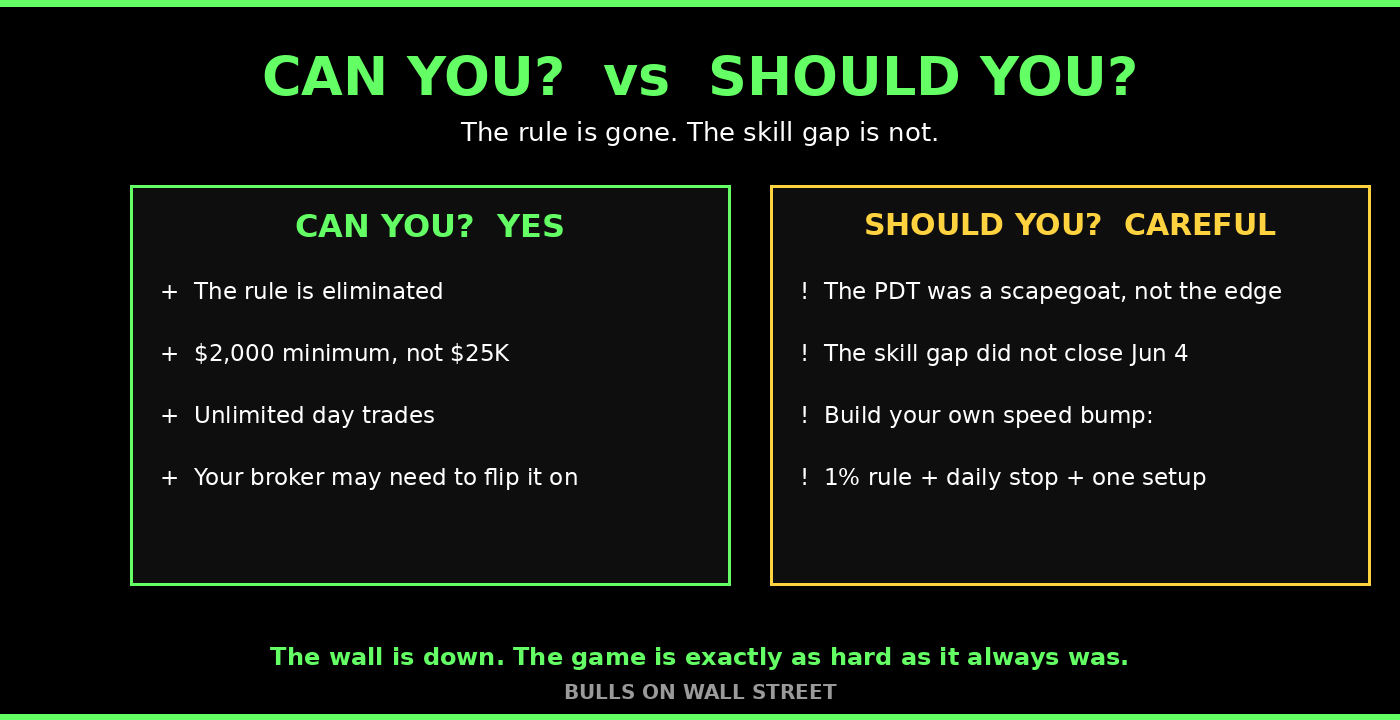
That is the real lesson here. Yes, you can day trade a $2,000 or $5,000 account now. But the rule coming down did not hand you an edge. For years, traders told themselves the PDT was the only thing holding them back. It was not. It was a scapegoat. The reason small accounts lose was never the trade cap. It was the skill gap, and that gap did not close on June 4. If anything the danger went up, because now nothing stops a new trader from overtrading a tiny account straight into the ground.
The old rule had one accidental benefit. Three trades a week forced you to be selective. That speed bump is gone, so you have to build your own. A fixed risk per trade using the 1% rule. A hard daily stop. The complete framework is in my risk management system for day traders. One setup you run over and over, like the first pullback, instead of machine-gunning every ticker that moves. The mechanics of managing risk on a small account matter more now, not less.
If you want the full playbook on actually growing a small account in this new environment, the setups, the capital math, and the rules that keep you in the game, read how to day trade a small account in 2026. For the complete breakdown of the rule change itself, see the PDT rule elimination guide.
What I Tell the $3,000 Trader
So someone shows up tomorrow with $3,000 or $5,000 wanting to go all in because they finally can. Here is exactly what I tell them. Always manage your position size by risk, not by going all in. And understand this one thing that beginners get wrong: your margin is not your risk. That is the bank's money, not yours. Start small. Risk something like $100 per trade and size off your stop. If you have a one dollar stop, that is 100 shares. If you have a fifty cent stop, that is 200 shares. Same risk, different size. We wrote a whole position sizing guide on exactly how to do this, so check it out.
The bottom line: yes, you can day trade under $25,000 now. Whether you should comes down entirely to whether you have done the work. The wall is down. The game is exactly as hard as it always was.
Frequently Asked Questions
Can you day trade with less than $25,000 in 2026? Yes. As of June 4, 2026, the $25,000 minimum equity requirement for pattern day trading was eliminated. You can day trade a standard margin account with as little as $2,000, subject to your broker having implemented the new intraday margin rule.
Is the $25,000 day trading rule gone for good? The pattern day trader designation, the $25,000 minimum, and the four-trades-in-five-days count were all removed from FINRA Rule 4210 by SEC-approved amendments effective June 4, 2026. They are replaced permanently by a risk-based intraday margin framework.
How many day trades can I make now under $25K? There is no trade count limit anymore. You can take as many day trades as your account equity and intraday margin support. The old three-trades-per-five-days cap no longer exists.
Do I still need $25,000 to day trade? No. The $25,000 minimum tied to pattern day trader status is gone. The standard margin account minimum of $2,000 is what applies now.
Why might my broker still be enforcing the old $25K rule? Brokers were given until October 20, 2027 to phase in the new system. If your broker has not implemented it yet, your account may still be subject to the old PDT cap. Contact your broker to confirm their timeline.
What replaced the PDT rule? A real-time intraday margin standard. Your required equity is now based on the actual risk of the positions you hold during the trading day, rather than a fixed $25,000 floor and a trade count.
Does this apply to cash accounts, futures, or crypto? The change applies to US equities and equity options in margin accounts at FINRA member firms. Cash accounts were never subject to the PDT rule, and futures, forex, and crypto were never governed by it, so they are unaffected.
Should I day trade a small account now that I can? You can, but be careful. The rule change removed a restriction, not the difficulty. You still need a real edge, a fixed risk per trade, and a daily stop. Without your own discipline, unlimited day trades on a small account is a fast way to blow up.
Is day trading on margin still risky under the new rule? Yes. Trading on margin means borrowing from your broker, and losses can exceed your deposit. Removing the $25,000 minimum lowered the barrier to entry, not the risk. Only trade with money you can afford to lose.
Ready to Do It the Right Way
The wall is down, which means the only thing standing between you and a blown small account is your own discipline. That is exactly what we build.
In the Bulls on Wall Street 60-Day Bootcamp, you learn one setup at a time, simulate it until the data says you are ready, and watch me trade these setups with real money every morning in the trading chatroom before you ever risk a dollar. No hype, no shortcuts, just the work that keeps you in the game.
If you are starting a small account in 2026, join the next 60-Day Bootcamp and learn to trade it the way that actually lasts.
Kunal Desai is the CEO and founder of Bulls on Wall Street. A professional trader since 2007, he has navigated every major market cycle -- from the 2008 financial crisis to today's high-volatility environments. Having mentored 7,000+ students through his live trading bootcamps, Kunal trades live every morning in the Bulls on Wall Street Trading Chatroom and is dedicated to teaching real-world execution and high-probability strategies. Based in Miramar Beach, Florida.
Connect with Kunal: Read his full story | Instagram | YouTube

