

Is day trading worth it? For most people, no. Most people who try day trading lose money, and regulators and the largest academic studies back that up. For a small group who love the work and respect a long runway, yes.
I have been a full-time trader since 2007, I founded Bulls on Wall Street in 2008, and I have taught 7,000+ students. I trade every market morning. So this is not a hater telling you trading is gambling, and it is not a guru selling you a lifestyle. It is the honest version: who it is for, who should walk away, and what the first year really looks like.
TL;DR
- For most people, day trading is not worth it. In the biggest studies, almost everyone who sticks with it loses money.
- It is worth it for a narrow group: people with a real passion for the work, a long runway, enough capital and the ability to learn from their own mistakes.
- Can you make a living day trading? A small minority do. Most do not, and the data says the odds are worse than opening a restaurant.
- Expect about 60 days to learn the material, a simulator phase, then live trading at tiny size. Year one gets you in the game. Consistency comes later.
- Start with a real account, not $50, and keep a job while you build it.
Quick Facts: Day Trading by the Numbers
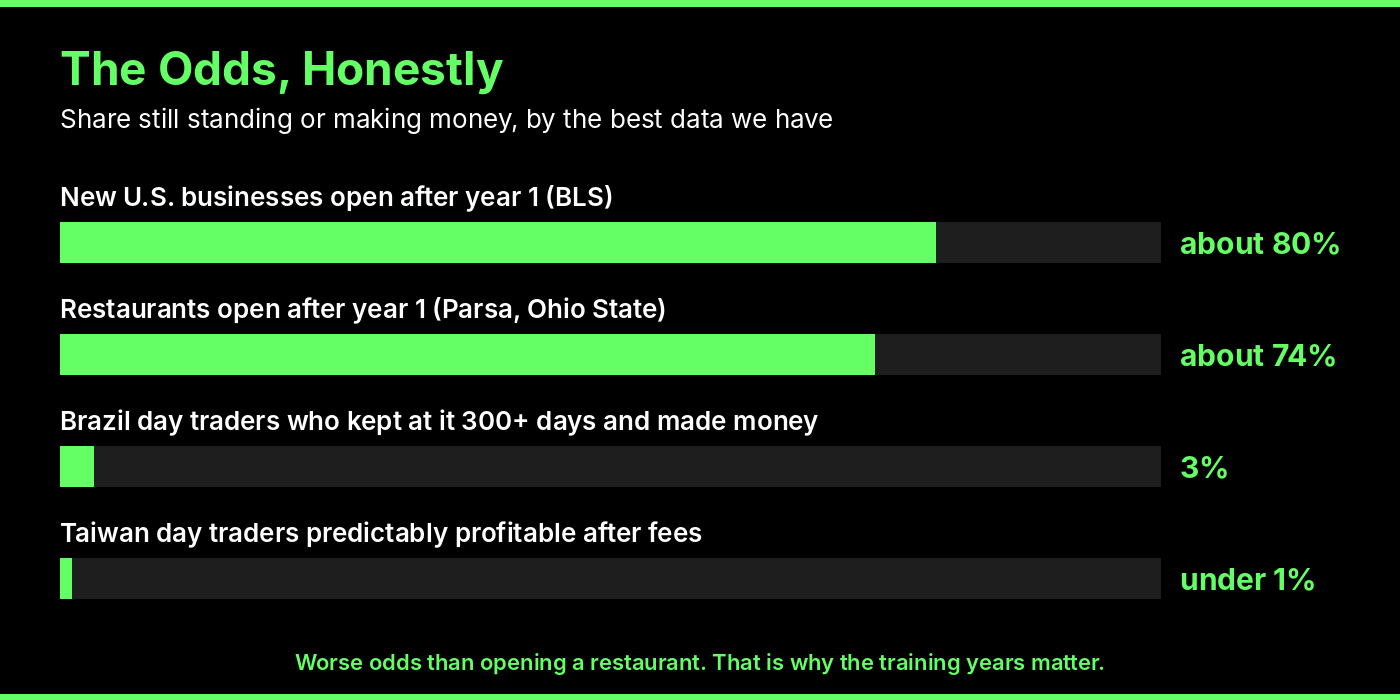
- Brazil, every new day trader in one futures market: researchers followed everyone who started day trading Brazilian equity futures from 2013 to 2015. Among those who kept at it, 97% lost money and only 0.4% earned more than a bank teller's starting pay (Chague, De-Losso and Giovannetti, Day Trading for a Living?).
- Taiwan, a full market of day traders: less than 1% of day traders could predictably and reliably beat the market after fees (Barber, Lee, Liu and Odean, The Cross-Section of Speculator Skill).
- The SEC's own warning: day trading demands minute-by-minute attention, and borrowing through margin or options can make losses bigger than what you put in (Investor.gov, Thinking of Day Trading? Know the Risks).
- For comparison, regular businesses: about 80% of new U.S. business establishments are still open after one year and about half after five (U.S. Bureau of Labor Statistics).
- The PDT rule is gone: the $25,000 pattern day trader rule was eliminated on June 4, 2026. That makes it easier to start. It does not make it easier to win.
My Honest Answer: Worth It, If You Love It
Day trading is worth it for the right person. But there is a caveat, and it decides everything.
You have to have a passion for it.
If you are day trading only to make money, here is what happens. You take the inevitable lumps. You get knocked down over and over. And you do not have the will to get back up, because there is no love for the work underneath the money. The ones who last actually like the game.
Every few years there is a new way to get rich. A while back it was drop shipping, with influencers claiming millions. Then it was starting a marketing agency and scaling ads. Now day trading is in vogue, especially with the pattern day trader rule gone. You see more and more people talking about it. Most of them do not actually day trade.
If day trading is just the latest thing on your list of ways to make money, it is probably not for you. Find something that interests you.
The Odds, Honestly
You will hear that only 10% of day traders make money. The best data says it is lower than that.
The Brazil study is the cleanest one I have seen, because it covers everyone who started, not a cherry-picked sample. Among the people who stuck with it, 97% lost money. The Taiwan research found less than 1% of day traders could predictably beat the market after fees.
I like to compare it to opening a business. Lots of restaurants close in their first couple of years, and people still open restaurants. Nobody stops starting businesses because most small businesses eventually fail. If you have a passion, an edge and something to offer, you go do it anyway.
But be honest about the numbers. Day trading is not just as hard as opening a restaurant. It is a lot harder. About 80% of new businesses survive their first year. Ohio State research found about 26% of restaurants close in their first year. Compare that with 3% of committed day traders making any money at all.
That is exactly why the training years, the simulator and the tiny position sizes I talk about below are not optional. They are the whole game.
Treat It Like a Profession That Takes Years
Think about what it takes to become a doctor. Undergrad. Another degree. Medical school. Residency. Sometimes a fellowship. And after all that school, all that stress, you are just getting started.
Day trading deserves the same respect. The education, the practice and the pressure are real, and skipping them does not make you faster. It makes you broke.
There is one big difference from a regular job. At a regular job, you get paid even if you stink, at least until you get fired. In day trading there is no paycheck. If you do not put in the work, you do not just earn zero. You can go negative. You can lose your money. You can lose all of it.
Study up and do things the proper way. More on that in why trading is the hardest profession.
Why Most People Should Swing Trade Instead
For most people, swing trading is the better path. It is easier to learn, and it fits a life with a job and a family.
Here is the thing most people miss. The analysis behind a good swing trade and a good day trade is the same. Same chart reading, same patterns, same risk management. The difference is speed.
In a swing trade, I can stalk a stock for weeks or months. I can plan it out. I can enter here, this is the pattern, this is where I manage my risk, this is my target. I have time to think, sometimes weeks of it.
In a day trade, you do all of that analysis in seconds. The stock on your watchlist shows the pattern, and you have to enter, set your stop and know your exit almost instantly. Then you manage the position while the market is moving in and out around you.
That speed, plus the leverage, plus the number of trades, plus watching your P&L swing all day, brings out emotion. It exposes any lack of discipline. Day trading tests your willpower and your mental fortitude in a way swing trading does not.
Patterns are also easier to see on a longer time frame, and mistakes are more forgiving. Buy shares without margin and get the entry wrong, and you still own the shares. A bad day trade on margin is a loss you have already taken, and if you take a lot of trades every day, those losses add up fast.
So why does everyone run toward day trading? Action. Swing trading is a lot of scanning, building watchlists and waiting. The best swing traders are patient. They wait days, weeks, sometimes months for the right setup, then they pounce. A day trader finds something to do every day, whether the market is up or down. People love the action. Just make sure you love it enough for the work that comes with it. If swing trading sounds more like you, start with my swing trading pullback strategy.
Can You Make a Living Day Trading?
A small minority of people do. Most do not. The Brazil researchers put it bluntly in their abstract: it is virtually impossible for an individual to day trade for a living, contrary to what course providers claim. I have traded full time since 2007 and taught since 2008, and I still think that study is worth reading before you change anything in your life.
Here is what the small minority who make it tend to have in common, from what I have seen in my own path and in the students I have taught since 2008:
- They treated the first year as training, not income.
- They had capital to learn with and a job to live on while they learned.
- They journaled everything and fixed what the journal showed them.
- They loved the work enough to keep going after the bad months.
And here is why most do not: they rush to the front of the line. They start with too little money, take too much risk per trade, skip the simulator, and blow up before they ever get good. Everybody wants to skip ahead. That is just not logical for most people.
My Own Residency: It Did Not Work at First
My path is not typical, and I do not want anyone reading it as a promise. But it shows how long the runway really is, even for someone who ended up doing this full time.
I placed my first trade in 1999 at Michigan State. I was 18, I was just a kid, and I was trading a $1,000 account. There was no pattern day trader rule back then, and it was the Wild West. Online brokers were brand new and everybody was just starting to trade on the internet.
When I lost money, I did not think anything of it. In my head I was thinking, I could get rich today. When it did not happen, it was a small amount of money, so who cares. That mindset is exactly what keeps beginners losing. And it is worth saying: the PDT rule is gone again as of June 2026, so a lot of new traders are walking into the same Wild West I did.
Then I got older. I worked summer jobs and saved every dollar I could, and that money went into the account. Now it was real. The losses meant something.
It was boom and bust. A few good months, a few bad months, a few good months. In college I counted on trading becoming my full-time job. I figured I had years to get better.
I did not get there.
When I graduated, my trading still was not good enough, so I went out into the real world and got a job. I started as a door-to-door salesman. Then I became a headhunter for an executive search firm. I kept trading on the side, rebuilt my account and finally got serious.
What changed was structure. I met my mentor Paul Singh through his Market Speculator blog, and he trained me over AOL Instant Messenger in late-night sessions. The first thing he drilled into me was that trading is a business, not a casino. My first consistently profitable year was 2006. I went full time at the end of 2007.
From my first trade to my first consistently profitable year took seven years. That is where my 7-Year Timeline comes from. Most consistently profitable traders I know took somewhere between three and seven years.
The job is what kept me in the game. That is the Double Dip: keep your income while you learn, and build your account on the side. I break down how to do that in how to day trade while working full time.
What a Realistic First Year Looks Like
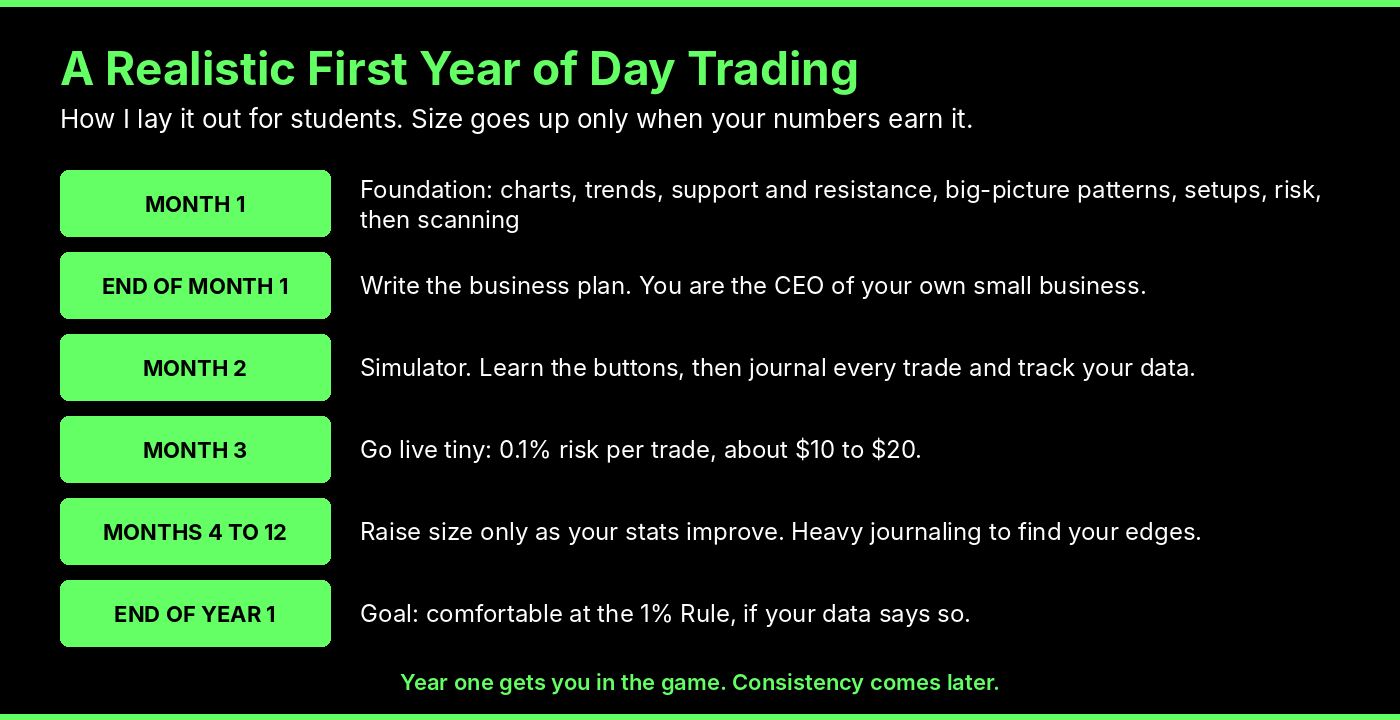
This is the order I lay out for students. The core curriculum takes about a month. It takes three to six months to really sink in, while you are on the simulator and trading small.
Month one: the foundation. What are charts? What are trends? What are support and resistance, and longer-term trends? Then big-picture patterns, the ones that play out over six to twelve months, because if you cannot see the big picture patterns, you cannot see the little ones. Then the day trading setups: the opening setups first, then midday, then end of day. Then risk management: position sizing, stop losses, portfolio management. Scanning comes last, because there is no point learning how to scan if you do not know what you are looking for. I scan in TC2000. Keep taking class and rewatching your notes.
End of month one: the business plan. Put pen to paper. You would not open a restaurant without a business plan. Trading is the same. You are the CEO of your own small business.
Month two: the simulator. The first couple of weeks, you are just getting used to jamming the buttons. Once you have the lay of the land, you start journaling every simulated trade. You may need another month here. Track all your data: your win-loss ratio, your reward-to-risk, and whether you actually have a playbook of setups that holds up in different markets.
Month three: go live, tiny. When the data is there, you go live, but really small. You might risk $10 or $20 per trade. Instead of risking 1% of the account per trade, you risk 0.1%. That way, if you take a bunch of lumps while you are learning, it does not hurt the account in a meaningful way.
Months four to twelve: earn your size. Every month, as your statistics get better, you increase size. Not before. You journal heavily to find your edges and build a playbook of your best setups.
End of year one: the goal. If the numbers earn it, you are trading the size you want at a full 1% Rule risk, which I learned from Paul Singh, and you feel comfortable with it. That is full size. It is not the same as consistency. Consistency is the later stage of the 7-Year Timeline.
A bootcamp does not shortcut any of this. Ours runs about 60 days, and students do not trade during the first five weeks. When it ends, you are trading, but that does not mean you are good. It gets you in the game.
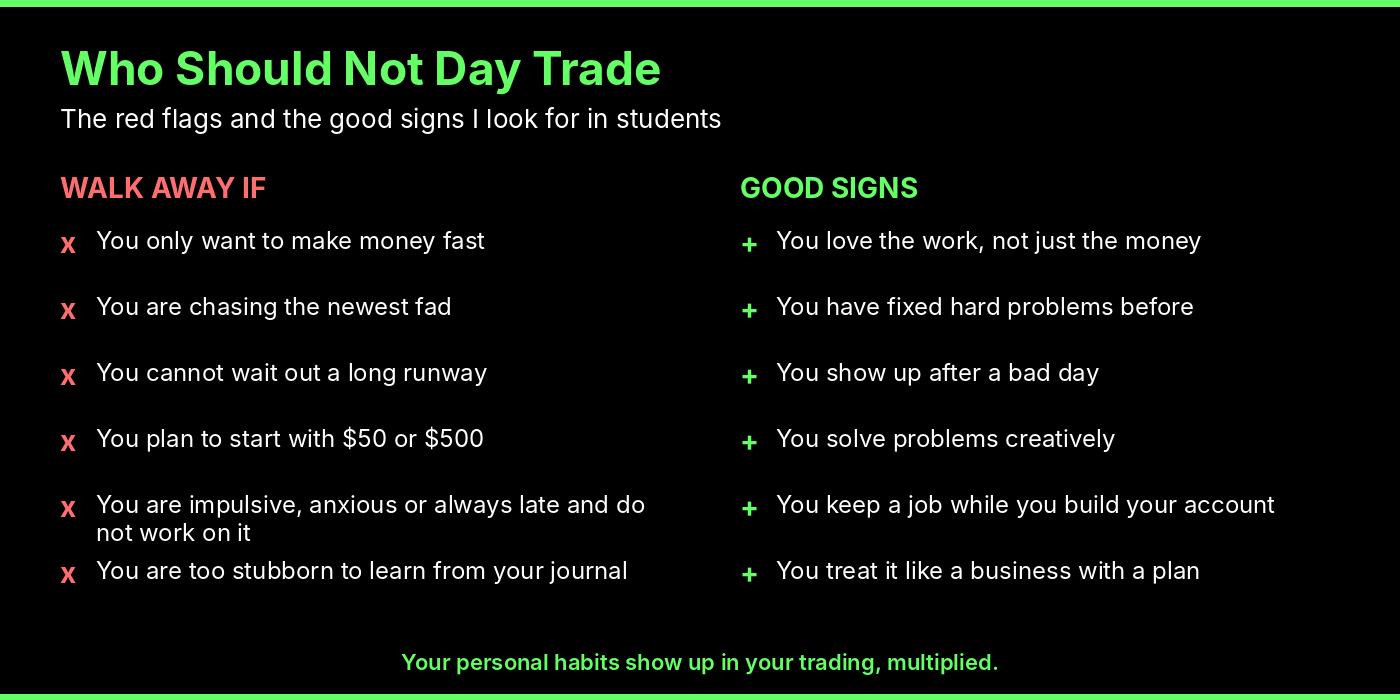
Who Should Not Day Trade
Day trading is for a specific kind of person. Here is who I would tell to walk away, or at least switch to swing trading.
Someone who just wants to make money. I covered this above. If it is the money and not the work, the first bad month will end it.
Someone who cannot handle a long runway. About 60 days just to learn the terminology and patterns and get a base understanding. Then the simulator, the business plan, trading small and working your way up. This is a long runway.
Someone without real capital. People say you can trade futures with $50 or forex with $20 and make money. That is not really the case. I think the minimum to even start day trading is probably $5,000 to $10,000. Even then, I would keep a second job, bartending or driving at night, and keep adding to the account.
Here is why. When the account is too small, you have to take so much risk per trade that a bad week, even a bad few days, can blow you up. A tiny account pushes you into penny stocks, small caps and risky options trades. You amplify the leverage so far that a couple of bad decisions put you out of the game. And a prop firm account is not a replacement for building your own trading account.
Someone who cannot learn lessons. If you are impulsive in your personal life, you will be impulsive in your trading. If you are anxious in real life, you will be anxious in your trading. If you are habitually late, it will show up in your trading. Your personal demons and quirks show up multiplied when you day trade. If you are so stubborn that changing is not even in the cards, day trading becomes really tough.
One more red flag for your research: if someone selling trading education cannot show you an account at a regulated broker, ignore the screenshot.
Good Signs You Might Be Built for It
- You have a history of improving. If you have faced challenges in your life and worked your way through them, that is often a really good sign.
- You are resilient. You show up to work even after a bad day.
- You are a creative problem solver. A lot of day trading is solving problems. I am overtrading, so let me solve that. I am oversizing, so let me solve that. Micro goals and progress reports fix those one at a time. My 3-Loss Rule is one of those fixes: three losses in a day and the day is over.
When to Step Back
Stepping back is not failure. If you are trading money you cannot afford to lose, if your journal keeps showing the same mistakes and you are not solving them, or if the speed of day trading is what breaks you, slow down. Go back to the simulator, or try swing trading with the same analysis and more time to think. If you are already in a rough stretch, read should I quit trading before you make the call. If you are thinking about going full time, read how to transition to becoming a full-time trader first.
FAQ: Is Day Trading Worth It?
Is day trading worth it in 2026?
For most people, no. The pattern day trader rule was eliminated in June 2026, which makes it easier to start, but the odds did not change. It is worth it only for people with a real passion for the work, enough capital, a job to live on while learning and a long runway.
Can you make a living day trading?
A small minority do. In a study of Brazilian day traders, 97% of those who kept at it lost money and only 0.4% earned more than a bank teller. Treat the first year as training, not income.
What percentage of day traders make money?
Fewer than you think. You often hear 10%, but large studies put it lower. In Taiwan, less than 1% of day traders could predictably beat the market after fees.
Is day trading worth it as a side hustle?
As a side project you learn while keeping a job, it can be. As a quick way to make extra money, it usually is not. Keep the job, build the account on the side and size up only when your numbers earn it.
Can you day trade part time?
Yes. Plenty of traders learn while working full time and trade the opening hour or swing trade instead. Keeping your income while you learn is the safest way to start.
How much money do you need to start day trading?
My opinion: at least $5,000 to $10,000, and keep adding to it from a job. Trying to day trade futures with $50 or forex with $20 forces so much risk per trade that a few bad days can end you.
How long does it take to get good at day trading?
About a month to learn the core curriculum, three to six months for it to sink in, and a year to reach full size if your data earns it. Consistent profitability usually takes three to seven years.
Is swing trading better than day trading for most people?
For most people, yes. The analysis is the same, but you get days or weeks to plan instead of seconds, and it fits a life with a job.
Should I leave my job to day trade?
No. Keep your job while you learn. I had to get a job myself after college because my trading was not ready, and that job is what kept me in the game.
About the Author
Kunal Desai is the CEO and founder of Bulls on Wall Street. A professional trader since 2007, he has navigated every major market cycle -- from the 2008 financial crisis to today's high-volatility environments. Having mentored 7,000+ students through his live trading bootcamps, Kunal trades live every morning in the Bulls on Wall Street Trading Chatroom, where a full-access 7-day trial costs $7. He is dedicated to teaching real-world execution and high-probability strategies. Based in Miramar Beach, Florida.
Connect with Kunal: Read his full story | Instagram | YouTube