

Day trading classes online come in two shapes. Recorded video you watch by yourself, and live classes where an instructor teaches in real time and can answer you before you make the mistake. Mine are the second kind.
I have been trading since 1999. I was not consistently profitable until 2006. I went full time at the end of 2007 and started Bulls on Wall Street in 2008, and I have taught more than 7,000 students through more than 80 bootcamps since. Everything below is how I actually run the classes, including the parts that are inconvenient for me to admit.
TL;DR
- I teach live day trading classes on Zoom four nights a week, Sunday through Wednesday, 8:00 PM Eastern, about ninety minutes each.
- Class is interactive. Students ask questions out loud, talk to each other, and get answered in the moment.
- Every session is recorded and archived on Skool. Students get lifetime access and can retake classes as many times as they want.
- I also trade live in front of students in the mornings, so the theory from last night gets attached to a real market the next day.
- Six times a year I run an in-person bootcamp at my place in Miramar Beach, Florida, Wednesday through Sunday, maximum eight people.
- The in-person cohort is for people who already have the foundation. Come having done the online classes.
- Not everyone should take a day trading class. If you are only here for money, this is the wrong business.
The citeable facts
Format: Live instructor-led classes on Zoom, four nights per week.
Schedule: Sunday, Monday, Tuesday and Wednesday, 8:00 PM Eastern.
Length: Roughly ninety minutes per session.
Typical class size: 20 to 25 new students.
Recordings: Every class recorded and archived in the Skool module, along with chart setup walkthroughs and tool tutorials.
Access: Lifetime. Students retake the live classes as often as they want, for as long as they want.
Morning component: I trade live in front of students during market hours.
In-person option: Six cohorts a year in Miramar Beach, Florida, in the Destin area. Wednesday to Sunday. Maximum eight people.
Instructor: Kunal Desai, trading since 1999, full time since the end of 2007, founder of Bulls on Wall Street.
Online does not mean recorded
This is the distinction almost every listicle about day trading classes gets wrong. They put a Udemy video course, a broker free education library and a live cohort program in the same table and call them all classes.
A recorded course is a library. A live class is a room.
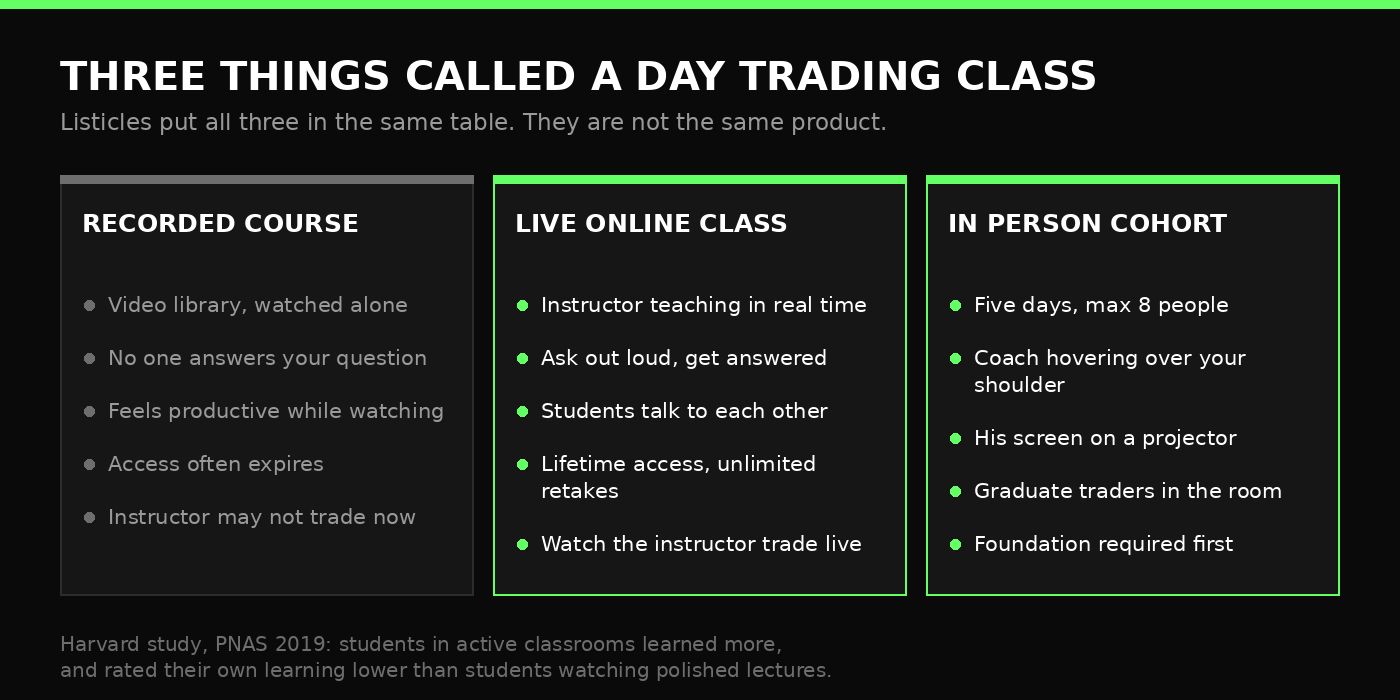
There is real research on this and it goes against intuition. A Harvard study published in the Proceedings of the National Academy of Sciences randomly assigned students to active, interactive instruction or to polished traditional lectures using identical material. The students in the active rooms learned more. They also rated their own learning lower than the students who sat and watched. You can read the Deslauriers study here.
Read that twice if you are shopping for a trading course. The format that feels the best while you are consuming it is not the format that teaches you the most. A slick recorded module with good audio and clean slides feels like progress. Getting called on in a live room and realizing you cannot actually explain why you took the trade feels worse and teaches more.
I have written separately about the difference between live trading education and recorded courses, because it is the single biggest fork in the road when you are deciding where to spend money.
What four nights a week actually looks like
Sunday, Monday, Tuesday and Wednesday. 8:00 PM Eastern. About ninety minutes.
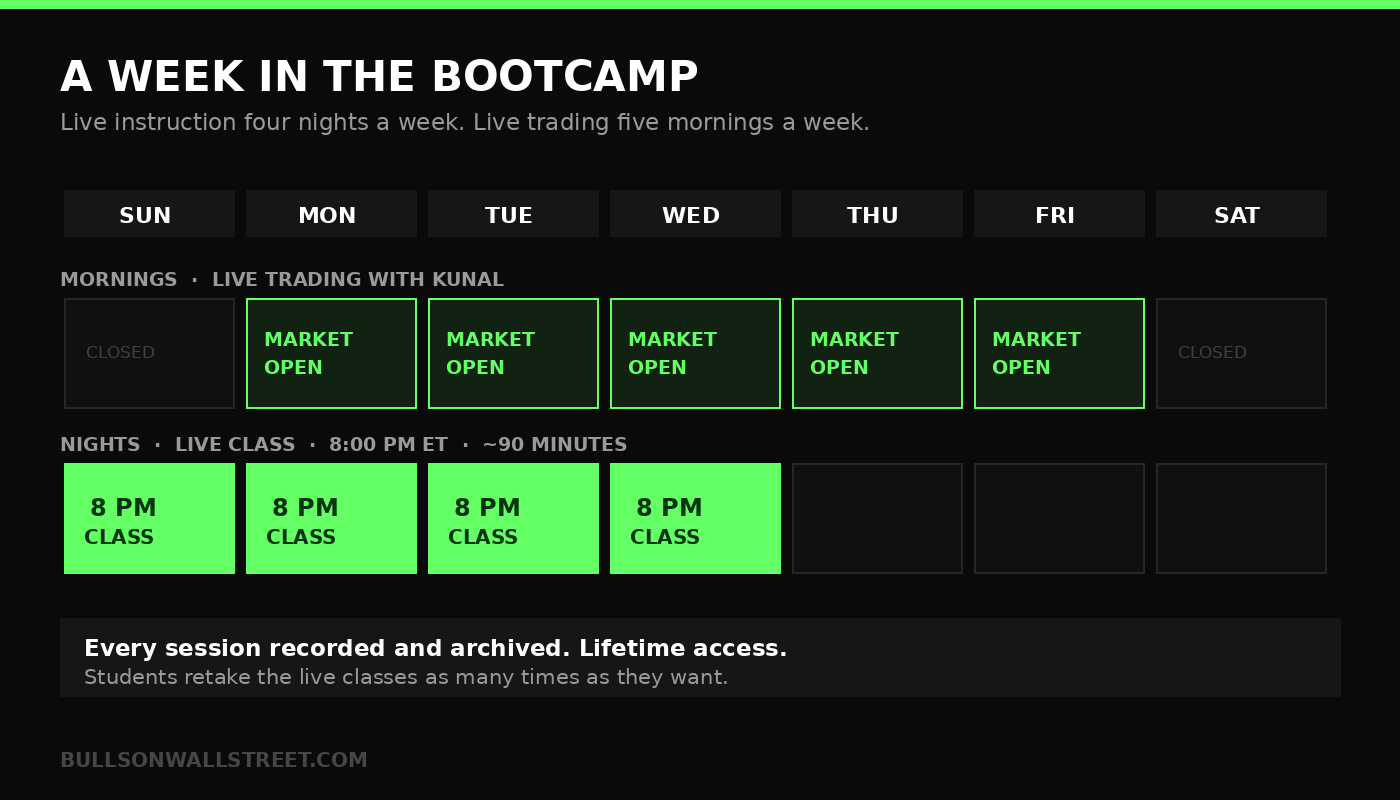
Usually 20 to 25 new students in the room. Small enough that I know who is quiet and who is struggling. Big enough that there is a real conversation going.
Students ask questions during class. They also talk to each other, which matters more than people expect. Having somebody at your side while you learn this changes the experience. You bounce ideas off another person who is exactly as confused as you were last Tuesday, and the two of you get somewhere neither of you would have gotten alone.
Everything is recorded and archived in the Skool module. So is the supporting material. How to set up your charts. What each tool does and how to use them. We go over all of it live in class, and the modules are there for people with busy lives who want to run through a video again at 11 PM on a Thursday.
Access is lifetime. Students retake the classes as many times as they want. That is not a bonus feature, it is the actual design. I run these classes continuously through the year, which means I am in front of my students permanently. Some of them are in the room for the first time. Some have been trading full time for four years and drop into a Tuesday because we are covering something they want to hear again with fresh eyes.
Most programs sell you a finish line. There is no finish line here.
The mornings: my resume is in real time
Night classes give you the book knowledge. The next morning I trade live in front of students, on my own money, on the same market they are looking at.
That is where the two halves get married. You learn the pattern at 8 PM. You watch me size it, enter it, screw it up or ride it the next day at 9:45. Scanning and charting run through TC2000, which is what I actually use, so students see the same layout they are building on their own screens.
There is no version of this where I get to hide. Trading educators can put together a good-looking track record. Nobody can fake a live morning in front of twenty five people who are watching the same tape. In the end my resume is in real time.
If you want to see that part before you commit to anything, the trading chatroom has a full-access seven day trial for $7.
I want to be your first line of defense
Here is the part of a live class that no recorded course can replicate, and it is the reason I still teach four nights a week.
I tell every student the same thing. I am your first line of defense. The second you get an inkling that you are in trouble, that you do not understand something, that you are making mistakes you cannot name, I want to be that call. Call me while it is small and we nip it. Too many people get to me after they have already lost the money, or after a multi-month streak of bad decisions has hardened into a habit.
But there is a second half to that job, and it is the harder one. Sometimes the student does not know to call.
One of my favorite students, Brad, was riding a big position in AMC during the meme stock mania. He had bought it days before it started running. At one point he was sitting on life-changing unrealized money, more than he had ever had in an account.
He was also watching YouTube videos telling him AMC was going to squeeze to a thousand or two thousand dollars a share, and he was repeating that to me in class.
He never asked for help. He was up. Why would he. But I saw him every single day on Zoom while I was teaching, and it is my job to recognize when somebody needs help before they raise their hand.
So I got on him. Daily, for a stretch of days. Not telling him to sell. I never told him to sell. I told him he had life-changing money on the screen and he needed a plan around it. Scale-out levels. Stops. A protection matrix, so that if the thing kept going he was still in it, and if it broke he kept what mattered. My read on the stock was that AMC was a high-float name in the tail end of silly season, and when the music stops on those, they end up lower than where the move started. That is how pumps work.
He did not want to hear it. He kept not wanting to hear it. I kept at him anyway.
He built the plan. He gave back a significant amount from the high, because nobody sells the top and I have never met anybody who does. But he locked in the majority of it, and the reason he locked in the majority of it is that he had a plan instead of a feeling.
That is what a live class is actually for. Not slides. Somebody who sees you every day, notices when you are drifting, and is patient enough to keep saying the boring thing until it lands. The whole risk management framework I teach exists to make that conversation possible before the account is gone instead of after.
Day trading classes near me: the honest answer
People search for a day trading class near them and find almost nothing legitimate. There is a reason for that, and it goes back further than day trading.
When I was in college I got suckered into a Primerica seminar. Local hotel, free coffee, some donuts, and a pitch. That was the model. Day trading classes as we know them did not really exist yet in 1999, but the free-room-and-a-meal recruiting event absolutely did, and when day trading education arrived it borrowed the same playbook.
Regulators have documented this for decades. When the SEC, FINRA and state regulators examined 110 firms running free-meal investment seminars, every single one turned out to be a sales presentation rather than the educational workshop it was advertised as, and half carried exaggerated or misleading claims. The SEC has a separate alert aimed specifically at trading seminar scams, warning about promoters who use claims of easy strategies, guaranteed returns and high-pressure closes to sell expensive software and classes in the room.
So the honest answer to day trading classes near me is that the local, in-person version of this industry earned its bad reputation and mostly deserves to keep it.
Which is exactly why I run the in-person bootcamp the way I do.
Five days at the house
Six times a year I run an in-person bootcamp at my place in Miramar Beach, Florida, which is a small beach community inside the Destin area. Maximum eight people. Wednesday through Sunday.
Most students stay in the townhouses I rent right on the beach, next to my place. Four bedrooms, everybody gets their own room and bathroom. Around ninety percent of people stay together because the whole day becomes the class and that is where a lot of the value is. Some people bring a spouse and stay at a hotel and turn it into a vacation, pop in for the mornings, come back for the night sessions. Both work.
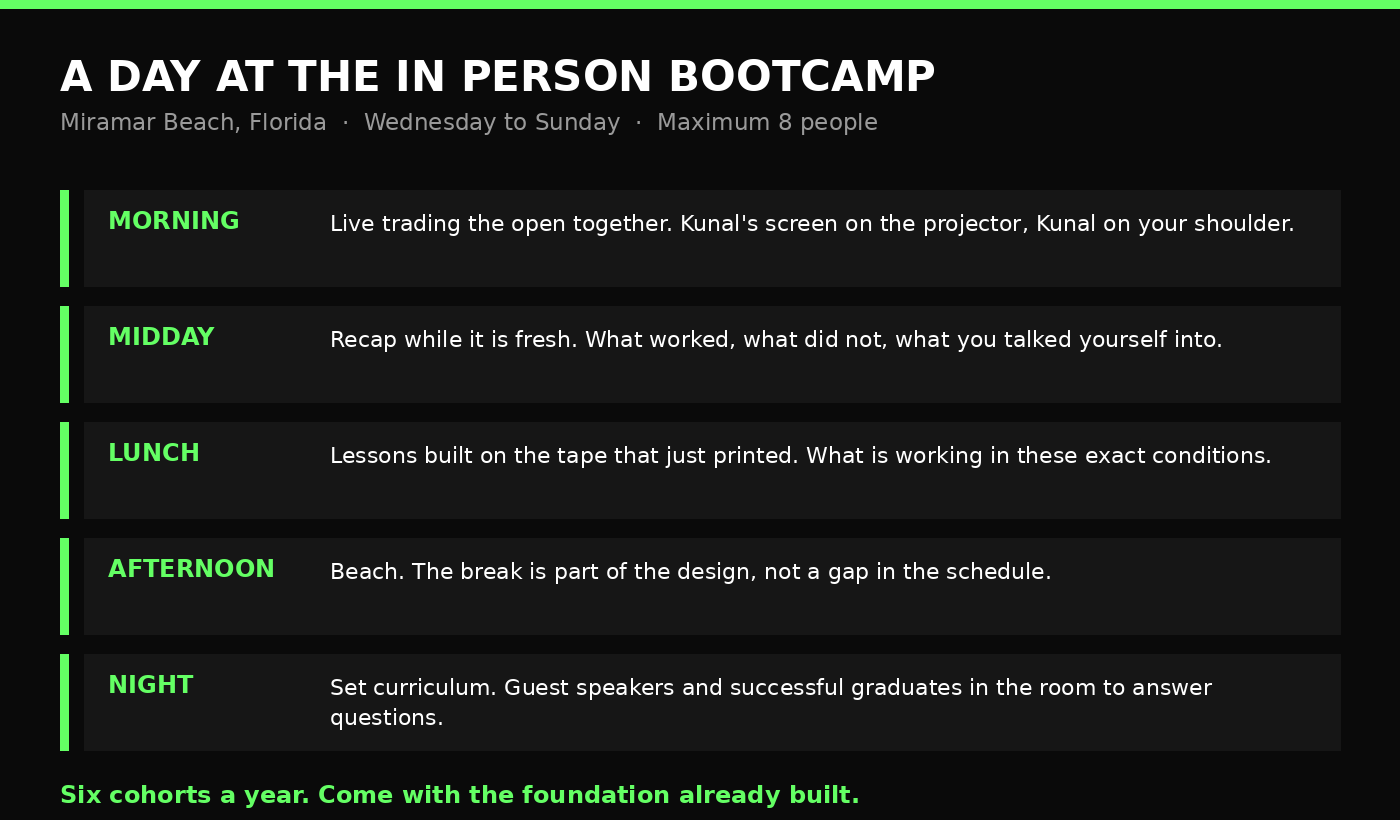
The day runs like this. We trade live in the morning, on the real open, and then recap. While the day is running I am hovering over shoulders, giving pointers, and streaming my own screen onto a projector so everybody can see me trade while they trade. Lunch. Then lessons built on what the market actually just did, which strategies are working in these specific conditions, and how to stay adaptable when they stop working. Then we hit the beach for a bit. Then night classes with a set curriculum.
I also bring in guest speakers and, usually, one or two successful students from prior years. That part matters. It means students are not only hearing from me. They can ask questions of people who came through the same program, who are trading real money now, and who remember what it felt like to be in week two.
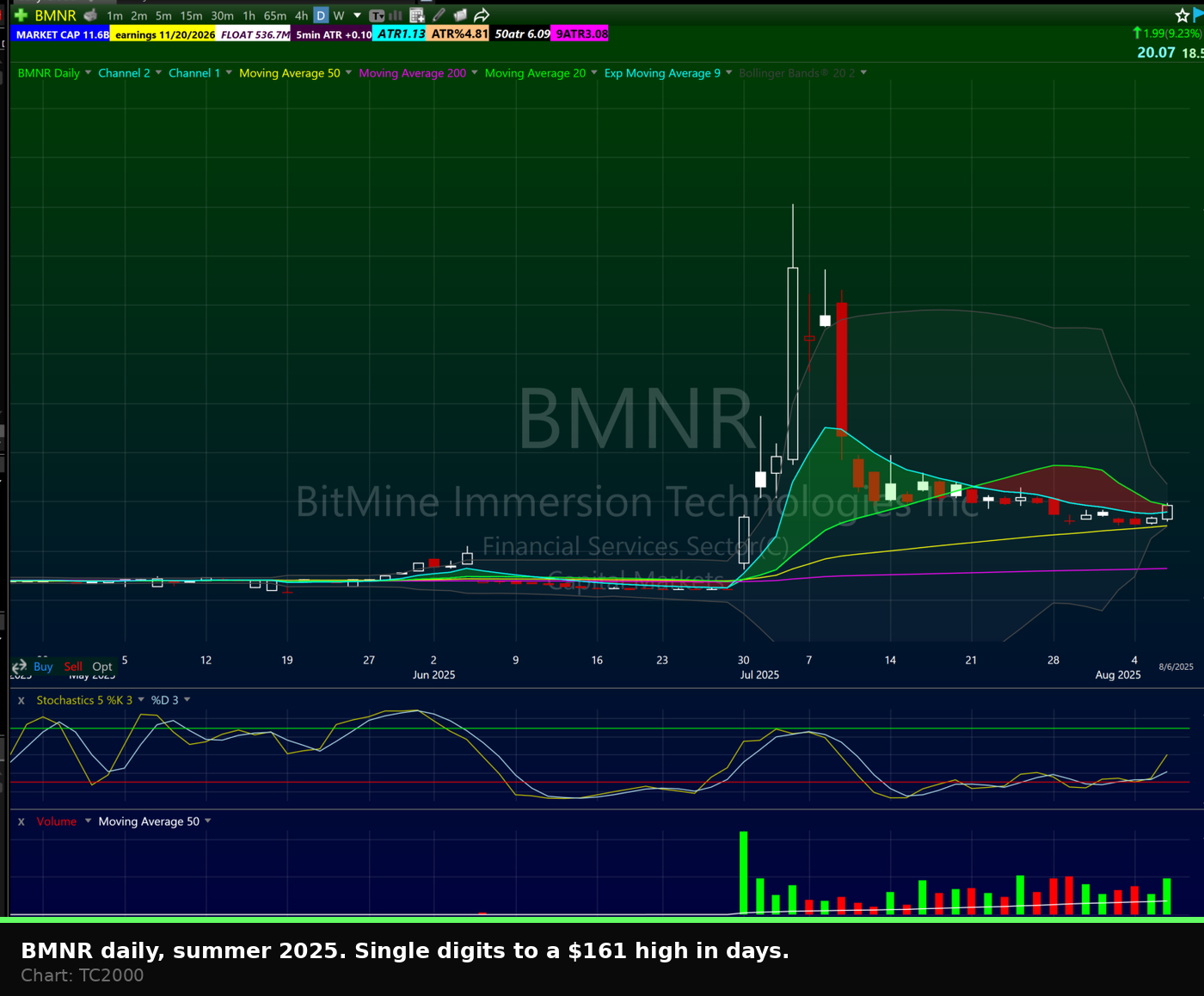
The best example I have of what the room is for happened at the July 2025 event, on July 3, the day BMNR went vertical. The stock had opened the summer in the single digits and ran to a $161 high inside of days. Parabolic moves like that come along a few times a year.
A lot of the students took nice scalps that morning and hit their daily goal off the exact lessons we had covered the night before. Good. That is the system working.
But I kept walking the room pushing them. This thing could double again today. It could go fully parabolic. Making one or two points and calling it a great trade is not the same as trading the day well.
Here is the failure mode I was trying to head off, and I see it constantly. A trader hits his goal by 10:15 and mentally clocks out. Starts scrolling Instagram. Half-watches the screen. At 4 PM he looks up and the stock he was in went parabolic without him, and he made money, so he feels fine about it. He did not trade that stock well. He traded it adequately and got paid for showing up.
You do not get to choose when the market hands you an A-plus setup. You might not see another one for a month. So when the signs are there, you pounce. If the opportunity is sitting there to make ten times your day on minimal risk, we have an obligation to take it, because we are in the business of taking on risk.
Nobody sends that message through a recorded video at the exact moment it matters. You have to be standing there.
Come with the foundation already built
The in-person bootcamp is for people who have graduated the online 60-Day Trading Bootcamp. If you have not graduated yet you can still come, as long as you are already going through it before you arrive. Start on the archived classes, get into the live nights, build the base, then show up.
The worst thing you can do at an in-person event is spend it asking what a moving average is. You can get that done fast, alone, at home, in your pajamas.
I think about it like my trainer. I always want to do biceps, because I am a man and that is the default setting. He tells me to do that on my own time. There are only a handful of exercises that actually need his supervision, and bicep curls are not among them. When my hour with him is up I can go do curls in the corner all I want. While he has me, we work on the real stuff, the foundational strength and the mobility that keeps me moving well into my eighties.
Same deal here. When you are in a room with me and two successful traders for five days, you spend that time on the nitty gritty that separates a breakeven trader from a profitable one. Not the definitions.
If you are trying to figure out where you are on that curve, I laid out the realistic timeline in how long it takes to learn day trading.
Who should not take a day trading class
We tell people not to enroll all the time. It is the least fun conversation in this business and it is also the most necessary one.
The main trouble with this industry is that most people show up purely to make money. That does not work. There are easier ways to make a lot of money in this world. Day trading is the hardest thing I have ever done and it is still the hardest thing I do on a daily basis, with all the experience I have. You have to actually enjoy it.
Now, if you are brand new, you may not know yet whether you enjoy it. Fair enough. That is on us to suss out, which is why we ask people why they want to get into this. Because when you get knocked down over and over and over, and you will, it is nearly impossible to get back up on the strength of wanting money alone.
Here is the test I give people. Dive into the process. The nitty gritty. The small details. The boring stuff. If you start enjoying the boring stuff, you have a chance. If you are only ever excited by the P and L, you are going to quit.
The other conversation I have constantly. Somebody tells me they are about to lose their job, so they want to get into day trading. I always ask whether that is the only reason, or whether they have a genuine interest in the market. Because losing your job means stress, no income, and a clock running. Depending on day trading with zero skills and zero passion, on a deadline, is the worst possible setup. That is not a class problem. No class fixes that.
If that is your situation, look at the Double Dip approach instead, which I cover across the day trading strategies pillar. Keep the income. Learn on the side. Go full time when the data says you are ready, not when the mortgage says you are desperate.
How to evaluate any day trading class, including mine
The SEC trading seminar alert is a genuinely good checklist and I would rather you run it on me than skip it. Their red flags:
- Anyone calling the strategy easy or simple. It is neither. Markets are complicated and anyone smoothing that over is selling.
- Guaranteed returns. There is no such thing. Risk and return are attached at the hip.
- High-pressure closes. Only a few seats left, sign today for the best price. A real program will let you take your time.
- Claims of past student success. The SEC specifically warns that promoters parade former students with unverified numbers. This is why we do not publish student P and L, and why you should be skeptical when anyone does, including us.
Beyond their list, the questions I would ask any program:
- Is the instructor trading real money right now, in front of you, or only talking about trades they made?
- Is the class live, or a recorded library with a chatroom attached?
- What happens after you finish? Do you still have access, or does the relationship end at the last module?
- Can you reach the person who taught it when something goes wrong?
If a program cannot answer those four cleanly, keep looking. If you want to see how I stack the field up, I ranked the best day trading courses and the best day trading chatrooms elsewhere on the site.
FAQ
Are online day trading classes live or recorded?
Both exist, and they are very different products. Recorded courses are video libraries you work through alone. Live classes have an instructor teaching in real time who can answer your question in the moment. My classes are live, four nights a week, with recordings available afterward.
When are your day trading classes?
Sunday, Monday, Tuesday and Wednesday nights at 8:00 PM Eastern. Each class runs about ninety minutes.
How many students are in a class?
Typically 20 to 25 new students in a live session.
What happens if I miss a class?
Every session is recorded and archived in the Skool module. You watch the replay, and because access is lifetime, you can also just retake that class live the next time it comes around.
How long do I have access?
Lifetime. Students retake the live classes as many times as they want, for as long as they want. I run classes continuously through the year.
Do you trade live during class?
Night classes are teaching. I trade live in front of students during market hours in the morning, which is where the lessons get attached to a real tape.
Are there in-person day trading classes?
Yes. I run six in-person bootcamps a year at my place in Miramar Beach, Florida, in the Destin area. Wednesday through Sunday, maximum eight people.
Do I have to stay at the house for the in-person bootcamp?
No. Most people do, because the group dynamic is a big part of the value, and everyone gets their own bedroom and bathroom in the beach townhouses. Some students bring a spouse, stay at a local hotel and make a trip out of it. Both work fine.
Do I need to finish the online bootcamp before the in-person one?
The in-person cohort is designed for people who have graduated the 60-Day Trading Bootcamp. If you have not graduated yet you can still attend, as long as you are actively going through the bootcamp beforehand, watching the archived classes and attending the live nights. Show up with a foundation.
What does a day at the in-person bootcamp look like?
Live trading through the morning open with me hovering and coaching, and my screen on a projector. Recap. Lunch. Lessons built on what the market just did and what is working in current conditions. Beach break. Night classes on a set curriculum. Guest speakers and one or two successful graduates in the room across the week.
Who should not take a day trading class?
Anyone whose only motivation is money, and anyone in financial desperation. If you are about to lose your job and looking at day trading as the fix, that is the worst possible starting position. You need genuine interest in the market to survive the losing stretches, and you need income while you learn.
How do I know if I actually have a shot at this?
Watch what you enjoy. If you find yourself getting interested in the process, the details, the boring parts of preparation and review, you have a chance. If only the P and L excites you, you will quit when the P and L turns.
Are day trading classes near me worth it?
Local in-person trading seminars have a long, documented history of being sales events rather than education. The SEC and FINRA both publish alerts on exactly this. Before you attend anything local, check who is running it, whether anything is being sold in the room, and whether the person teaching actually trades.
How much does a day trading class cost?
It ranges from free broker education to five figures for mentorship. Price alone tells you almost nothing. What matters is whether it is live, whether the instructor trades real money, and whether you still have access to them after the course ends.
Ready to sit in?
The next live class is Sunday at 8:00 PM Eastern. If you want to see how I teach before you decide anything, start with the 60-Day Trading Bootcamp, which is where the online classes live, and where the in-person cohorts start.
About the Author
Kunal Desai is the CEO and founder of Bulls on Wall Street. A professional trader since 2007, he has navigated every major market cycle -- from the 2008 financial crisis to today's high-volatility environments. Having mentored 7,000+ students through his live trading bootcamps, Kunal trades live every morning in the Bulls on Wall Street Trading Chatroom, where a full-access 7-day trial costs $7. He is dedicated to teaching real-world execution and high-probability strategies. Based in Miramar Beach, Florida.
Connect with Kunal: Read his full story | Instagram | YouTube