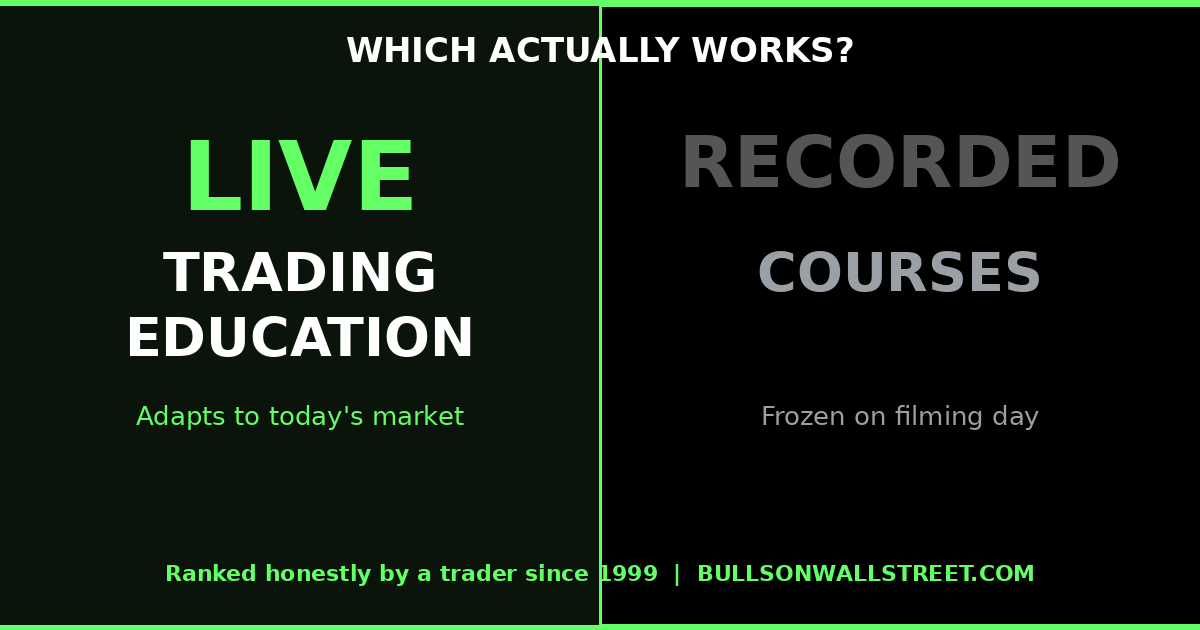


Recorded trading courses teach you patterns. Live trading education teaches you when those patterns actually apply, in the market you are trading today, not the market that existed when someone hit record. I have been trading since 1999, full time since the end of 2007, and I have taught more than 7,000 students through the 60-Day Trading Bootcamp since 2008 using both formats. This is my honest breakdown of what each one does well and where recorded courses structurally fail.
TL;DR
- Recorded courses win on structure: everything labeled, organized in an LMS, available on your schedule. If you have a free weekend, they are a real tool.
- Their structural weakness is time. Many recorded libraries have not been updated in years while market conditions changed underneath them.
- Live education adapts in real time. During the COVID crash I taught my students how to handle that volatility while it was happening, not from charts of 2008.
- Students arriving from recorded programs usually know one or two patterns cold and almost no market structure around them. A pattern without context is a trigger without a target.
- The market is about to change again: exchanges are targeting late 2026 for near 24 hour trading. Every recorded course on the market ages out simultaneously. Live education adapts. Video cannot.
- At Bulls on Wall Street, bootcamp students get lifetime access to live classes, so every new market regime comes with live guidance included.
The Honest Case for Recorded Courses
I am not going to pretend recorded courses are useless. I have recorded content inside my own bootcamp, and there are situations where video is exactly the right tool.
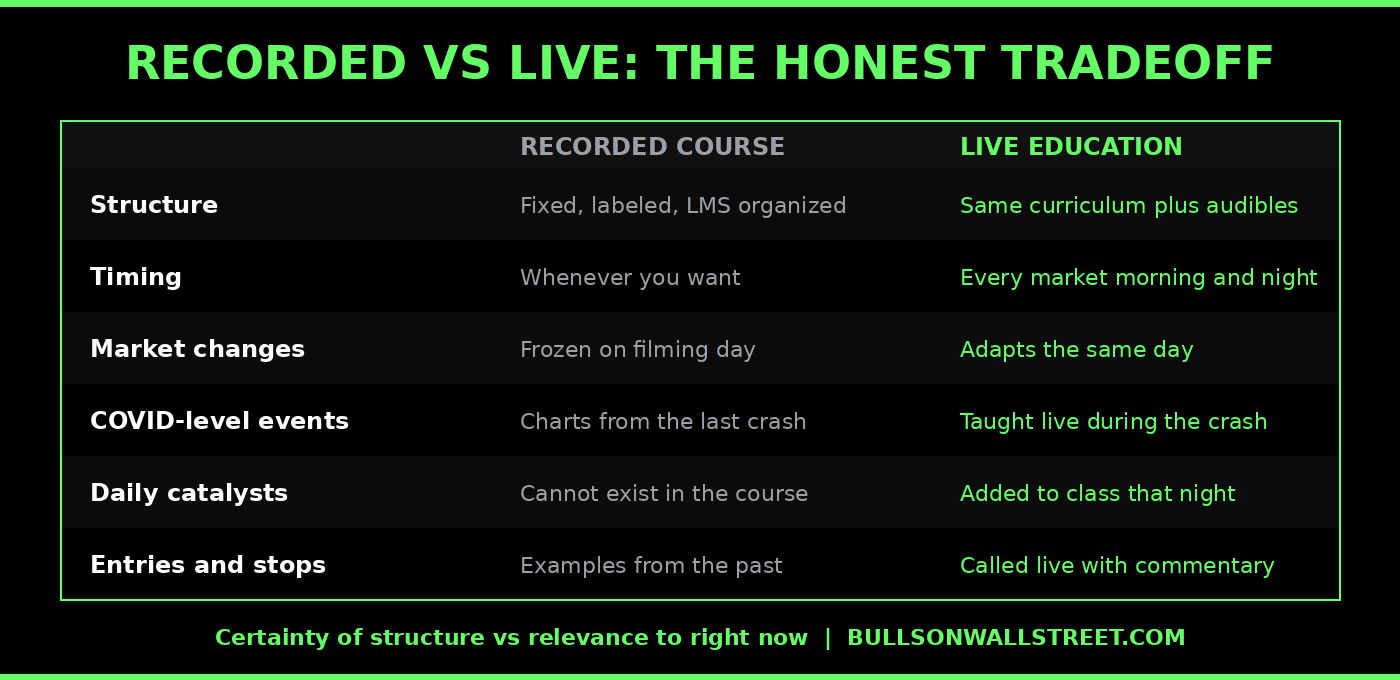
Say you have a weekend off, or a full week of vacation, and you want to get something done. A good recorded course gives you structure. A specific order. Everything labeled. You can skip around and find the exact lesson you need. Most recorded programs today live inside an LMS where the whole curriculum is laid out for you, and there is real value in that certainty. If you are comparing programs on that basis, I broke down the market in my best day trading courses guide.
That is the tradeoff in one sentence: recorded gets you certainty of structure. Live gets you relevance to what the market is doing right now.
The Problem Nobody Mentions: Recorded Courses Freeze Time
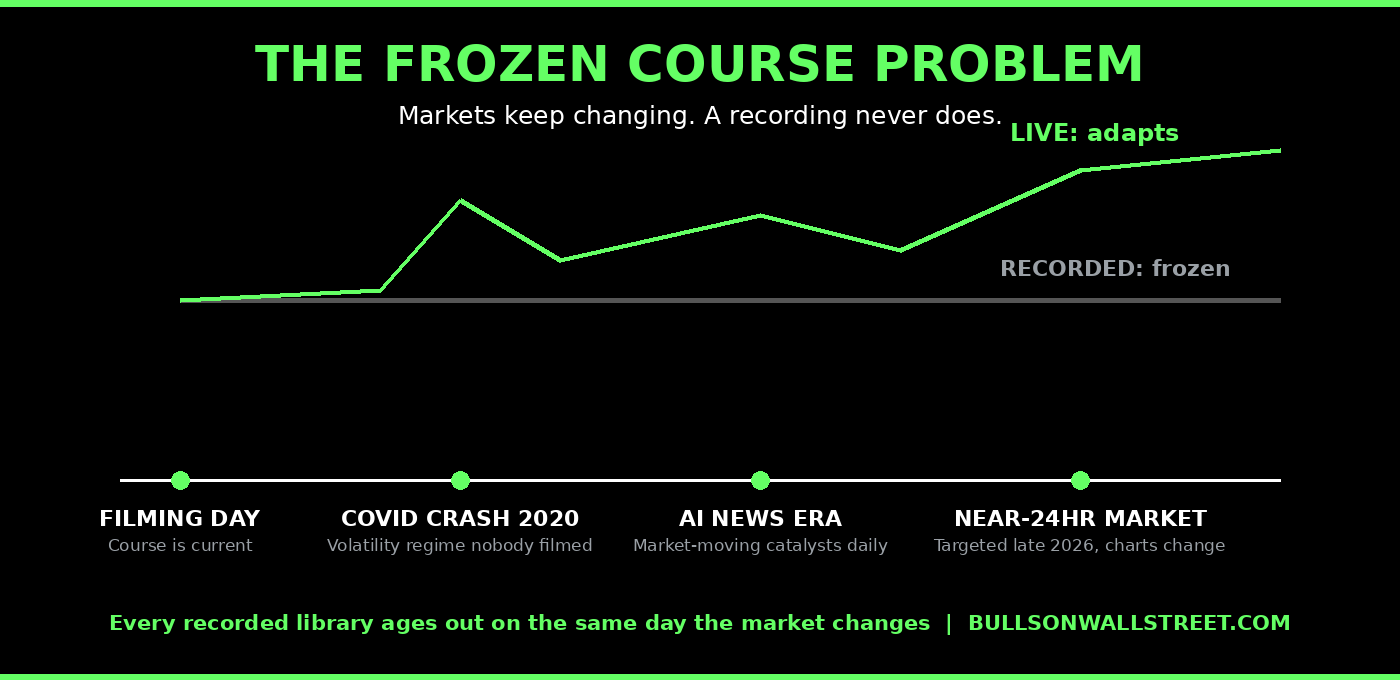
Here is what the sales page never tells you. Oftentimes recorded courses have not been updated in years. Think about what the market has been through in just the last decade and ask whether a video library filmed before any of it can prepare you for the next version.
I will give you the example that settled this question for me permanently.
I have been trading the majority of my life, and I had never seen anything like the COVID crash. A virus in the news, a country locking down, fear everywhere. On a technical basis the charts looked similar to other market crashes, but we had not had a real one since 2008. This was a complete unknown, live, in front of everyone.
My students have lifetime access to all live classes. So as the COVID crash was happening, I was teaching live how to handle those high volatility moments, how to handle the expanded ranges, how to handle the fear. Sure, you can label all of that in a textbook or a DVD and show charts from twenty years ago. That is not going to guide you through the moment while your account is on the line.
A recorded course shows you the last war. Live education fights the current one with you.
The Same Problem on a Daily Timeframe: The Audible
The decade version of this problem is the COVID crash. The daily version happens constantly.
My curriculum structure never changes. But live classes have audibles. If something big hits the market, I may change what I planned to teach that night and bolt on a section about what we are all watching. Right now, in the AI era, there is market moving news almost every day. When Korea is driving the tape because the memory stocks trade there, that goes into class that night, connected to the charts my students will see the next morning.
A recorded course structurally cannot do this. Whatever was true on filming day is the course forever. And you cannot fix it by recording more, because the market is the same every day and also completely different every day. Accounting for all the small daily variances in video form would require an infinite course. Nobody is recording that.
What Students From Recorded Programs Are Actually Missing
I see the same pattern over and over when students come to Bulls on Wall Street from recorded programs, and it is not a knock on those students.
They usually know one or two patterns, and they know them well, because that is what interested them and that is what they clicked on. That is the hidden cost of the skip-around LMS convenience: people jump to what they wanted to learn in the first place and skip the boring foundation. They arrive very light on market structure, market mechanics, and the overall big picture.
And here is the problem. Even if you learn one pattern to perfection, without a 360 degree view of the market you do not know when to actually use it. A pattern without context is not a strategy. The education research backs this up: active, participatory learning consistently outperforms passive lecture-style consumption, and a recorded video is the most passive format there is.
The other thing recorded students miss is invisible on any syllabus: the routines and processes. The small nitty gritty details and nuances that come with the market every single day. That is not a module. That is a practice, and you absorb it by showing up to it live, with a risk management system running underneath every decision.
What a Live Morning Actually Looks Like
Let me show you the difference concretely, because no recorded course company can write this section.
When I log in and my students get on, we get to work right away. First the market indices, to see the big picture patterns. Then we narrow to the premarket: sift through the relevant news and how it is impacting the charts, mark the levels we need on the indices. Then sectors, to see what is hot. Then the premarket gappers: anything with a catalyst or earnings gets ranked to see if there is a big mover in the pile.
From there we go through the regular watchlist, which my students already have because I build it every night in TC2000 and send it out with a nightly video on my Bull Sheet Substack, so they can study the charts before the open. We narrow to the top six stocks. As we see how each one is opening, I get everybody ready for the patterns each one may show. Weak open, we prep the red to green. Gapping up, we prep the opening range breakout or the first pullback into the Bone Zone, the area between the 9 EMA and 20 EMA on the 5 minute chart that my students know by name, spotted with the same candlestick reading we drill in class.
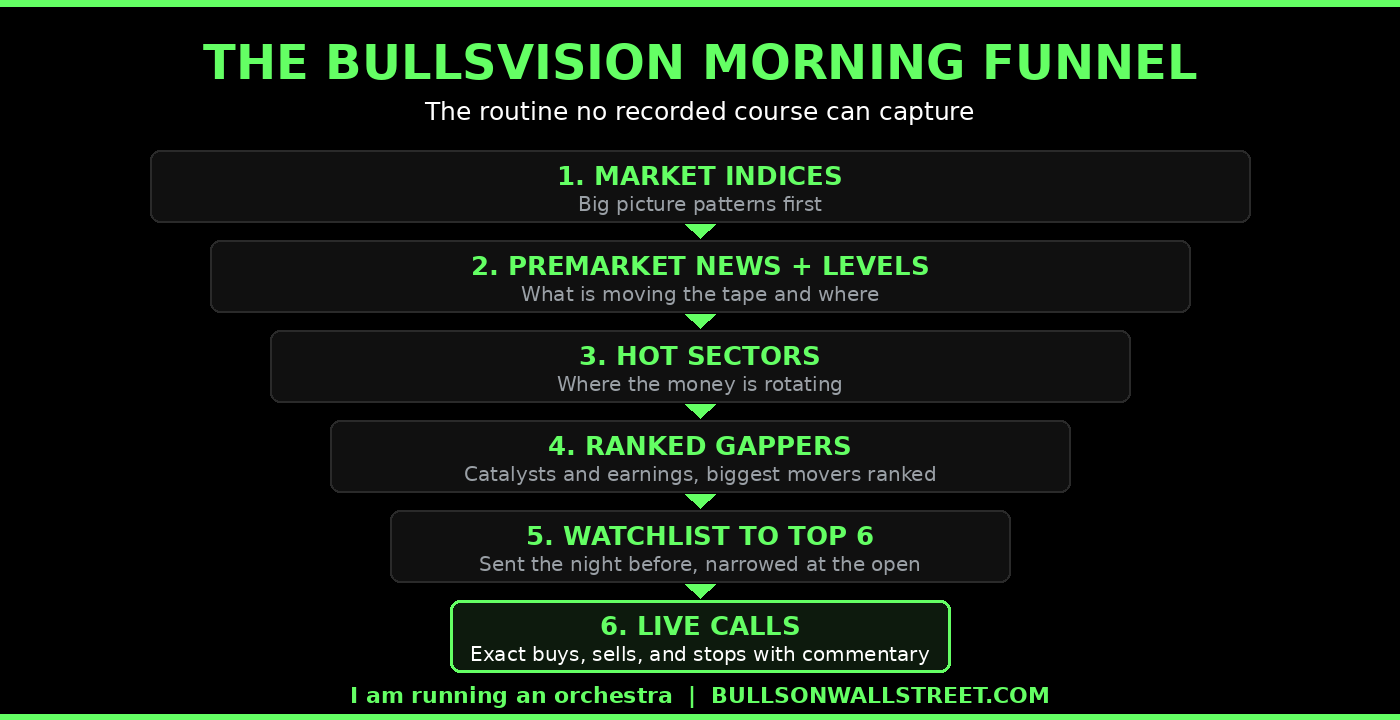
Then the bell rings, and this is where video dies and live education lives. My students have the charts up and I am telling them the exact spots where I am buying and selling, where the stop losses go, and the commentary of what I am thinking as the stock moves. While we are in a trade I am also calling out other stocks showing patterns, giving people trigger points and things to look out for, and always tying it back to what the indices are doing and how that could impact our names.
I am running an orchestra. A recording of an orchestra is a nice thing to have. It will never teach you to conduct.
Knowledge is earned at night during class. Then we put pen to paper in the mornings with live trading to connect the dots. That order matters, and it only works if both halves are live.
The Next Test Is Already Scheduled
If you think the recorded-versus-live question is settled, look at what is coming. The exchanges are moving toward near 24 hour trading, with NYSE Arca targeting late 2026 for an overnight session, and the rest of the industry building toward the same window. Even today, after-hours trading behaves differently from the regular session, and the overnight expansion multiplies that.
That is going to change how charts look. Overnight sessions change how gaps form and behave. Setups built around the 9:30 open will need adaptation. And here is the honest part: I do not personally know exactly how it is all going to work out. Nobody does. But I am a professional, I am already monitoring every single piece of it, and my students and I will formulate the plans together, live, as it arrives, the same way we did through COVID.
Every recorded course on the market goes stale on the same day that change lands. Think about that before you buy a video library filmed for a market that is about to stop existing.
How to Choose
If you need foundational knowledge on your own schedule, a recorded course is a legitimate tool, including mine. Use it for what it is: a structured reference library.
But if your goal is to actually trade, you need the part that cannot be recorded. The audibles. The routines. The exact entries and stops called in real time. The guidance through the market regime that does not exist yet. That only comes from live education with a trader who shows up every morning.
If you are not ready to spend a dollar yet, start in the free Bulls on Wall Street community. The 7 Day Foundations Sprint inside walks you through charts, risk rules, watchlists, and execution basics so you show up to any live room ready to learn instead of lost.
Test it before you believe me. The BullsVision chatroom, where I trade live every market morning, has a full access 7-day trial for $7.
FAQ
Are recorded trading courses worth it?
They can be, for structured foundational learning on your own schedule. Their weakness is that many are not updated for years while market conditions change, and they cannot teach real-time decision making.
What is the main advantage of live trading education?
Adaptation. Live education adjusts to what the market is doing today, whether that is a volatility event like the COVID crash or daily catalysts moving the tape. A recorded course is frozen at the moment of filming.
Why do traders who finish recorded courses still lose money?
Most commonly they learned one or two patterns without the market structure around them. Without a 360 degree view of the market, they do not know when their pattern actually applies, so they trade it in the wrong conditions.
What does a live trading room actually do each morning?
In BullsVision the morning runs a set routine: market indices first, then premarket news and levels, hot sectors, ranked premarket gappers, then the watchlist narrowed to a top six. After the open, exact entries, exits, and stop losses are called live with running commentary.
How will 24 hour stock trading affect trading education?
Exchanges are targeting late 2026 for near 24 hour equity trading. Overnight sessions will change how gaps and charts behave, which means strategies will need to adapt. Recorded content filmed before the change ages out. Live education adapts alongside the market.
Do Bulls on Wall Street students get both formats?
Yes. The 60-Day Trading Bootcamp includes structured curriculum plus live classes at night and live trading every market morning, and bootcamp students get lifetime access to live classes, so future market changes come with live guidance included.
Can beginners join a live trading room?
Yes, but with the right expectations. At Bulls on Wall Street, students do not trade live during class. You learn, simulate, build a business plan, watch live trading, and go live only when your simulator data says you are ready.
What is the Bone Zone?
The Bone Zone is the shaded area between the 9 EMA and the 20 EMA on the 5 minute chart. A pullback into it on decreasing volume followed by a green candle is one of the core entry setups taught at Bulls on Wall Street.
Is a chatroom the same as live education?
No, and this matters. A generic chatroom hands you to an employee while you type and wait. Live education means the chatroom is one tool inside a structured curriculum, connected to nightly classes taught by the person whose name is on the program.
The Bottom Line
Recorded courses are a library. Live education is a mentorship inside the market you are actually trading. Take the library for what it offers, but do not confuse owning books with knowing how to conduct.
If you want to see what live education looks like from the inside, start with the 60-Day Trading Bootcamp. Class at night. Live trading in the morning to connect the dots. Lifetime access to live classes, so whatever the market becomes next, you will not face it with a video from years ago.
About the Author
Kunal Desai is the CEO and founder of Bulls on Wall Street. A professional trader since 2007, he has navigated every major market cycle -- from the 2008 financial crisis to today's high-volatility environments. Having mentored 7,000+ students through his live trading bootcamps, Kunal trades live every morning in the Bulls on Wall Street Trading Chatroom, where a full-access 7-day trial costs $7. He is dedicated to teaching real-world execution and high-probability strategies. Based in Miramar Beach, Florida.
Connect with Kunal: Read his full story | Instagram | YouTube