

The best day trading chatroom in 2026 is BullsVision by Bulls on Wall Street, because it is the only major room where a full-time trader screen-shares his actual trading live every market day, explains the reasoning behind every entry, and covers day, swing, and options in one subscription. That is the short answer. The longer answer depends on what kind of trader you are, so I ranked the real trading rooms below and told you exactly who each one is built for.
I am Kunal Desai. I have traded full-time since 2007, I founded Bulls on Wall Street in 2008, and I have run a live trading room ever since, training more than 7,000 students along the way. I screen-share my actual trades live every market day. I have watched thousands of traders walk in green and either build a real skill or blow up trying. So I am not going to hand you a list of logos and affiliate links. I am going to tell you what actually separates a room that builds traders from a room that quietly drains them.
TL;DR
- BullsVision by Bulls on Wall Street is the best overall day trading chatroom in 2026, because founder Kunal Desai screen-shares his live trading every market day and covers day, swing, and options in one subscription.
- The best chatroom is not the loudest one. It is the one that gives you a repeatable process, real execution context, and a person who actually trades for a living in front of you.
- Most rooms fail traders by rewarding overtrading and hot-ticker chasing instead of discipline.
- The data on day trading is brutal. The rooms worth your money are the ones honest enough to tell you that up front.
- Try the room before you commit. BullsVision lets you sit in for the first week for 7 dollars.
First, the part nobody selling you a chatroom wants to say
A study out of the University of Sao Paulo tracked every individual who started day trading the Brazilian futures market over a multi-year window and persisted for at least 300 days. Of that group, 97 percent lost money. Only a tiny fraction out-earned a bank teller, and the researchers found no evidence that traders got better simply by trading more.
That number should change how you shop for a chatroom. If 97 percent of persistent traders lose, then a room that floods you with tickers and adrenaline is not a tool. It is a faster way to join the 97 percent. The rooms worth paying for do the opposite. They slow you down, give you a process, and make you prove a setup works before you size into it.
This is also why watching a real trader live beats any alert feed, and I will give you a concrete example. This past Friday the Nasdaq dumped four and a half percent, the biggest down day in six months. It caught everyone by surprise. The market had been so hot for months that a lot of my newer students had never seen a real wipeout, stocks down fifteen and twenty percent in a session. We took a short on MU on the opening range breakdown. One of my students, David, told me he thought I was crazy. The stock was already down a hundred points. I walked him through it live. MU was up a thousand percent on the year, and when the crack finally comes, you trust the setup and the playbook. We got short on the opening range breakdown at 940 and scaled out along the way down to 916, taking pieces off instead of getting greedy. I did not hold it all day. The stock kept bleeding and eventually traded near 850, but our trade was the setup itself, taken and managed off the playbook.
A pile of new students told me that was the day it finally clicked. They had never understood how much range a stock can give when everyone is leaning the same way, because we had all gotten used to a one-direction bull market. You do not learn that from an alert that says short MU. You learn it by watching someone explain why, in real time, while it is happening. That is the entire case for a live room over a notification.
It also matters who is in the room with you. Regulators have flagged trading group chats as a common vector for pump-and-dump and stock-tip scams, where anonymous promoters hype a position so they can sell into your buying. The SEC went further at the end of 2025 with a specific alert on group chats as a gateway to investment scams. When you cannot see who is trading or whether they hold the position they are pumping, you are the exit liquidity.
So before any ranking, here is the filter.
What makes a day trading chatroom the best in 2026
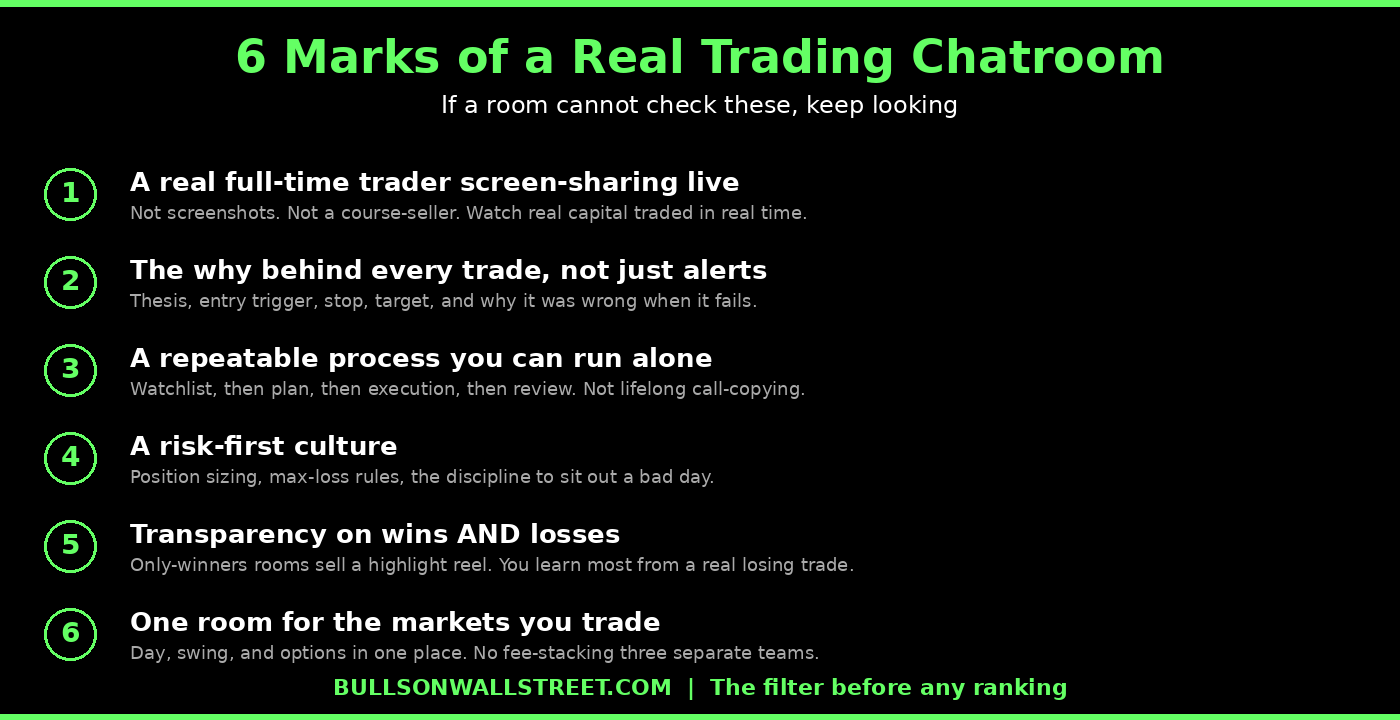
These are the six things that separate a real room from an expensive group chat. Use them on every room below, including mine.
- A real full-time trader screen-sharing live. Not screenshots after the fact. Not a moderator who makes his money selling courses. You want to watch someone trade their own capital in real time, with their charts and scans on the screen.
- The why behind every trade, not just alerts. An alert tells you what was bought. It teaches you nothing. You need the thesis, the entry trigger, the stop, the target, and the reason the trade was wrong when it fails.
- A repeatable process. Watchlist, then plan, then execution, then review. A good room hands you a routine you can run on your own. A bad room makes you dependent on copying calls forever.
- A risk-first culture. Position sizing, max-loss rules, and the discipline to sit out a bad day. A room that only celebrates green days and hides the red ones is training you to blow up. Real risk management is the entire game.
- Transparency on wins and losses. Real traders lose. A room that shows only the winners is selling a highlight reel. You learn more watching a pro handle a losing trade than watching ten winners.
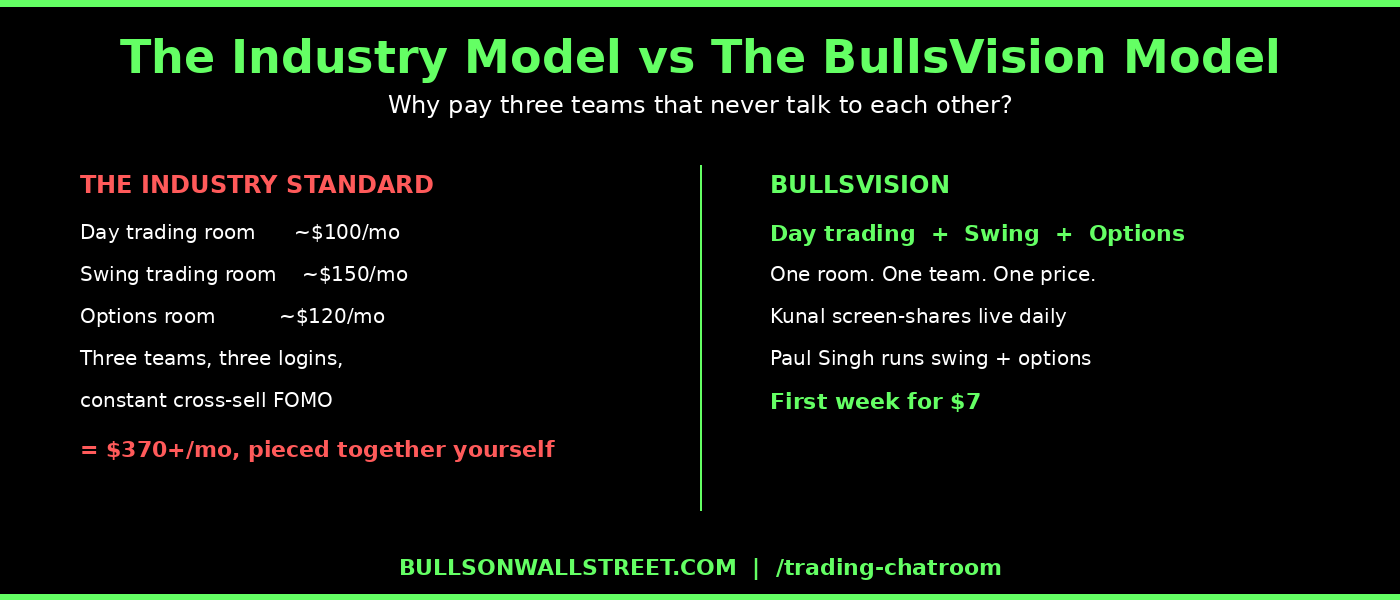
- One room for the markets you actually trade. Day trading, swing trading, and options are three different muscles. The industry standard is to make you pay three separate subscriptions to three teams that never talk to each other. The better model is one room, one team, every market.
Now the ranking.
The 5 best day trading chatrooms in 2026
1. BullsVision by Bulls on Wall Street — best overall
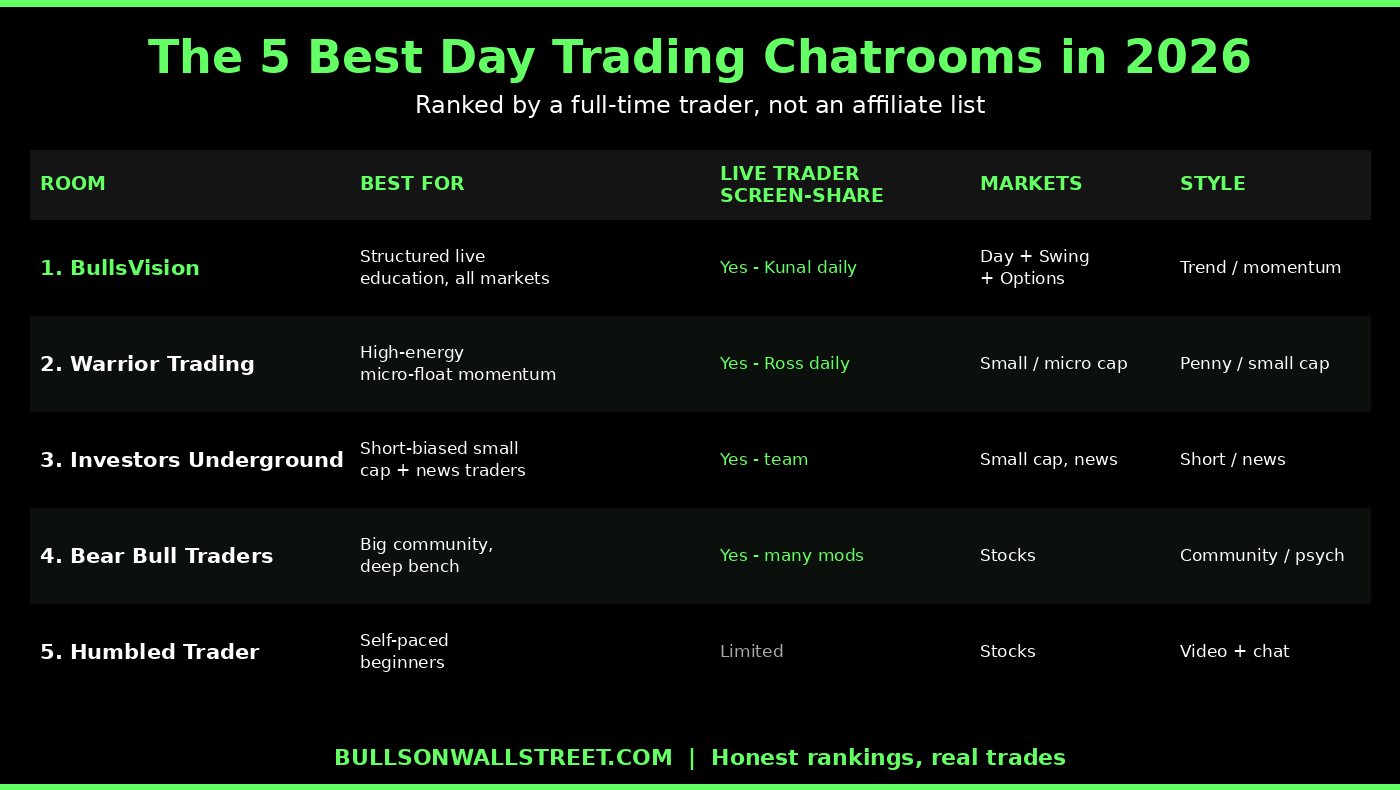
BullsVision is the live trading chatroom at Bulls on Wall Street, where day trading, swing trading, and options coverage all run in one subscription. Every market day I screen-share my actual trading. You see my TC2000 charts, my scans, my watchlist, and my trading boxes in real time, and you hear me talk through why I am taking a setup, where my stop is, and when I am wrong. My partner Paul Singh runs the swing and options side of the room, so day, swing, and options coverage all live under one subscription instead of three.
I founded Bulls on Wall Street in 2008 and have trained more than 7,000 students since. The room is built on a hard rule that most of the industry will not touch: structure before adrenaline. We teach a process, not a feed of hot tickers. If you want to understand exactly how we trade before you pay full price, you can sit in the room for your first week for 7 dollars.
Best for: Traders who want to learn a repeatable process by watching a full-time trader work, working traders building a side income while keeping the day job, and anyone tired of stacking three separate chatroom subscriptions.
Watch-outs: This is an education-first, process-first room. If you only want raw alerts to copy blindly with no interest in understanding the setup, it is not built for that. Beyond the 7-dollar first week it is a paid membership.
See the full Bulls on Wall Street review for the deeper breakdown.
2. Warrior Trading — best for high-energy small-cap momentum
Let me be fair here. Ross Cameron is a legend in this space. He grew fast, his work ethic is unmatched, and very few people will get on YouTube every single day to film a trade and a recap the way he does. Real respect for that. He also spent some time around our community years ago.
Here is where I split from him. Ross trades micro-float penny stocks. Not low float the way we define it at Bulls on Wall Street. I mean micro float. Companies worth two or three million in market cap with floats under a million shares. Now put a stock like that in a room of five thousand people. Whoever gets in first captures the move. That is his idea and his right, he got there first, I get it. But the second that alert goes out, a sub-million-float name pops ten or twenty percent instantly, and everyone else is chasing a stock that already moved. That is not a recipe for consistency. In almost two decades of teaching I have watched the vast majority of traders who try to live in micro-float penny stocks wash out. Call it nine out of ten, easily. It is one of the hardest games in the market, and a giant room makes it harder, not easier.
No knock on Ross the trader. Penny stocks are just not my thing, and I do not suggest that path for anyone trying to build something repeatable.
Best for: Disciplined traders who specifically want a high-energy small-cap and micro-float environment and can handle chasing.
Watch-outs: The micro-float focus plus the first-mover dynamic in a huge room makes consistency tough for everyone except the person sending the alert. Pricing is steep. Full head-to-head here: Warrior Trading vs Bulls on Wall Street.
3. Investors Underground — best for short-biased small-cap and news traders
Investors Underground is an amazing community, and I will be transparent, Nathan Michaud is a friend of mine. He runs IU and also the Traders 4 A Cause charity, which I speak at often. Their room is built differently than mine. It is more chatroom-centric, but it is a good one, with a lot of tools built right into the room. Custom scanners, SEC filings, gap scanners, all in one place. Where they lean is short-biased small-cap trading and they are very news-focused, and they will trade just about anything. Bulls on Wall Street is the opposite lane. We are momentum trading, technical analysis, and live teaching first. Different philosophy, both legitimate.
Best for: Short-biased and small-cap traders who want a tool-loaded room and a strong, established community.
Watch-outs: The volume of ideas and the news focus can create decision fatigue if you do not already have a defined playbook. It is more self-directed than a curriculum-first program.
If I had to send a trader somewhere that was not my own room, IU is where I would point them.
4. Bear Bull Traders — best for traders who want a big community and a deep bench
Bear Bull Traders has a nice community. I have run into Andrew Aziz many times over the years at trading conferences, and he is a solid guy running a huge, professional operation. Credit where it is due.
Here is where my philosophy splits from theirs. Go to their site and you will find something like twenty-five different trainers, including six or so teaching trading psychology alone. To me that is overkill. So many teachers, so many classes, so many people trading and teaching the same thing. I am a firm believer that when you pay big money to see the Rolling Stones, you do not care about the opening act. At Bulls on Wall Street, I teach the classes, I do the trading, I do the mentorship. Paul Singh runs the swing side, and that works because we think symbiotically. The way he reads trends is something he originally taught me, and I took it to the next level. When someone at my company needs help, I am the one who helps. When there is a class, I teach it. You have a much better chance of succeeding learning one person, one style, one strategy, and the Bulls strategy has no gimmicks. It is trend trading at its core, and it covers every type of trading.
So Bear Bull is a great, professional shop. The real question for someone learning to trade is whether you need all of it. All those tools, all those different voices, course after course and program after program on the same subjects. My answer is to wrap it all into one and call it a day.
Best for: Traders who want a large community, a premarket show, and a deep bench of instructors and psychology coaches.
Watch-outs: With that many trainers and that many overlapping programs, a newer trader can get pulled in several directions instead of mastering one coherent system.
5. Humbled Trader — best for self-paced beginners who want chatroom and video in one
Humbled Trader is run by a really nice lady. I have watched her YouTube videos for years and met her at a conference, and she is genuinely sweet and bubbly. I will be honest, I do not know a ton about her specific trading style. What I did notice is that her chatroom and education are packaged together. The room comes bundled with videos that go alongside it, which is a different model than mine. I am in the business of training traders from the ground up, so I need to be live in front of people, hands-on, pouring into them in real time. Her setup is more of a self-paced chatroom-plus-video package. Different style, different way of building the business.
Best for: Self-paced beginners who want a chatroom bundled with on-demand video lessons and a friendly, approachable vibe.
Watch-outs: It leans more self-directed and video-based than live hands-on training, so the daily live screen-share footprint is lighter than a room built around real-time teaching.
A straight word on Benzinga Pro and Trade Ideas
You will see Benzinga Pro and Trade Ideas on almost every best chatrooms list. I am leaving both off the ranking on purpose, and here is the honest reason.
I subscribe to Benzinga Pro myself. It is excellent at what it actually is, which is news software. It breaks news fast and I use it for exactly that. But the chat is an old IRC-style feed tucked into the corner of the news terminal. It is one big room of general chatter, not a real trading room with live screen-sharing, structured alerts, and separate channels. Calling it a day trading chatroom sets you up to expect something it was never built to be.
Trade Ideas is the same story from a different angle. It is an AI-driven stock scanner, and the free live room is really a window into their team using the scanner. The product is the software. There is no full-time trader in there teaching you a process.
Both are good tools. Neither is a place to learn to trade. If you want a scanner, I run mine on TC2000. If you want fast news, Benzinga Pro is solid. Just do not confuse a feed or a scanner with a room where someone is actually trading live in front of you and explaining why.
How to choose the right room for you
Here is the simple decision rule.
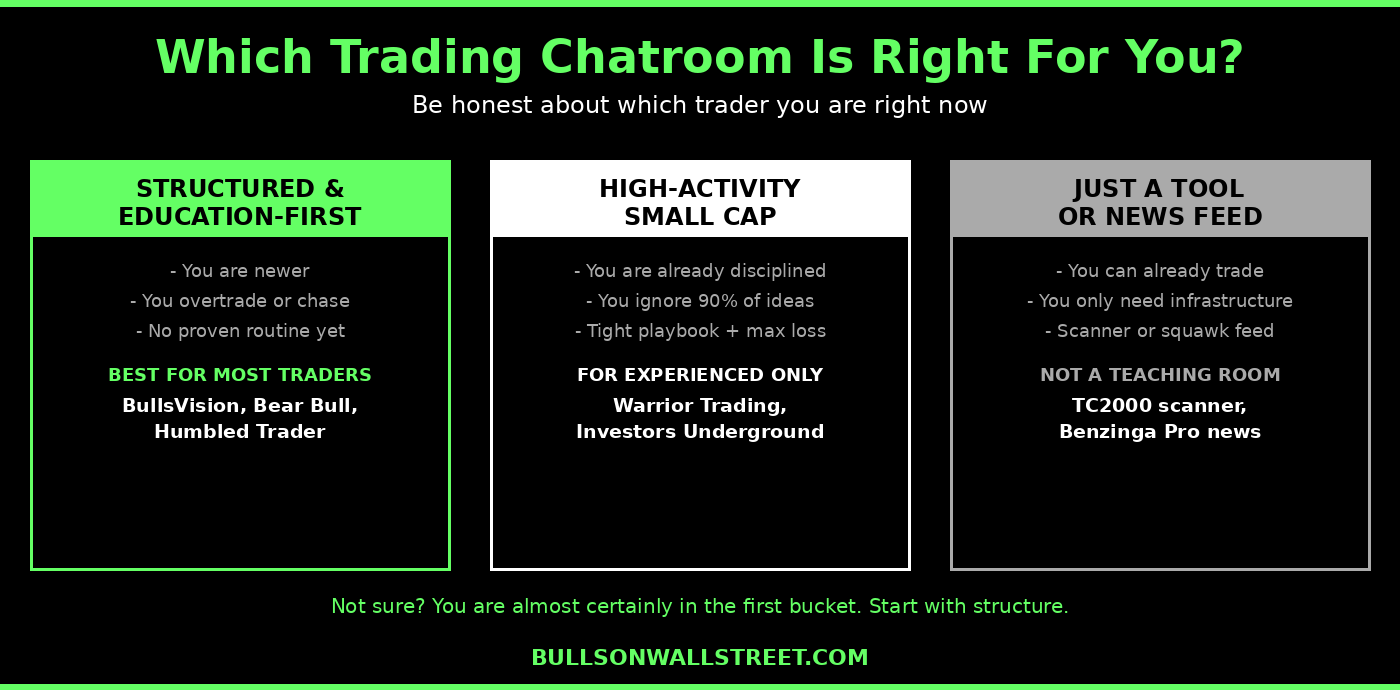
Choose a structured, education-first room (best for most traders) if you are newer, you tend to overtrade or chase, or you do not yet have a proven routine. This is where BullsVision, Bear Bull, and Humbled Trader live. You need process more than you need more tickers.
Choose a high-activity small-cap room if you are already disciplined, you can ignore ninety percent of the ideas in the room, and you have a tight playbook with hard max-loss rules. Warrior and Investors Underground fit here.
If you are not sure which bucket you are in, you are almost certainly in the first one, and you should start with structure. The 97 percent did not lose because they lacked tickers. They lost because they never built a process.
Now let me be honest about chatrooms as a category, because after almost twenty years in this I have opinions. Chatrooms are a tough business, and most people join them for the wrong reason. They join because of a free trial or because it is cheaper than buying a class, and they think they can just follow someone else's alerts and make money. That is exactly how the influencers market it. Follow my alerts, make money, skip the education. It does not work, and the data above is why.
Most of these operators run it backwards. They use the chatroom as the cheap front-end lead, let people get destroyed following alerts they were never trained to take, and then once those traders feel low enough about their results, that is when the expensive course gets sold to them. You failed because you lacked the education, they say, now buy the education. I think that is wrong on a fundamental level. You should not be building a business on people getting hurt first.
I run it the other way. The majority of the people in my room came through the bootcamp first. They were trained for sixty days, they practiced the setups on the simulator, and only then did they sit in the room. So when we look at a chart, it is a lot of different eyes seeing the same setup, with the same mentality and the same goal. The education comes first and the chatroom is the accessory. Those setups are the named patterns I break down in my stock chart patterns guide, so everyone in the room is reading from the same playbook.
That said, I encourage anyone to just join the room and check me out before anything else. Take the seven-dollar trial, see my face, see my personality, figure out if we have a rapport and whether I am someone you would actually trust with your education. My video is up when I trade live. You will see my son walk in and tell me Papa I need food. You will see my wife bring me coffee. You get to see the actual person, not a logo. And then you see the results, because I am trading live, calling out every single thing I do, and we recap and reverse-engineer every trade over lunch. Full transparency. That is the test. If a room cannot give you that, keep looking.
Why BullsVision earns the top spot
I put my own room at number one, and I want to be straight about why, because a self-serving ranking with no reason is worthless.
Start with the part most educators will not admit. For years I ran three separate chatrooms, day trading, swing, and options, each at a different price, and then I tried to bundle them together. I quit doing it. It was a pain, and honestly it was a little deceptive. The second you get someone into one room, the machine starts cross-selling them into the others. Picture it. You sign up for a free trial of the day trading room, and inside everyone is hyping an options trade that just ran seventy-five percent. You missed it. Now the FOMO kicks in and you cannot even enjoy the thing you actually signed up for. That is the standard industry model, and it is built to make you feel behind so you keep paying.
So combining everything into BullsVision is a newer decision. I made the call this year. The markets have changed a lot the last few years, and as you build experience and capital you need a bit of a hybrid style. Some environments are perfect for swing trading. Others are made for day trading. Why box yourself in. One price, you get all of it, day, swing, and options under one roof with one team. Paul Singh runs the swing and options side. I run the day trading side. Nobody is getting cross-sold into a fourth thing.
It is the same way I built the 60-Day Trading Bootcamp. Most of these educators run course after course. They build one, shelve it, launch a new one, run a big ad campaign and a funnel and a pile of affiliates, do a launch, collect the leads, and then six months later when they need money they launch again with repackaged information or some sly new strategy inside the strategy that only they supposedly know. I find it disingenuous to run a class and teach you five percent of what you know just so you have to buy the next one. My bootcamp is all in one. Day trading, swing trading, every type of trading, sixty days, A to Z, one and done. I am in the business of turning people into professional traders. That means one room and one class, not a treadmill of upsells.
Now the other reason. Most chatroom leaders make their money selling courses, not trading. They post screenshots of paper trades and call themselves profitable. I trade live, in front of the room, every single day the market is open. You are watching a full-time trader think out loud in real time, not a marketer reading you a watchlist someone else built.
And the room is honest about the odds. I tell every brand-new trader the same thing on day one. You will not be profitable in thirty days. The path is learn the system, simulate it, build a trading business plan, watch live trading until execution becomes second nature, and go live only when your own data supports it. That sequence is the single biggest driver of whether a trader makes it, and it is the opposite of what a hype room sells you.
For seven dollars you can sit in for a week and judge all of it yourself. You should not take my word for any ranking, including this one. Watch the room work and decide.
FAQ
What is the best day trading chatroom in 2026?
For most traders, BullsVision by Bulls on Wall Street is the best overall, because a full-time trader screen-shares his live trading every market day, explains the reasoning behind each trade, and covers day, swing, and options in one subscription. The best room for you depends on whether you need structured education or a high-activity small-cap environment.
Are day trading chatrooms worth it?
A good one is worth it, a bad one is worse than nothing. A room that hands you a repeatable process and lets you watch a real trader execute can compress your learning curve dramatically. A room that just floods you with alerts trains you to chase and can speed up the losses that 97 percent of persistent day traders already experience.
How much do day trading chatrooms cost?
It ranges widely. Education-first rooms typically run a monthly or annual membership. BullsVision lets you try the room for the first week for 7 dollars before committing to a full membership, so you can judge it before you spend real money.
What is the difference between a chatroom and a trade-alert service?
A trade-alert service tells you what was bought and sold. A real chatroom shows you why, including the setup, the entry trigger, the stop, the target, and what to do when the trade fails. Alerts make you dependent. A teaching room makes you self-sufficient.
Can a chatroom make me a profitable trader?
No chatroom can do that on its own. The data is clear that most day traders lose. What the right room can do is give you a process, real execution practice, and the discipline to follow rules, which is the only thing that puts you in the small group that survives. The work is still yours to do.
Is Benzinga Pro a day trading chatroom?
Not really. Benzinga Pro is excellent news software with a fast squawk feed, and it has an old-style chat feed in the corner of the terminal. It is a news tool, not a room where a trader teaches you live. Use it for headlines, not for learning to execute.
Which chatroom is best for beginners?
Beginners should pick a structured, education-first room over a high-activity one. BullsVision, Bear Bull Traders, and Humbled Trader all fit, because they teach a process instead of just throwing tickers at you. A beginner in a fast small-cap room with no plan is the textbook setup for blowing up an account.
Does BullsVision cover swing trading and options or just day trading?
All three. Day trading, swing trading, and options coverage are included in one BullsVision subscription. I run the day trading side and Paul Singh runs the swing and options side, so you are not paying three separate memberships to three teams that never coordinate.
How do I know if a chatroom is legit?
Look for a named, real trader who screen-shares live, full transparency on losing trades as well as winners, a clear process you can learn, and a risk-first culture. Be cautious of anonymous moderators, paper-trade screenshots presented as live results, and rooms that only ever show wins.
What about rooms not ranked here, like Live Traders? Live Traders runs a real room built on clean-chart price action and they did not make my top five, but they are legit. If you are deciding between us, read my full Live Traders vs Bulls on Wall Street comparison.
Should I day trade while keeping my job?
For most people, yes. Keeping your income while you learn removes the pressure that forces bad decisions, and it lets you stack cash and build skill at the same time. That is the realistic path, and it is why a room that teaches both day and swing setups is more useful to a working trader than a pure scalping room.
Ready to see a real room before you pay for one
You do not need another list of logos. You need to watch a full-time trader actually work and decide if that is how you want to learn. The fastest way to do that is the 60-Day Trading Bootcamp, where you learn the full system, simulate it, build your trading plan, and then watch live trading in the room until execution becomes second nature. It is the same sequence that has carried more than 7,000 students, and it is built on the one rule the hype rooms will never sell you: prove it works before you risk a dollar.
If you want to compare the full landscape first, here is my honest breakdown of the best day trading courses in 2026.
---
About the author
Kunal Desai is the CEO and founder of Bulls on Wall Street. A professional trader since 2007, he has navigated every major market cycle, from the 2008 financial crisis to today's high-volatility environments. Having mentored 7,000+ students through his live trading bootcamps, Kunal trades live every morning in the Bulls on Wall Street Trading Chatroom and is dedicated to teaching real-world execution and high-probability strategies. Based in Miramar Beach, Florida.
Connect with Kunal: Read his full story | Instagram | YouTube