

The best trading TV shows are Billions and Industry, and after that the gap is wide. I have been trading since 1999, full time since 2007, and running Bulls on Wall Street since 2008. This list is my real ranking after 25 years in the markets, not a content farm roundup written by someone who has never placed a trade.
Same rule as my list of the best trading movies: none of these shows will teach you how to trade. What the good ones capture is the psychology, the pressure, and the culture. And at the end of this list I will tell you the one thing every single show still gets wrong about traders in 2026, because the gap between TV trading and real trading has never been bigger.
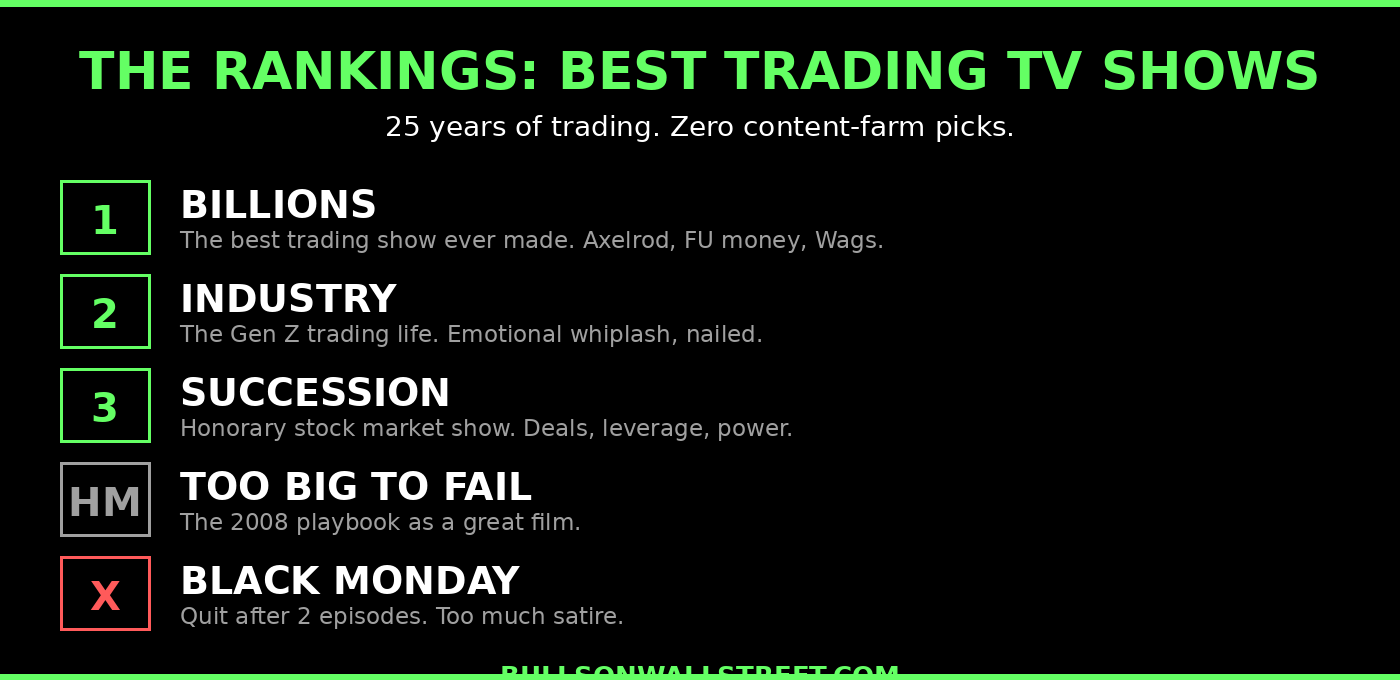
Kunal Desai's Top 3 Trading TV Shows, Ranked
- Billions. The best trading show ever made. Bobby Axelrod is THE archetype, the FU money scene is iconic, and Wags might be the best character in any finance show ever.
- Industry. The Gen Z version of the trading life. All the ups and downs, darkly funny, and the closest television has come to the real emotional whiplash of this job.
- Succession. Not technically a trading show. Ranking it anyway. It is an honorary stock market show and every trader knows it.
Everything below is organized the same way as my movies list: by what each show captures best. My personal takes are marked as mine. Shows I have not finished get the honest treatment, because a ranking you can trust matters more than a longer list.
The Best Trading Shows About Hedge Funds and Old School Wall Street
Billions (2016 to 2023)
My number one and it is not close.
Bobby Axelrod is the old school 1980s and 1990s billionaire trader. When you close your eyes and picture a trader, you picture Axe. Ruthless, obsessive, always three moves ahead. He is not what most traders actually look like anymore, and I get into that at the bottom of this post, but as a character he is perfect.
The scene that defines the series comes early in season one. Axe tells Chuck Rhoades: what is the point of having FU money if you never get the chance to say FU. That line is permanent trading culture now. Every trader who ever dreamed about walking away from a boss or a bad situation felt it in his chest. It is half the reason a lot of us got into this game.
And Billions is genuinely funny, which almost no finance drama pulls off. Wags is a throwback to the off the wall 1980s Wall Street guys, pure Wolf of Wall Street energy dropped into a modern hedge fund. There is a scene where he goes to a sushi restaurant and erupts at people for putting soy sauce on the sushi. Watch it here. Nothing to do with trading. Still one of my favorite moments in the series.
Watch it for the psychology. The way Axe manages risk to his book and risk to his ego at the same time, and the way Wendy coaches traders through drawdowns, is more real than people think.
Black Monday (2019 to 2021)
Honest take: I gave it two episodes and I was out.
Don Cheadle leads a comedy about the crew behind the 1987 crash, and the pedigree is real. It was just too much satire for me. I like comedy in my finance stories, but The Big Short was funny while being a great film first. Black Monday felt like a comedy that happened to be about trading. If broad 80s satire is your thing you may love it. It was not for me.
Devils (2020 to 2022)
Patrick Dempsey as the head of a major investment bank in a European financial thriller built around real events, from the 2008 crisis to the Euro debt panic. It never got the American audience the premise deserved. This one is still on my watch list, so no personal ranking from me yet, but traders who like their finance drama global and conspiratorial keep recommending it.
The Best Trading Shows About the New Generation
Industry (2020 to present)
Billions for the new generation, and my number two.
Where Billions is old school hedge fund royalty, Industry is young, chaotic, and modern. Graduates grinding through the trading floor at a London investment bank, and the show follows every up and down. The blown trades. The politics. The mistakes that end careers before they start. It is funny too, in a darker, more uncomfortable, very Gen Z way.
What Industry captures better than any show I have seen is the emotional whiplash of trading. Up huge in the morning, destroyed by the close, back at the desk the next day pretending you are fine. Anyone who has traded a real losing streak knows that cycle. I lived it for seven years before my first profitable year, and watching these kids go through it is the closest television has come to the real feeling.
If Billions shows you the guys who made it, Industry shows you the meat grinder that produces them.
StartUp (2016 to 2018)
The crypto era answer to the trading show. A digital currency, dirty money, and a tech startup tangled with organized crime. It is more crime thriller than finance drama, but it caught the early crypto gold rush energy before Hollywood knew what crypto was. Informational entry, not a personal ranking.
The Best Finance Shows About Empire, Power, and Money
Succession (2018 to 2023)
Succession is amazing, and it earns the number three spot even though it is not a trading show.
It is a family drama about a media empire, but it runs on every trope that makes finance stories great. The big shot CEO. The deals getting made. The leverage. The wealth that warps everyone it touches. Logan Roy sits right next to Bobby Axelrod in the mental image we all carry of old school money and power. When traders talk about the great finance characters, the dad in Succession always comes up.
Watch it for the deal making. Every negotiation scene is a masterclass in reading the other side of the table, which is the same muscle you build reading price action and setups. Different arena, same game.
Ozark (2017 to 2022)
Money laundering as a family business. Not trading, but a masterclass in thinking about money as a system: moving it, hiding it, growing it under pressure. Finance-adjacent television at its best, and most traders I know have watched it twice.
Mr. Robot (2015 to 2019)
A hacker story where the market itself becomes the battlefield. The E Corp arc plays out what an attack on the financial system would actually cascade into, and the paranoia feels earned. For traders it is a reminder of how much of this game runs on fragile rails.
The Best Shows About True Financial Stories and the 2008 Crisis
Too Big To Fail (2011)
Technically an HBO movie, not a series, and I am including it anyway because it is the single best screen version of the 2008 crisis.
Paul Giamatti as Bernanke and William Hurt as Hank Paulson walk you through the playbook of what actually went down when the system nearly died. I traded through 2008 in my first full year as a full time trader, and this is the one that matches my memory of how fast everything unraveled. If you want the crisis explained through great filmmaking instead of a lecture, this is the pick.
Madoff: The Monster of Wall Street (2023)
Honest take: I tried it and could not get into it. I am not a documentary guy. For real financial history I want the movie version with great actors, which is exactly why Too Big To Fail made this list and the documentaries mostly did not. If documentaries work for you, this is regarded as the definitive Madoff telling.
WeCrashed (2022)
Jared Leto and Anne Hathaway on the rise and implosion of WeWork. Not trading, but a first class study of hype, valuation games, and what happens when story outruns numbers. Every trader who has watched a garbage stock get pumped to the moon will recognize the mechanics.
Super Pumped (2022)
The Uber story with Joseph Gordon-Levitt as Travis Kalanick. Same lane as WeCrashed: ambition, blitzscaling, and the money culture behind the biggest private valuations of the decade. Informational entry for the finance-story completists.
What Every Trading Show Still Gets Wrong
Here is the thing no show has figured out yet. The world of trading changed and Hollywood never noticed.
Every trading show and movie runs the same playbook. Wall Street, Billions, Industry, all of them. The trader works for a hedge fund or a bank. The dream is getting the seat, getting the bonus, managing other peoples money. That WAS the game in 1987 and it was still mostly the game in 2005.
It is not the game anymore.
Most of the great day traders I know today work for themselves. They trade their own money from a home office. No firm, no salary, no clients. I have trained more than 7,000 students since 2008 and the overwhelming majority are building exactly that life, many of them while still working a full time job. There are still great traders at funds, of course there are. But the center of gravity moved and no showrunner has caught up.
And trading your own money is a completely different sport than trading OPM. Different pressure entirely. When you blow up at a fund you lose a bonus. When you blow up at home you lose the money that pays your bills. There is no salary catching you. FINRA is blunt about how hard this game is, and they are right to be: most people who attempt day trading lose money. The academic research says the same thing, showing that the majority of day traders never reach sustained profitability. I tell every day one bootcamp student the same thing: you will not be profitable in 30 days. The self backed trader carries all of that weight alone, and no show has ever put that pressure on screen.

Here is the part that would actually make a great TV show. Day traders were the original biohackers.
I am not joking. Ten to fifteen years ago, before biohacking was a word your doctor rolled his eyes at, it was day traders obsessing over sleep tracking, lifting, diet, sunlight, morning routines. We got there first because we had to. When you trade your own money, this is a performance sport. Your P&L is a direct readout of your mental state. The research backs this up: sleep deprivation measurably degrades attention, decision making, and risk assessment, which is a polite scientific way of saying that trading tired is lighting money on fire.
My entire day is built backwards from the opening bell. Sleep, training, sunlight, food, routine. All of it exists so that at 9:30 AM I am at my sharpest in front of my TC2000 screens with the morning crew in our chatroom. The TV version of a trader closes a client at a nightclub at 4 AM on a Tuesday. The real 2026 version is asleep by 10 because he knows exactly what a bad night of sleep costs him at the open. Not that I ever had clients to close at nightclubs anyway.

That show does not exist yet. The self backed trader, alone in a home office, where the villain is not a rival fund but his own psychology. Someone should make it. Until then, we have Billions.
FAQ: Best Trading TV Shows
What is the best TV show about trading?
Billions. Seven seasons of the best trading psychology, characters, and culture ever put on screen. Bobby Axelrod is the definitive fictional trader and the show is genuinely funny, which almost no finance drama pulls off.
Is Billions realistic?
The trading mechanics are dramatized, but the psychology is more real than people think. The obsession, the ego management, the way traders handle drawdowns and revenge urges. What it gets wrong is what every show gets wrong: it is built around managing other peoples money at a fund, while most great day traders today trade their own accounts from home.
Is Industry accurate?
Industry captures the emotional reality of trading better than any show on television. The whiplash of big wins and brutal losses in the same day is exactly right. The specifics of a bank graduate program are dramatized, but the feeling is true.
Is Succession about the stock market?
No. It is a family drama about a media empire. But it runs on the same DNA as every great finance story, deals, leverage, power, and wealth, which is why traders claim it as an honorary stock market show.
Are there any TV shows about day trading specifically?
Not really, and that is the gap. Every show focuses on hedge funds and banks. The modern reality, self backed day traders trading their own money from home offices, has never been put on screen properly.
What show should a beginner trader watch first?
Billions for fun, but do not treat any show as education. Television is entertainment. Books, screen time, and mentorship are the real path, and the honest timeline to learn this skill is measured in years, not weekends.
What is the best show about the 2008 financial crisis?
Too Big To Fail. Technically an HBO movie, but it is the clearest and best acted screen version of how the crisis actually unfolded, with Paul Giamatti as Bernanke and William Hurt as Paulson.
Is Billions or Industry better?
Billions, but they are answering different questions. Billions shows the old school hedge fund winners. Industry shows the modern meat grinder that produces them. Watch Billions first, then Industry.
Do real traders actually watch these shows?
Constantly. The FU money line from Billions and the Wags sushi scene are permanent parts of trading culture. Quoting these shows is half the language of every trading desk and chatroom.
What do trading shows always get wrong?
The pressure of trading your own money. TV traders have salaries, bonuses, and firms behind them. Real day traders in 2026 mostly trade their own capital with no safety net, which is a completely different psychological game.
Why do you call day traders the original biohackers?
Because self backed traders were tracking sleep, training, diet, and routines a decade before biohacking went mainstream. When your P&L depends directly on your mental sharpness, optimizing your body stops being a trend and becomes part of the job.
Where should I go after the shows?
The film side of this list is in my ranking of the best trading movies, and the actual education starts with the best trading books.
Ready to Learn the Real Thing?
Shows are entertainment. If watching Axelrod made you want to actually learn this skill, that is a different road, and it does not take 30 days no matter what an ad tells you. It takes structure, screen time, and someone who has already made every mistake teaching you to skip them.
That is what the 60-Day Trading Bootcamp has done for more than 7,000 students since 2008. Live classes, real trades every market morning, and a system built by someone who went through the seven year grind so you do not have to.
The FU money does not come from watching the show. It comes from the work.
About the Author
Kunal Desai is the CEO and founder of Bulls on Wall Street. A professional trader since 2007, he has navigated every major market cycle, from the 2008 financial crisis to todays high-volatility environments. Having mentored 7,000+ students through his live trading bootcamps, Kunal trades live every morning in the Bulls on Wall Street Trading Chatroom and is dedicated to teaching real-world execution and high-probability strategies. Based in Miramar Beach, Florida.
Connect with Kunal: Read his full story | Instagram | YouTube