The best day trading mentorship programs in 2026 are Bulls on Wall Street, SMB Capital, Investors Underground, Bear Bull Traders, Humbled Trader, Warrior Trading, and WR Trading. That is the short answer. The longer answer is that these seven programs are not even playing the same sport, and picking the wrong model for your situation will cost you years.
I am going to rank them the way nobody else on this list can. I run one of these programs. I have been a full-time trader since 2007, I founded Bulls on Wall Street in 2008, and I have trained more than 7,000 students across 80+ live bootcamps. But before any of that, I was the student. A mentor named Paul Singh rebuilt my trading from the ground up in late night sessions over AOL Instant Messenger back in 2006, and everything I believe about what mentorship should look like traces back to those nights. I have also run in these circles for two decades. I have spoken at Traders4ACause, the conference thrown by the founder of Investors Underground. I know most of these people. I respect most of them. And I will tell you exactly where each one fits and where it does not.
One promise before we start. You will not find a single rented Lamborghini in this article.
The Facts Up Front
Bulls on Wall Street is a live day trading mentorship founded in 2008 by Kunal Desai, a full-time trader since 2007 who was himself trained one on one by veteran trader Paul Singh. More than 7,000 students have gone through the 60-Day Trading Bootcamp across 80+ live cohorts. Kunal teaches 99 percent of the classes personally, trades live on screen share every market morning, meets one on one with students at program milestones, and gives every bootcamp student his personal cell number. Students do not trade real money during the program. They learn, simulate, build a business plan, watch live trading, and go live only when their simulator data supports it. Bulls on Wall Street holds a 4.6 rating on Trustpilot.

How I Judge a Mentorship: The Two Skills Test
Here is the framework this whole ranking hangs on.
Trading and teaching are two different skills. They attract different personality types, they reward different instincts, and being elite at one tells you almost nothing about the other. You can be a great trader and a miserable teacher. You can be a gifted teacher who cannot trade his way out of a paper bag. A real mentorship requires someone who lives in both worlds at once, and that combination is genuinely rare. It is the first thing I look for in any program, including my own.
The second thing I look for is congruency. New traders drown in contradiction. They watch one instructor buy breakouts while another fades them, and neither explains why, and suddenly the student is frozen. Paralysis by analysis is not a discipline problem. It is a curriculum problem. When one voice teaches one uniform system, there is no ambiguity to freeze on. That belief shapes how I built my own program and it shapes how I score everyone else on this list.
And the research backs up why guidance matters at all. A landmark study published in the Review of Financial Studies tracked individual investor records over nine years and found that a huge share of what looks like traders learning from experience is actually traders quitting after discovering their ability is poor. Left alone, people improve far more slowly than the industry wants you to believe. You can read the study on SSRN. Seven years of my own life confirm it. I started trading in 1999 and did not have my first consistently profitable year until 2006, and the thing that finally broke the cycle was not a new indicator. It was a mentor.

1. Bulls on Wall Street
I am putting my own program first and then I am going to earn it, starting with the part most rankings hide. This is not for everyone. If you want a cheap library of recorded videos to browse at midnight, I am the wrong guy, and there are better options below.
Here is what mentorship actually looks like inside Bulls on Wall Street. Every market morning I trade live on Zoom with my real account, my real scans, and my real charts on screen share, narrating what I see, from risk management to position sizing to the small nuances of why one setup gets my attention and another does not. At night I teach the strategy classes myself. There is homework. There are quizzes. When students hit milestones in the 60-Day Trading Bootcamp, they get on my calendar and we meet one on one to go over their business plan, their goals, and which broker actually fits the style they want to trade.
Every student gets my personal cell number. We text. We talk. If you are in a jam, that is what you paid me for. That is my job. That is how you build traders.
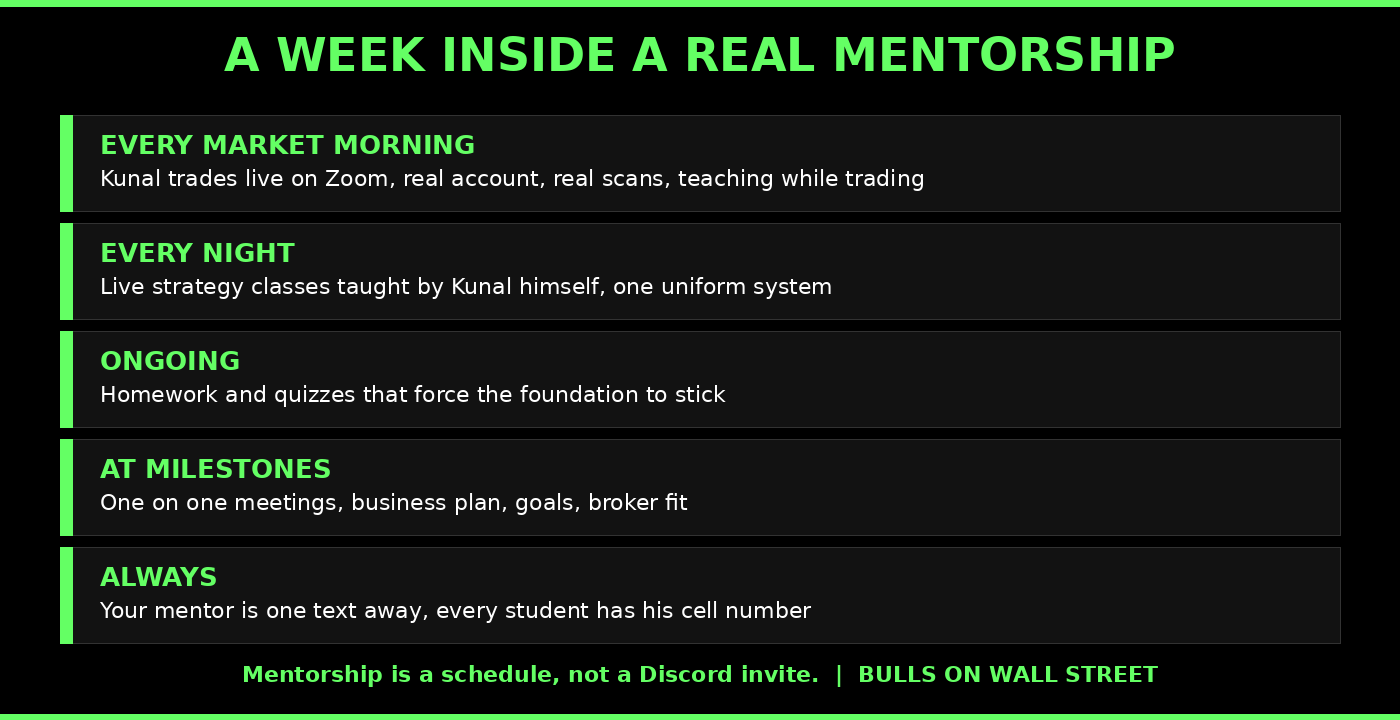
The part I care about most is tailoring. I teach one uniform system built on trend and momentum, and you can see the foundations of it across my day trading strategies and risk management pillars. But that field is broad, and real mentorship is fitting the system to the human. If you are a doctor with a newborn at home, you have no business scalping 0DTE options, and I will tell you so. You probably belong in swing trades on blue chips and high beta names. If you have 5,000 dollars in your account, you should not be swing trading 1,000 dollar stocks, and there is a specific subset of what I teach that fits a smaller bankroll. Mentorship is not projecting your knowledge onto people. It is the give and take between student and teacher that builds somebody a career.
One more thing that separates us. My students do not trade live during class. The order is learn, simulate, build the business plan, watch me trade live, then go live when the simulator data says you are ready. I tell every day one student they will not be profitable in 30 days. Some people hear that and leave. Those people were never going to make it anyway.
Want to see the teaching style before committing to anything? The BullsVision trading chatroom is where I trade live every morning, and it is the cheapest possible look inside the program.
2. SMB Capital
SMB is the closest thing on this list to what I do, and they are excellent. They are a proprietary trading firm, which means their traders are in house, trading firm capital, developed hands on at a desk. That is real mentorship in the truest old school sense, and it is the model I have the most respect for because it is immersive the way mine is. The difference is structural. SMB is building traders for their own desk. I am building independent traders who own their accounts, their process, and their careers, live over Zoom instead of across a desk in Manhattan. If your goal is a seat at a prop firm and you can get through their selection process, SMB is a phenomenal path. If your goal is trading your own capital on your own terms, that is a different journey.
3. Investors Underground
The people at IU are awesome, and I say that from almost two decades of running in their circle. I have spoken at Traders4ACause, the charity trading conference their founder throws, and the roster of traders they have assembled is genuinely impressive. Their edge is infrastructure. IU has serious tools built directly into their room, live news feeds, SEC filing alerts, and scanning firepower I do not own and do not pretend to. Their community is deep in small caps, shorting, and news driven trading.
It is a different ball game than mine. I am building traders from the ground up on one uniform system. I deliberately own no proprietary tools, because TC2000 is reliable, cheap, and does everything my strategy needs, and I would rather my students learn to fish with equipment they can afford forever. I use catalysts in the morning, but once my charts and game plan are set, I am not monitoring news all day, I am teaching while I trade. IU is a room full of sharp professionals sharing an arsenal. BOWS is one mentor walking you through one system until it is yours. Know which one you need.
4. Bear Bull Traders
I have run into the Bear Bull crew many times and they seem like a genuinely good group. Their model is the opposite of mine. They operate like a university, with a large roster of instructors, around 30 the last time I looked, including multiple dedicated trading psychology coaches. You go to one teacher at 9 AM and a different teacher at 10, buying classes a la carte or bundling a program stitched together from different voices.
Some people thrive in that structure. But I built my program on the opposite bet, and I will state it plainly. When you pay the big money, you want the big dog. You want the headliner teaching you, not an undercard. And more importantly, a dozen instructors means a dozen styles, and styles contradict each other, and contradiction is poison for a new trader trying to build conviction. One teacher, one system, zero ambiguity. That is the bet I made 18 years ago and 7,000 students later I would make it again.
5. Humbled Trader
Shay is a really talented communicator. Her delivery, her cadence, the way she breaks down concepts on YouTube, it is genuinely some of the best trading content on that platform. Full transparency on my sourcing here, because you deserve to know how I know what I know. I have not taken her classes. What I can see from her site and from her students who later found their way to me is that the program is primarily a module based class system. That is a legitimate way to sell education. It is just not mentorship as I define it, because a module cannot look at your chart, your account size, and your life, and adjust. I wrote a whole piece on why live trading education beats recorded courses if you want the full argument. If you are early, on a budget, and want polished foundational content from an honest voice, Humbled Trader is a fine on ramp. When you are ready for someone to actually coach you, you will need more.
6. Warrior Trading
You have to give it to Ross Cameron. The man is a grinder. He makes videos every single day with all the wealth he has presumably stacked, and I respect work ethic wherever I find it. My issue is not with Ross. It is with the lane. Warrior is built around low float momentum names, and that is the hardest possible style to hand a beginner. Those stocks are violent, they are frequently driven by promotion and crowd behavior, and if you are buying the breakout, you are often the last guest at the party. Consistency dies in that neighborhood.
And here is the thing. In 2026 you do not even need those names anymore. The volatility came to the big caps. In late July, SanDisk ripped 26 percent in a single session and Micron jumped 18 percent the same day. These are companies worth hundreds of billions of dollars moving like the penny stocks of 2015. When household name stocks hand you 20 percent ranges, choosing the sketchiest corner of the market for your education is a choice, not a necessity. I broke down the full landscape of Ross alternatives in my Warrior Trading alternatives ranking if you want the deeper dive.
7. WR Trading
Honest admission. When I started this article, I had never heard of WR Trading, and I have been in every corner of this industry for two decades. So I researched them. WR Trading launched in March of 2025 out of Singapore, focuses on forex and S&P futures scalping using one minute charts, and reports having coached a bit over 100 traders. They are not even in my asset class, and there is nothing wrong with any of that on its face. What you should know is that most of what you will read about them online is syndicated press release and sponsored placement content, which is why they show up in search results next to firms with 15 and 20 year track records. A one year old program with a hundred students may turn out to be great. But if you are comparing it against operations that have survived multiple full market cycles with thousands of documented students, understand that you are not comparing like with like. Longevity is not everything. In this business, it is close.
How to Spot a Fake Mentorship Before It Costs You
Everything above covers the established programs, the ones with real websites and real track records. But there is a second ecosystem out there, and it is where most new traders actually get burned. It lives on YouTube and Instagram. It is young guys with a million subscribers, a watch collection, and a car that is usually rented. I know that world better than you might expect, because I have owned every Porsche and Rolex you can imagine over the years. That stuff is fun. It also has absolutely nothing to do with trading, and the moment somebody makes the lifestyle the sales pitch, you have learned everything you need to know about the product.
The regulators are watching the same thing I am. The FINRA Foundation published research in 2026 on what it calls finfluencer followers, and the numbers are brutal. Sixty one percent of investors aged 18 to 34 have made an investment decision based on a social media personality. Those followers scored an average of 42 percent on objective investing knowledge tests while 63 percent rated their own knowledge as high. And among people targeted by fraud, 69 percent of finfluencer followers lost money, versus 26 percent of people who do not follow them. Read the FINRA Foundation research yourself.

Here are the tells, from someone who has heard hundreds of these stories firsthand from students who came to me after getting burned.
A fake mentorship leads with the lifestyle. Cars, watches, beach clubs, screenshots. A real mentorship leads with the process and treats the money as a byproduct.
A fake mentorship hooks you with something free and then buries you in emails and calls to join the mastermind. A real mentorship tells you on day one that you will not be profitable in 30 days, and lets that honesty filter the room.
A fake mentorship has a headliner who claims he made tens of millions by 25 and then never shows up to teach. Somebody else runs the class, or worse, it is just low level recorded modules. A real mentorship has the owner in the room. Ask one question before you pay anyone a dollar. Who actually teaches the classes, and will I ever speak to him.
A fake mentor cannot be reached. A real mentor gives you a way to reach him and answers when you do. My students have my cell number. That is not a perk. That is the product.
And a fake operation charges 10,000 dollars for the dream. A real one charges for a structured process, a working system, and access to the person who built it. Before you pay anyone in this industry, spend five minutes on the free background check tool at Investor.gov. It will not catch every YouTube guru, because most are not registered with anybody, which itself should tell you something. But it costs nothing and it has saved a lot of people a lot of money.
What Paul Singh Taught Me About All of This
I want to close the ranking with the story that built the criteria, because I did not come up with any of this in a marketing meeting.
When Paul Singh took me on in 2006, I had already been trading for seven years. Badly. I came to him convinced I just needed patterns. I remember complaining about it, telling him I already knew trading, just give me the setups. He refused. He started me at the dead beginning and he kept harping on the same line. If you have a weak foundation and we stack strategies on top of it, you will never get anywhere. So we built it step by step, the way you build a house. It drove me crazy at the time. It is also the reason my understanding of technical analysis is rock solid to this day, and the reason I hand every new trader our free candlestick patterns PDF before we talk about a single strategy. The foundation is the mentorship. Everything else is decoration.
That is the standard I hold every program on this list to, including mine. Does the person teaching you actually trade. Can they actually teach. Will they meet you where your life and your account actually are. And will they tear your weak foundation down and rebuild it even when you complain, because you will complain. I did.
Day Trading Mentorship FAQ
What is a day trading mentorship?
A day trading mentorship is ongoing, interactive training under an experienced trader who watches your development and adjusts the teaching to you. The defining feature is feedback. Courses deliver information. Mentors deliver correction. If nobody ever looks at your specific trades, your plan, and your situation, you bought a course, not a mentorship.
What is the difference between a mentorship and a trading course?
A course is one way. You watch, you absorb, you are on your own. A mentorship is two way. You are seen. Inside Bulls on Wall Street that means live trading every morning, live classes at night, homework, quizzes, milestone one on one meetings, and direct access to me between all of it. My comparison of the best day trading courses breaks down which programs are actually courses wearing a mentorship label.
Do I really need a mentor to learn day trading?
Need is a strong word. People have done it alone. But the academic evidence says solo traders learn far slower than the industry claims, and that much of what looks like learning is actually failing traders quitting. I spent seven years trying to figure it out alone, from 1999 to 2006, and got nowhere until Paul Singh rebuilt my process. A mentor does not guarantee success. A mentor compresses the timeline and cuts the odds of quitting broke.
How much does a day trading mentorship cost?
Real mentorship programs in this industry generally run from a few thousand dollars into five figures, and price alone tells you nothing. A 500 dollar module library is expensive if nobody ever coaches you. A serious program is cheap if it saves you two years and one blown account. Judge the model, the access, and the person, then judge the price.
How do I know if a trading mentor is legit?
Ask who teaches the classes and whether you will ever speak to that person directly. Ask what happens when you hit a losing streak. Ask for the process, not the profits. Run their name through the free background check at Investor.gov. And if the marketing is cars and watches, close the tab.
How long does it take for mentorship to pay off?
Longer than the ads say. I tell every day one bootcamp student they will not be profitable in 30 days, and I built the program around that truth. Most committed traders need months of structured work before consistency shows up, and the full arc takes years. My honest breakdown of how long it takes to learn day trading covers the real timeline.
Who mentored Kunal Desai?
Paul Singh, a veteran trader Kunal met through the Market Speculator blog, trained him one on one starting in 2006 in late night sessions over AOL Instant Messenger. Paul remains part of the Bulls on Wall Street team today, leading swing trading and options education. There has never been any other co instructor at Bulls on Wall Street.
Is Bulls on Wall Street mentorship live or recorded?
Live. Kunal trades on screen share every market morning and teaches the strategy classes himself at night. Recordings exist for review, but the program is built around live interaction, which is the entire difference between mentorship and a video library.
Can I join a mentorship with a small account?
Yes, and a real mentor will adjust the strategy to the account instead of pretending size does not matter. A 5,000 dollar account has no business swing trading 1,000 dollar stocks, and part of my job in milestone meetings is matching students to the subset of the system that actually fits their bankroll.
Are YouTube trading gurus the same as mentors?
No. Some produce genuinely useful free content, and I make videos myself. But content is not coaching. FINRA Foundation research found finfluencer followers dramatically overestimate their own knowledge and get defrauded at nearly three times the rate of non followers. Watch YouTube for ideas. Do not confuse a subscription with a mentorship.
What is the No Live Trading During Class Rule?
Bulls on Wall Street bootcamp students do not trade real money during the program. The sequence is learn, simulate, build a business plan, watch live trading, then go live only when simulator data supports it. Trading real money while still learning the system is how new traders destroy accounts before they have a process to protect them.
What makes a mentorship actually work?
Two things. A mentor who is skilled at both trading and teaching, which is rarer than it sounds, and a student willing to be rebuilt from the foundation up, even when it is boring, even when they think they already know. I fought Paul on it in 2006. He was right. Twenty years and 7,000 students later, that is still the whole game.
Ready for the Real Thing?
If everything above resonated, you already know whether you are a course person or a mentorship person. The 60-Day Trading Bootcamp is where I do this work. Live classes taught by me, live trading every morning, milestone one on ones, my cell number in your phone, and a system built to be rebuilt around your life, your schedule, and your account. No Lambos. No masterminds. Just the same foundation first process that saved my trading in 2006, refined across 80+ cohorts since.
Enrollment is limited because I personally teach and personally meet with every student. Come see how I trade first in the live chatroom, or go straight to the bootcamp page and let's talk about whether it actually fits you. That conversation is honest in both directions. It always has been.
Kunal Desai is the CEO and founder of Bulls on Wall Street. A professional trader since 2007, he has navigated every major market cycle from the 2008 financial crisis to today's high volatility environments. Having mentored 7,000+ students through his live trading bootcamps, Kunal Desai trades live every morning in the Bulls on Wall Street Trading Chatroom and is dedicated to teaching real world execution and high probability strategies. Based in Miramar Beach, Florida.
Connect with Kunal: Read his full story | Instagram | YouTube