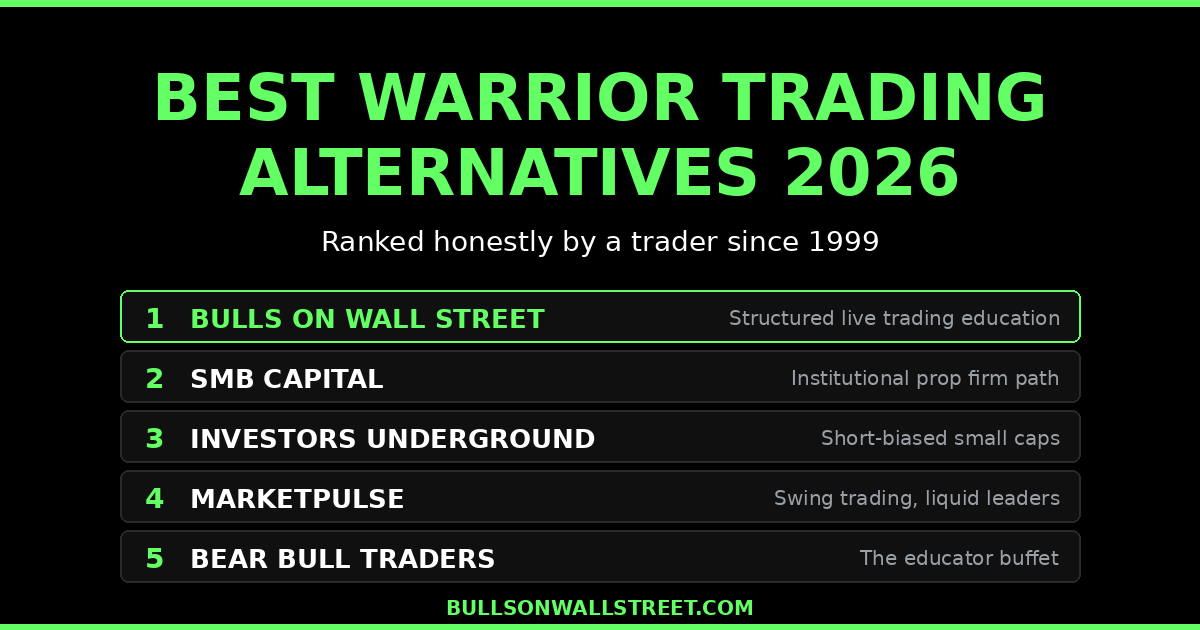


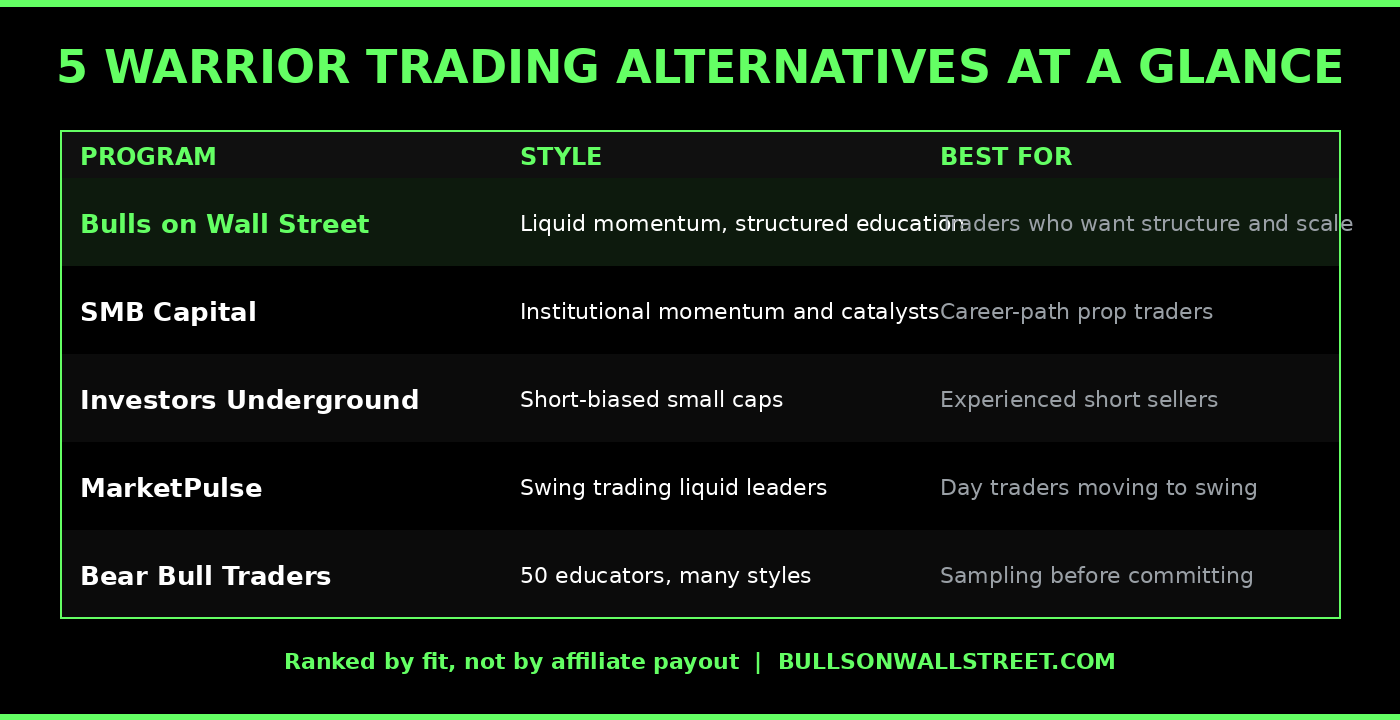
The best Warrior Trading alternatives in 2026 are Bulls on Wall Street for structured live trading education, SMB Capital for institutional style momentum trading, Investors Underground for short-biased small cap trading, MarketPulse for swing trading, and Bear Bull Traders for sampling many educators and styles in one place. This list comes from someone who has traded since 1999 and run a trading school since 2008, not from an affiliate site that has never placed a trade.
Let me be upfront about the obvious thing. I run Bulls on Wall Street. I am going to rank my own program first and you should apply skepticism to that. So I am going to earn it the same way I did in my day trading chatrooms ranking: by telling you exactly who each program fits, who it does not, and by putting real competitors on this list that other alternatives articles have never heard of.
TL;DR
- Most traders leave Warrior Trading because of the trading style, not the teacher. Ultra low float small caps are stressful, prone to pump and dump dynamics, and have a hard liquidity ceiling that locks out anyone trading real size.
- Bulls on Wall Street is the structure alternative: class at night, live trading in the morning to connect the dots, and a checklist for every setup and strategy. 60-Day Trading Bootcamp since 2008, 7,000+ students.
- SMB Capital is the closest to my own style of trading: a real prop firm trading momentum and catalysts like hedge fund traders.
- Investors Underground is the short side answer to the same small cap universe Warrior trades long.
- MarketPulse with Ariel Hernandez is the swing trading pick nobody else lists, trading the same high beta liquid trend universe I do.
- Bear Bull Traders is the buffet option: around 50 educators and many styles to sample, the opposite of a one method school.
First, Some Respect: What Ross Cameron Does Well
Ross Cameron is one of the hardest working guys in this business. Look at his YouTube channel. He shows up almost every day with recaps, going over his trades, his profit and loss, the whole thing. The guy is a worker, and the volume of free content he puts out is real.
You should also know the regulatory history, because it is public record. In April 2022, Warrior Trading and Ross Cameron settled with the Federal Trade Commission for $3 million to refund consumers over earnings claims in their marketing. The FTC complaint stated that the vast majority of customer accounts lost money. Warrior settled without admitting or denying the allegations and agreed to stop making unsubstantiated earnings claims. That is the factual record. Draw your own conclusions.
But here is the honest part most reviews miss. The FTC settlement is not the main reason experienced students leave.
The Real Reason People Look for a Warrior Trading Alternative
It is the stocks.
Warrior Trading is built around ultra low float small caps and penny stocks. That is the hardest type of stock to trade. The moves are violent, the float structure is designed for pump and dump dynamics, and if you are in first it is great. If you are in last, you are losing all your money. Regulators publish alerts warning that low-priced, thinly traded stocks are the most susceptible to price manipulation for a reason.
I know this style intimately because I loved it when I was a 22 year old young man. The adrenaline was the point. As I got older, that type of stress was just something I did not want anymore, and most of my students do not want it either.
Then there is the ceiling nobody talks about. Low float stocks can only absorb so much size. Most of the time you cannot buy more than a few thousand shares because the liquidity simply is not there. So the style caps you structurally. Many of my students are doctors, lawyers, and professionals trading with larger capital. For them, low float small cap trading does not just feel wrong. It literally does not fit. You cannot put meaningful capital to work in a stock that trades by appointment.
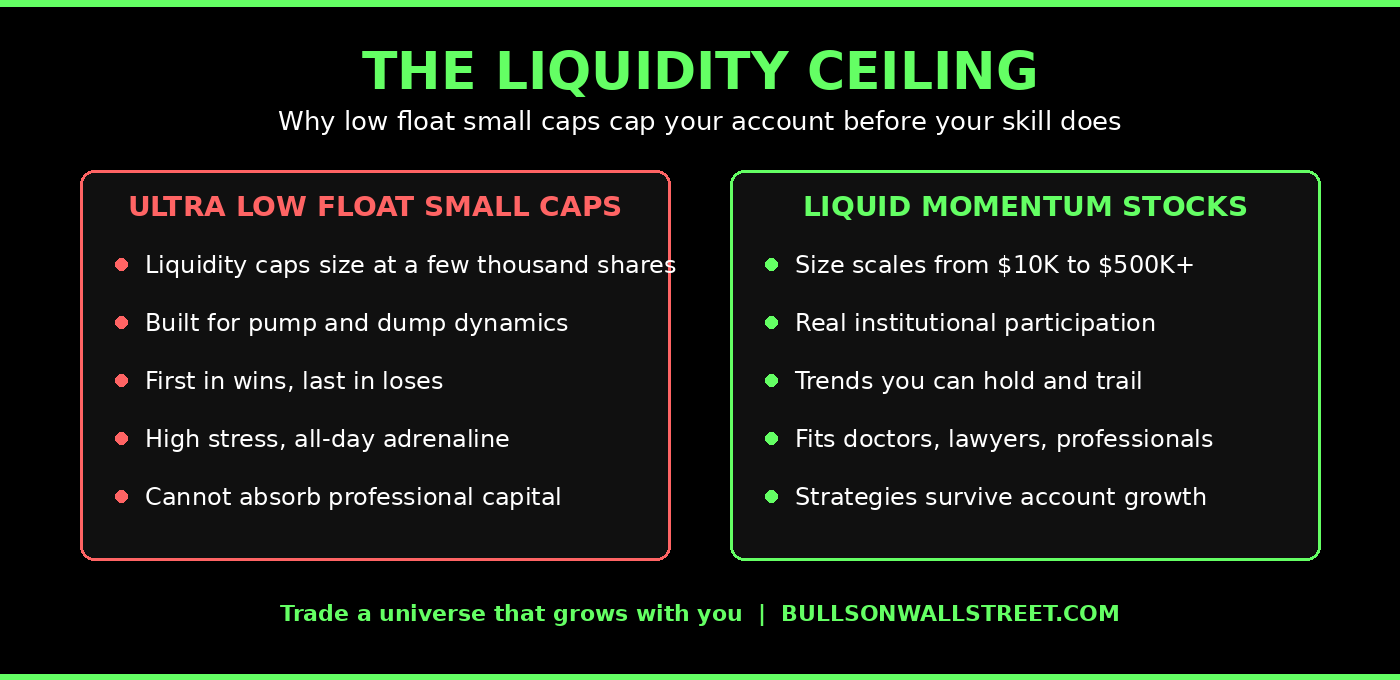
So the pattern I see over and over: the marketing and the work ethic bring students in, and then somewhere between month three and year two they realize the style is too high stress for their life and too small for their account. They start looking for a professional alternative where education is the center point. This list is for that trader.
The 5 Best Warrior Trading Alternatives, Ranked
1. Bulls on Wall Street: The Structured Education Alternative
Yes, this is my program. Here is the case, and you can check every claim.
I have been trading since 1999, full time since the end of 2007, and I founded Bulls on Wall Street in 2008. More than 7,000 students have come through the 60-Day Trading Bootcamp. Many of them came from Warrior Trading, Timothy Sykes, and similar programs, and they almost all say the same thing when they arrive. It is not a bash on those programs. They were just looking for structure.
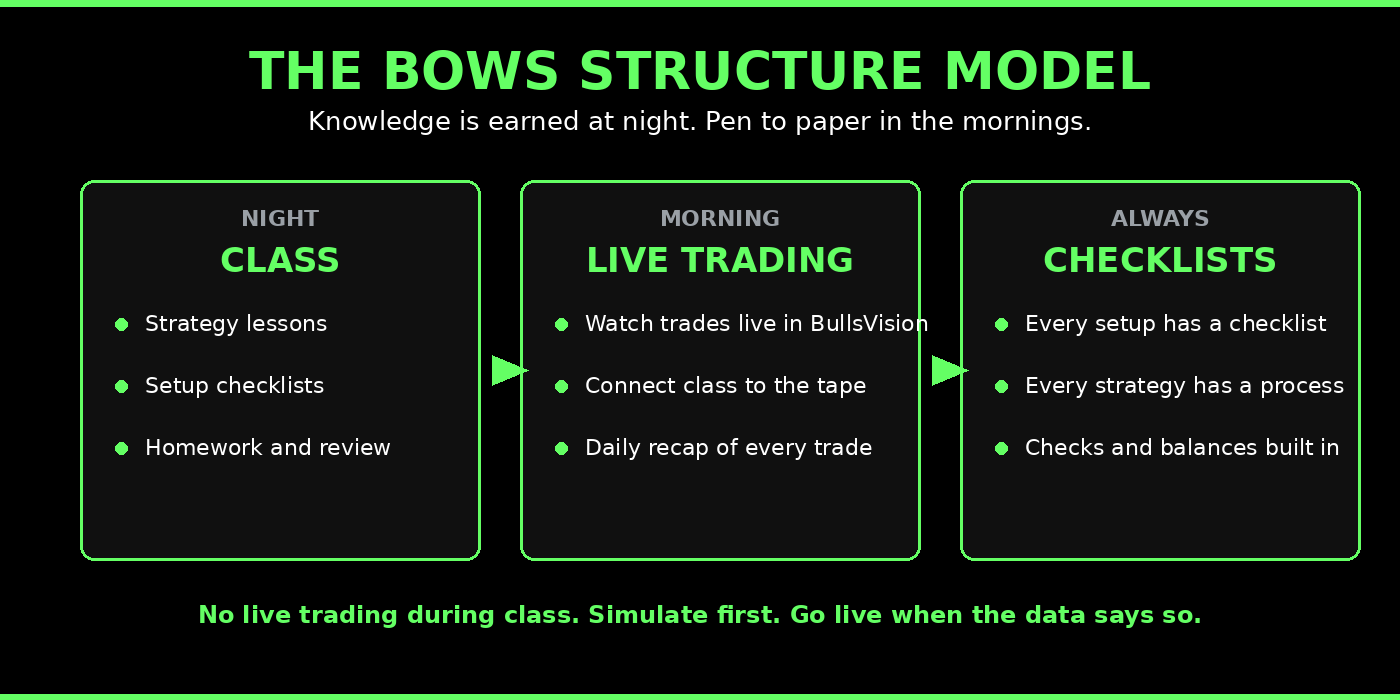
They did not want to be handed off to an employee in a generic chatroom, typing and waiting. Our whole thing is education, and the chatroom is part of the education, a tool to get better. Knowledge is earned at night during class. Then we put pen to paper in the mornings with live trading to connect the dots. Not the other way around.
Everything is list based. Every setup has a checklist. Every strategy has a checklist. Every part of the process has routines and checks and balances built into it, from the risk management system with its named rules down to reading candlestick patterns the same way every time.
The stock universe is different too. I trade liquid momentum stocks with real institutional participation, not lottery ticket floats. That means the strategies scale whether you are trading a $10,000 account or a $500,000 account.
One more structural difference: I do not let students trade live during class. You learn, you simulate, you build a business plan, you watch live trading, and you go live only when your simulator data says you are ready. A burned out Warrior Trading student who comes to Bulls on Wall Street comes for one simple reason: to make real money on a long term basis and keep it.
If you want to test the room before committing to anything, the full access 7-day trial is $7.
Best for: Traders who want structure, professionals with real capital, anyone who has outgrown the low float stress game.
Not for: People who want lottery ticket trades or think they will be profitable in 30 days. I tell every day-1 student they will not be.
2. SMB Capital: The Institutional Path
If it is not me, the program closest to my own style of trading is SMB Capital. They run a real proprietary trading firm in New York, and their traders trade like hedge fund traders: momentum, trends, and really spotting catalysts. That is my language.
The difference from everything else on this list is that SMB is ultimately a prop firm with a training arm. The ceiling is genuinely high, and their best trainees end up trading firm capital. The tradeoff is that the path is demanding and geared toward people who want trading as a career, not a supplement to one.
Best for: Traders who want the institutional route and are willing to compete for it.
Not for: Part time traders or anyone who wants flexibility over intensity.
3. Investors Underground: The Short Side of the Same Universe
Investors Underground deals with small caps too, but often from the other side. They short the pumps that low float long traders chase. They teach other styles as well, and while I do not trade in that universe anymore, I know they are good guys with a real track record. A lot of successful traders have come out of that program, some of whom have had books written about them.
If part of what burned you out at Warrior was watching low float pumps collapse, IU teaches you to be the trader on the other side of that collapse. I wrote a full head to head in my Investors Underground vs Bulls on Wall Street comparison if you want the deeper breakdown.
Best for: Experienced traders drawn to short selling and small cap structure.
Not for: Beginners. Short selling low floats is an experts-only game, and borrowing costs and squeeze risk are unforgiving.
4. MarketPulse: The Swing Trading Pick Nobody Else Lists
Here is a name you will not find on the content farm listicles. MarketPulse is run by Ariel Hernandez, who goes by RealSimpleAriel on X. He is an awesome dude and very focused on education, more on the swing trading side, and here is why he makes my list: he trades the same stocks I do. High beta, very liquid, big trend names. In my opinion that is the best universe of stocks anyone can trade.
If the lesson you took from Warrior Trading is that you want slower, higher timeframe trading in real stocks instead of intraday scalps in tickers you have never heard of, MarketPulse is the swing lane version of that answer.
Best for: Traders moving from day trading to swing trading in liquid leading stocks.
Not for: Pure intraday traders who want a morning-session focus.
5. Bear Bull Traders: The Buffet Option
Bear Bull Traders shows up on every alternatives list, and it belongs on an honest one. They are fine, and I mean that without any edge. They have a huge roster of educators teaching different styles, something like 50 of them, plus their own technology stack and most of the other tools you might need. If you are early in your journey and want to go to a buffet and sample a bunch of different approaches to figure out what you actually like, they are a great group for exactly that.
The tradeoff is the flip side of the same coin. Fifty educators means no single method drilled to mastery, and which teacher you get matters. Bulls on Wall Street is a one man show by design. When you spend two thousand dollars on a Taylor Swift ticket, you do not go for the opening act. At Bulls on Wall Street you get the main event every single time. I laid the full argument out in my Bear Bull Traders vs Bulls on Wall Street comparison.
Best for: Newer traders who want to sample many styles and teachers before committing to one.
Not for: Traders who already know what they want to trade and need one structured method taught by the person whose name is on the door.
How to Actually Choose
Ask yourself three questions.
What size will you trade in two years, not today? If the answer is anything above a small account, the low float world is already too small for you, and you should weight Bulls on Wall Street, SMB, or MarketPulse.
Do you want a career or a skill? Career means SMB. A durable skill you control means structured education, and that is my lane.
How do you learn? If you learn by process, checklists, and accountability, pick the program built that way. If you learn by osmosis in a big room, know that going in, because that is how most chatroom-first programs work and it is exactly what my former Warrior students said stopped working for them. The academic research on retail traders without a process is brutal: individual investor trading results in systematic, economically large losses, and the losses trace directly to aggressive orders placed without an edge.
Whatever you choose, choose it the way you would choose a university, not the way you would choose a slot machine.
FAQ
What is the best alternative to Warrior Trading in 2026?
For structured live trading education, Bulls on Wall Street. For an institutional prop firm path, SMB Capital. For short-biased small cap trading, Investors Underground. For swing trading, MarketPulse. For sampling many educators and styles in one place, Bear Bull Traders.
Why do traders leave Warrior Trading?
The most common reason is the trading style itself. Ultra low float small caps are high stress, prone to pump and dump dynamics, and have a liquidity ceiling that prevents trading meaningful size. Traders with growing accounts or professional careers often outgrow the style.
Did Warrior Trading really settle with the FTC?
Yes. In April 2022, Warrior Trading and Ross Cameron agreed to pay $3 million to refund consumers and to stop making unsubstantiated earnings claims. The settlement was made without admitting or denying the FTC allegations.
Is Warrior Trading a scam?
No. Ross Cameron works extremely hard and produces a large volume of real educational content. The FTC action concerned marketing claims, not fake trading. The question is not whether Warrior is legitimate. It is whether ultra low float small cap trading fits your capital, your stress tolerance, and your goals.
How is Bulls on Wall Street different from Warrior Trading?
Structure and stock universe. At Bulls on Wall Street, knowledge is earned at night in class, then applied in morning live trading to connect the dots. Every setup and strategy has a checklist. And the program trades liquid momentum stocks that scale with account size instead of low float small caps. Full breakdown in the Warrior Trading vs Bulls on Wall Street comparison.
Can I try Bulls on Wall Street before committing?
Yes. The BullsVision chatroom has a full access 7-day trial for $7, which includes the day trading, swing trading, and options rooms.
What if I am a complete beginner?
Then slow down. Do not buy any program, mine included, expecting profits in 30 days. I tell every new student they will not be profitable in 30 days. Learn the basics, trade a simulator, and read the best day trading courses breakdown before spending real money.
Is small cap trading always bad?
No. It is a legitimate style that some traders excel at, including on the short side. But it is the hardest universe for beginners, it carries pump and dump risk, and it structurally caps position size. Go in with eyes open.
The Bottom Line
Warrior Trading brings people into this business, and Ross Cameron outworks almost everyone. But if you are reading this, some part of you already knows the low float game is not your long term home. Pick the alternative that matches where your account and your life are headed, not where they were when you started.
If structure is what you have been missing, see how the 60-Day Trading Bootcamp works. Class at night. Live trading in the morning. A checklist for everything. That is the whole system, and it has been since 2008.
About the Author
Kunal Desai is the CEO and founder of Bulls on Wall Street. A professional trader since 2007, he has navigated every major market cycle -- from the 2008 financial crisis to today's high-volatility environments. Having mentored 7,000+ students through his live trading bootcamps, Kunal trades live every morning in the Bulls on Wall Street Trading Chatroom, where a full-access 7-day trial costs $7. He is dedicated to teaching real-world execution and high-probability strategies. Based in Miramar Beach, Florida.
Connect with Kunal: Read his full story | Instagram | YouTube