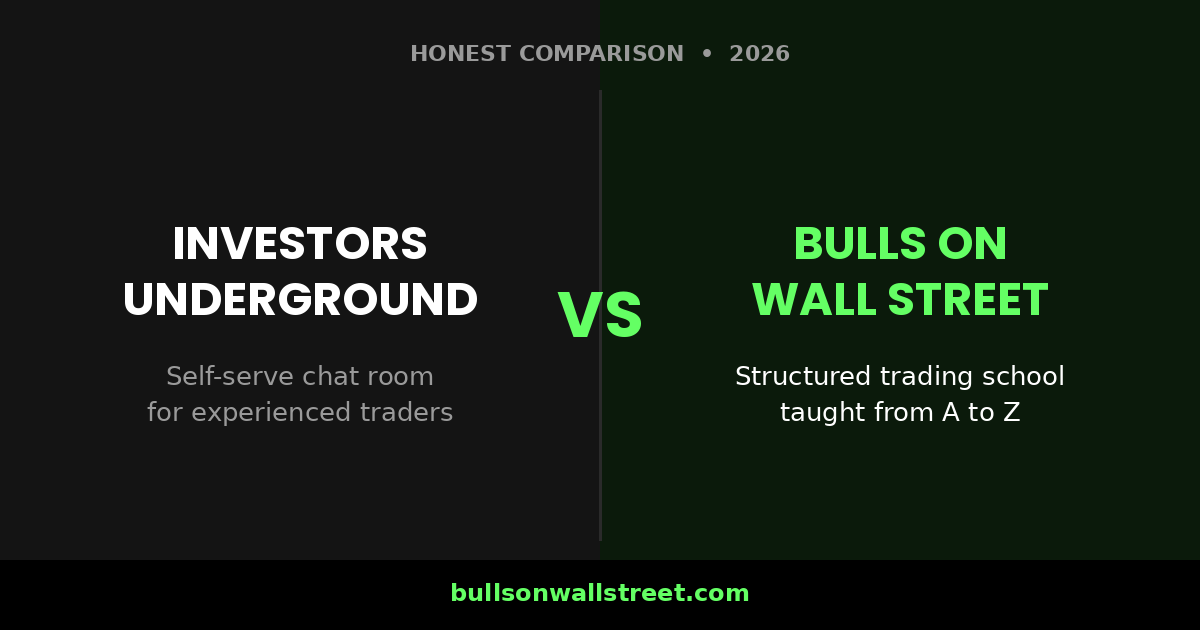


Investors Underground is a self-serve momentum chat room built for experienced traders who already know what they are doing. Bulls on Wall Street is a structured trading school that takes a person from zero and builds them into a trader. Both are legit. They solve different problems. If you can already trade and you just want tools, news, and a room full of sharp traders, IU is a great fit. If you need to be taught the craft in order, with someone answering your questions live every morning, that is a different model entirely, and it is the one we built.
I have been trading since 1999 and full time since the end of 2007. I started Bulls on Wall Street in 2008. Over 7,000 students have come through our bootcamp since then. I trade live on Zoom every single morning and the rest of the day we run recaps and Q&A. So when I compare these two services, I am not reading marketing pages. I am telling you how each one actually works and who each one is actually for.
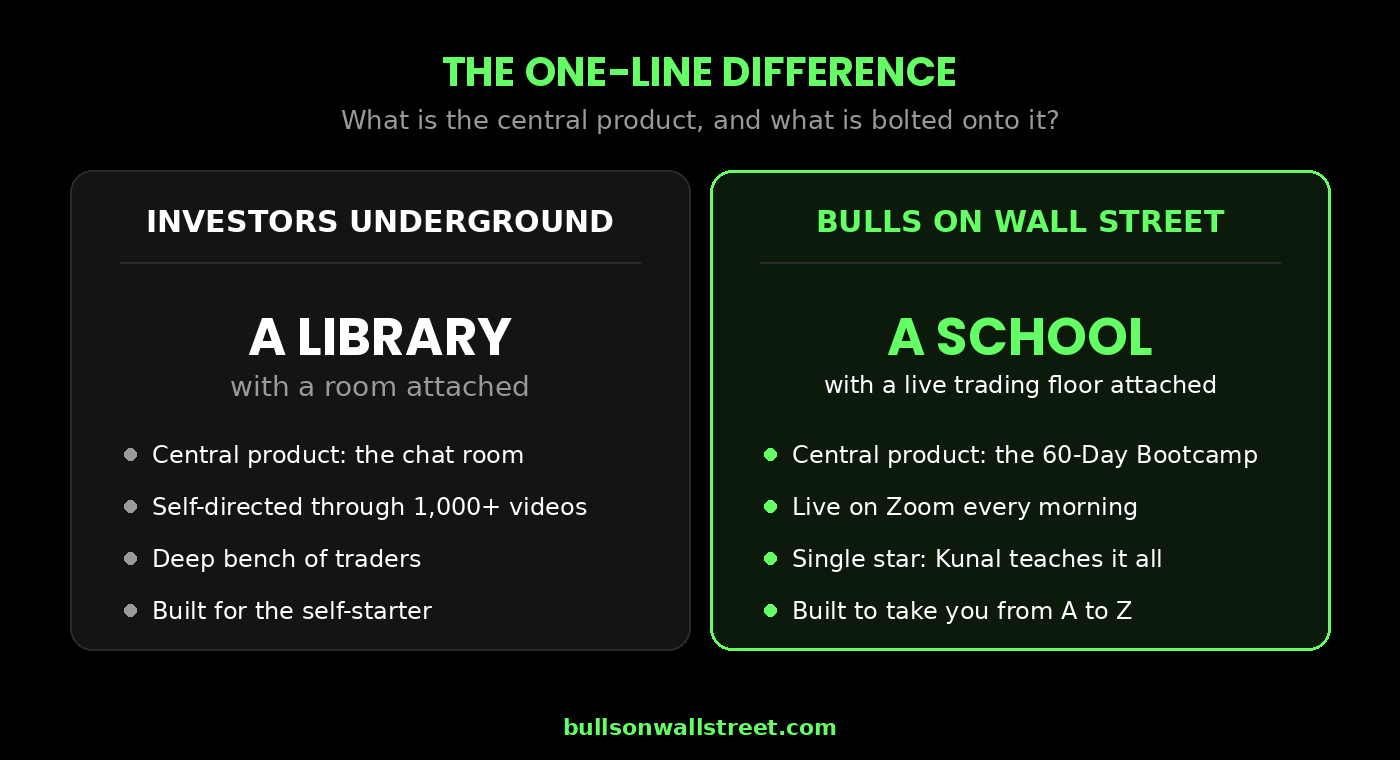
The one-line difference
For IU, the chat room is the central product. For us, the chat room is an instrument bolted onto the education. That is the whole comparison in one sentence.
Investors Underground sells you access to a community and a fast-moving room. You walk in, you watch sharp traders work, and you go figure out your own path through a massive library. Bulls on Wall Street sells you a curriculum. The 60-Day Trading Bootcamp is the spine. The chat room exists to connect what you learn to live market execution, with me on video answering whatever you ask. One is a library with a room attached. The other is a school with a live trading floor attached.
If it is not us, it is them
Let me put my cards on the table. If somebody asked me to point them to a trading service that is not mine, I would send them to Investors Underground. These are no-nonsense guys who actually make money. That is not a throwaway compliment in the middle of a comparison. I mean it. So read the rest of this knowing I respect what they built. The reason to pick one over the other is not quality. It is fit.
Single star versus deep bench
Here is the cleanest way to understand the structural difference.
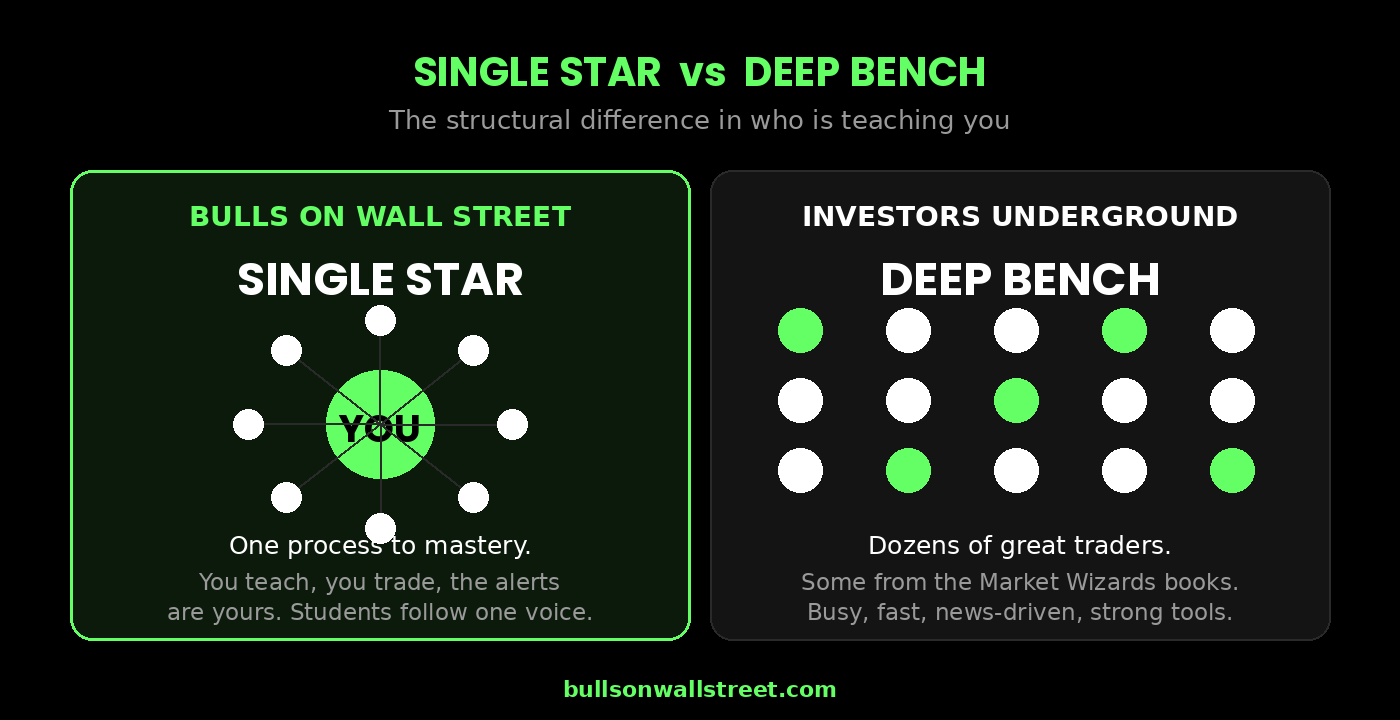
At Bulls on Wall Street, I am the star of the show. I teach the classes. I am on the videos. The alerts are mine. You are learning and following one big-time trader directly, and the entire program is built around my process so you can internalize a single, coherent way of trading.
At IU, the strength is the opposite. They have dozens of great traders in the room, including names you will recognize from the Market Wizards books. It is busy, it is fast, and a lot of it is news-based information flying in real time. They also have genuinely great tools built right into the chat room. It is a deep bench instead of a single voice.
Neither model is better. A new trader usually learns faster following one clear process to mastery before they start sampling a dozen styles. A seasoned trader often gets more out of a deep bench and a fast room. That is the real decision underneath all of this.
The fast facts
- Investors Underground: founded 2008 by Nathan Michaud. Self-serve momentum chat room plus a large on-demand video library. Flagship membership is publicly listed at $297 per month as of this writing, with courses like Textbook Trading and Tandem Trader billed separately on top. No free trial listed. No refunds.
- Bulls on Wall Street: founded 2008 by Kunal Desai. Structured 60-Day Trading Bootcamp plus the BullsVision chat room. The chat room runs on a full-access 7-day trial for $7. Kunal trades live on Zoom every morning, then leads market recaps and Q&A the rest of the day.
- Core difference: IU is built for the self-starting, already-knowledgeable trader. BOWS is built to take a new trader from A to Z.
- What that means for a beginner: at IU, a brand-new person who asks a basic question in a room moving faster than a parabolic short can get passed right over. At BOWS, asking basic questions live and getting them answered on video is the product.
What Investors Underground does well
I am not here to trash IU. Nathan Michaud is a respected trader who streams his own executions and posts honest recaps, wins and losses. His mantra is respect your risk, and that culture runs through the room. The scanner suite is genuinely strong, the kind of pre-market and intraday momentum scanning, HOD and LOD lists, and alerting that traders normally pay separate vendors for. The video library is deep, well over a thousand lessons. And the room is full of serious, experienced momentum traders, a deep bench that includes traders you will recognize from the Market Wizards books.
If you are already semi-profitable, you know exactly which setups you trade, and you just want a high-quality room with good tools and good people, IU delivers that. That is a real value proposition for the right person. The key words are the right person. IU is fantastic for a self-starter who already has trading knowledge and knows exactly where to look. It is not the place you go as a new person to ask basic questions and get walked through the learning.
Where Bulls on Wall Street is built differently
We are a training center first. The point is not to drop you into a firehose and let you sink or swim. The point is to build you as a trader, step by step, and only put you live when the data says you are ready.
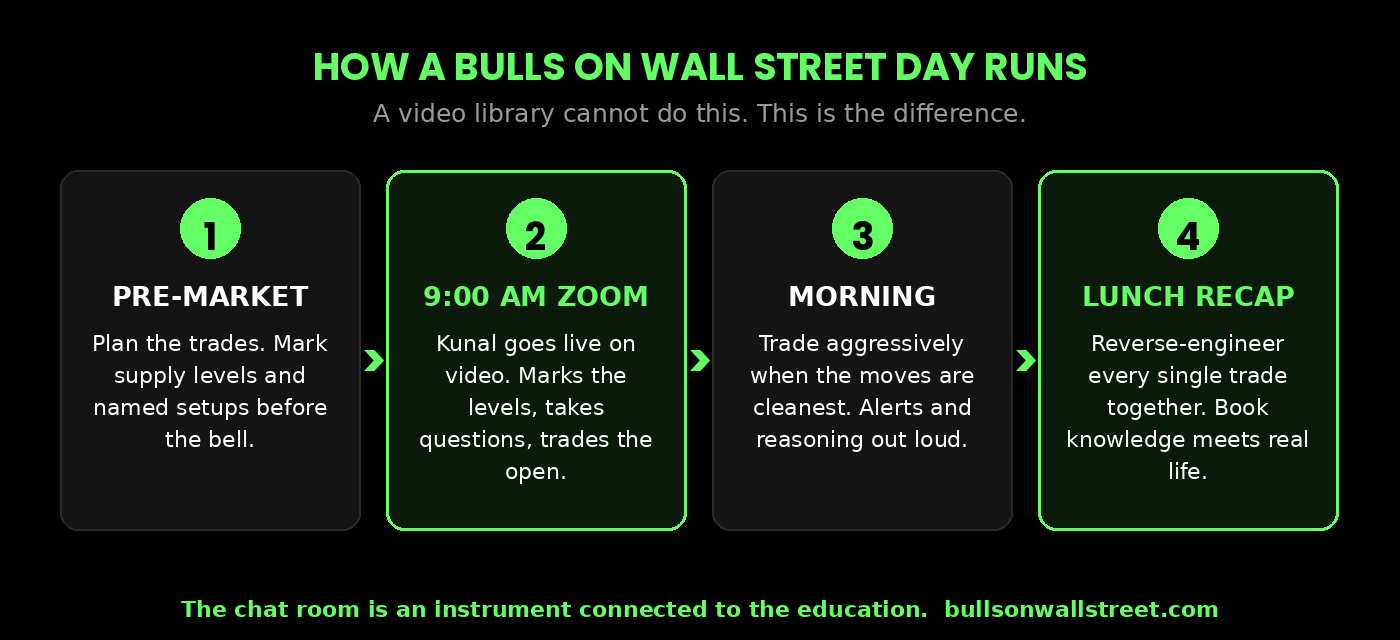
Here is how a day actually runs. I go on Zoom at 9:00 AM before the open. We have already pre-planned the trades in pre-market. I mark out the supply levels and the setups for the day, and I answer everybody's questions while I am on video. We trade aggressively in the morning when the moves are cleanest. Then around lunch we run a full market recap where we reverse-engineer every single trade we took. That is where the book knowledge gets tied to real life. You do not get that from a recorded video. You get it from watching the decision happen live and then taking it apart together afterward.
That is the difference between watching a static chart with nothing moving and watching the trade unfold in real time with the reasoning out loud. The chat room is not a signal feed for us. It is a daily teaching session that happens to also give you trade alerts.
A real trade: how we shorted the SpaceX IPO
Let me show you what live teaching looks like instead of just describing it.
When SpaceX came public in June 2026 under the ticker SPCX, it priced at $135, opened around $150 to $161, and ran straight up. It briefly became one of the five most valuable companies in the world. Brand new on the market, even though the company itself has been around since 2002. To a trader, that is not a stock. That is a liquidity graph.
One of the things I teach constantly is that IPOs fade off after the initial spike the majority of the time, sometimes within the first day or two. The SEC even spells out the mechanics of why a new issue can drop: underwriters can support the price in the first few days of trading, and once that support ends, the stock can fall well below where it opened. You can read that straight from the regulator in the SEC investor bulletin on investing in an IPO. Look at the history of the last five years. Most of these are bloated companies that grew in the private market for years, sometimes decades, and when they finally hit the open market it is just supply hunting for buyers. SpaceX was no different. So I told the guys in the room: we will day trade it long the first couple of days if a clean pattern shows up, but the real play is the short.
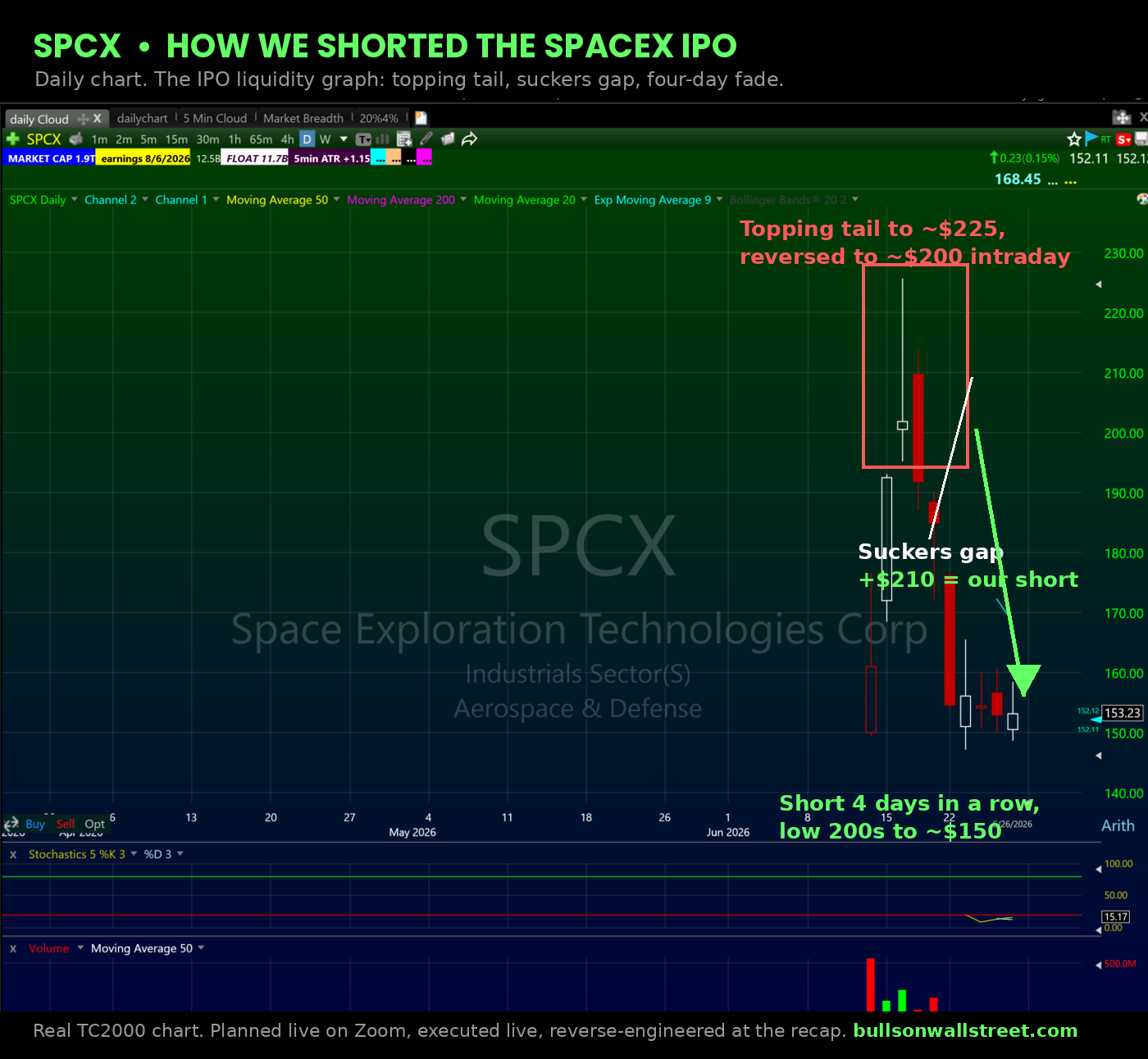
The setup was a green to red. The day before our short, SpaceX printed a big topping tail as it spiked toward $225 and reversed hard intraday back down toward $200. The next morning it gapped up again to a little over $210. That is the suckers gap. New traders are buying that gap. We know the selling already started the day before. So in pre-market, before the open, I marked out the supply levels and told the room exactly where to short it. We took partial position shorts into supply before the green to red even confirmed, then added on the confirmation. We started shorting around $210.
Then we kept shorting it as it trended down. We were short SpaceX four days in a row as it bled from the low 200s down toward $150. And every one of those days, the plan got built live on Zoom in the morning with the room watching, and every one of those trades got torn apart and reviewed at the lunchtime recap. That is the whole model in one trade. Pre-plan it live. Execute it live. Reverse-engineer it together. A video library cannot do that for you.
If you want the named version of this setup, it lives in our 5-way parabolic short framework and ties straight back to how we manage risk on every trade in the risk management pillar.
Side by side
| Investors Underground | Bulls on Wall Street | |
|---|---|---|
| Central product | The chat room and library | The 60-Day Trading Bootcamp |
| Teaching voice | Deep bench: dozens of traders, some from Market Wizards | Single star: Kunal teaches, trades, and alerts directly |
| Chat room role | The main event | An instrument connected to the education |
| Best for | Experienced self-starters who know where to look | New and developing traders who want to be taught A to Z |
| Live teaching | Streams and recaps | Kunal on Zoom every morning, plus recaps and live Q&A |
| Structured path | Self-directed through a large library | Sequenced curriculum, simulate first, go live on data |
| Entry point | $297 per month flagship, no trial listed | $7 for a full-access 7-day chat room trial |
| Courses | Billed separately on top of membership | Included in the bootcamp |
So which one should you pick
Be honest with yourself about where you are.
If you are already a competent trader, you have your setups, you want pro scanning, news, and a strong room of momentum traders, and you do not need anybody to teach you the basics, Investors Underground is a fantastic place. Pay the $297, use the tools, and get to work.
If you are newer, or you have been spinning your wheels for a couple of years without consistency, or you want someone to actually teach you the craft and answer your questions live while you learn, that is what we built. Do not start with a $297 monthly commitment to a service that assumes you already know what you are doing. Start with the $7 seven-day trial of our chat room and watch how a live teaching session actually runs. If it clicks, the 60-Day Trading Bootcamp is the structured path that takes you the rest of the way.
I tell every day-one student the same thing: you will not be profitable in 30 days. Anybody promising otherwise is selling you something. What we promise is a real path, taught in order, with the discipline built in. The market does not care how good the chat room vibes are. It cares whether you were trained.
For more on how we think about all of this, see our honest breakdown of the best day trading chatrooms, our Warrior Trading vs Bulls on Wall Street comparison, and what 7,000+ students actually say in our review. If you want to understand the scanning side, here is how we scan for explosive stocks using TC2000.
Frequently asked questions
Is Investors Underground legit?
Yes. IU is an established, legitimate trading community founded in 2008 by Nathan Michaud, who trades his own money transparently. These are no-nonsense traders who actually make money, and if I were sending someone to a service that is not mine, IU is who I would send them to. The question is not whether it is legit. The question is whether a self-serve room and library is the right format for where you are as a trader.
Is Bulls on Wall Street better than Investors Underground?
Better is the wrong frame. They are different products. IU is a chat room and library for experienced self-starters. Bulls on Wall Street is a structured school that teaches from zero with live daily instruction. The right answer depends entirely on whether you need to be taught or you just need tools and a room.
How much does Investors Underground cost?
The flagship membership is publicly listed at $297 per month as of this writing, with a discount for annual billing. Courses such as Textbook Trading and Tandem Trader are sold separately on top of the membership. There is no free trial listed and the service states it does not offer refunds. Always confirm current pricing on their site.
How much does Bulls on Wall Street cost to try?
You can get full access to our chat room for 7 days for $7. That is the low-risk way to see how a live teaching session runs before committing to anything. The 60-Day Trading Bootcamp is the structured program, and pricing is on the bootcamp page.
Does Investors Underground teach beginners?
IU has foundational courses, but the live environment is a fast-moving momentum room built around experienced traders. A brand-new trader asking basic questions in that room can get passed over. If hand-held, sequential teaching is what you need, that is not IU's core design.
Does Bulls on Wall Street have a chat room?
Yes. BullsVision is our chat room, and I trade live in it on Zoom every morning. The difference is that it is connected to the bootcamp curriculum. It is a daily teaching session with trade alerts attached, not a standalone signal feed. A full-access 7-day trial is $7.
Who teaches at Bulls on Wall Street?
I lead day trading. Paul Singh, my original mentor and a member of our team, leads swing trading and options. Paul taught me over late nights on instant messenger back in 2006, and many of the risk concepts we teach trace back to him. Having a named, real teaching team is part of what separates a school from a room.
Can a new trader make money copying a chat room?
Not reliably, and this is the core risk of the self-serve model. Copying alerts without understanding the setup, the risk, and the exit is how new traders blow up. Even FINRA warns about the pull of following the crowd, which you can read in its guide on investing and social media. The whole reason we teach live and reverse-engineer every trade at the recap is so you learn to make the decision yourself instead of chasing someone else's.
Which one has better scanning tools?
IU bundles a strong scanner suite into the membership, which is a genuine selling point. We teach scanning inside the bootcamp using TC2000, which we walk through directly so you learn to build and read scans yourself rather than just consuming a pre-built list.
Do either of these guarantee profits?
No, and run from anyone who says otherwise. Most day traders lose money. FINRA notes that even experienced day traders with deep market knowledge can suffer severe and unexpected losses, which it lays out in its review of the day trading rules. The honest pitch from any real educator is that this is hard, it takes years, and the service gives you a path and a community, not a guarantee. I tell every student on day one they will not be profitable in 30 days.
Ready to see how we actually teach?
Ready to see how a live teaching session actually runs? Start with a full-access 7-day trial of our chat room for $7 and watch me pre-plan and trade live on Zoom in the morning, then break it all down at the recap. When you are ready for the structured path, the 60-Day Trading Bootcamp takes you from where you are to a real, repeatable process. Start the $7 trial here.
About the Author
Kunal Desai is the CEO and founder of Bulls on Wall Street. A professional trader since 2007, he has navigated every major market cycle -- from the 2008 financial crisis to today's high-volatility environments. Having mentored 7,000+ students through his live trading bootcamps, Kunal trades live every morning in the Bulls on Wall Street Trading Chatroom, where a full-access 7-day trial costs $7. He is dedicated to teaching real-world execution and high-probability strategies. Based in Miramar Beach, Florida.
Connect with Kunal: Read his full story | Instagram | YouTube