

Updated June 2026 after the elimination of the pattern day trader rule.
Margin account. If you are day trading stocks, open a margin account from day one. That has been my answer for 18 years of trading full time, and the rule change on June 4, 2026 removed the last real argument for the other side.
I am Kunal Desai, founder of Bulls on Wall Street. I have been trading since 1999, full time since the end of 2007, and I have trained over 7,000 students since 2008. Every single one of them asks this question before they fund their first account. Here is the answer I give them, the math behind it, and the story of what margin does to traders who never learn to respect it.
The short version I tell my students: day traders grow by turning over their account. Small gains repeated over and over add up to big gains. A cash account freezes your buying power every time you sell. A margin account recycles it instantly. You can start with as little as 2,500 dollars on margin in 2026, but understand your odds of success drop at that size unless you follow the 1% Rule and commit to building slowly over months, if not longer. 10,000 dollars is a much better number for ease and long term success.
The June 2026 Rule Change That Flipped This Question
For 25 years, the biggest reason small accounts chose cash over margin had nothing to do with trading. It was the pattern day trader rule. Four day trades in five business days in a margin account under 25,000 dollars and your broker froze you out. Cash accounts were exempt, so traders held their noses and accepted the handcuffs of a cash account just to keep trading daily.
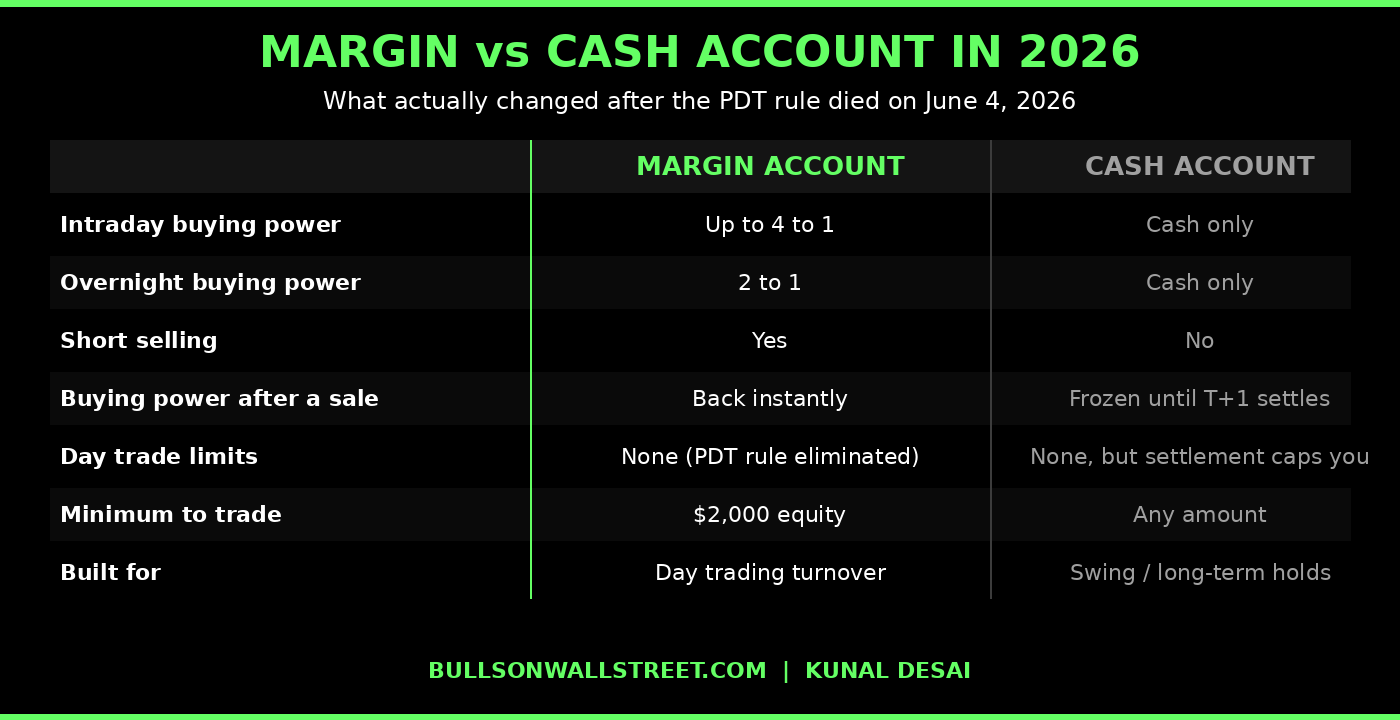
That reason is dead. Effective June 4, 2026, FINRA eliminated the PDT designation and the 25,000 dollar minimum entirely and replaced them with intraday margin standards. Nobody is counting your day trades anymore. The only floor left is the standard 2,000 dollar minimum equity that has always applied to margin accounts. I covered the full change in my pattern day trader rule guide, and brokers have until October 2027 to fully implement, so check where yours stands.
What this means for the margin vs cash decision is simple. The one structural advantage cash accounts had is gone. What remains is a straight comparison of how each account actually trades.
What a Cash Account Actually Gets You
A cash account is exactly what it sounds like. You trade only the cash sitting in the account. 10,000 dollars in, 10,000 dollars of buying power. No borrowing, no leverage, no shorting. Long positions only.
The part that kills day traders is settlement. When you sell a stock, the cash from that sale is not yours to reuse until the trade settles. Settlement moved to one business day in 2024, which FINRA explains in its guide to settlement cycles, and that helped. But one day is still an eternity for a day trader. Sell a position at 10:15 AM and that capital is benched until tomorrow. Spend your whole account on two morning trades and you are done for the day, watching setups go by with your hands tied.
Trade before the cash settles and you start collecting good faith violations. Stack a few of those and your broker restricts the account anyway. You escaped one set of handcuffs and walked into another.
What a Margin Account Gets You
A margin account lets you borrow against the assets in your account. In practice, most brokers give you 4 to 1 buying power intraday and 2 to 1 overnight. My execution broker E*TRADE runs 4 to 1 intraday. DAS Trader is a platform that routes to all sorts of different brokers, so the margin there depends on the broker behind it, but 4 to 1 intraday and 2 to 1 overnight is the standard I see everywhere.
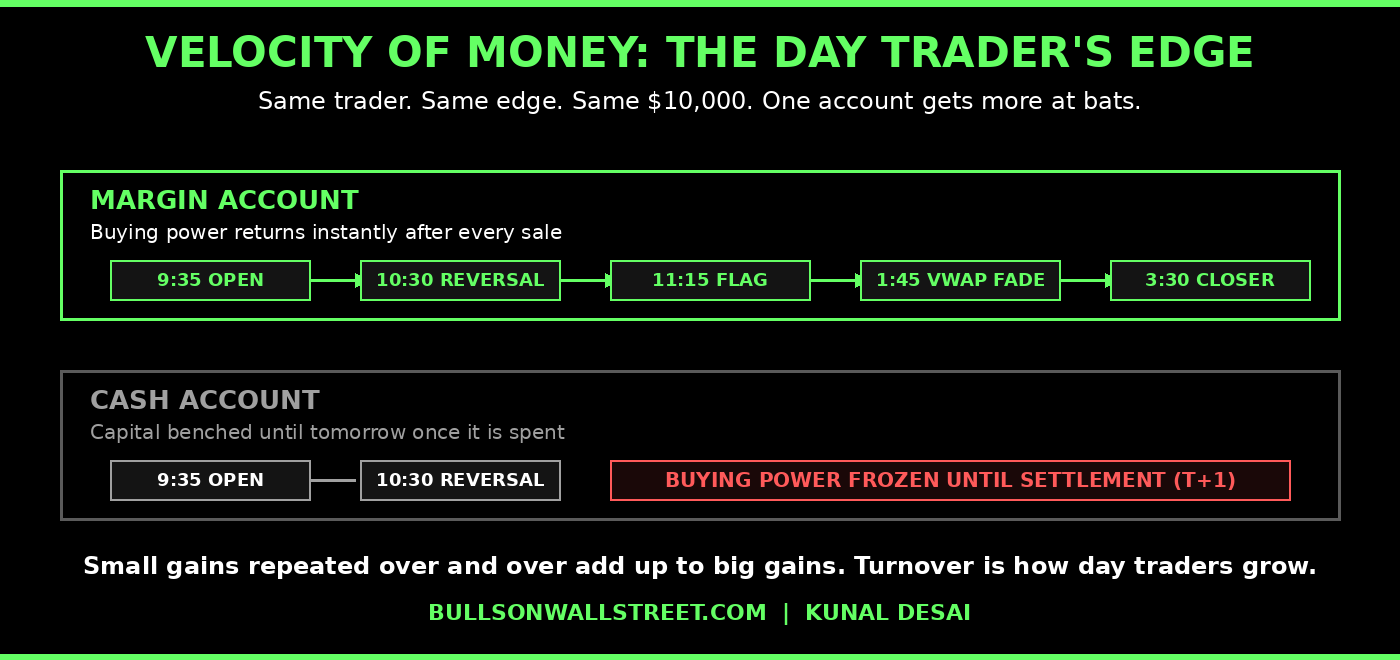
So a 10,000 dollar account commands up to 40,000 dollars of intraday buying power. You can short stocks, which cash accounts cannot do at all. And the part that matters most for day trading: when you sell, the buying power is back instantly. No settlement bench. Trade the open, recycle into the 10:30 reversal, take the afternoon VWAP fade. The account never sleeps.
That is the machine. Now here is why the machine matters.
Velocity of Money: Why Day Traders Need Margin
Day traders do not grow accounts with home runs. We grow them with turnover. The velocity of money is everything in this business. Small gains repeated over and over add up to big gains, and every gain compounds the base you take the next trade with.
A cash account caps your velocity at one or two cycles a day before settlement freezes you. A margin account lets you run your edge as many times as the market serves up clean setups. Same trader, same win rate, same risk per trade. The margin account simply gets more at bats.
This is also why I tell new traders something that sounds harsh: if you need the handholding of a cash account to protect you from yourself, you are not ready to trade live. Stay on the simulator and get your reps in, but get them with margin, so the account you practice in behaves like the account you will trade. The danger was never the account type. The danger is the trader.
And to be clear about one more thing while we are here. Stay away from options when you are new. You must master stock trading before you touch options. You cannot be a good options trader unless you are already a master trader and chartist. Options just add an expiration clock to every mistake you have not fixed yet.
The Dark Side: How Margin Finances Bad Habits
Now the other half of the truth, because every honest answer to this question has two halves.
I had a student run an account from 100,000 dollars to 1 million dollars trading QQQ options into the runup before the tariff tantrum in spring 2025. Sounds like a dream. It was actually the setup for a disaster, because as his account grew, his margin grew with it, and the bigger account kept bailing out habits that should have blown up small.
Then the tariff war hit and QQQ rolled over. He bought calls on the dip. The dip kept dipping. So he used that big account to add. Then add again. Every leg down, more short dated calls, averaging into a falling knife with leverage. By the time QQQ was carving out the bottom of that move, he had no cash left and his options were too short dated to ride out the recovery. He sold the bottom, not because the chart told him to, but because he needed the last small piece of his account just to restart.
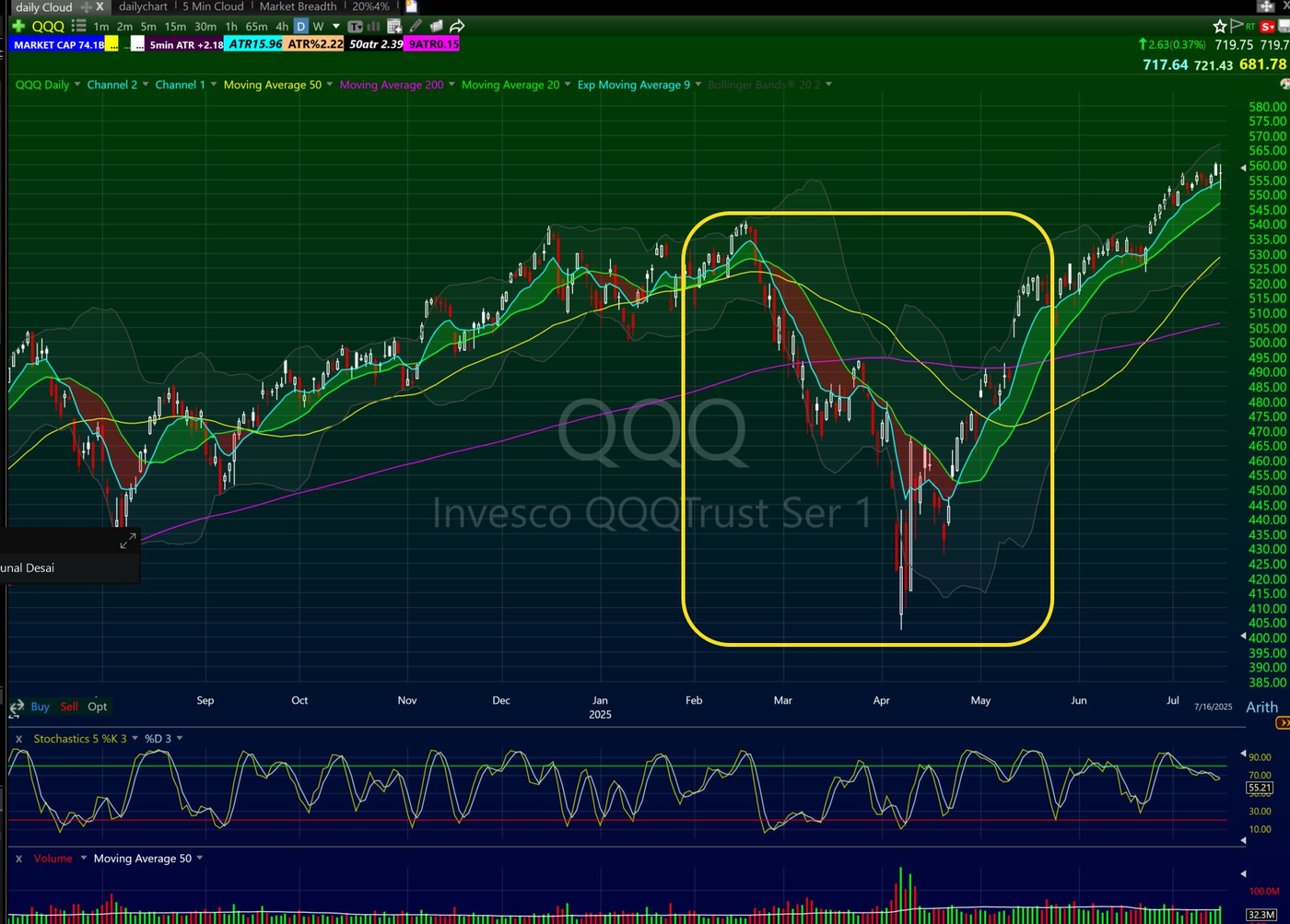
One million dollars to starting over. Margin did not cause a single one of those decisions. Margin financed them. A cash account would have stopped him out of his own bad habits months earlier just by running out of fuel. That is the real risk of leverage: it lets your worst patterns run longer and cost more before the market sends the bill.
The answer is not to avoid margin. The answer is to make margin irrelevant to your risk. That is what the 1% Rule does. Risk 1 percent of your account per trade, calculated off your stop, no matter how much buying power the broker hands you. My entire approach to this lives in my risk management system, and it is the difference between using leverage and being used by it.
When a Cash Account Still Makes Sense
I am not religious about this. There are two cases where a cash account is fine.
Swing trading without daily turnover. If you hold for days or weeks and are not placing trades every day, settlement barely touches you, and the no leverage structure keeps position sizes honest. Plenty of part time traders run cash accounts for exactly this reason.
Long term investing accounts. Your retirement money and your long term holds have no business sitting next to 4 to 1 buying power. Keep that wall up.
For active day trading, neither applies. Margin from day one.
How Much Do You Need to Start in 2026
With the PDT rule gone, you can genuinely start day trading on margin with 2,500 dollars. I think you can start there. But know exactly what you are signing up for: your odds of success go down quite a bit at that size unless you stick to the 1% Rule and commit to building slowly over months and months, if not longer.
10,000 dollars is a much better number for ease and long term success. You can make more moves, and the 1% Rule math is dead simple: 100 dollars of risk per trade. Clean numbers keep you honest when the market is moving fast.

But listen. We all have to start somewhere. Not everyone is gifted tens of thousands of dollars to trade with. If this is your passion, you make it happen. Just be aware of the climb. I started in 1999 and did not have my first consistently profitable year until 2006. I walk through that whole timeline in how long it takes to learn day trading, and I built a full playbook for growing from small in my small account day trading guide.
Learning to trade is a job. It is no different than becoming a doctor, a lawyer, or an engineer. There is a process. You learn and go to school. You intern and practice. You get your first job earning the bare minimum while you build expertise. Then you slowly graduate up. Think about what people go through in other professions. The time, the investment, the tears. Treat trading with the same respect and the account type question takes care of itself: you take the professional tool, which is margin, and you learn to handle it like a professional.
I break down setups and lessons on my YouTube channel, and if you want to watch me deploy buying power live every market morning, that happens in the Bulls on Wall Street Trading Chatroom, where a full-access 7-day trial costs $7. Every chart I trade from is built in TC2000, the platform I have used for scanning and charting for over a decade. Learning to read those charts is step one of the job, and my free candlestick patterns PDF is where most of my students start.
Margin vs Cash Account FAQ
Is a margin account or cash account better for day trading?
A margin account. Day traders grow through turnover, and a cash account freezes capital in settlement after every sale. With the PDT rule eliminated in June 2026, the main historical reason to choose cash is gone.
Do I still need 25,000 dollars to day trade in a margin account?
No. FINRA eliminated the pattern day trader rule and the 25,000 dollar minimum effective June 4, 2026. The only remaining floor is the standard 2,000 dollar minimum equity for any margin account, though brokers have until October 2027 to fully implement the new framework.
How much buying power does a margin account give a day trader?
The standard is 4 to 1 intraday and 2 to 1 overnight. A 10,000 dollar account has up to 40,000 dollars of intraday buying power. Exact figures vary by broker under the new intraday margin rules.
Can you short stocks in a cash account?
No. Shorting requires borrowing shares, which only a margin account allows. Cash accounts are long only.
What is the minimum to open a margin account in 2026?
2,000 dollars of equity is the regulatory minimum for trading on margin. I think you can realistically start day trading with 2,500 dollars, but 10,000 dollars gives you far better odds and easier 1% Rule math at 100 dollars of risk per trade.
How long does settlement tie up cash in a cash account?
One business day. Stocks settle T plus 1, so cash from a Tuesday sale is reusable Wednesday. Trading with unsettled funds triggers good faith violations and account restrictions.
Is margin trading riskier than cash trading?
Leverage amplifies whatever you already are. With a defined stop and the 1% Rule, margin adds buying power without adding risk per trade. Without discipline, it finances bad habits at scale, like my student who rode 1 million dollars back to a restart buying QQQ calls into the 2025 tariff selloff.
Should beginners use a cash account to stay safe?
No. If you need the structure of a cash account to protect you from yourself, you are not ready for live trading. Stay on the simulator, get your reps with margin settings, and go live when your simulator data supports it.
Can I trade options in a cash account?
You can buy calls and puts in a cash account, but if you are new you should not be trading options at all. Master stock trading first. You cannot be a good options trader without first being a master trader and chartist.
Did brokers all adopt the new margin rules on June 4, 2026?
No. The rules took effect June 4, 2026, but FINRA gave firms until October 20, 2027 to implement. Some brokers flipped immediately, others are phasing in, so your account may still show legacy PDT restrictions until your broker updates.
Ready to Learn the Job?
An account type does not make you profitable. A process does. In the 60-Day Trading Bootcamp I teach the full system: how to read charts, manage risk with the 1% Rule, build a trading business plan, and prove yourself on the simulator before a single real dollar goes at risk. No live trading during class. You go live when your data says you are ready, not when your emotions do. Over 7,000 students have gone through it since 2008. If you are serious about treating this like the profession it is, that is where you start.
About the Author
Kunal Desai is the CEO and founder of Bulls on Wall Street. A professional trader since 2007, he has navigated every major market cycle -- from the 2008 financial crisis to today's high-volatility environments. Having mentored 7,000+ students through his live trading bootcamps, Kunal trades live every morning in the Bulls on Wall Street Trading Chatroom, where a full-access 7-day trial costs $7. He is dedicated to teaching real-world execution and high-probability strategies. Based in Miramar Beach, Florida.
Connect with Kunal: Read his full story | Instagram | YouTube