

The best trading documentaries are Trader (1987), The Trillion Dollar Bet (2000) and Million Dollar Traders (2009). Every one of them puts a camera on a real person risking real money, which is the only thing that separates a useful trading film from a history lecture.
I have been trading since 1999. Full time since the end of 2007. I started Bulls on Wall Street in 2008 and have taken more than 7,000 students through the bootcamp since then. I have watched most of what is on this list more than once, and I have used clips from a few of them in class.
Here is the thing almost every list of trading documentaries gets wrong. It ranks films by how important they are. Importance is not the same as useful. A film can win an Academy Award, explain the 2008 crisis better than any book, and still teach you absolutely nothing about sitting in front of a screen at 9:31 in the morning with your own money on the line.
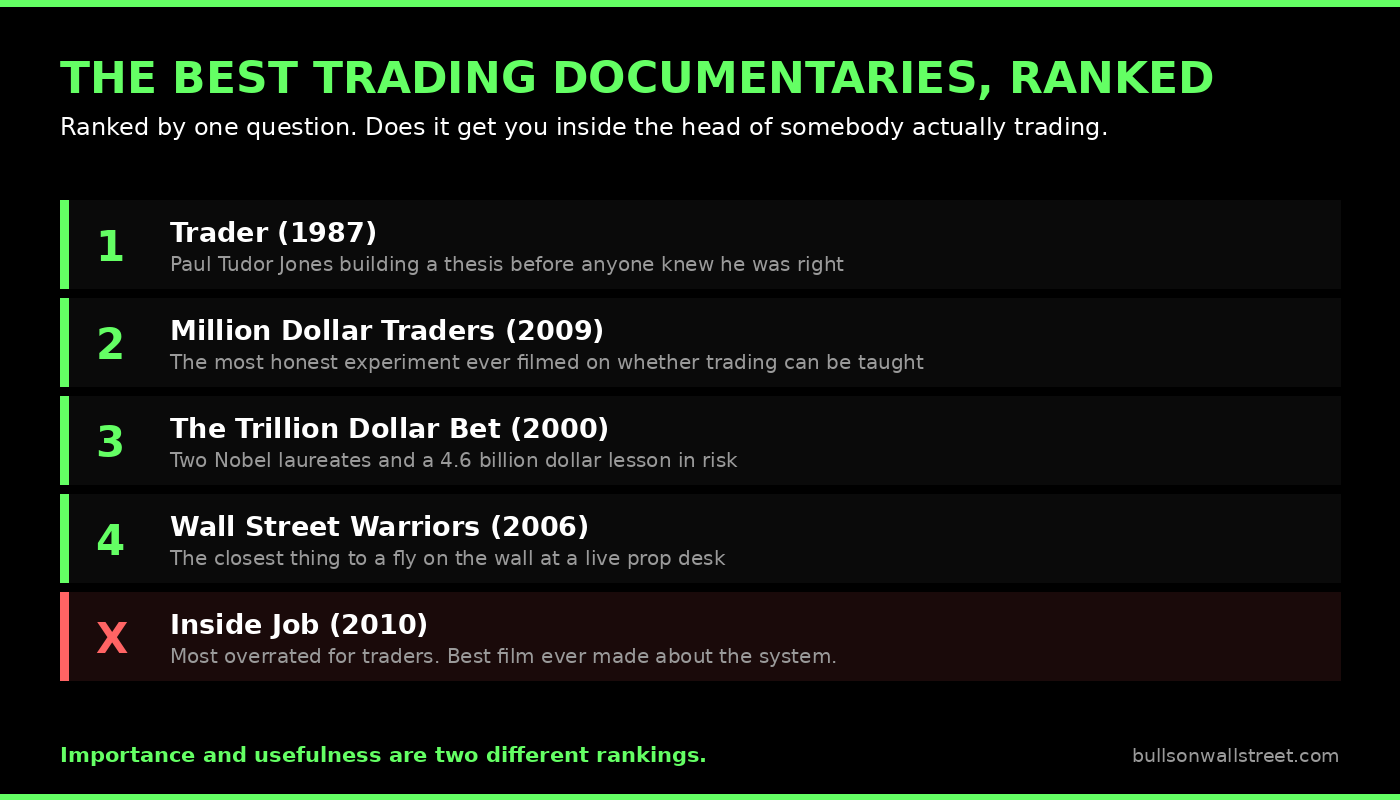
So I ranked these by a different question. Does this film get you inside the head of somebody actually trading.
Kunal Desai's Top 4 Trading Documentaries, Ranked
- Trader (1987) for watching a legend build a thesis in real time before anyone knew he was right.
- Million Dollar Traders (2009) for the most honest experiment ever filmed about whether trading can be taught.
- The Trillion Dollar Bet (2000) for the most expensive lesson in market history about models versus risk.
- Wall Street Warriors (2006) for the closest thing to a fly on the wall at a real prop desk.
If you only watch one, watch Trader. If you only watch one and you are brand new, watch Million Dollar Traders.
The Best Trading Documentaries That Actually Teach You the Job
Trader (1987)
This is the best trading documentary ever made and it is not particularly close.
Michael Glyn filmed a 32 year old Paul Tudor Jones over the year leading into 1987. One hour, no narration gimmicks, just a man and his operation. It aired on public television and then Jones spent the 1990s trying to make it disappear. He asked the director to pull it from circulation and bought up the copies he could find. For years the surviving VHS tapes traded online starting around 295 dollars because traders treated it like a holy grail.
I saw it in the summer of 2009, when a copy surfaced on YouTube before it got taken down again. I had been full time for about a year and a half. The market had just bottomed in March and everything was ripping off the lows and I was learning to trade the wreckage of a crash while watching a film about a guy who called the last one.
What makes it great is not the crash. It is watching the thesis assemble itself on camera. You see how he reads, how he prepares, how he sits with an idea. You see the whole operation, not a highlight reel. Nobody in that room knows what is about to happen. Then Black Monday hits on October 19, 1987, the Dow falls 22.6 percent in a single session, and the guy in the film is suddenly the most famous trader on the planet. The Federal Reserve History archive on the 1987 crash is worth reading next to it if you want the macro version of that day.
His fund returned roughly 62 percent in October alone and 125.9 percent net for the full year.
Here is the part almost nobody mentions. In the same hour, he calls the end of a 200 year bull market. He was spectacularly right about the crash and spectacularly wrong about that. A legend being both inside sixty minutes is the most honest thing on this entire list.
What stayed with me was how different the world looks and how identical the job is. Everything is paper and pencil. The screens are ancient. The technology has nothing to do with what I use today. And none of it matters, because the fear is the same, the greed is the same, and it is still one person trying to make his bones. Market cycles do not change. Efficiency does not kill greed. Greed is what runs the market up in the first place, and it will do it again next cycle with better hardware.
The Trillion Dollar Bet (2000)
This one is personal for me because I spend a lot of class time making fun of the exact thing it is about.
The film tells the story of the Black Scholes model and what happened when the people who built it decided to trade it. Fischer Black, Myron Scholes and Robert Merton produced the most elegant options pricing formula in the history of finance. Scholes and Merton shared the Nobel Prize in 1997. Black had died in 1995 and the prize is not awarded posthumously, which is a detail most write ups get wrong.
Then Scholes and Merton joined Long Term Capital Management, the fund John Meriwether founded in 1994. Early returns were spectacular. Roughly 21 percent, then 43 percent, then 41 percent after fees.
Then 1998 happened. Russia defaulted. The fund lost 4.6 billion dollars in under four months. On September 23, fourteen financial institutions put together a 3.65 billion dollar recapitalization under the supervision of the Federal Reserve, and the fund was liquidated in early 2000. The Federal Reserve History account of the near failure of Long Term Capital Management lays out how close the whole system came to seizing.
The smartest people in the world, holding a Nobel Prize for the formula, blew up.
When a new trader comes into my class asking about pricing models and volatility surfaces and correlation matrices, this is the film I point at. We are retail traders. We are not managing a portfolio, we are not hedging a book, we do not have institutional relationships and we are not carrying client money on a multi year mandate. Our job is much smaller and much harder to do well. Find one edge. Get genuinely good at that one edge. Then manage risk aggressively enough that being wrong does not end you. That is it. That is the entire business, and it is exactly the discipline the smartest men in finance skipped.
The Doc Style Series Everybody Miscalls Documentaries
Three of the most useful films about trading are not documentaries at all. They are reality series shot in documentary style, and every list on the internet files them wrong, including some of the sources that should know better. I am naming that up front because the distinction matters when you are deciding what to watch.
Million Dollar Traders (2009)
This one is close to my heart for a reason nobody would guess.
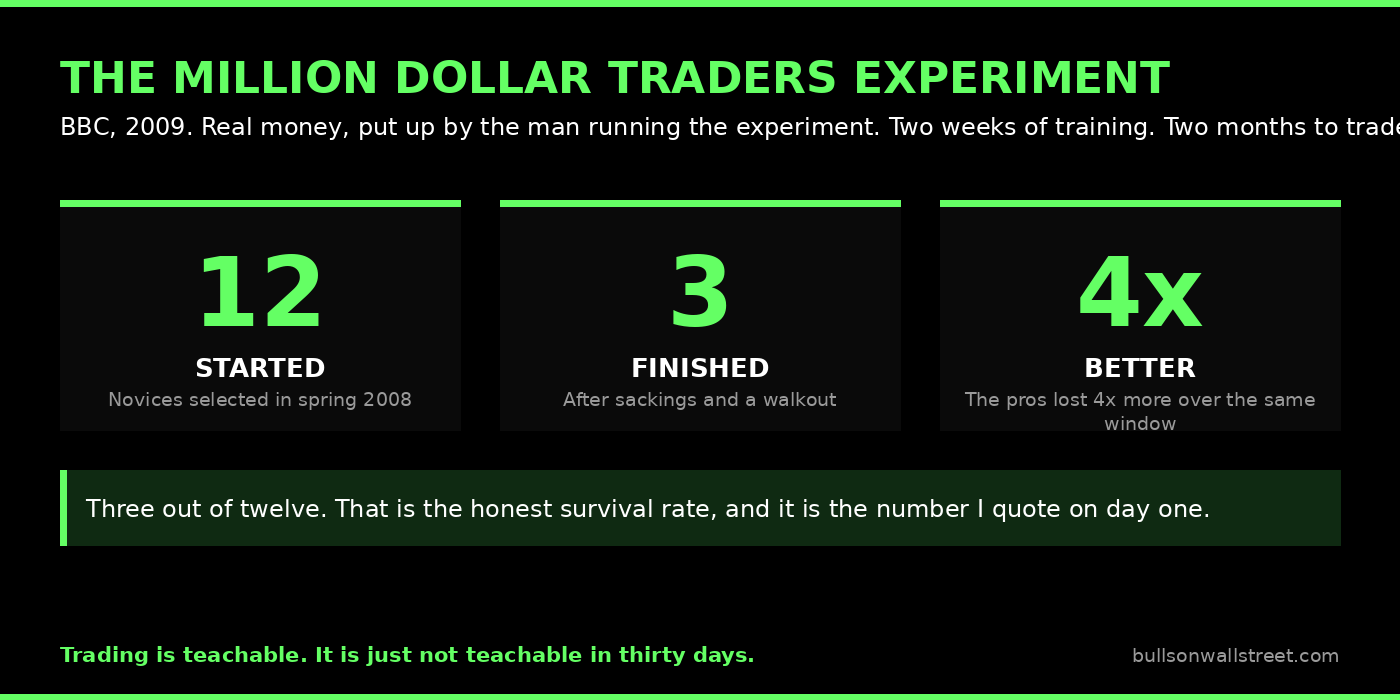
The premise is the best trading experiment ever put on television. Lex van Dam, a former Goldman Sachs proprietary trader, put up the sterling equivalent of one million dollars of his own money. Not simulated. His actual capital. He took a group of complete novices, gave them about two weeks of intensive training, and turned them loose to run a hedge fund for two months. Anton Kreil, another ex Goldman trader, ran the desk day to day. The BBC aired it in three parts in January 2009.
The cast was an environmentalist, a soldier, a boxing promoter, an entrepreneur, a retired IT consultant, a vet, a student and a shopkeeper.
The whole thing was a restaging of the Turtle Traders experiment that Richard Dennis and William Eckhardt ran in the 1980s, built on the question of whether trading is a teachable skill or an innate talent.
And the timing was accidental and perfect. They were selected in spring 2008. They traded through the teeth of the global financial crisis. Whatever you think you lived through during covid or during a normal five percent pullback, it was not this. Gaps that made no sense. Reversals that took the whole tape with them. People genuinely wondering whether the money in their bank account was safe. You could not design a harder psychological environment to drop eight beginners into.
Here is the result, and it is brutal and encouraging at the same time. Only three of the original twelve were still standing at the end, after sackings and a walkout. But the ones who lasted made small profits or smaller losses than the professionals, who lost four times more over the same stretch.
Three out of twelve. That is the number I want every person reading this to sit with. It is also almost exactly what I tell students on day one, which is that they will not be profitable in thirty days and anybody promising otherwise is selling something.
The best scene in any film on this list is in this show. Kreil starts pulling capital away from the traders who are struggling and handing it to the ones who are performing. That is it. That is position sizing taught by consequence instead of by lecture. Every prop desk on earth works this way and almost no retail trader applies it to their own account. You are supposed to be doing this to yourself. Size up what is working, starve what is not, and stop treating every setup in your playbook as though it deserves the same risk. Our whole approach to risk management is built on that idea.
Now the part that makes this personal.
When I was building Bulls on Wall Street in the early Groupon era, I met a Groupon vice president at a bar. We had a few drinks and came up with the idea of running a stock trading course on the platform. At the time the only other person doing it was Lex van Dam, and he was running local deals in individual cities. I talked my way into a national deal that put me in every city at once.
I got mocked relentlessly for it. I was selling a four day live class for thirty dollars and a recorded version for fifteen. Real traders told me I was destroying my brand.
I sold roughly 33,800 of them. Those buyers became the leads that built the business, and a meaningful number of them eventually came into the chatroom and the bootcamp. I would see van Dam's deals everywhere I went on that platform and people constantly compared the two of us. His were polished and professional. Mine were live, and that live energy is exactly what I became known for.
So no, I am not a neutral party on this one.
Wall Street Warriors (2006)
This is a TV show, not a documentary, and I want to be straight about that because half the internet lists it as one.
It follows a spread of Wall Street people at once. A commodities trader. A day trader working from home. Analysts, fund managers, a corporate lawyer. It is a smorgasbord and that is the appeal, because you get to see how differently the same market looks depending on where you sit.
The three season arc is what makes it worth your time. Season one premiered on October 22, 2006, with the Dow closing above 12,100 that night, deep in a bull market with money flying around. Season two ran January to March 2008 and you start to see the cracks. Mojo shut down its programming in December 2008 and season three was filmed during the downturn and sold off afterward. Euphoria, then cracks, then meltdown, recorded live as it happened.
Two personal notes. Tim Sykes is on the show and he has been a friend of mine since 2008. I have watched him build his business from that appearance into a real company, and whatever anybody thinks of the penny stock world, the entrepreneurship is not in question.
The other is SMB Capital, which was about three years old when it appeared. Of everybody on that screen, SMB is closest to how we actually trade. Their training program was featured on the show, and the segment was effectively another run at the Turtle experiment with a college kid dropped onto a live prop desk. I have learned a lot from how they train proprietary traders and a good deal of what I teach is prop style, even though I am one guy running it from my house over Zoom and doing live events in person.
The Two GameStop Films Are Not the Same Film
Everybody asks about the GameStop documentaries and most people do not realize there are two worth watching, made by different people with completely different intentions.
Eat the Rich: The GameStop Saga (2022)
Netflix, three episodes, roughly forty minutes each. This is the better of the two by a wide margin. It puts you in the room and in the moment. It is funny, it pops, it is built entirely around the David versus Goliath feeling that was happening globally, and it works because it is about people rather than mechanics.
Gaming Wall St (2022)
HBO, two episodes, released March 3, 2022, narrated by Kieran Culkin. This one is about the machine. Payment for order flow, the clearing system, the decision to grey out the buy button, naked shorting, whether the market is a fair place at all. One of its own interviewees describes the clearing corporation as the plumbing of the market, which is the right word for the whole film.
I will be honest. I did not finish it in one sitting. I was half watching on my iPad and drifted. It is more investigation than story.
Watch Netflix for what it felt like. Watch HBO for how it was possible. If you want the actual mechanics of what a squeeze is, the SEC glossary entry on short squeezes is a cleaner explanation than either film gives you.
The Most Overrated Trading Documentary
Inside Job.
Let me be precise, because I have written elsewhere that this is the most important stock market film ever made and I still believe that. Those are two different claims.
Inside Job is the best film ever made about the system. Deregulation, mortgage securitization, the rating agencies, the incentive structures, the accountability that never arrived. It won the Academy Award and deserved it and every investor should see it once.
It is close to useless for learning the job.
The gap is that fund managers and retail day traders are doing fundamentally different work. They allocate across mandates, hedge exposures, manage client money and think in quarters. We are hunting one or two edges and managing risk on our own accounts. Most days the macro picture does not touch what I do at all.
So if you are twenty three years old and you want to understand what the person you are trying to become actually does all day, Inside Job will not get you there. Million Dollar Traders and Wall Street Warriors will.
What Every Trading Documentary Gets Wrong
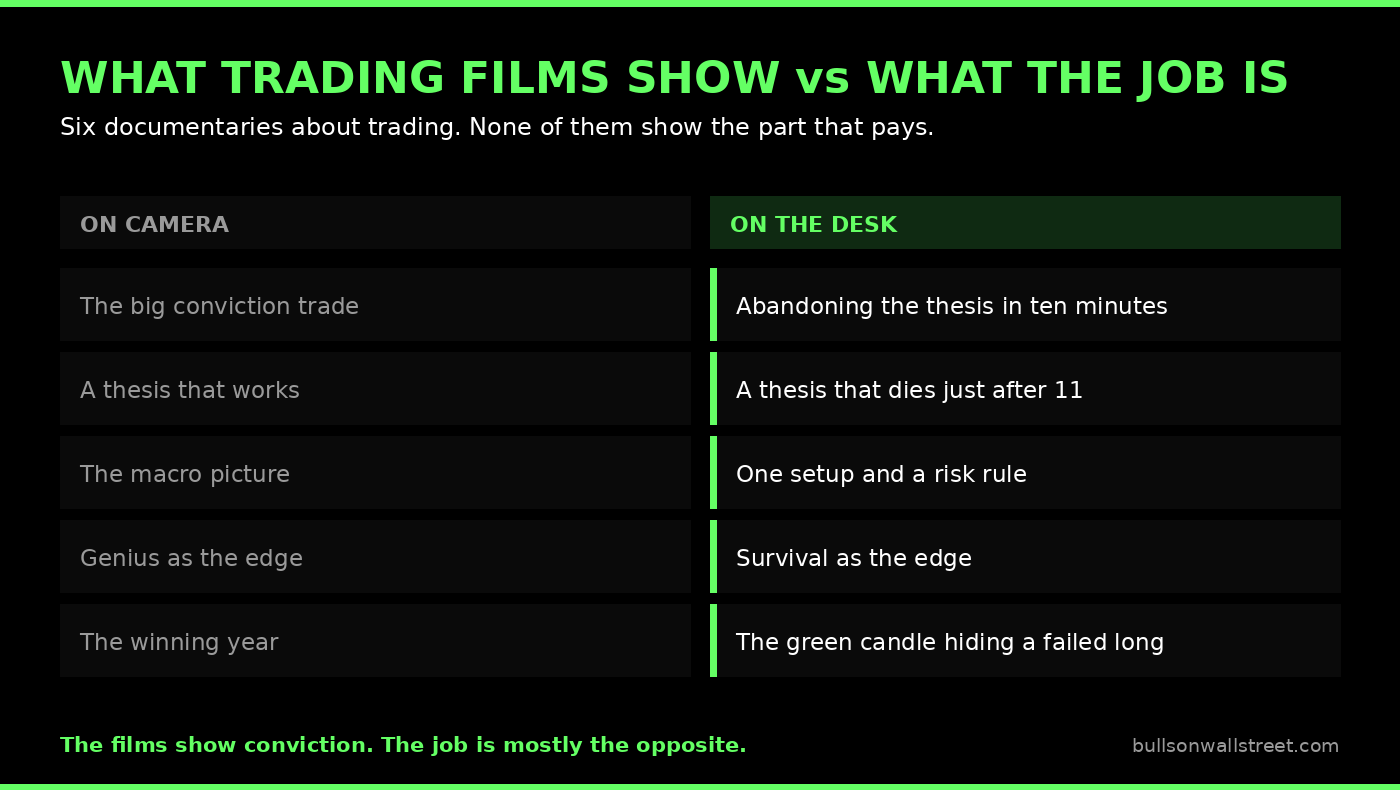
None of them show you the reversal.
Here is my Friday. AXTI, August 14.
I came in bullish. The whole watchlist was bullish names and I woke up still bullish. Then it opened at 78.50 and lost 78 on the second bar of the day. Red open, thesis already under pressure.
I did not chase it lower and I did not abandon the idea. I waited for the pattern. When it ripped back through 80 I took the opening range breakout long, it ran to 85, and I scaled out into 84 on the way up.
Then the tape turned. Every name on the list started rolling over at once. AXTI lost VWAP a little after 11 and the long thesis was dead the moment it did, so I flipped and shorted it back down to 78.50 by noon.
Now the part worth sitting with. It chopped the rest of the afternoon and rallied into the close to finish at 81.70, up 5.41 percent on the day.
So the daily candle is green. A big green candle, up more than five percent, on a semiconductor name in an uptrend. Look at that candle tomorrow and you would never know there was a red open, a failed break, a clean long, and a fully tradeable short all inside it.
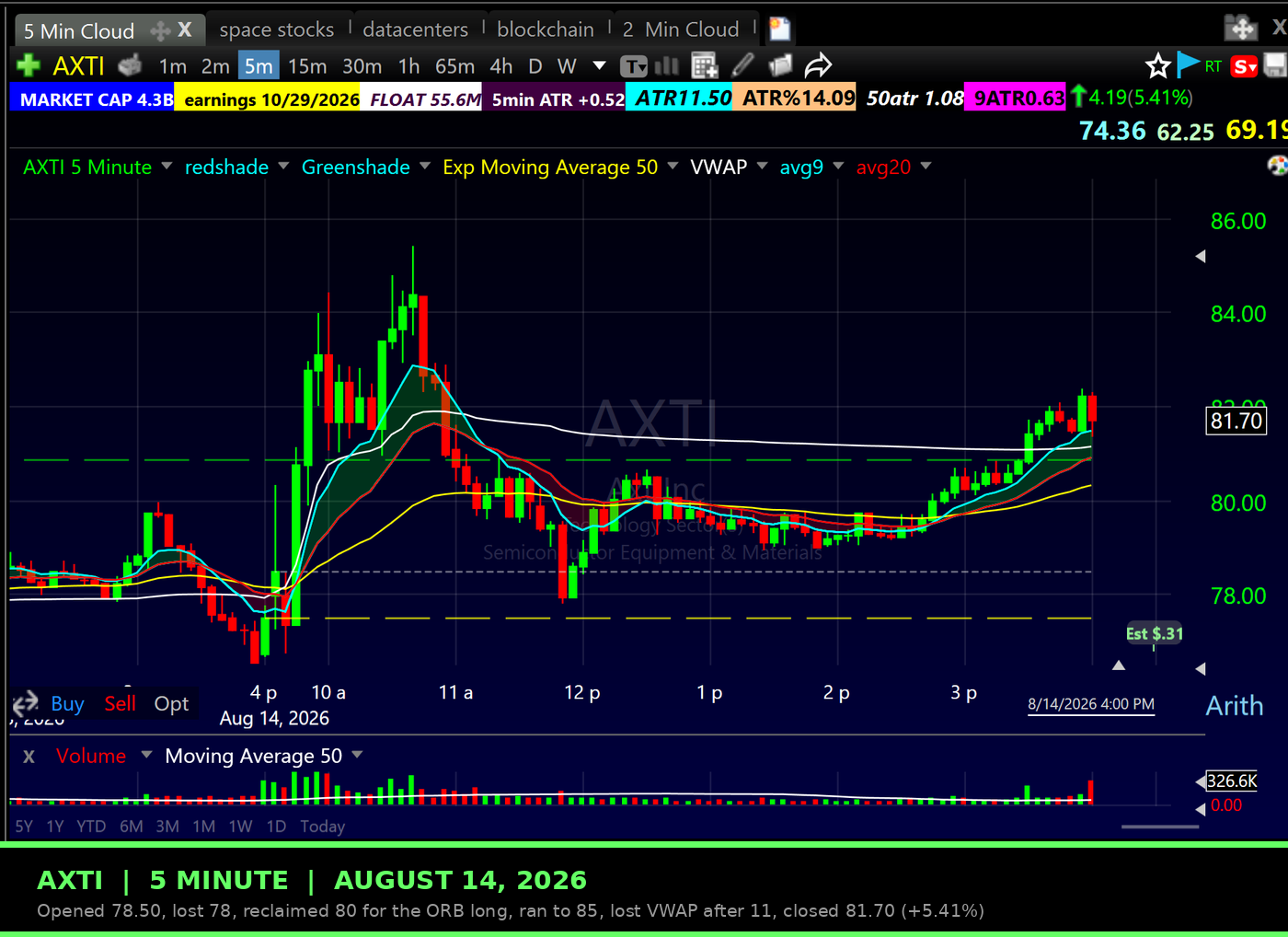
That is the job. Not the thesis. The abandoning of the thesis.
No film shows that, because it is not cinematic. There is no music cue when a retail trader quietly decides he was wrong at 9:52 in the morning. But being able to flip in one minute is the single biggest structural advantage we have over everybody in these movies. We have no clients, no mandate, no committee, no billions to reposition. We can be wrong at 9:47 and short by 9:52. The people in Inside Job could not do that if their lives depended on it.
The films show conviction because conviction films well. The job is mostly the opposite.
On My List, Not Yet Watched
I am not going to rank films I have not seen. Most lists you will find on this topic are assembled by people who watched a trailer and read a synopsis, and you can tell.
These are the ones sitting on my own watchlist. If you get to them before I do, they are worth your time for the reasons below.
Quants: The Alchemists of Wall Street (2010) from the Dutch broadcaster VPRO. The people who build the models, interviewed on their own terms. The natural companion piece to The Trillion Dollar Bet.
The Wall Street Code (2013), also VPRO. Built around Haim Bodek, a high frequency insider who went public about order types. This is the one I most want to watch, because algorithmic order flow is the reason levels behave like zones instead of lines on today's tape.
Money and Speed: Inside the Black Box (2011), VPRO again. A reconstruction of the 2010 flash crash.
The China Hustle (2017). Reverse mergers and the short sellers who exposed them. One of the few films where the short seller is the protagonist.
Betting on Zero (2016). Bill Ackman's public short thesis on Herbalife, filmed as it played out. A live short thesis on camera is rare.
Chasing Madoff (2010). Harry Markopolos spending years trying to get somebody to listen.
If you have seen any of these and think I am wrong to have skipped them, tell me in the chatroom. I will watch it and update this page.
FAQ: Best Trading Documentaries
What is the best trading documentary of all time?
Trader, the 1987 PBS film about Paul Tudor Jones. It is one hour, it was filmed before the October 1987 crash, and it is the clearest look ever recorded at how a discretionary trader actually builds a thesis. Paul Tudor Jones had it pulled from circulation in the 1990s, which only made traders want it more.
Why is the documentary Trader so hard to find?
Jones asked director Michael Glyn to remove it from circulation in the 1990s and bought up remaining copies. Surviving VHS tapes traded online starting around 295 dollars. Copies surface on video platforms periodically and get taken down on copyright claims.
Is Inside Job a good documentary for day traders?
Inside Job is the best film about how the financial system failed in 2008 and one of the least useful films for learning to day trade. It covers deregulation, securitization and the rating agencies. It never shows you a trader making a decision. Watch it for context, not for craft.
What documentary should a brand new trader watch first?
Million Dollar Traders. It is the only film that shows ordinary people being trained and then handed real money, and the results are honest. Three of the original twelve finished. The survivors still outperformed the professionals over the same period.
Are there any documentaries about day trading specifically?
Very few, which is the real answer nobody gives. Most trading films are about institutions, crises or fraud. The closest things to day trading on film are Million Dollar Traders and Wall Street Warriors, and both are reality series rather than true documentaries.
Is Wall Street Warriors a documentary?
Not really. It is a reality series shot in documentary style, produced for Mojo HD across three seasons between 2006 and 2009. It gets filed as a documentary constantly. It is still worth watching because the three seasons accidentally captured the bull market, the cracks and the meltdown in sequence.
What is the best GameStop documentary?
Eat the Rich on Netflix if you want the story and the feeling of that moment. Gaming Wall St on HBO if you want the market structure, the buy button decision and the naked shorting argument. They are not competing films, they answer different questions.
What is The Trillion Dollar Bet about?
The Black Scholes options pricing model and the collapse of Long Term Capital Management. Two Nobel laureates helped run a fund that lost 4.6 billion dollars in under four months in 1998 and required a 3.65 billion dollar recapitalization organized under the Federal Reserve.
Do trading documentaries actually make you a better trader?
Not directly. No film teaches you to read a five minute chart or size a position. What the good ones do is show you the psychology under real pressure, and psychology is where most traders actually fail.
What is the difference between trading movies and trading documentaries?
Movies dramatize the psychology and usually get the mechanics wrong. Documentaries show real people and real consequences but rarely get inside a retail trader's decision making. Our full ranked list of trading movies and trading TV shows covers the fiction side.
Where can I watch these trading documentaries?
Availability moves constantly. Eat the Rich is on Netflix, Gaming Wall St is on HBO Max, and the older films including Trader and The Trillion Dollar Bet circulate on video platforms in varying quality.
What should I do after watching these?
Build an actual process. Learn to read the chart, define one setup, and put a risk rule around it. Start with our candlestick chart patterns PDF and the Bone Zone, which is the indicator I use on nearly every pullback entry I take.
Ready to Watch Somebody Actually Trade?
Every film on this list is somebody else's trading day, edited after the fact, with the ending already known.
If you want to watch a trader work with the ending unknown, that happens every morning in the Bulls on Wall Street Trading Chatroom. Full access for seven days costs 7 dollars.
And when you are ready to build the process rather than watch one, the 60-Day Trading Bootcamp has taken more than 7,000 students through it since 2008.
About the Author
Kunal Desai is the CEO and founder of Bulls on Wall Street. A professional trader since 2007, he has navigated every major market cycle -- from the 2008 financial crisis to today's high-volatility environments. Having mentored 7,000+ students through his live trading bootcamps, Kunal trades live every morning in the Bulls on Wall Street Trading Chatroom, where a full-access 7-day trial costs $7. He is dedicated to teaching real-world execution and high-probability strategies. Based in Miramar Beach, Florida.
Connect with Kunal: Read his full story | Instagram | YouTube