

Updated August 2026
These are the 75 best inspirational quotes from the richest people in the world, and after 27 years of trading I can tell you which ones will actually make you money. Most quote lists are copied and pasted by people who have never placed a trade. I started trading in 1999, went full time at the end of 2007, and have trained over 7,000 students at Bulls on Wall Street since 2008. Some of these quotes changed my career. Some of them, taken the wrong way, will blow up your account. I am going to tell you which is which.
TL;DR: The best quotes from the richest investors are all secretly about the same thing: risk. Buffett saying risk comes from not knowing what you are doing. Keynes warning the market can stay irrational longer than you can stay solvent. Livermore mocking the Wall Street fool who thinks he must trade all the time. None of them are really motivation. They are job descriptions. And a few famous quotes, like Peter Lynch telling you not to get scared out of your stocks, are great advice for a retirement account and poison for an active trader. Below: the full list of 75, the five that shaped my trading, the ones I tell my students to ignore, and the lines I say in my own room every day.
The Quote That Changed How I Trade
Risk comes from not knowing what you are doing.
Warren Buffett
When I started trading in 1999, nobody worked from home. Everyone had a regular job in an office, and every single person I knew said the same thing to me. Isn't trading risky? They said investing was risky. Trading was gambling. One of the first day traders I ever knew was in my circle back then, an actual professional making a living clicking buys and sells while the rest of the world commuted, and this quote is the answer I wish I had for every one of those conversations.
The real risk is not knowing what you are doing. That is the whole quote. Flip it around: if you are the best at what you do, where exactly is the risk? The risk is in NOT doing it.
Michael Jordan missed half his shots. Some years more than half. Nobody in the building ever said it was risky when Jordan rose up, because he was the best shot taker on the floor. A prepared trader taking a planned trade with defined risk is not gambling, no matter what your coworkers think. An unprepared one buying a ticker his buddy texted him is gambling, even if it works. FINRA's own risk education says the same thing in drier language: risk you understand and size for is manageable, risk you have not identified is the one that takes you out.
Spend seven years getting dangerous at one craft and the word risky stops applying to you. That was my path, and it is the honest timeline I give every student: how long it really takes to learn day trading.
Never Lose Money Is Not a Slogan. It Is the Job.
Rule No. 1: Never lose money. Rule No. 2: Never forget rule No. 1.
Warren Buffett
Everybody knows this one. Almost nobody trades like they understand it.
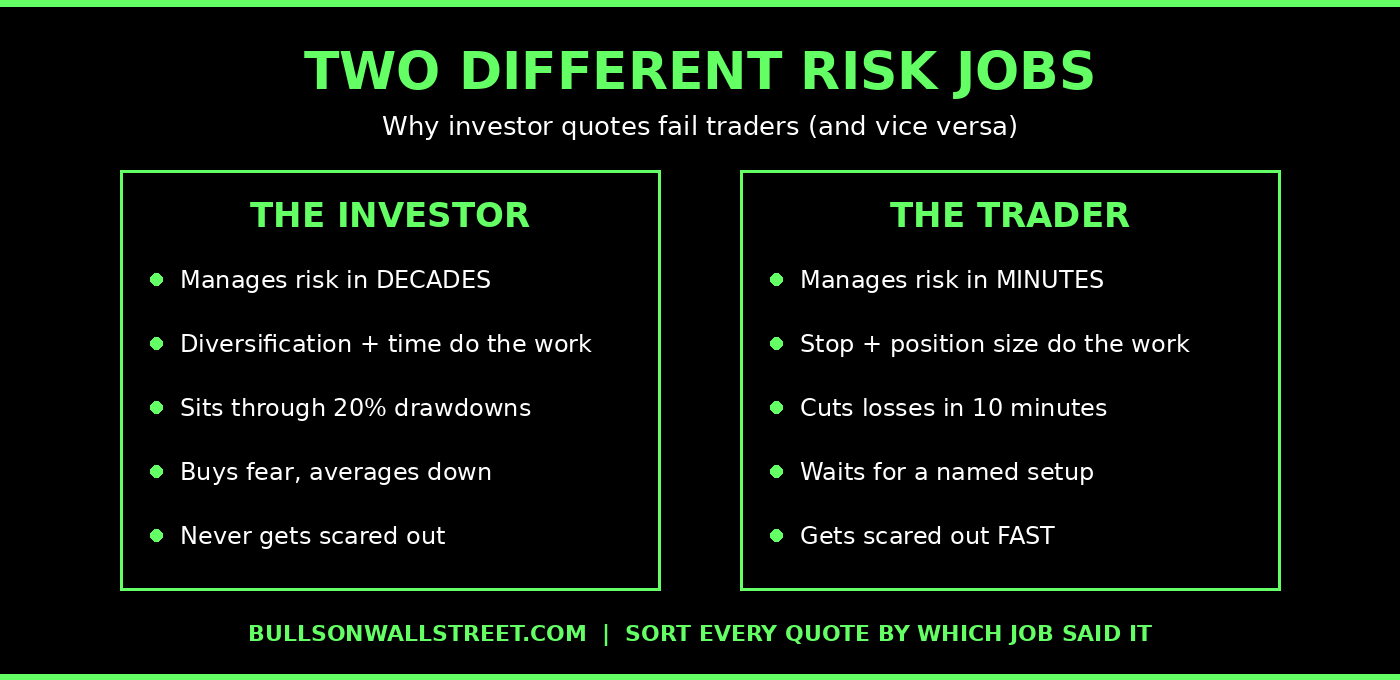
Beyond being catchy, this is the epitome of trading. Here is the difference between a trader and an investor dollar cost averaging into index funds: the trader makes concentrated bets on specific setups he knows can work, so he has to manage risk aggressively. The index investor manages risk with time and diversification. The trader manages it with a stop and a position size, on every single trade, forever.
That is why I use the 1% Rule. If I am wrong, I lose one percent of my account. Run the math on that. I would need to lose twenty trades in a row to even be in a statistically serious drawdown. Twenty straight losses is hard to do if you have any edge at all.
My main job is not day trader or swing trader. My main job is risk manager. That is the title. The trading is just what the risk manager does between risk decisions. If that framing is new to you, start with my full risk management guide, because nothing else on this page matters until that clicks.
The Librarian Problem
If past history was all there was to the game, the richest people would be librarians.
Warren Buffett
Too many traders think taking a class, reading some books, and memorizing chart patterns is the key. Study the past, recognize the pattern, collect the money. If that worked, the richest people on earth would be librarians.
The best traders I know focus on the mental and physical side of this game. They exercise religiously. They hack their sleep. They hunt for edges in their mindset and discipline, not just their charts, because how you live shows up in how you trade. A chart shows you something that already happened. Thinking it must happen again is not thinking in three dimensions.
A real trader analyzes dozens of variables instantly before taking a trade. The pattern is evidence, not a verdict. And then comes the hard part: acting on it aggressively while managing the risk, which takes a brain that is malleable, rested, and ready to pounce. That is a body problem and a mind problem, not a knowledge problem. It is why trading psychology is half of what I teach.
Complexity Kills Accounts
Unfortunately, the more complex the system, the greater the room for error.
George Soros
This one holds true for day traders all over the world. We get so enthusiastic about the new software. Some new fancy indicator. Better news feeds, better scanners, some algo service. You start stacking all of it, hopping from tool to tool, indicator to indicator, strategy to strategy, and what you end up with is a confused layer of nothing.
The setup I have made the most money on in my entire career is the First Pullback. A stock spikes, pulls back into the Bone Zone, the shaded area between the 9 and 20 EMA, and gives you an entry. The most simple setup I have. It tends to be the cleanest, it gives me the best reward to risk, it is the easiest to identify, and it only has a handful of pieces to it.
Twenty-seven years in this business and my biggest earner has a handful of pieces. Let that fight with your urge to buy a fourth indicator subscription.
The Quote That Cost My Student a Million Dollars
Markets can stay irrational longer than you can stay solvent.
John Maynard Keynes
Every year the market hands us a couple of huge dips, and everybody knows the market eventually comes back. That is what has historically happened. It is also lazy thinking, and here is what lazy thinking costs.
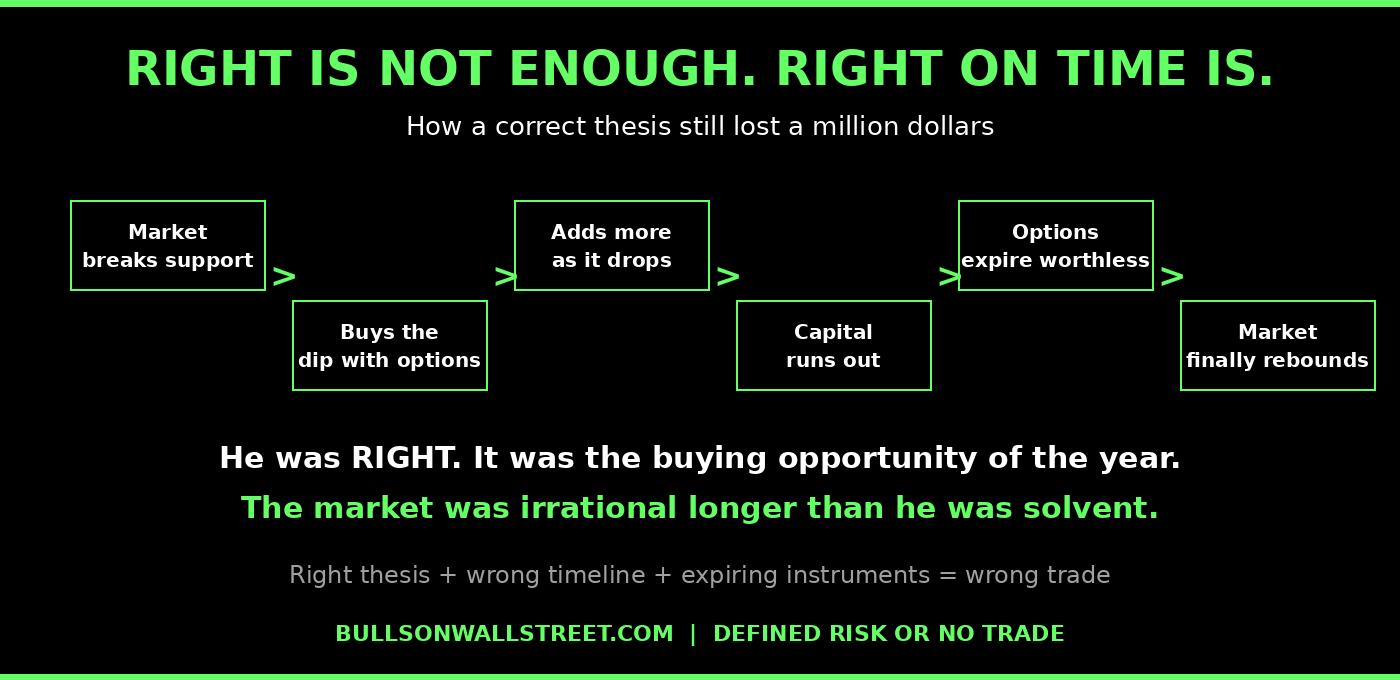
One of my students, Bobby, was crushing it through 2025. The market had been easy for a couple of years, and easy markets teach bad lessons: Bobby kept getting rewarded for buying every dip and adding more when it dipped again. Then the tariff tantrum hit in spring 2025. The market started breaking under support, and Bobby kept buying, with options, on the indexes and names like HOOD. His mantra the whole way down: this thing is going to rip back, this is the buying opportunity of the year.
He was right. It was the buying opportunity of the year. It also kept going down for weeks after he started buying. He ran out of capital, his options started expiring worthless, and when the market finally rebounded he had already lost the majority of his capital base. He made a million dollars that year and gave the whole thing back.
Right thesis, wrong timeline, instruments with expiration dates, and no risk plan. The market was irrational longer than he was solvent, exactly like the quote says. If you trade with leverage or options, understand precisely what margin and time decay do to a right-but-early trade: they turn it into a wrong trade with extra steps. Being early is being wrong. Size and time horizon are risk decisions, and when a drawdown starts making your decisions for you, that is a different animal entirely. I wrote about that spiral in my revenge trading post.
What Livermore Actually Teaches
There is the Wall Street fool, who thinks he must trade all the time.
Jesse Livermore
Everyone quotes Livermore about sitting tight and big money. This is the Livermore line I actually use, because after training over 7,000 day traders I can tell you the thing that gets people in trouble more than almost anything else is overtrading. The belief that something is always happening and you need to be in it.
I see it live every single day. In my chatroom we nail a few trades in the morning, and then I stop trading. And people get annoyed with me. Genuinely annoyed. What about this ticker, what about that spike, we need more trades. And I tell them the same thing every time: just because you see something moving does not mean there is a trade. Sometimes the best trade is holding what you have and letting it ride the trend.
Livermore watched men go broke on the New York Stock Exchange a hundred years before Robinhood existed, and the fool he described has not changed one bit. He just has a phone now.
The Full List: 75 Quotes From the Richest Traders and Investors
Here is the complete list, organized the way a trader actually thinks about them, not alphabetically by billionaire. I cleaned up the attributions too. Yes, I counted. There are exactly 75.
Risk: The Quotes That Keep You Alive
1. Rule No. 1: Never lose money. Rule No. 2: Never forget rule No. 1.
Warren Buffett
2. Risk comes from not knowing what you are doing.
Warren Buffett
3. Markets can stay irrational longer than you can stay solvent.
John Maynard Keynes
4. There are old traders and there are bold traders, but there are very few old, bold traders.
Ed Seykota
5. The whole secret to winning big in the stock market is not to be right all the time, but to lose the least amount possible when you are wrong.
William J. O'Neil
6. Throughout my financial career, I have continually witnessed examples of other people that I have known being ruined by a failure to respect risk. If you do not take a hard look at risk, it will take you.
Larry Hite
7. If you have trouble imagining a 20% loss in the stock market, you should not be in stocks.
John Bogle
8. The cardinal rule is to have enough capital at the end of the day.
Carl Icahn
9. In trading, you have to be defensive and aggressive at the same time. If you are not aggressive, you are not going to make money, and if you are not defensive, you are not going to keep money.
Ray Dalio
10. Are you willing to lose money on a trade? If not, then do not take it. You can only win if you are not afraid to lose.
Sami Abusaad
11. Cash combined with courage in a time of crisis is priceless.
Warren Buffett
12. You get recessions, you have stock market declines. If you do not understand that is going to happen, then you are not ready, you will not do well in the markets.
Peter Lynch
13. People who succeed in the stock market also accept periodic losses, setbacks, and unexpected occurrences. Calamitous drops do not scare them out of the game.
Peter Lynch
14. When you make a mistake in the stock market, the only sound thing to do is correct it. Pride and ego never pay off; neither does vacillation when losses start to show up.
William J. O'Neil
Psychology: You Are the Problem
15. The investor's chief problem, and even his worst enemy, is likely to be himself.
Benjamin Graham
16. Individuals who cannot master their emotions are ill-suited to profit from the investment process.
Benjamin Graham
17. The most important quality for an investor is temperament, not intellect.
Warren Buffett
18. Trading is a psychological game. Most people think they are playing against the market, but the market does not care. You are really playing against yourself.
Martin Schwartz
19. The key to trading success is emotional discipline. If intelligence were the key, there would be a lot more people making money trading.
Victor Sperandeo
20. I am only rich because I know when I am wrong. I basically have survived by recognizing my mistakes.
George Soros
21. I have lost tremendous amounts of money in various markets and I think that that is something that makes you better at my job, not worse.
Jim Cramer
22. We are all wrong so often that it amazes me that we can have any conviction at all over the direction of things to come. But we must.
Jim Cramer
23. More than anything else, what differentiates people who live up to their potential from those who do not is a willingness to look at themselves and others objectively.
Ray Dalio
24. We do not have to be smarter than the rest. We have to be more disciplined than the rest.
Warren Buffett
25. The real key to making money in stocks is not to get scared out of them.
Peter Lynch
26. There is no single market secret to discover, no single correct way to trade the markets. Those seeking the one true answer to the markets have not even gotten as far as asking the right question, let alone getting the right answer.
Jack Schwager
Patience: The Money Is in the Waiting
27. It was never my thinking that made the big money for me. It always was sitting.
Jesse Livermore
28. There is the Wall Street fool, who thinks he must trade all the time.
Jesse Livermore
29. It takes time to make money.
Jesse Livermore
30. Nobody can catch all the fluctuations.
Jesse Livermore
31. If you took our top fifteen decisions out, we would have a pretty average record. It was not hyperactivity, but a hell of a lot of patience. You stuck to your principles and when opportunities came along, you pounced on them with vigor.
Charlie Munger
32. Our job is to find a few intelligent things to do, not to keep up with every damn thing in the world.
Charlie Munger
33. It is waiting that helps you as an investor, and a lot of people just cannot stand to wait. If you did not get the deferred-gratification gene, you have got to work very hard to overcome that.
Charlie Munger
34. Investing should be more like watching paint dry or watching grass grow. If you want excitement, take $800 and go to Las Vegas.
Paul Samuelson
35. The older I get, the more I see a straight path where I want to go. If you are going to hunt elephants, do not get off the trail for a rabbit.
T. Boone Pickens
36. Trading is a waiting game. You sit, you wait, and you make a lot of money all at once. Profits come in bunches. The trick when going sideways between home runs is not to lose too much in between.
Michael Covel
37. If it is obvious, it is obviously wrong.
Joe Granville
Simplicity: Complexity Is a Tax
38. Unfortunately, the more complex the system, the greater the room for error.
George Soros
39. Based on my own personal experience, both as an investor in recent years and an expert witness in years past, rarely do more than three or four variables really count. Everything else is noise.
Martin Whitman
40. We ignore outlooks and forecasts. We are lousy at it and we admit it. Everyone else is lousy too, but most people will not admit it.
Martin Whitman
41. It is remarkable how much long-term advantage people like us have gotten by trying to be consistently not stupid, instead of trying to be very intelligent.
Charlie Munger
42. Usually a very long list of securities is not a sign of the brilliant investor, but of one who is unsure of himself.
David Dreman
43. Wide diversification is only required when investors do not understand what they are doing.
Warren Buffett
44. Obsession with broad diversification is the sure road to mediocrity.
John Neff
45. If you are shopping for common stocks, choose them the way you would buy groceries, not the way you would buy perfume.
Benjamin Graham
46. Know what you own, and know why you own it.
Peter Lynch
47. Do not bottom fish.
Peter Lynch
Contrarian Thinking: Where the Money Hides
48. Be fearful when others are greedy. Be greedy when others are fearful.
Warren Buffett
49. The time of maximum pessimism is the best time to buy and the time of maximum optimism is the best time to sell.
John Templeton
50. The four most dangerous words in investing are: this time it is different.
John Templeton
51. The stock market is the story of cycles and of the human behavior that is responsible for overreactions in both directions.
Seth Klarman
52. Generally, the greater the stigma or revulsion, the better the bargain.
Seth Klarman
53. If you buy stocks when they are out of favor and unloved, and sell them into strength when other investors recognize their merits, you will often go home with handsome gains.
John Neff
54. There is a thin line between being a contrarian and being just plain stubborn.
John Neff
55. Money is made by discounting the obvious and betting on the unexpected.
George Soros
56. What seems too high and risky to the majority generally goes higher and what seems low and cheap generally goes lower.
William J. O'Neil
57. Every once in a while, the market does something so stupid it takes your breath away.
Jim Cramer
The Craft: Study, Work, Self-Belief
58. Price is what you pay. Value is what you get.
Warren Buffett
59. If past history was all there was to the game, the richest people would be librarians.
Warren Buffett
60. Should you find yourself in a chronically leaking boat, energy devoted to changing vessels is likely to be more productive than energy devoted to patching leaks.
Warren Buffett
61. The stock market is filled with individuals who know the price of everything, but the value of nothing.
Philip Fisher
62. In investing, what is comfortable is rarely profitable.
Robert Arnott
63. The individual investor should act consistently as an investor and not as a speculator.
Benjamin Graham
64. In the world of securities, courage becomes the supreme virtue after adequate knowledge and a tested judgment are at hand.
Benjamin Graham
65. Everyone has the brainpower to follow the stock market. If you made it through fifth-grade math, you can do it.
Peter Lynch
66. There is a company behind every stock, and there is only one real reason why stocks go up. Companies go from doing poorly to doing well or small companies grow to large companies.
Peter Lynch
67. Those who ignore what the market says usually pay a heavy price. Those who listen and who learn the difference between normal and abnormal action are said to have a good feel for the market.
William J. O'Neil
68. Practical investors usually learn their problem is finding enough outstanding investments, rather than choosing among too many.
David Dreman
69. If you cannot do a thing better than others are doing it, do not do it at all.
David Dreman
70. The goal of a successful trader is to make the best trades. Money is secondary.
Alexander Elder
71. It is not how much money you make, but how much money you keep, how hard it works for you, and how many generations you keep it for.
Robert Kiyosaki
72. Invest in yourself. Your career is the engine of your wealth.
Paul Clitheroe
73. Persist. Do not take no for an answer. If you are happy to sit at your desk and not take any risk, you will be sitting at your desk for the next 20 years.
David Rubenstein
74. What I have learned is that if you really want to be successful at something, you will find that you put the time in. You will not just ask somebody if it is a good idea, you will go figure out if it is a good idea.
Mark Cuban
75. You learn in this business: if you want a friend, get a dog.
Carl Icahn
The Famous Quotes I Tell My Students to Ignore
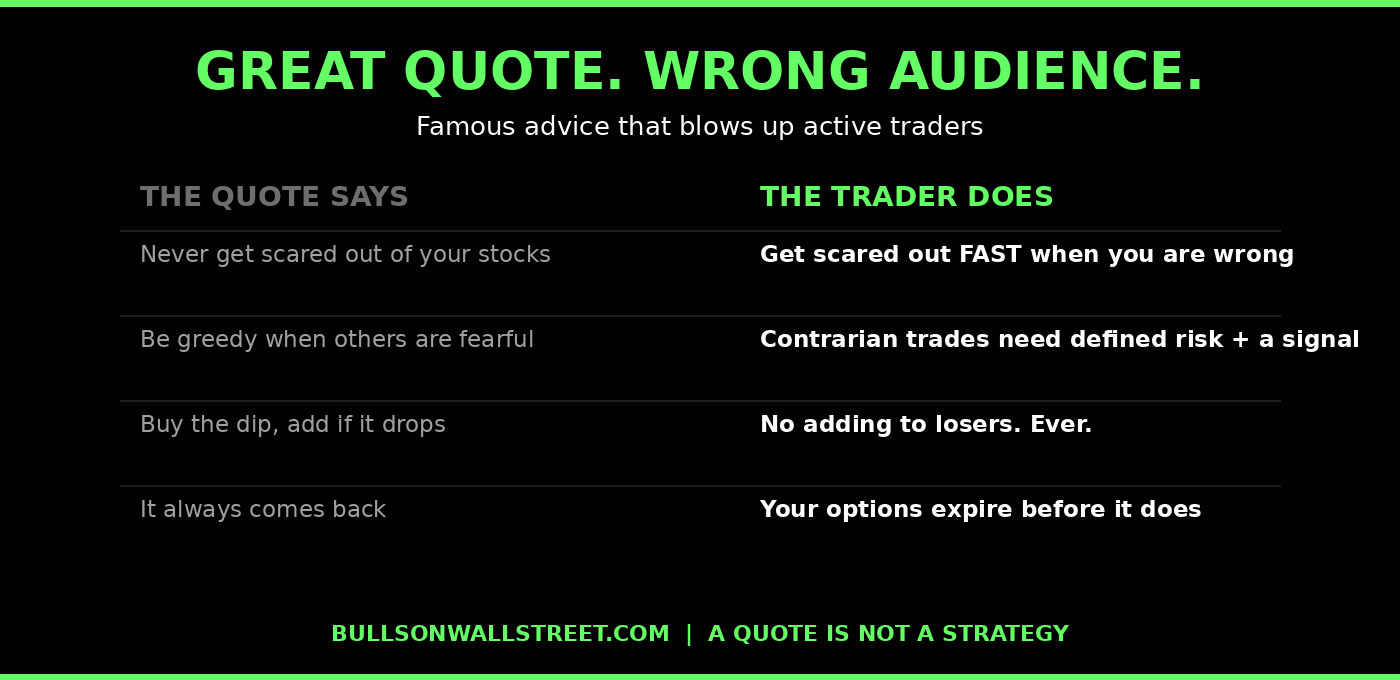
Now the section no other quote list will give you. Some of the most famous quotes on this page are great advice for an index fund investor and genuinely dangerous for an active trader. The audience matters. Here are the big ones.
The real key to making money in stocks is not to get scared out of them. (Peter Lynch)
Number 25 on the list, and probably true for the old school investor holding a diversified retirement account through decades. For a trader, somebody trading aggressively and probably using some level of leverage, getting scared out of a stock is the healthiest thing you can do. You NEED to get scared out. If the market turns or your analysis is wrong, you get out fast. Some of my best trades are stocks I enter and exit within ten minutes, the moment I realize I am wrong. And usually those are exactly the stocks that go on to tank. Lynch is telling his audience to sit through drawdowns. My audience uses a stop loss and lives to trade the next setup.
Be greedy when others are fearful. (Warren Buffett)
Beautiful advice for Buffett, who buys entire companies with permanent capital and no margin clerk. Deadly for a trader who reads it as permission to average down into a falling market with options. That is precisely the thinking that took my student Bobby from a million-dollar year to giving it all back during the tariff tantrum. Buffett can be greedy when others are fearful because he can be wrong for three years without consequence. You cannot. If you want the contrarian trade, take it with defined risk, a real entry signal, and instruments that do not expire while you wait to be proven right.
The lesson underneath both: a quote is not a strategy. Investor wisdom and trader wisdom are different tools for different jobs, and most quote lists mix them together like they are interchangeable. They are not. Sort every quote on this page by one question first: was this said by someone managing risk in decades, or in minutes?
FREE COMMUNITY
Want the risk-first version of trading, not the fortune cookies?
Inside the free Bulls on Wall Street community I share the intro course, real trade breakdowns, and the frameworks behind every quote on this page.
Hundreds of traders inside. No card required.
The Lines I Say in My Own Room
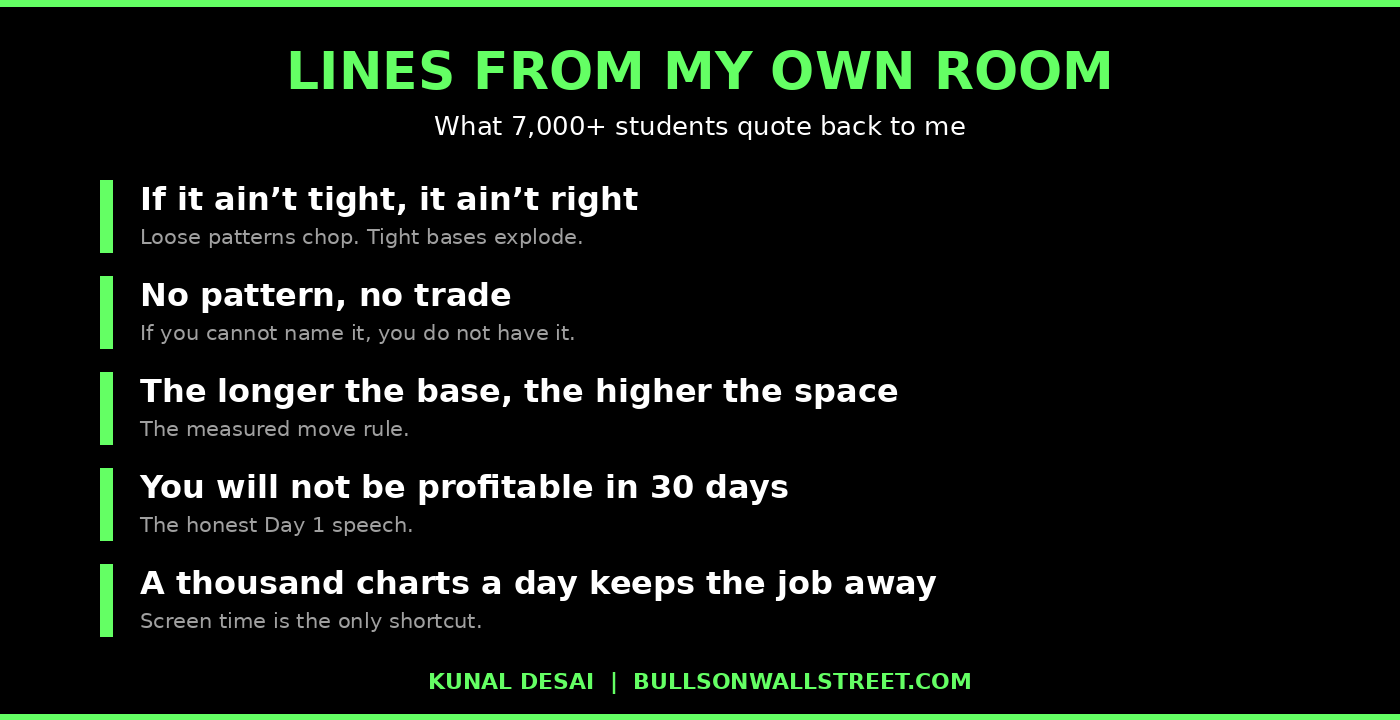
After 18 years of running a live chatroom and 82+ bootcamps, my students quote me back to me. These are the lines that stuck, the ones people repeat years later. If the billionaires get a section, so does the guy who taught 7,000 traders.
If it ain't tight, it ain't right.
Kunal Desai
The one students bring up most. It means do not buy loose, sloppy patterns trading far away from the EMAs. A loose stock is a choppy stock, and chop does not give you the explosion you need. Tight consolidation near the moving averages is where the energy loads up.
No pattern, no trade. If you cannot name the pattern, there is no trade.
Kunal Desai
The fastest filter in trading. If you cannot say the name of the setup out loud, you do not have a setup. You have an urge. My full playbook of named setups is in the day trading strategies guide.
The longer the base, the higher the space.
Kunal Desai
My measured move rule. A one-month flat top sets up a one-month move. A five-month flat top sets up a five-month move. Stocks get their power from consolidation, from basing, and the size of the rest tells you the size of the run.
You will not be profitable in 30 days. Anyone who tells you otherwise is lying to you.
Kunal Desai
I say this to every Day 1 bootcamp student, and I am the only person in this industry who opens with it. It took me seven years to reach consistency. The students who accept the real timeline are the ones still trading five years later.
A thousand charts a day keeps the job away.
Kunal Desai
How you train your eye. I still flip through a thousand charts a day in TC2000, and pattern recognition at a glance is the compounding result. There is no shortcut for screen time, only ways to make it count. I break down the best charts every week on my YouTube channel if you want to train alongside me.
FAQ: Trading and Investing Quotes
What is the most famous trading quote of all time?
Warren Buffett's Rule No. 1: Never lose money. Rule No. 2: Never forget rule No. 1. It is quoted everywhere because it compresses the entire job of trading into two sentences. Professional traders operationalize it with position sizing rules like risking 1% of the account per trade.
What is Warren Buffett's most famous quote about risk?
Risk comes from not knowing what you are doing. The point is that risk lives in the skill gap, not in the activity itself. A prepared trader taking a planned trade with defined risk is doing something fundamentally different from an unprepared one guessing.
Are trading quotes actually useful for learning to trade?
They are useful as compressed principles, not as strategies. A quote can orient your thinking about risk, patience, or psychology, but it cannot tell you where to enter, where your stop goes, or how much to size. Treat quotes as headlines for skills you still have to build.
What did Jesse Livermore mean by the Wall Street fool?
Livermore wrote that there is the Wall Street fool, who thinks he must trade all the time. He meant that the compulsion to always be in a trade destroys traders. Overtrading remains the most common account killer a century later. The discipline is trading only when a real setup exists.
What does markets can stay irrational longer than you can stay solvent mean?
The quote, attributed to John Maynard Keynes, means you can be completely right about where the market is eventually going and still go broke before it gets there. Timing, leverage, and expiring instruments like options can turn a correct thesis into a total loss.
Why are some famous investing quotes dangerous for day traders?
Because they were written for people managing risk over decades. Advice like never get scared out of your stocks works for a diversified retirement investor and fails badly for a leveraged trader, who survives precisely by exiting fast when wrong. Always ask whether a quote came from someone managing risk in decades or in minutes.
What is the difference between investor quotes and trader quotes?
Investor quotes emphasize holding through volatility, buying fear, and letting time do the work. Trader quotes emphasize cutting losses instantly, waiting for specific setups, and aggressive risk management. Mixing up the two audiences is how good quotes produce bad decisions.
Who said if it ain't tight it ain't right?
Day trading educator Kunal Desai, founder of Bulls on Wall Street, uses this line to teach pattern quality: avoid loose, choppy patterns trading far from the moving averages, and favor tight consolidations near the 9 and 20 EMA where explosive moves originate.
What quote should every beginner day trader know?
Ed Seykota's line that there are old traders and bold traders, but very few old, bold traders. Survival comes first. A beginner who internalizes risk management before chasing profits has already beaten most of the field.
How do professional traders apply the never lose money rule?
Through hard position sizing rules. A common professional standard is risking no more than 1% of total account value on any single trade, which means it would take roughly twenty consecutive losses to produce a serious drawdown. The rule turns a slogan into arithmetic.
The Quotes Are Free. The Skill Is Not.
Print your favorites. Tape them to your monitor. But understand what they are: headlines for skills that took these people decades to build. Reading Livermore does not give you patience any more than reading Jordan quotes gives you a jump shot.
If you want the actual skills behind the quotes, the risk management, the setups, the psychology, that is what I teach in the 60-Day Trading Bootcamp. Live instruction, real trades, honest timelines, and me telling you on Day 1 that you will not be profitable in 30 days. Over 7,000 traders have gone through it since 2008. The next class is filling now.
About the Author
Kunal Desai is the CEO and founder of Bulls on Wall Street. A professional trader since 2007, he has navigated every major market cycle -- from the 2008 financial crisis to today's high-volatility environments. Having mentored 7,000+ students through his live trading bootcamps, Kunal trades live every morning in the Bulls on Wall Street Trading Chatroom, where a full-access 7-day trial costs $7. He is dedicated to teaching real-world execution and high-probability strategies. Based in Miramar Beach, Florida.
Connect with Kunal: Read his full story | Instagram | YouTube