

The best free trading websites in 2026 are YouTube, X, EarningsWhispers, StockAnalysis, TheStockCatalyst, and Finviz. That is the whole list. I have been trading since 1999 and full time since 2007, I have taught more than 7,000 students through the 60-Day Trading Bootcamp, and I am telling you the golden age of free trading tools is over. Most sites that call themselves free today are paywall bait. This post covers the six that still deliver, exactly how I use each one, and the honest answer to when free stops being enough.
The Truth About Free Tools Nobody Selling You Software Will Say
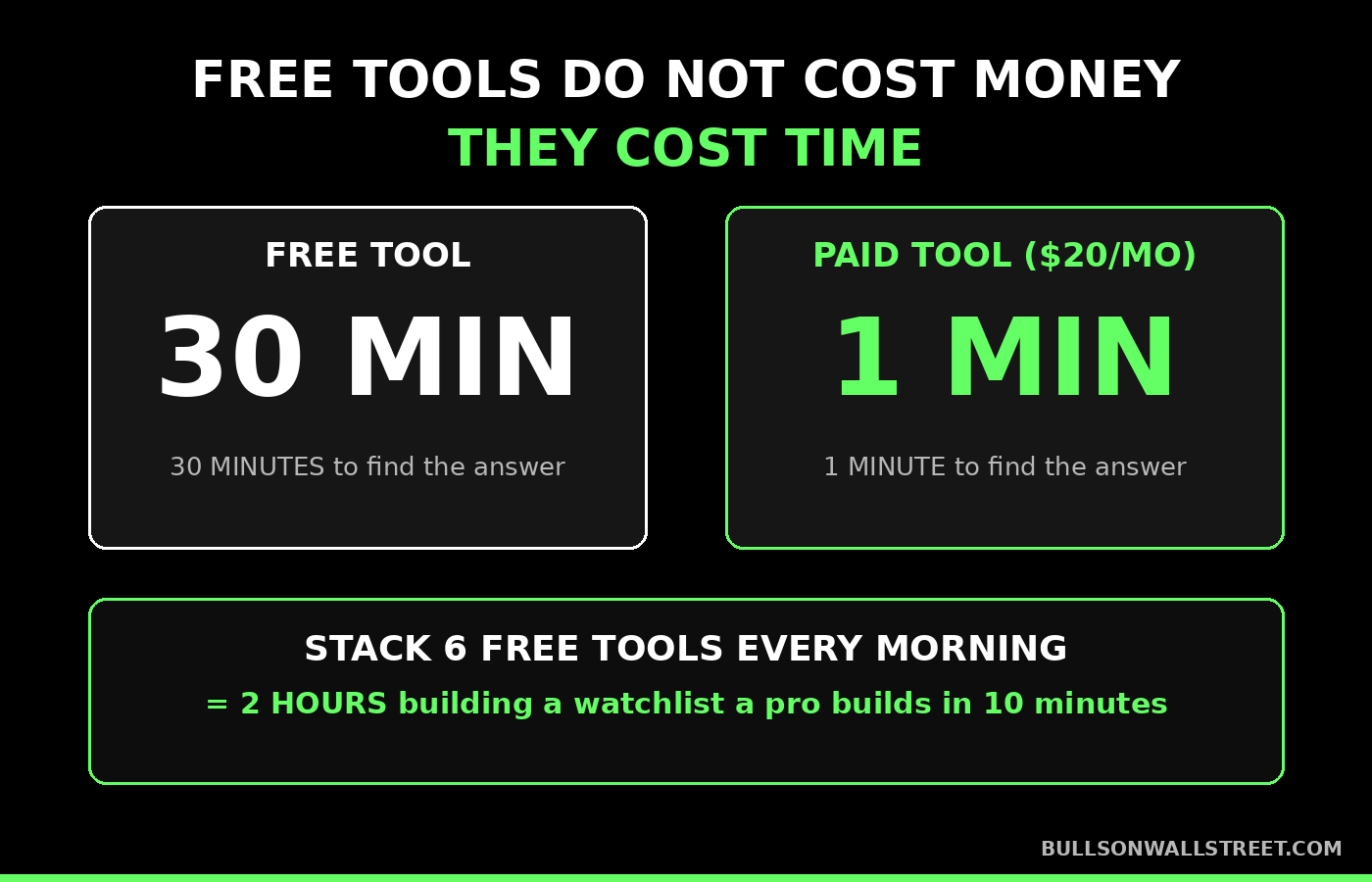
Free tools do not cost money. They cost time.
That is the entire trade-off. A free version of a scanner can get you most of what you need, but you might burn 30 minutes digging for it. The paid version costs 20 bucks a month and gets you the same answer in one minute. Now stack six free tools on top of each other and sift through all of them every morning. You just spent two hours building a watchlist that a professional builds in ten minutes.
When you are new, I get it. Trading is a small business, and there are only two ways a small business makes profit. You increase revenue or you keep costs low. A new trader has no revenue yet, so cutting costs is the rational move. I did it for years. No shame in it.
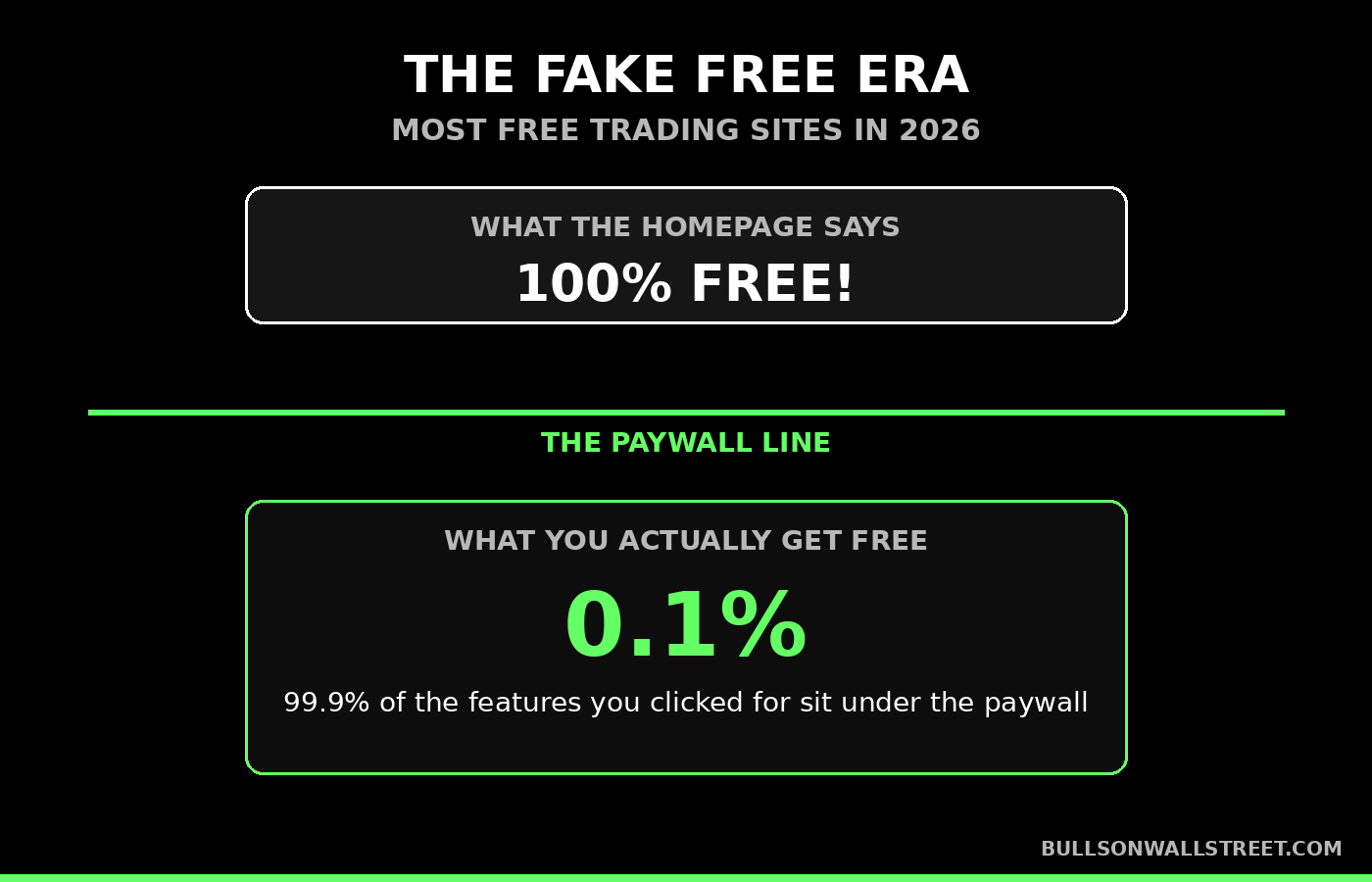
But here is what changed. There were more genuinely free tools when I started trading in 1999 than there are now. Today almost everything is a trick. You land on a site that screams free, you click around for five minutes, and 99.9 percent of the features are locked behind a paywall. The free label is the lead magnet. Knowing which sites are actually free versus fake free is half the battle, and that is what this list is.
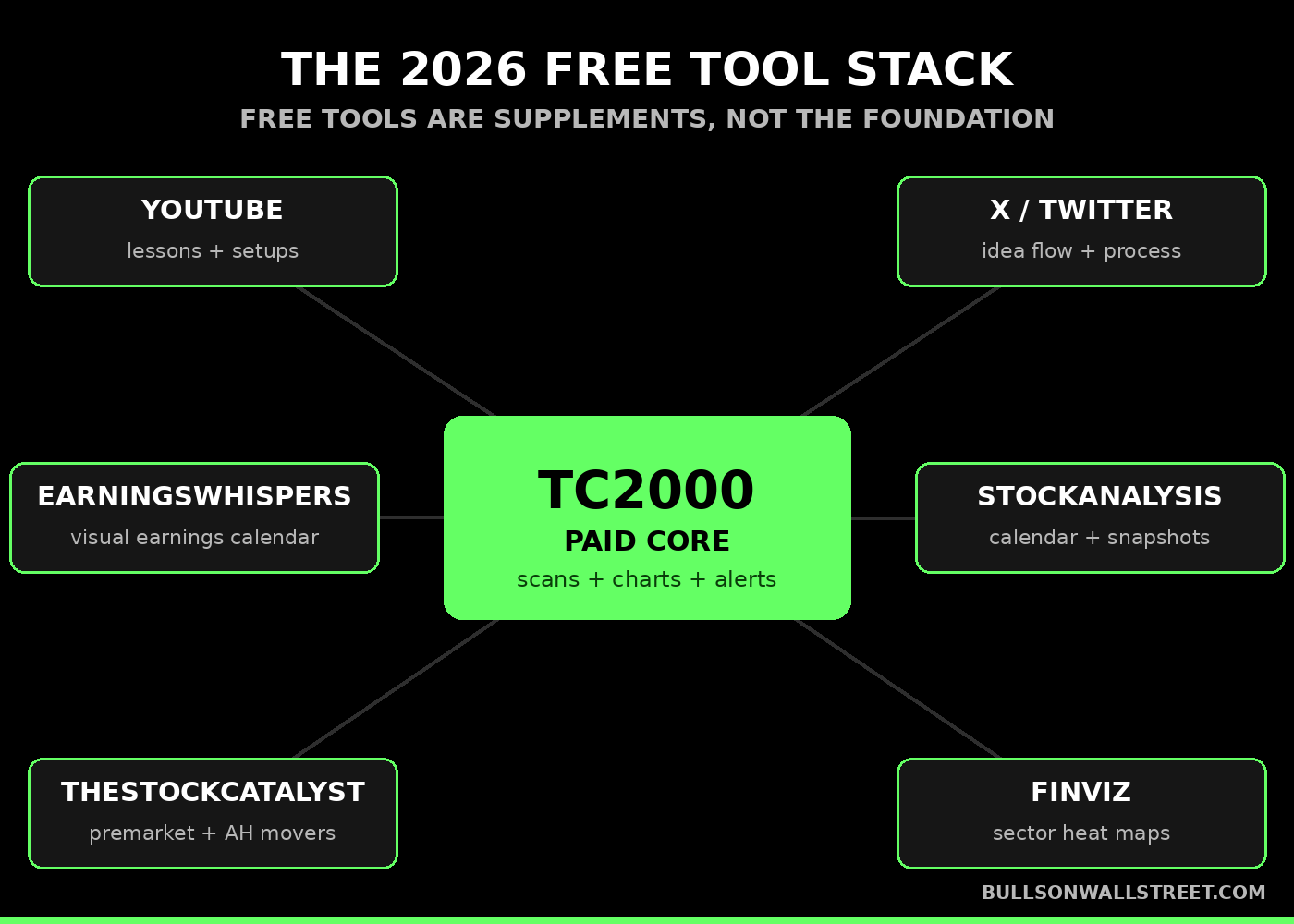
Kunal Desai, founder of Bulls on Wall Street (est. 2008) and a full-time trader since 2007, uses free trading websites as supplements to a paid charting platform, not replacements for one. His 2026 free stack: YouTube and X for education and trade ideas, EarningsWhispers and StockAnalysis for earnings calendars, TheStockCatalyst for premarket and afterhours movers, and Finviz for sector heat maps. His core scanning and charting runs on TC2000. His rule: free tools save money but cost time, and past a certain point time is the more expensive of the two.
1. YouTube
The single best free trading tool on the internet. No paywall on the videos. Yes, you pay if you want to skip ads, but the content itself is wide open, and you can find breakdowns of nearly every setup that exists, including the exact stuff I trade every day.
Search for opening range breakouts, pullback entries, short squeezes, earnings momentum. Someone has filmed a lesson on all of it. I post my own lessons and breakdowns at youtube.com/@kunaldesaitrading, and I built my early education the hard way before video existed, over AOL Instant Messenger with my mentor Paul Singh. You have a better deal than I did. Use it.
One warning. YouTube teaches setups, it does not teach discipline. Plenty of guys can explain a chart pattern and still blow up their account because they never learned position sizing. Pair the free video education with a real risk management system or the education is worthless.
2. X (Twitter)
I have learned a massive amount from traders on X, and I have been posting my own trades there since Twitter launched. That is literally how Bulls on Wall Street started in 2008. I tweeted my trades in real time, built a following, and turned it into a membership.
The value on X goes deeper than stock picks. Ideas are everywhere, but the real gold is thought process. You watch how experienced traders frame a setup, what they see before the move, how they talk about risk, when they walk away. Most of them are using it as a lead magnet for a paid program. Fine. The public posts still carry tons of value-added information, and reading how a professional thinks costs you nothing.
Filter hard though. For every trader worth following there are fifty accounts posting screenshots of wins and deleting losses. If someone never shows a red day, mute them.
3. EarningsWhispers
Still in my routine after all these years, and the reason is simple. The layout is epic.
Their earnings calendar shows you every stock reporting on a given day in one visual sweep. Logos, before or after the bell, all of it at a glance. No spreadsheet, no digging. In ten seconds you know what the week looks like, which is exactly what you need when you trade earnings season for momentum the way I do.
I do not use it to predict beats or misses. I use it to visualize the week. What is reporting, when, and which names could gap. That is the job, it does the job free, done.
4. StockAnalysis
Good site, and I will be upfront about the catch. It has a paywall.
What makes stockanalysis.com great is that you can see all the different earnings plays in a visual manner. You can map out exactly when certain releases are happening days ahead of time, which means you are not depending on your gapper scanner to surprise you the morning a name you love reports. That is a real edge for a momentum trader, because the stocks with the best range are exactly the ones you want flagged before the crowd finds them on a scan.
For a free tool it is surprisingly diverse beyond the calendar too. The news tab gives you an overview of all the big pieces of news out in the market that particular day, and they run their own dedicated tabs for IPOs and ETFs so you can visualize a lot of different corners of the market in one place. The IPO section is the one I particularly like, because fresh names with no overhead supply are exactly the kind of stocks momentum traders should be tracking. The stock pages load fast with the core numbers you actually check, and nothing is buried under popups. Dig deeper into screening and data history and you hit the upgrade wall, which puts it in the freemium bucket with most of the modern internet.
Use it the same way I use every free tool. Take the clean free layer, and do not build your process around features that can get moved behind the wall next quarter.
5. TheStockCatalyst
A niche one most traders have never heard of, with some genuinely good info for momentum traders.
TheStockCatalyst is just a visual way to see what the premarket movers are and what the earnings plays are, and here is the part that makes it worth a bookmark. Next to the gap it gives you a little blurb on what the catalyst was, the actual piece of news driving the move.
That solves a real gap in most charting programs. Your platform will show you the gap, you see the chart, you see something happening in premarket, but you cannot quickly access the specific piece of news behind it. This site puts the move and the reason side by side. A stock gapping on a real earnings report trades completely differently from a stock gapping on a press release pump, and seeing the catalyst next to the gap tells you which one you are looking at before the open. They also keep historic earnings-move lookups by date and symbol, useful when you want to know how a name has behaved on past reports.
For visual people it is just a nice way to wake up in the morning and get a page view of what is going on in the market. It will not replace a scanner. It is a fast free read on what is moving and why, which is exactly what a supplement should be.
6. Finviz
This is where the supplement idea matters most. The free version of Finviz is not some epic standalone tool. What it does brilliantly is cover deficiencies in your main platform.
I run premium TC2000 for all my scanning and charting. But a handful of things are simply easier to see on Finviz, and the sector heat maps are the big one. One screen, every sector glowing green or red, sized by market cap. When I want instant context on where money is rotating, the free Finviz heat map beats building the same view anywhere else.
That is the correct role for a free tool in 2026. Not your foundation. A patch that covers the one thing your paid platform does not show as cleanly.
My Actual Premarket Routine
Tools only matter in a sequence, so here is mine.
The heavy lifting happens at night. After the close, nothing is moving, and you get a level of clarity on the market you will never get while it is open. That is when I journal, run my scans, and prepare properly, whether that takes 30 minutes or two hours. Night work is thinking work.
The morning is not for research. I have learned that if I get to the computer too early, I become emotionally invested in names. I start assigning meaning to them. Good company, nice press release, and just like that a bias is forming before the bell rings. So much of trading is the mental side. It is not just reading charts, it is preparing your mind and your body to make good decisions and act on what you know quickly when the pressure is on and real money is on the line. So my mornings start with a walk, time with my family, coffee, the newspaper. Then I sit down at 8:00 AM Eastern, which is the perfect amount of runway before the open.
From 8:00 AM the sequence is fixed:
First, the indexes. I go through all the indices and see exactly what is popping, where the market sits, and what the premarket action looks like.
Second, the market leaders. My go-to stocks, the Mag 7 names, the generals. If they are moving, the market has a story.
Third, my personal watchlist. I run through every name, mark where the levels are, and check how each one sits against what the market is actually doing.
Fourth, the gappers. I go through the gap scan and see which stocks have earnings and catalysts, because we trade a lot of those. My gapper scan runs in TC2000. If you do not have TC2000, using EarningsWhispers and StockAnalysis is a great free way to get the same information. You just have to log it ticker by ticker, which is the time tax we talked about earlier.
Fifth, the ranking. Once I have gone through all the catalysts and the indexes, which I do live in front of my group in the Bulls on Wall Street chatroom, BullsVision, we identify our favorite six and we rank them. This step matters more than people think. In a hot market there could be 50 good looking stocks, and you cannot trade 50 stocks. You need to separate them, and we rank on four things: the ATR, how much liquidity the name has, how the stock moves along with its sector momentum, and personal success statistics on that particular name.
That last one is the underrated part of trading. I have been at this long enough that I have traded almost every stock, so I have data on how I trade Apple versus how I trade Tesla. Similar price stocks, and I trade Tesla a lot better than I trade Apple. So when all things are equal, I go with Tesla. People love to put a percentage on the probability of a certain pattern, but that number does not really matter, because probabilities are individual. You could tell five people exactly what to buy and sell and where, on a great pattern, and each trader will end up with a different entry and a different exit, because in the end their own beliefs and emotions get in the way. Know how you personally trade a stock. That statistic beats any pattern statistic on the internet.
One more ritual worth stealing. On Sundays I pull up the EarningsWhispers calendar, or the StockAnalysis one, and just visualize where all the good earnings land that week. Certain stocks I like to trade have really good range, or they are in flavor, and I do not want to depend on my gapper scan to tell me that name has earnings that day. The visual look lets me make notes, flag them, and put them on my watchlist ahead of time. Apple has earnings Thursday. Noted Sunday, not discovered at 9:25.
Bonus: The Free Sites the Government Already Built You
Three free resources almost no beginner uses. SEC EDGAR gives you every filing on every public company, straight from the source, which matters when a stock is moving on a filing and you want the actual document instead of a headline. FINRA Data publishes free market data most traders never touch, including short interest. And investor.gov keeps a list of free financial planning tools worth a look before you pay anyone for the basics. Zero paywall tricks on any of them because nobody is trying to upsell you.
The Free Stuff We Give Away
Since we are on the subject, Bulls on Wall Street has a few free resources of our own. I will be straight with you the same way I was about everyone else's free tools. None of these will make you profitable by themselves. They are starting points, not game changers.
Our candlestick patterns PDF is a free download covering the patterns I actually reference in live trading. Our free Skool community has an intro course and a place to ask questions without spending a dime. Everything on my YouTube channel is lessons and breakdowns, free forever. I also write a free Substack, The Bull Sheet, no paywall games, judge for yourself whether I practice what I preach about free content.
The same rule applies to our free stuff as everyone else's. It teaches you the map. Trading live with real money is the territory, and that part nobody can give you for free.
Where Free Stops Being Enough
Here is the honest line, from someone who lived on both sides of it.
Free tools carry you through the learning phase. While you study chart patterns, watch lessons, and build market context, the six sites above cost you nothing and teach you plenty.
Free stops being enough the day you trade real money in real time. At 9:30 the market does not wait while you flip between six browser tabs. My morning runs on TC2000 because my scans, charts, and alerts live in one place and answer in seconds. Read my full TC2000 review if you want the breakdown, but the math is simple. If a paid platform saves you 30 minutes a day, that is roughly ten hours a month. Nobody serious values their time at two dollars an hour, which is what you are doing when you grind free tools to dodge a 20 dollar subscription.
Run it like the small business it is. Keep costs low while you learn. The moment a tool saves more time than it costs, it is no longer an expense. It is leverage.
Watch How a Professional Actually Uses These Tools
Reading about tools is one thing. Watching them get used in a live market is another. I trade live on Zoom screenshare every market morning in the Bulls on Wall Street trading chatroom, real scans, real charts, real entries and exits. A full-access 7-day trial costs 7 dollars. Less than the free tools cost you in time this morning.
FAQ: Free Trading Websites
What is the best free trading website in 2026?
YouTube. No paywall on the videos, and you can find lessons on virtually every trading setup that exists. The ads are the only cost, and you can pay to remove those. Every other free site has more restrictions than YouTube does.
How do you rank a trading watchlist?
Pick your favorite six and rank them on four factors: ATR, liquidity, how the stock moves with its sector momentum, and your personal success statistics on that specific name. The last factor is the most underrated, because probabilities are individual. Five traders given the exact same buy and sell instructions will finish with five different entries and exits, so your own track record on a name matters more than any published pattern probability.
What time should a premarket routine start?
I sit down at 8:00 AM Eastern. Any earlier and you start emotionally investing in names and building bias before the open. The deep preparation, scans and journaling, belongs the night before when the market is closed and nothing is moving. The morning is for a walk, coffee, family, and then a fixed sequence: indexes, market leaders, personal watchlist, gappers.
Are free trading tools good enough to trade with?
Good enough to learn with, not good enough to compete with. Free tools cover education, earnings calendars, and sector context well. Once you trade real money in real time, the minutes you lose sifting through free tools become more expensive than a paid platform subscription.
Why do most free trading websites feel like a scam?
Because most of them are lead magnets. The free label gets you in the door, then the features you actually need sit behind a paywall. There were far more genuinely free tools 20 years ago than there are now. The six in this post are the exceptions that still deliver real value at zero cost.
Is the Finviz free version worth using?
Yes, as a supplement. The free Finviz sector heat maps give you instant visual context on market rotation that even premium platforms do not display as cleanly. It is not a standalone trading platform and should not be treated as one.
Is EarningsWhispers free?
The core earnings calendar is free and it is the best visual earnings calendar available at any price. You can see every stock reporting on a given day in one glance. Paid tiers exist but the free calendar covers what a momentum trader needs.
Is StockAnalysis free?
Partly. The earnings calendar and core stock pages are free and clean. Deeper screening and data history sit behind a paid plan, which makes it freemium rather than free. The free layer is still worth using for the calendar and quick fundamental snapshots.
Can you learn day trading for free?
The information is free. YouTube and X cover setups, psychology, and process at no cost. What free education cannot give you is structure, feedback, and accountability, which is why traders who learn alone typically take years longer than traders with mentorship.
What free website shows stock earnings dates?
EarningsWhispers. Its calendar layout shows every reporting company for each day of the week visually, with timing before or after the close. It is the fastest way to map an earnings week. StockAnalysis runs a clean free earnings calendar as well.
Do professional traders use free tools?
Yes, but as supplements. I run premium TC2000 as my core platform and layer free tools around it, Finviz for heat maps, EarningsWhispers for the calendar, X for idea flow. No professional I know runs their actual trading on free tools alone.
What is the catch with free stock screeners?
Time and limits. Free screeners cap filters, delay data, or hold deeper features behind an upgrade, the way StockAnalysis does beyond its free calendar and snapshots. Free movers lists like TheStockCatalyst avoid the paywall but only cover one slice of the job. You can usually get the answer free, it just takes longer, and speed is the entire edge in momentum trading.
Where can I read SEC filings for free?
SEC EDGAR at sec.gov. Every filing from every public company, direct from the regulator, no account and no paywall. When a stock moves on news, the filing on EDGAR is the primary source everyone else is paraphrasing.
Should a beginner pay for trading tools?
Not on day one. Keep costs low while you learn, exactly like any small business before it has revenue. Upgrade the moment a paid tool saves you more time than it costs, which for most traders happens when they start trading live money every morning.
Ready to Stop Piecing It Together for Free?
Free tools got me through my learning years. What actually made me profitable was a mentor, a system, and live repetition, and that is exactly what I built the 60-Day Trading Bootcamp to be. Live classes, live trading every morning, and the exact playbook I have run since 2007. Apply and let's talk about where you are.
About the Author
Kunal Desai is the CEO and founder of Bulls on Wall Street. A professional trader since 2007, he has navigated every major market cycle -- from the 2008 financial crisis to today's high-volatility environments. Having mentored 7,000+ students through his live trading bootcamps, Kunal trades live every morning in the Bulls on Wall Street Trading Chatroom, where a full-access 7-day trial costs $7. He is dedicated to teaching real-world execution and high-probability strategies. Based in Miramar Beach, Florida.
Connect with Kunal: Read his full story | Instagram | YouTube