

I have signed up for more than 100 free trading courses. I run Bulls on Wall Street, I have taught trading since 2008, and I still sign up for every free course, free training and intro class that any educator I respect puts out. Four of them were worth the time. This is the list, ranked, and then the more useful part: what the other 96 look like, and what a free trading course is actually for.
TL;DR
- The best free trading courses in 2026: the Bulls on Wall Street free Skool system, the Investors Underground Beginners Day Trading Guide, Emmanuel Malyarovich's 10-hour YouTube course, Alison's Day Trading Strategies course, and the TraderLion Annual Trading Conference.
- Roughly 99 out of 100 free courses are a one-hour sales presentation for an expensive on-demand product. Many are pre-recorded webinars staged to look live.
- A free course has two real jobs: it tells you whether you actually like this work, and it shows you whether you can trust the instructor with real money later.
- If the free version is thin, vague or fake, the paid version will be too.
Why I Keep Signing Up for Other People's Free Courses
I started Bulls on Wall Street in 2008. We update the curriculum every year, but the truth is I have been teaching the same kind of class for a long time, and the fastest way to get complacent is to stop looking at what everyone else is doing.
So I sign up. Anyone who makes good videos, anyone whose structure I admire, anyone whose name keeps coming up in my community. I want to see how they built the class, how they deliver it, what the modules look like, what they say in the first five minutes. Sometimes I learn something about presentation. Sometimes I learn what not to do.
After 100 of these, the pattern is impossible to miss. Here are the five that broke it, plus two that are not courses but earned a spot anyway.
The 5 Best Free Trading Courses in 2026
1. Bulls on Wall Street Free Trading Community on Skool
Yes, mine is first. It is on my site, and I built it specifically because of what I saw in the other 96. You can decide for yourself in about ten minutes whether that ranking is earned.
When I built the free course I made one rule: it had to be long. Not a teaser. Inside the free Skool community there are 25 hours of modules, starting with the 7 Day Trading Foundation and running through the fundamentals of the stock market, technical analysis, risk management, market analysis, swing trading for part-time traders, day trading strategies, scanning, options, a daily checklist and building a trading routine.
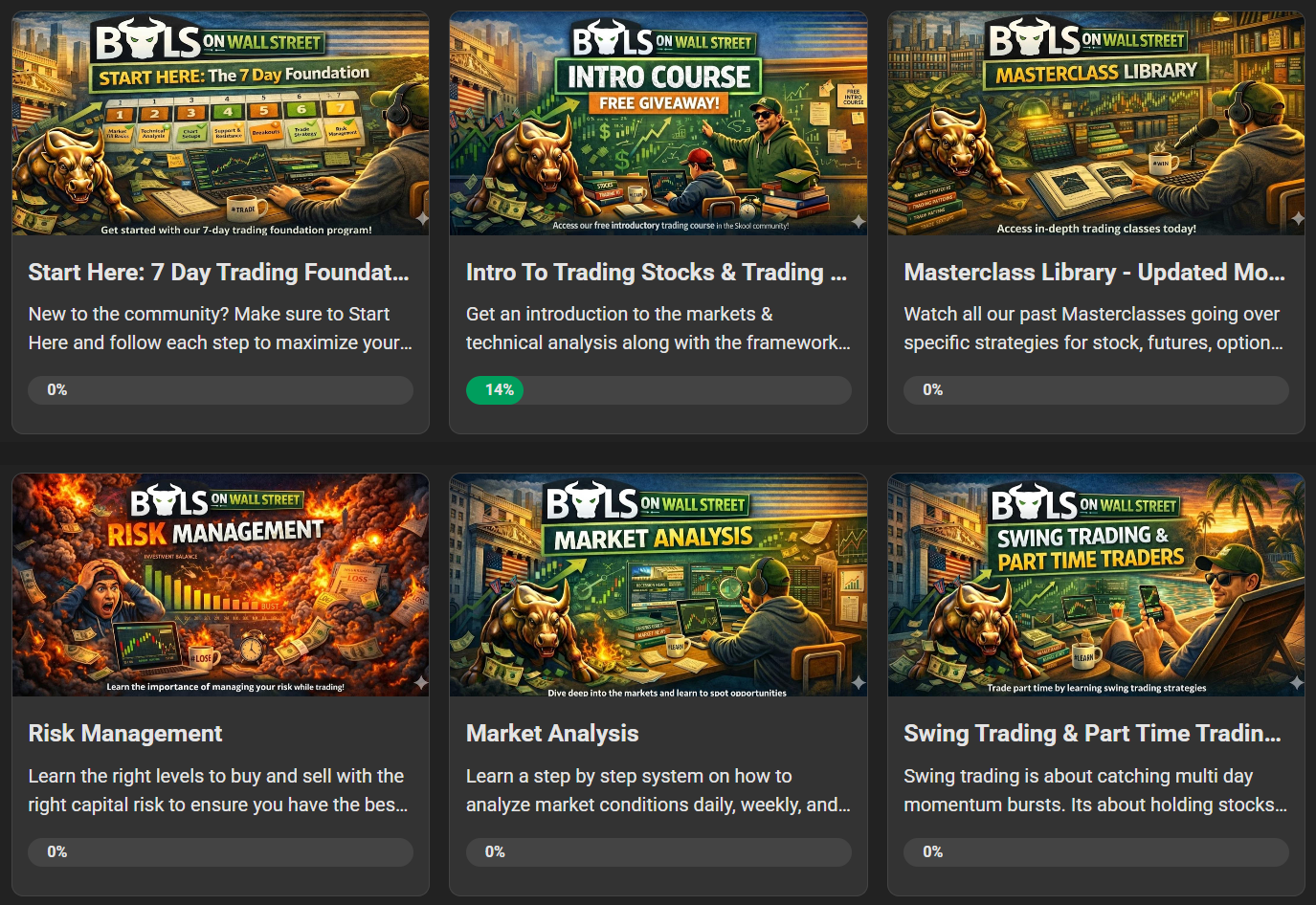
That is the on-demand half. The other half is live. A couple of times a month I run live webinars on a specific subject and take questions until they run out. A couple of times a week I open a Zoom in the pre-market, walk everyone through what I am watching and why, and then trade live with the room watching. It is part of the system, not an extra.
And the piece people mention most when they join: I answer. Members post in the feed or message me directly, and the reply comes from me, at night, when I get through my work. Not a bot. Not an employee. You will see exactly what kind of teacher you are dealing with before you spend a dollar, which is the entire point of a free course.
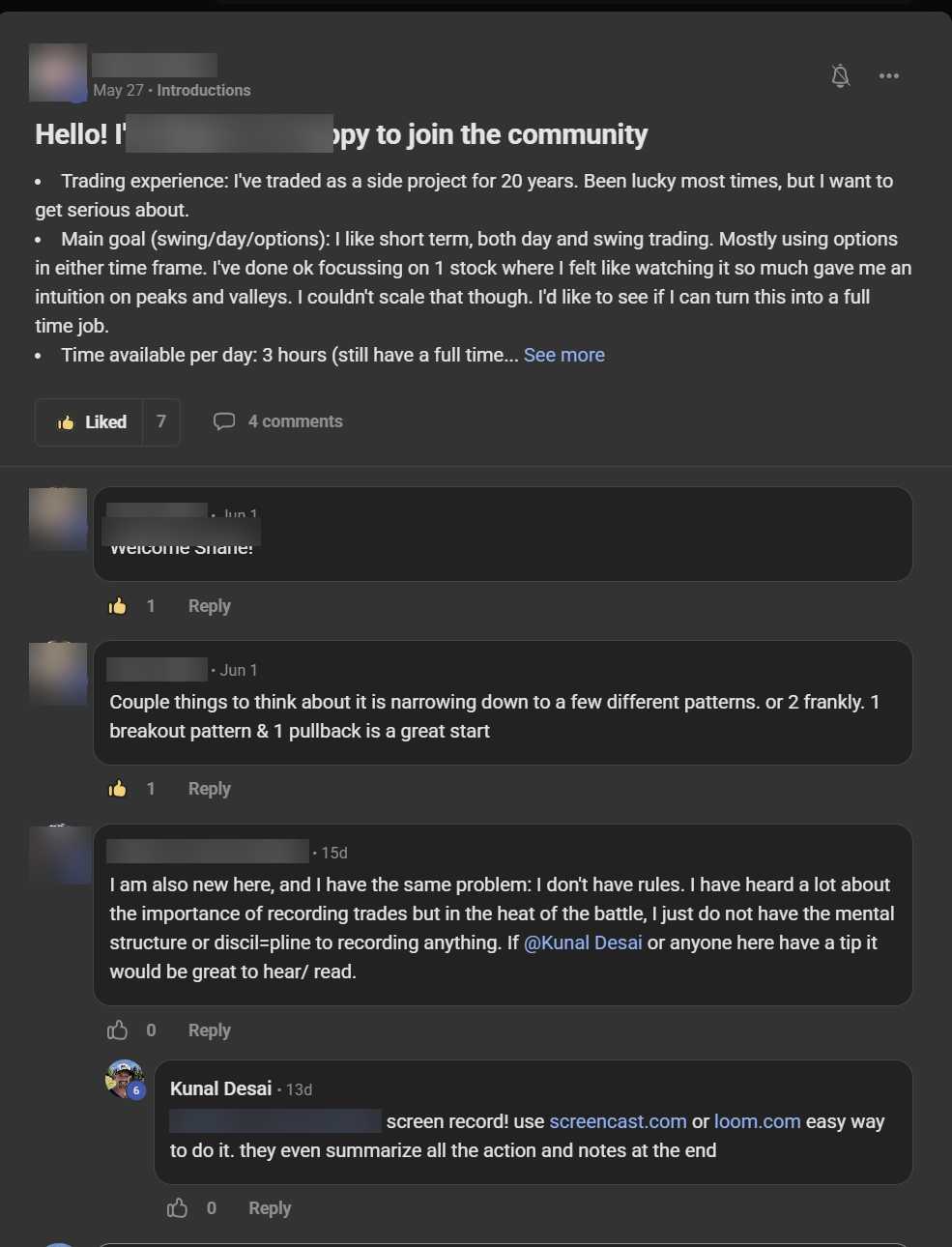
Best for: anyone who wants to know what real trading education looks like before paying for any of it, including mine.
2. Investors Underground: Beginners Day Trading Guide
Investors Underground is a competitor and I have said plenty about the differences between us in my Investors Underground vs Bulls on Wall Street comparison. None of that changes this: their free beginners guide is in depth, it respects the reader, and I enjoyed going through it. It walks a new trader through the pieces in order instead of hinting at a secret and pitching.
That is rarer than it should be. When a competitor does the free part properly, I say so.
Best for: complete beginners who want a structured written walkthrough before they touch a chart.
3. Emmanuel Malyarovich: The ONLY Trading Guide You'll Ever Need (10+ Hours on YouTube)
A ten-hour course, posted in full, for free, on YouTube. No email gate, no webinar registration, no countdown timer. Emmanuel just put the whole thing out.
I like it for two reasons. The length is honest. You cannot fake ten hours of instruction the way you can fake a one-hour webinar. And it is watchable, which matters more than people admit, because most traders quit a course in the first hour, not the tenth.
The caveat is the same one I give about every video course, and I wrote a whole post on why you cannot learn trading from YouTube videos. Watching is not doing. Nobody is checking your journal. But as a free primer, it is one of the best on the platform.
Best for: people who learn by watching and want the full picture in one sitting before deciding whether to go deeper.
4. Alison: Day Trading Strategies
I am including Alison for a reason that has nothing to do with the trading content, which I would call B level. It is fine. It is generic.
What I could not stop looking at was the delivery. Alison is a real learning management system. Progress tracking, gamification, assessments, a structure that pulls you through to the next lesson. The form was cutting edge and, honestly, enjoyable to use. If more trading educators paid attention to how a course is delivered instead of just how it is pitched, the whole industry would be better.
Best for: brand-new traders who want basic vocabulary in a well-built classroom, and anyone curious about what a proper LMS feels like.
5. TraderLion Annual Trading Conference
This one is not a course in the module sense. It is a free multi-day online conference that TraderLion runs once a year, streamed on their YouTube channel, and I am putting it on the list because the speaker lineup is some of the best in the world. Past years have had Jack Schwager, David Ryan, Denise Shull, Jim Roppel and Matt Caruso. Those are people I grew up watching. People I respect.
What I like most is the range. Momentum, position trading, psychology, risk, fund managers, investing champions, all in the same event. If you only ever learn from one style of trader you end up with one style of blind spot. Four days of watching the best people in different lanes explain how they think is the fastest cure for that I know of.
TraderLion runs a paid education service alongside it. I have no relationship with them. The conference stands on its own.
Best for: traders past the basics who want to hear how the best in the business actually think, across every style.
Worth Your Time but Not a Course
Three more that I would send people to, with the caveat that none of them is structured education. They are for the drive, the gym, the evening after the journal is done.
Chat With Traders. The granddaddy of trading podcasts. Chat With Traders started in 2015, it is one of the original shows in this space, and it is up past 330 episodes with some of the best traders in the world. I was episode 20 back in 2015. No fluff, no sales pitch, just long conversations about how people actually trade. It will not teach you to trade, it is audio, you are not getting a setup drawn on a chart. What it does better than anything else free is help you find your lane. Momentum, discretionary, systematic, options, longer-term. Sift through enough episodes and you start to hear which style sounds like you. That is worth knowing before you spend a dollar on a course built around a style you will hate.
B The Trader. A podcast and a YouTube channel. The host does a great job of bringing on a diverse group of people, different styles, different markets, different account sizes, and letting them talk. I have been a guest a couple of times myself. It is one of the better free educations you can get with your hands on the wheel.
The TraderLion podcast. Same crew as the conference above, long-form interviews with serious traders. Slower and deeper than most trading podcasts. Good.
What the Other 96 Look Like
Here is the free training you will actually find when you click sign up for my free course on a YouTube video or a landing page.
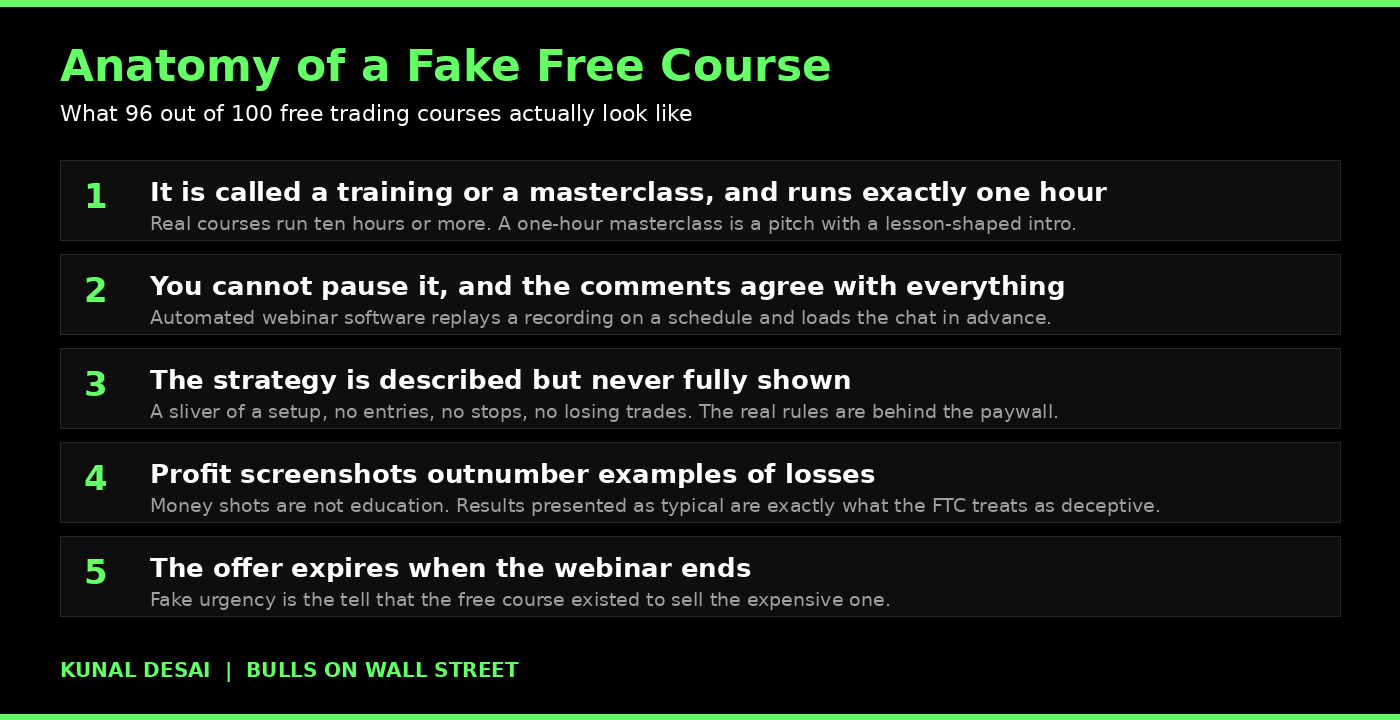
You register. You get a link to a live training starting in 15 minutes, or at a time that always happens to fit your schedule. A guy comes on. There is a chat box with comments rolling in. It feels live.
It is not live. It is an automated webinar, replayed by software that simulates a live event, and the comments were loaded in advance. The presentation is vague on purpose. It hints at a really cool strategy, shows a sliver of it, then spends most of the hour on testimonials and what I call money shots: how much was made on this trade, how much this student made last month. Then the pitch. A modules-and-videos product, usually expensive, often with a timer.
One more tell, and it is the one that sends the most people to me afterward. You land on a schedule page with ten different free webinars lined up for the week, every one of them two hours, every one of them billed as a full training. Nobody can run ten free, live, two-hour classes a week that are all worth your time. That is a sales calendar. Each slot is the same two-hour presentation with a different title on it, and the last twenty minutes are the offer. Some of the outfits that run this way have been around for decades and there is nothing illegal about it. It is just how they work their pipeline. Know what you are walking into, take whatever is useful, and do not mistake the calendar for a curriculum.
The big brokerages run a softer version of the same thing. Fidelity, Schwab and the rest all offer free trading classes, and the material is usually accurate. The catch is who is teaching it and why. When I was new I traded through Ameritrade, and I would get an alert for a free class, log on, and it was an employee with a slide deck. Not a trader. A presenter reading basic material off slides, as far as I could tell from a script, while the real goal was getting me to fund the account. The brokerage does not make money on the class. It makes money when you deposit and trade. That is not sinister, it is just the business, but it means the person teaching you has never had to hold a position through a bad open, and it shows. Use them for vocabulary. Do not mistake them for a trading education.
If you are being sold with fake urgency, staged comments and results screenshots you cannot verify, you are not in a course. You are in a funnel. The FTC now has a specific rule against fake reviews and testimonials, and its Endorsement Guides treat a real result presented as typical as deceptive. Most of these webinars would not survive either. That tells you everything about the paid product behind them.
What a Free Course Is Actually For
Most people come to trading from a glimpse. Something on social media, someone with the income or the lifestyle, and the thought: I could do that. They want in. They do not yet know what in means.
Here is what I know from 7,000+ students. To make real money trading you need some level of passion for the work itself, because the market is going to knock you down. You are going to lose money. Some of you will blow up an account. When that happens, are you going to sit up late doing your trade journal, running your scans, rewatching your own trades to find the mistake? That nitty gritty is what makes someone great at this craft, and there are easier ways to make money if you do not want it.
So the first job of a free course is a taste test. You thought trading was reading the news and buying stocks. Then you open the course and it is candlesticks, technical analysis, scanning, risk math, routines. Some people light up. Some people realize this is not what they pictured. Both outcomes are wins, and one of them just saved you thousands of dollars.
I built How Long Does It Take to Learn Day Trading around the same idea. The people who make it are the ones who like the work on a Tuesday night when nothing is going right.
The Instructor Audition
The second job matters even more. A free course tells you exactly what you need to know before you trust that instructor with real money for the paid version.
You can see how thoughtfully the class was built. You can see the structure, the attention to detail, whether lessons connect or just sit next to each other. You can see the instructor's personality, and whether that personality is someone you want in your ear for the next few years. And you can see one thing that no sales page will ever show you: what happens when you ask a question.
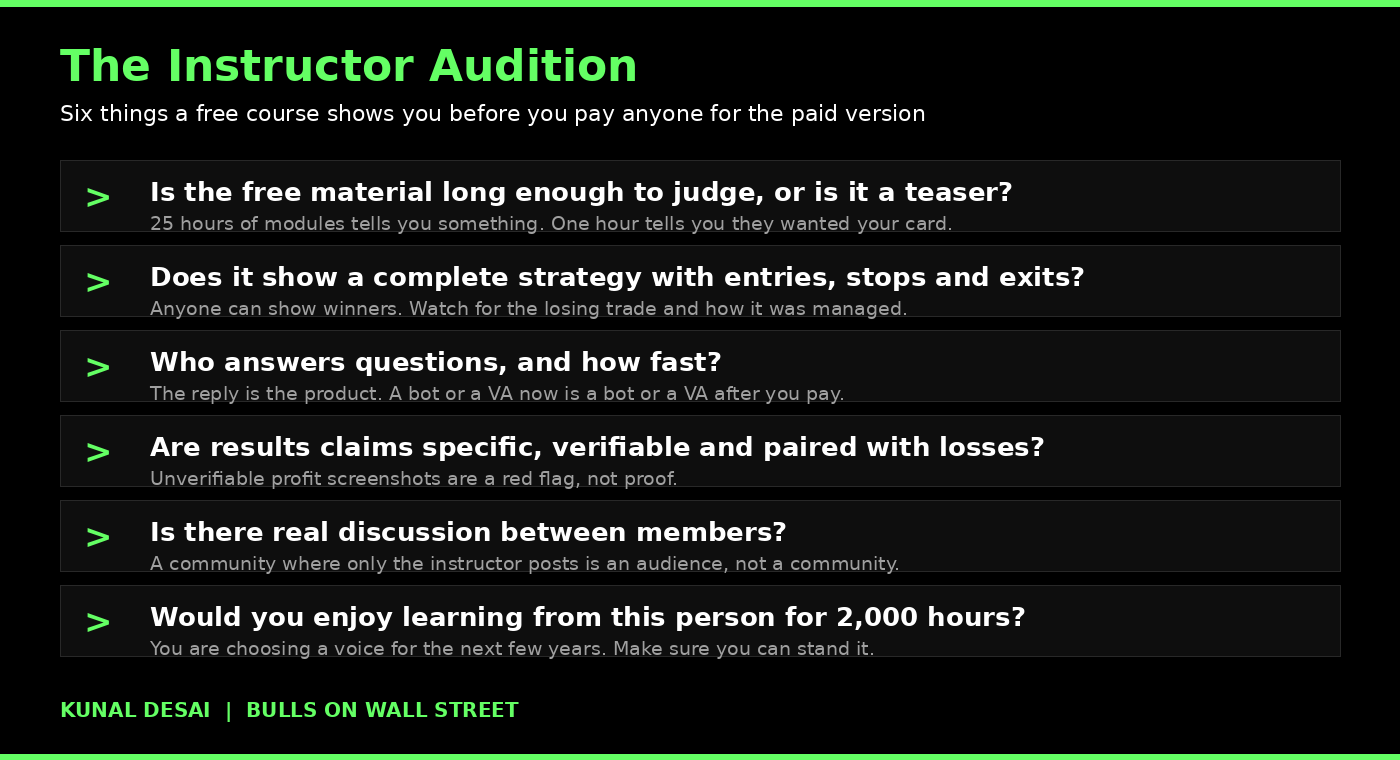
Six things to check before you pay anyone:
- Is the free material long enough to judge, or is it a teaser?
- Does it show a complete strategy with entries, stops and exits, or only the wins?
- Who answers questions, and how fast?
- Are results claims specific, verifiable and paired with losses?
- Does the community have real discussion between members, or only the instructor posting?
- Would you enjoy learning from this person for 2,000 hours?
If the free version fails this, do not pay for the paid version. The free version is the best behavior you will ever see.
A Word on Discord
A lot of educators funnel their free product through Discord. They open a few free channels, drop some videos in, call it a course. Discord is a chat. It is a good chat, and I run one alongside our live trading chatroom, but it is not a learning management system. There is no sequence, no progress, no structure. A pile of videos in a channel is not how a course is organized, and it is a tell about how much thought went into the paid one.
The combination I believe in is simple: real modules you can work through in order, live sessions where you can ask questions, and live trading you can watch. Free or paid, that is what education looks like.
When Free Stops Being Enough
Free gets you the taste test and the audition. What it does not give you is execution under real conditions with someone checking your work. That is why my free community leads into a $7 chatroom trial and eventually the 60-Day Trading Bootcamp, and it is why I wrote the ranked best day trading courses post as a separate piece. If you want the argument for live over recorded, it is in Live Trading Education vs Recorded Courses. Regulators keep pushing the same message to new self-directed investors, and FINRA's investor education resources are a decent free read alongside any of the five above.
Frequently Asked Questions About Free Trading Courses
Are free trading courses worth it?
The good ones are. They show you what the work actually involves and let you evaluate the instructor before you pay. The bad ones are sales webinars, and most are bad.
What is the best free day trading course in 2026?
For a complete system with modules, live webinars and live trading, the Bulls on Wall Street free Skool community. For a written beginners walkthrough, the Investors Underground guide. For a single long video course, Emmanuel Malyarovich on YouTube. For hearing the best traders in the world across every style, the free TraderLion Annual Trading Conference.
Can you learn day trading for free?
You can learn the vocabulary, the chart basics and the framework for free. You cannot get live execution feedback or accountability for free, which is where most traders actually stall.
How do I know if a free training is really live?
Try to pause it. Ask a specific question in the chat and see whether anyone answers it. Check whether the start time changes each time you reload the page. Automated webinar software runs on a schedule that looks live and is not.
Why do free trading courses ask for my email?
So they can market to you. That alone is not a red flag. The red flag is when the email gate leads to a one-hour pitch instead of actual lessons.
Is a free Discord a trading course?
No. Discord is a chat platform. It can host a great community, but it has no sequence or structure. A course lives in a classroom system with ordered modules.
How long should a free trading course be?
Long enough to judge the instructor. Ten hours on YouTube or 25 hours in a classroom tells you something. A one-hour masterclass tells you they wanted your credit card.
Should I pay for a course after finishing a free one?
Only if the free version passed the audition above. If you liked the work and trusted the teacher, the paid version is where execution gets built. If either failed, keep looking.
What should a free course teach a beginner first?
How the market works, how to read a chart, how to size risk, and how to build a daily routine. Strategies come after that foundation, not before.
Do free courses show real trades?
The honest ones do, wins and losses. Be careful with any course where every example is a winner.
Ready for the Next Step?
The free community is where most of my students start, and where a lot of them figure out whether trading is really for them. When you are ready to train for real, the 60-Day Trading Bootcamp is the world's longest-running live day trading bootcamp: live classes, a simulator phase, a business plan, and no live trading during class until your data says you are ready.
About the Author
Kunal Desai is the CEO and founder of Bulls on Wall Street. A professional trader since 2007, he has navigated every major market cycle -- from the 2008 financial crisis to today's high-volatility environments. Having mentored 7,000+ students through his live trading bootcamps, Kunal trades live every morning in the Bulls on Wall Street Trading Chatroom, where a full-access 7-day trial costs $7. He is dedicated to teaching real-world execution and high-probability strategies. Based in Miramar Beach, Florida.
Connect with Kunal: Read his full story | Instagram | YouTube