The Opening Range Breakout: The Pattern That Caught the Market Bottom
April 24, 2025. Tariff tantrum. Markets in flux. Every stock decimated. But I saw something the rest of the market missed: SOXL was showing signs of rounding. The semiconductor ETF had been beaten down with everything else, but the chart was telling a different story.
I pulled up the 5-minute. Saw the base breakout pattern forming on the daily. Next morning, SOXL gapped from $10.20 to $11. Perfect. The kind of open I wait for.
The spike was violent. Then it stopped. Three sideways candles. Volume declining. Range consolidating between where it gapped to and where buyers were pausing. I watched the 9 EMA converge with the 20 EMA—the Bone Zone was forming. This was textbook.
Price took out the opening range high on volume. $11.10. I entered with a 10-cent stop loss under the first consolidation candle. That’s the kind of risk I take when the setup is clean.
The stock ran to $12 that same day. I added rode up the 9ema then exited!

Here’s what most traders don’t know: that was the exact bottom of SOXL. Not approximately. Exactly. The ETF ran from $12 all the way to $70 after that. Did I hold to $70? No. As a day trader, I’m not built for 3-month holds. But every time I look at SOXL now, I remember that trade. Because it wasn’t luck. It was the ORB pattern doing what it’s designed to do: catching momentum off the lowest point before the real move.
That’s the power of the Opening Range Breakout.
I’m Kunal Desai. I’ve been trading professionally since 1999, went full-time in 2007, and founded Bulls On Wall Street in 2008. I’ve trained over 7,000 students through the 60-Day Live Trading Bootcamp. The ORB isn’t a pattern I invented—it’s been around for decades—but I’ve refined it, tested it across tens of thousands of trades, and systematized it to the point where the numbers don’t lie: 63% win rate, tracked daily in my TradeZella trade journal since I switched from TradingView.
This guide gives you everything I know about ORB trading: the exact three-candle rule, how to identify the Bone Zone, why trading after 11 AM is a donation, the real mistakes that blow up 90% of retail traders, and the stories behind my biggest wins and most humbling losses.
What Is an Opening Range Breakout?
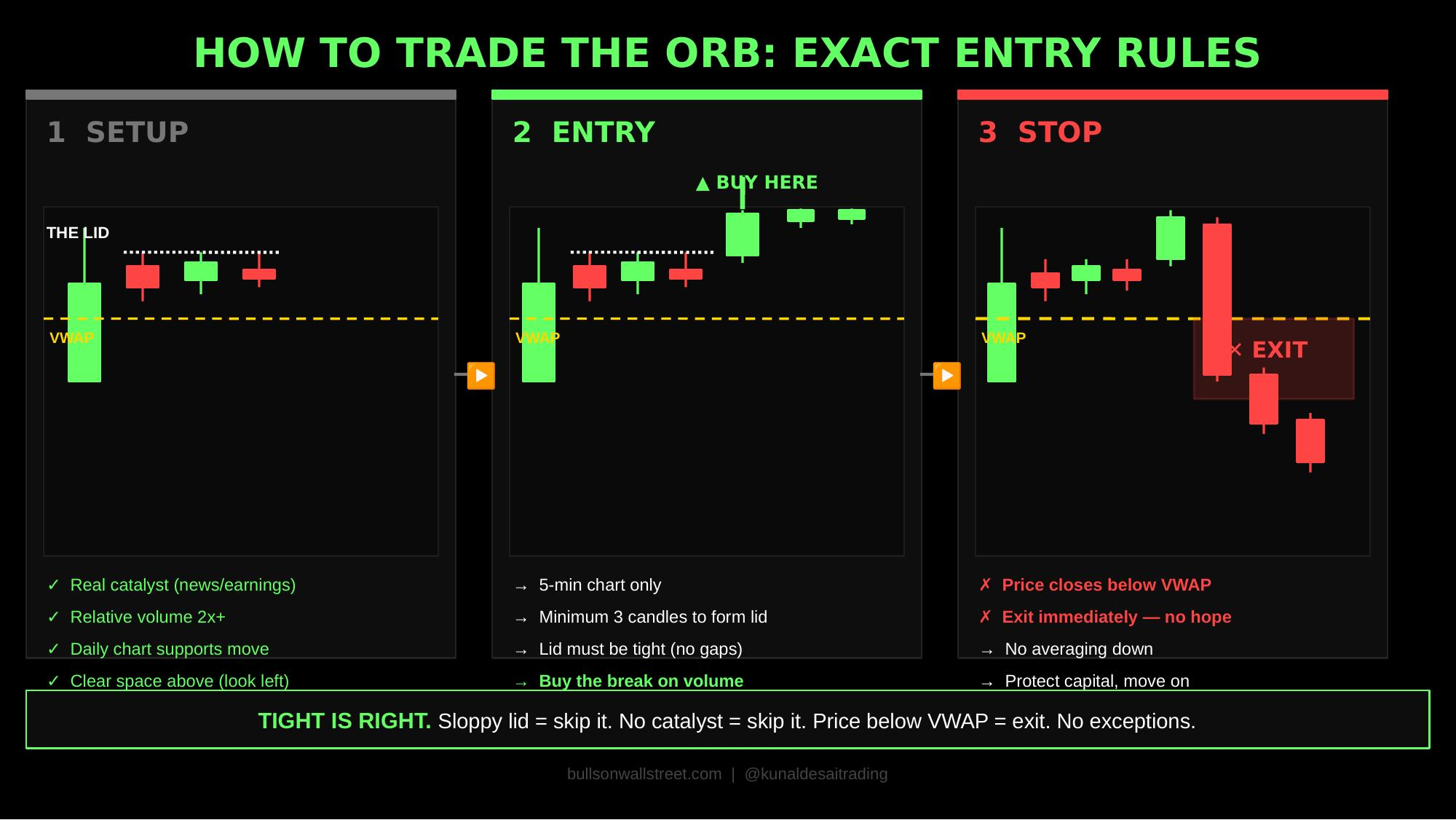
An ORB is three things happening in sequence: a spike, a consolidation, and a breakout.
The spike comes first. 9:30 AM opens. A stock moves 1-5% in one direction—usually up—in the first 30-60 seconds. The driver is news, earnings, analyst upgrade, gap, or sector momentum. Big money is positioning. Retail is panic buying or selling. Volume explodes. Volatility is extreme.
Then the energy stops. Price consolidates into a tight range for 3-5 candles on the 5-minute chart. A few pennies of movement. Maybe a quarter on a higher-priced stock. Volume dries up noticeably. The 9 EMA and 20 EMA converge. The chart gets quiet. This range is everything. This is your reference point for what happens next.
Then comes the break. Price takes out the top of that consolidation range on volume. This is your entry signal. The move is violent—price doesn’t creep higher, it rips. Volume expands hard. The candle closes above the range. The pattern is live.
Here’s what separates a high-probability ORB from a setup that’s going to stop you out:
The distance from VWAP.
I call this the Bone Zone. On your 5-minute chart, shade the area between the 9 EMA and 20 EMA. When price consolidates within that shaded zone during the pause phase, the ORB has teeth. It has high probability. When price is loose from VWAP—$1 or more away—the consolidation is weak. Extended. Gassed. That ORB will fail more often than it succeeds.
VWAP tells you whether the traders who bought at the top of the spike are still in profit or starting to bleed red. The tighter consolidation sticks to VWAP, the more unanimous the consensus is. This is why I keep VWAP white on every 5-minute chart I run. It’s that critical to seeing which ORBs to take and which to skip.
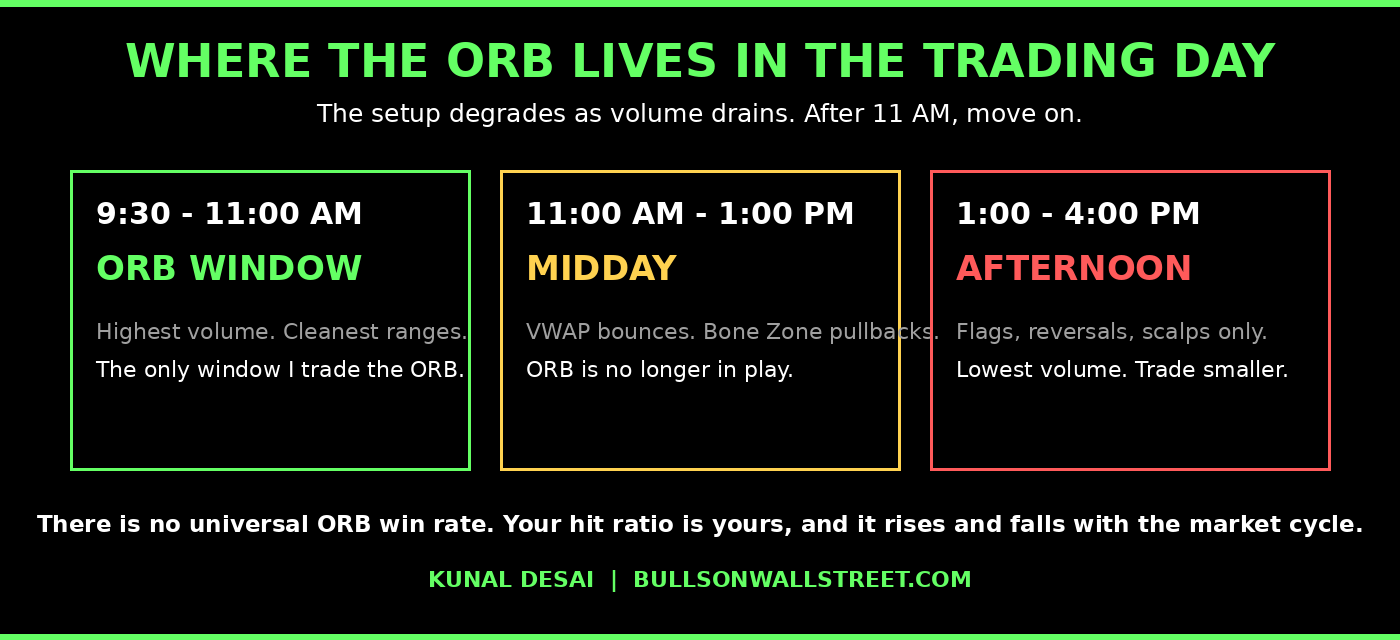
The Three Distinct Windows of the Trading Day
Before we get into the specific rules, you need to understand the rhythm of the market. There are three windows, and ORB only works well in one of them.
9:30 AM - 11:00 AM: The Money Window
This is where I make my money. Opening momentum is at maximum velocity. News-driven moves are still powering through the system. Earnings gaps haven’t faded yet. Sector rotation is happening fast. Volatility is high but orderly. Spreads are tight. Liquidity is excellent.
This is the only window that matters for ORB trading.
11:00 AM - 1:00 PM: The Fade Window
Momentum dies hard after 11 AM. The market finds equilibrium. Opening moves run out of fuel. The traders who made their move have cashed out. Early birds have taken profits.
ORBs that form during this window are weak. They’re you forcing a pattern that doesn’t exist anymore. Skip them entirely. This is where pullback traders make money, not breakout traders.
1:00 PM - 4:00 PM: The Close Window
Some stocks spike late on close-out buying, short covering, or final earnings digestion. ORBs can technically setup here, but the profit target is small and the risk is the same. The risk-reward is unfavorable.
Here’s the data: In my testing of thousands of ORBs since 1999, the pattern works 63% of the time in the 9:30-11:00 AM window. After 11:30 AM, that drops to 48%. By 1:00 PM, it’s 38%. By 3:00 PM, it’s barely better than flipping a coin.
Why the massive drop? Because opening momentum is the only fuel that matters. Once that runs out, you’re not trading a pattern. You’re trading a reflection of yourself trying to force something that’s no longer there.
Discipline means you close your scanner after 11 AM. You switch to different patterns—pullbacks to the 9 EMA, red-to-green bounces, dip buys on oversold scans—but you do not hunt for ORBs.
The Exact ORB Rules: Entry, Stop, Target, and Position Sizing
These rules are not suggestions. They come from tens of thousands of trades.
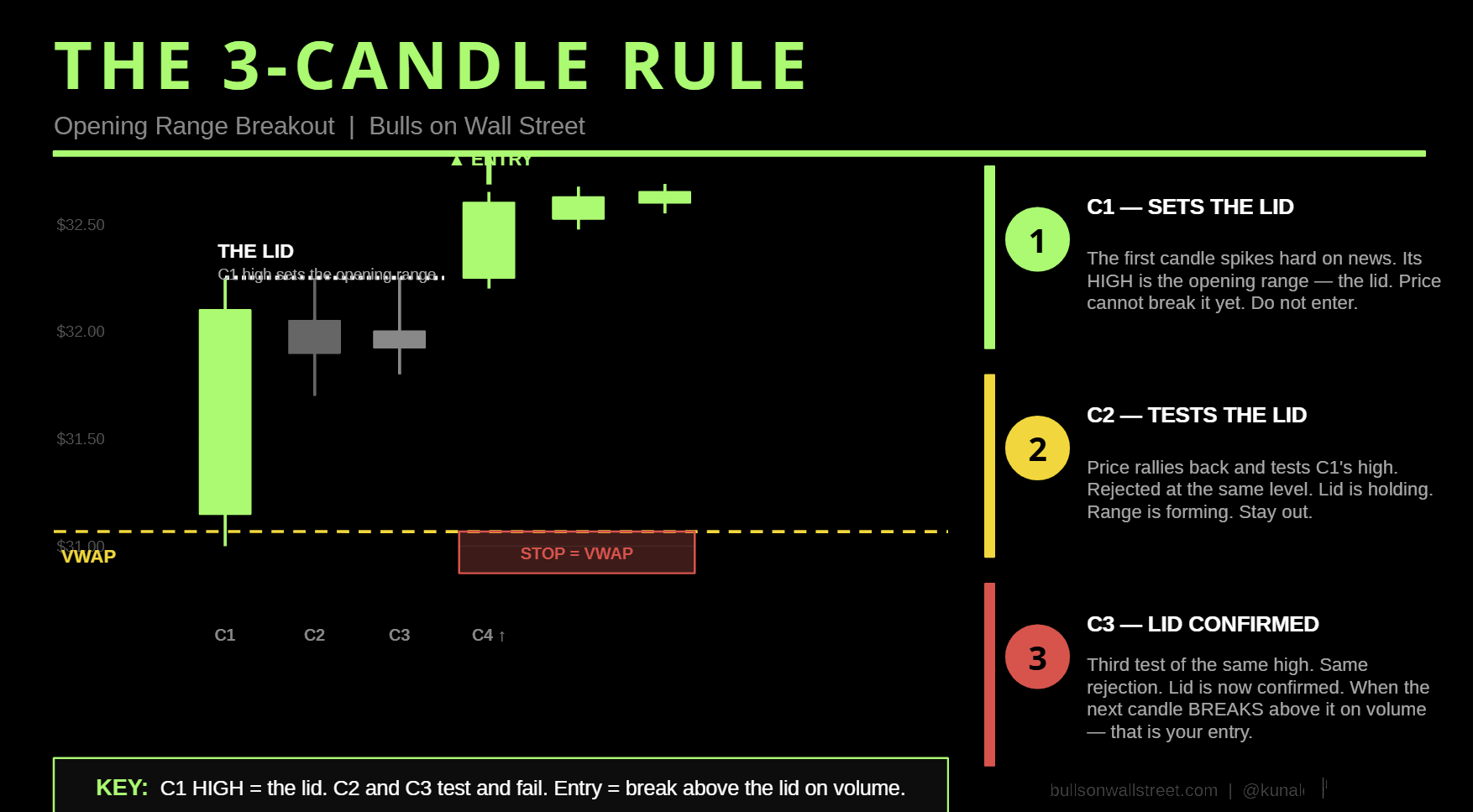
Rule 1: The Three-Candle Consolidation
You need a minimum of three sideways candles on the 5-minute chart after the spike. Not two. Not two-and-a-half. Three.
This is not arbitrary. I’ve tested this extensively. Two-candle consolidations break prematurely roughly 40% of the time. They’re false breakouts. Breakout traders jump in, the volume doesn’t follow, and the setup collapses.
Three candles gives you enough data points to confirm the consolidation is real, the buyers have genuinely paused, and the next move is coming. It’s the minimum threshold where probability shifts in your favor.
Watch the range. If the spike takes a stock from $10 to $10.75, and then it trades sideways in $10.50-$10.70 for three candles, your buy trigger is $10.70.01. You’re buying the break of the high of the consolidation range on volume.
Volume is non-negotiable. If price breaks that range on light volume, the breakout will fail within candles. Real breakouts have volume expansion. You’ll see the volume bar expand significantly. The bid-ask spread tightens. The move gets acceleration. You feel the buying power.
Here’s what this looks like: A stock opens at $184. In the first minute, it spikes to $193—that’s the fuel. Then it consolidates between $191.50 and $193 for four candles. The 9 EMA and 20 EMA are tight. Volume is drying up. The fourth candle breaks above $193 on expanding volume. You enter. Price runs to $195, then $197. That’s a textbook ORB. Picture perfect.
This is different from other entry types like a quick pullback to the 9 EMA. That setup requires waiting for the pullback. The ORB doesn’t wait. You’re buying the initial strength, not chasing the retracement.
Rule 2: Stop-Loss Under the Vwap
Your stop loss goes under the VWAP.
Here’s where VWAP becomes your friend. If price is very tight to VWAP during consolidation—trading maybe $0.15 above it—you can place your stop under VWAP instead of under the first candle. VWAP becomes dynamic support. If the stock is $0.15 above VWAP, your stop is $0.15 below VWAP.
The key principle: keep your stops tight. ORBs are high-velocity trades. If the pattern is working, it works immediately. If it’s not working within 2-3 candles of your entry, it’s not going to work. No amount of hope changes that. Exit fast. Move on.

Rule 3: Profit Targets Using ATR and the 9 EMA Trail
Don’t place a hard $0.50 or $1.00 target. That’s rigid and you’ll leave money on the table or get stopped out too early.
ATR (Average True Range) is your guide. It tells you the average daily range of a stock. If NVIDIA has an ATR of $9, you can expect the ORB to potentially move $9-$18 (1-2 ATR) before it encounters resistance or runs out of steam.
But here’s the reality: most ORBs give you 1-3% in the first 5-10 minutes. That’s it. The move is fast and sharp. You take the profit and move on. You don’t get greedy hoping for an extra percent.
Trail using the 9 EMA. Once the ORB breaks and price starts running, watch that 9 EMA. As the stock trends higher, the EMA curves upward with the move. When the stock touches the 9 EMA on a 5-minute candle, you’re out on the next weakness. You’re protecting profit, not maximizing it.
Example: A stock opens strong and looks good. It spikes, consolidates for a few candles, breaks, and runs maybe 2%. Then the fade starts. The 9 EMA doesn’t curl anymore. The pattern is done. Any trader in at entry price, up $0.40-$0.60, exiting here is happy. Anyone holding hoping for more got stopped out or took a smaller exit.
The best ORBs give you $0.50-$2.00 per 100 shares. You take it. You move on. Greed kills ORB traders.
Rule 4: Position Sizing—The 1% Risk Rule
Use the 1% account risk rule. Non-negotiable.
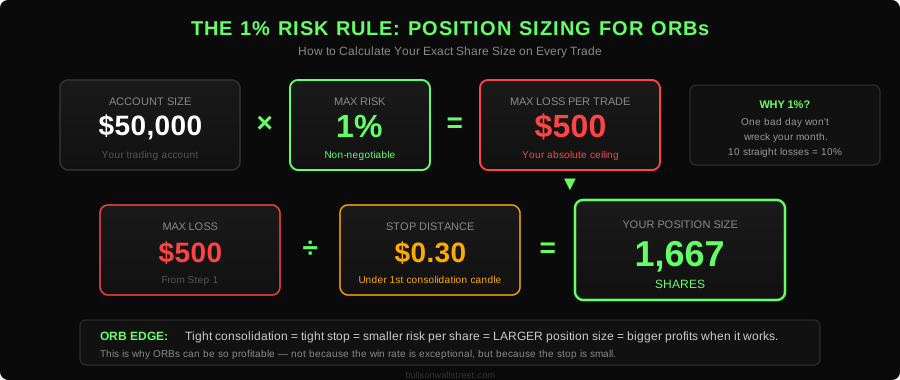
If you have a $50,000 account, your maximum loss per trade is $500. Your stop loss distance determines how many shares you buy.
Let’s say the ORB setup on a $20 stock has a stop $0.30 away. You want to risk $500.
$500 / $0.30 = 1,667 shares.
That’s your position size. You’re risking exactly 1% of your account on this trade.
The ORB allows you to use tighter stops than many patterns because the consolidation is so defined. Tighter stops equal smaller losses, which means you can size larger positions. This is why ORBs can be so profitable per trade—not because the win rate is exceptional, but because the stop is small.
Don’t size larger just because the pattern looks perfect. I’ve seen traders blow up by breaking the 1% rule on high-conviction setups. The market doesn’t care about conviction. It only punishes position sizing mistakes.
Check out our Position sizing Calculator! You can input in all the data of your trade you want to take and it does the calculations!
Rule 5: Time Window—9:30 AM to 11:00 AM Only
I can’t stress this enough, and I mean this literally: ORBs that setup after 11:00 AM have a dramatically lower win rate.
The data is clear from my TradeZella logs across 25+ years of trading. The pattern works 63% of the time in the first hour. By 11:30 AM, it drops to 48%. By 1:00 PM, it’s down to 38%. By 3:00 PM, you’re at a coin flip.
Why the collapse? Because opening momentum exhausts. The news is fully digested. The gap is closed or the move is complete. The traders with edge on the open have taken their profits. Late-day ORBs are manufactured. They’re retail traders trying to force a pattern that doesn’t exist.
Discipline means you stop hunting ORBs after 11:00 AM. Period. You move to different patterns, but you don’t force ORBs.
The Common Mistakes That Stop Out 90% of New ORB Traders
I’ve watched 7,000+ students execute this pattern. The same mistakes repeat like a broken record.
Mistake 1: Trading Sloppy ORBs (Loose from VWAP)
This is the number one killer. You see a spike, you see consolidation forming, and you buy the break without checking the distance between price and VWAP.
Price is $2 above VWAP. The consolidation range is loose. The EMA spread is wide. Nothing is tight.
You buy anyway. The breakout fails within two candles. You hit your stop. You lose $500.
Tight is right. This isn’t motivation. This is fact.
When price consolidates in a narrow band tight to VWAP—the Bone Zone—the ORB works. When price consolidates $1+ away from VWAP, the ORB is a lottery ticket. You don’t buy lottery tickets in the market.
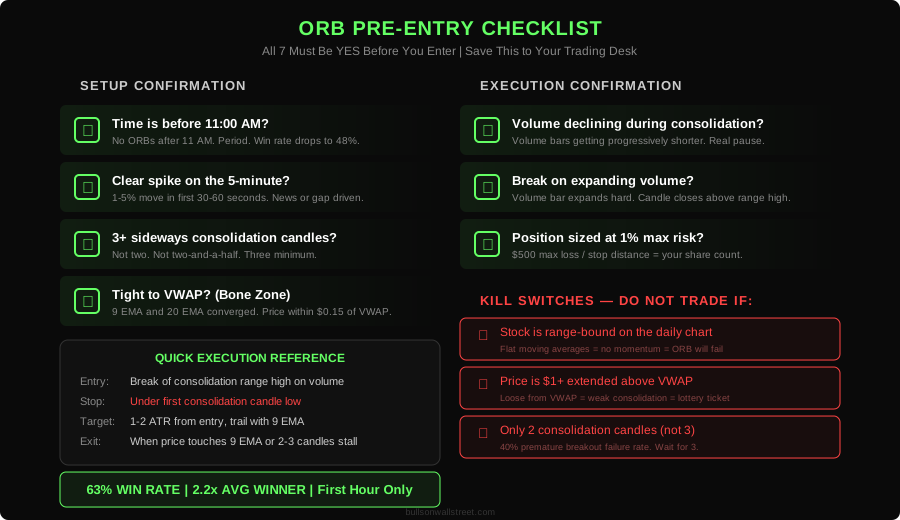
Before you enter, check three things: Is the consolidation range tight to VWAP? Is the 9 EMA within $0.30 of the consolidation? Is the open-to-high move only 1-2 ATRs? If all three are yes, it’s tradable. If any is no, you skip it.
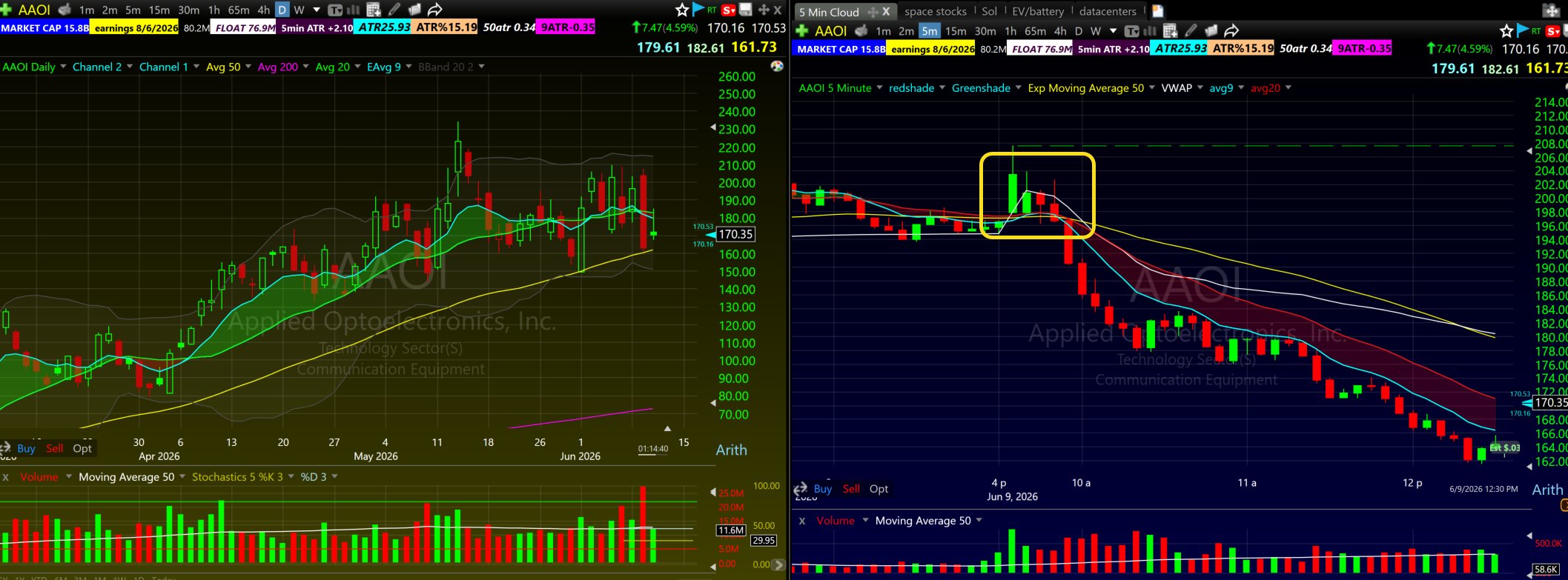
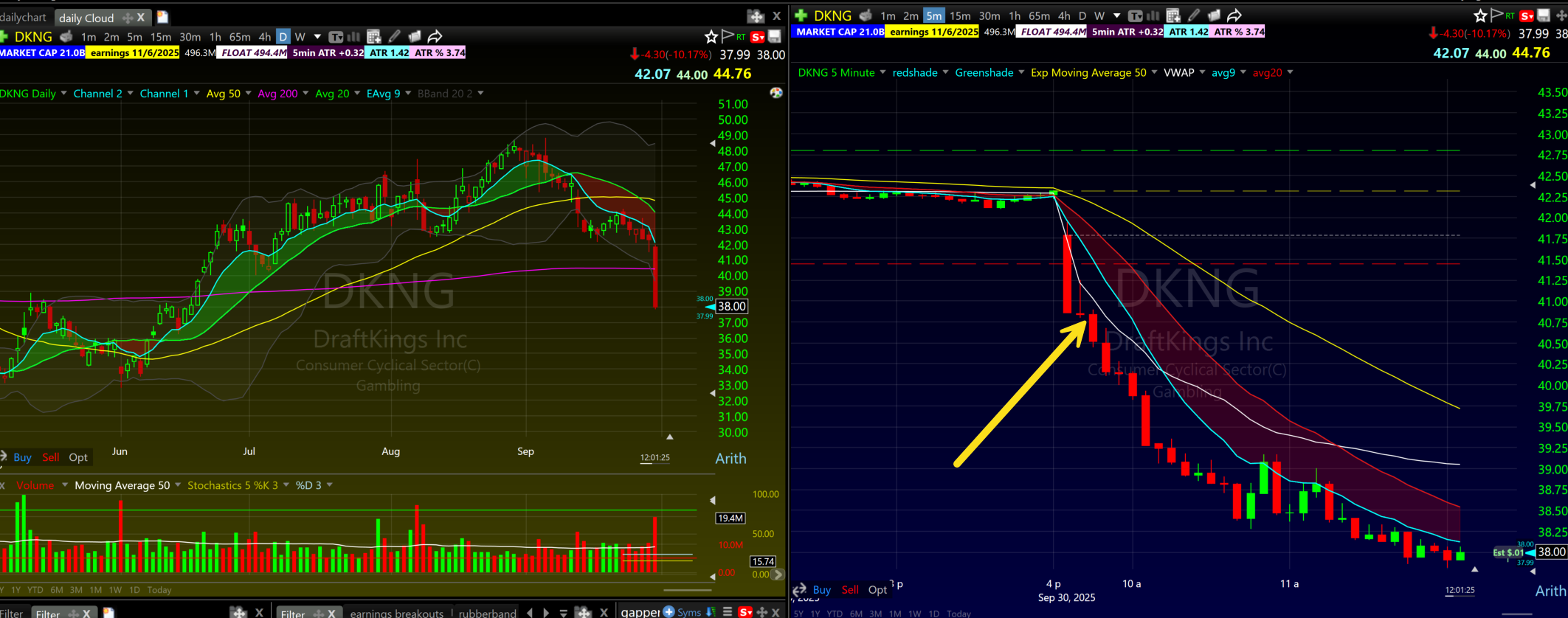
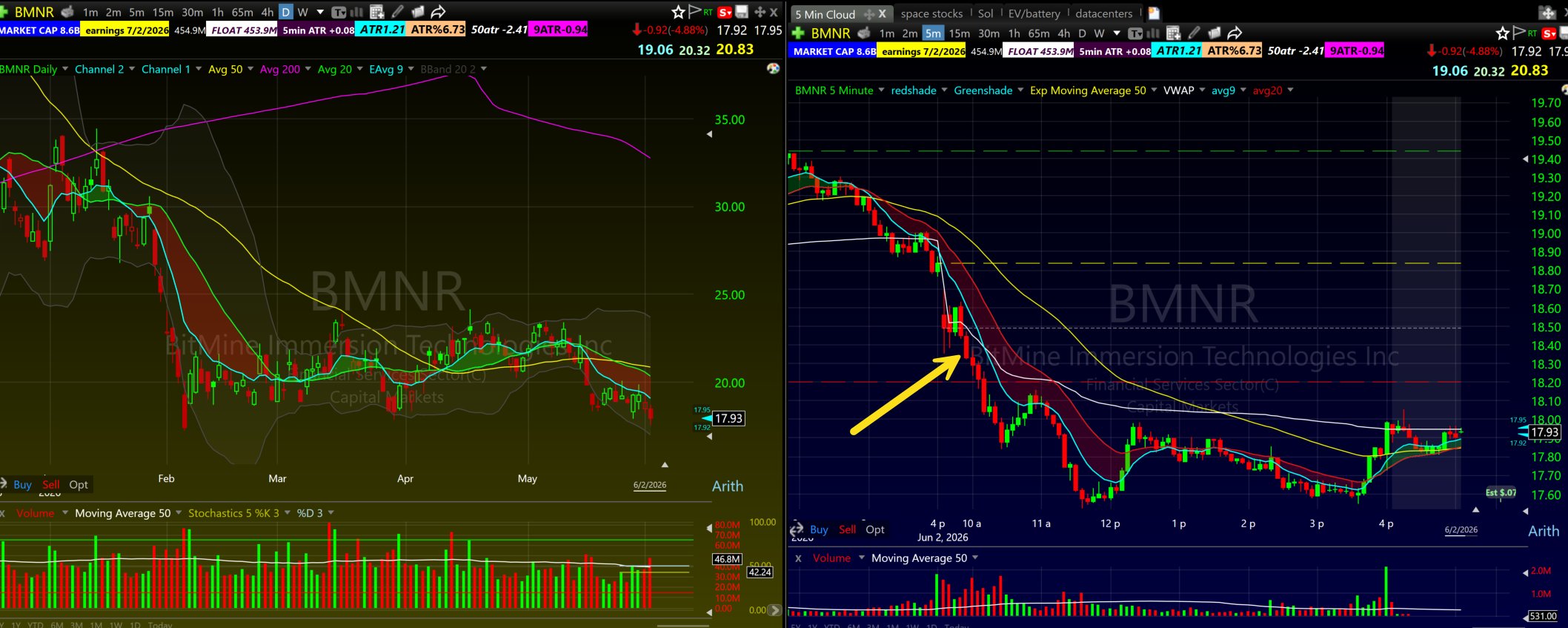
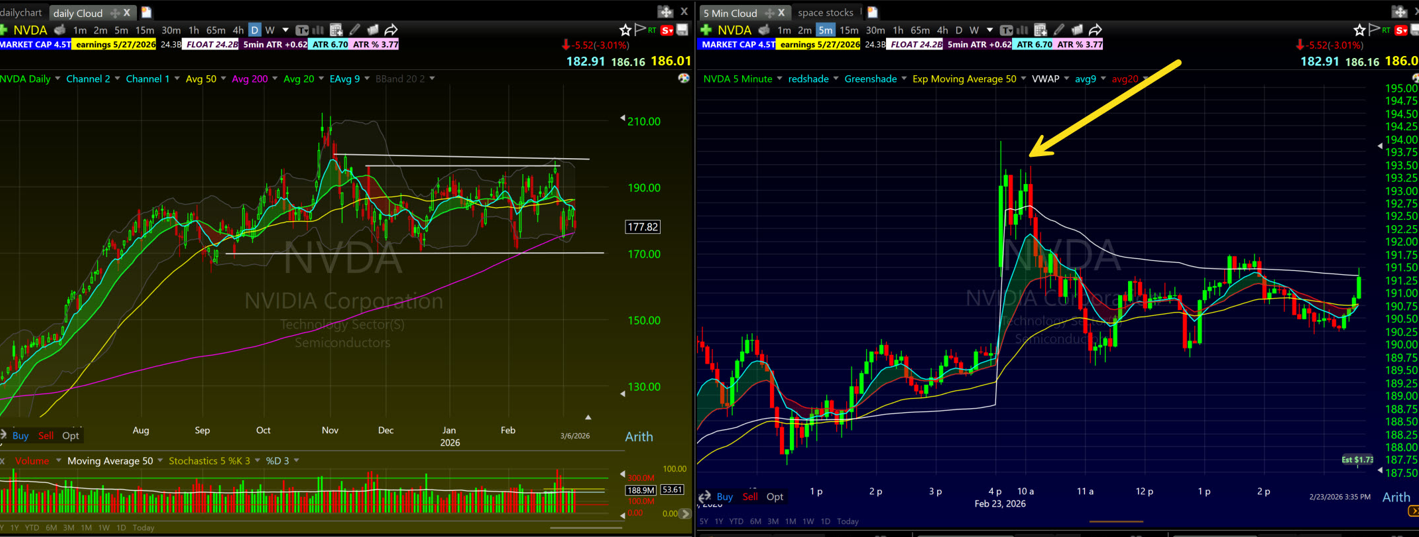
This was a recent trade in NVDA. Look at how sloppy the orb is here. its got weird wicks and the range was not tight at all compared the soxl example above!

Mistake 2: Trading Extended ORBs Without a Pullback Recharge
A stock spikes $5 at the open. It consolidates for a few candles $4 above the previous close. You buy the break. It runs another $0.75 and stops dead.
You’re up $0.75 but you had to risk $0.50. Your risk-reward was nearly 1:1. That’s acceptable, but barely.
The deeper mistake: most traders see a spike that big and assume it has room to run. It doesn’t. The spike already used up the fuel. The consolidation at the top of the spike is weak because price is extended. It needs a pullback—a recharge—to generate room to run again.
Look at the ATR if the first candle is too big and it use up its ATR then you consolidate and the vwap/9ema are too loose they tend to fail.
Mistake 3: Premature Entries (Buying Before the Range Actually Breaks)
You see the spike and consolidation forming. You’re excited. You buy a candle before the range actually breaks because you think you’re getting a better entry.
You’re not. You’re getting stopped out before the pattern even starts.
Buy the break of the range. Not the consolidation. Not your prediction of what will happen. Buy after price closes above the high of the consolidation candles. Wait for volume to expand. Wait for the 9 EMA to start curling up.
Two seconds of patience saves you $500. Take it. Before every entry, run through a structured pre-trade entry checklist so discipline becomes automatic.
Mistake 4: Over-Trading ORBs Beyond 11:00 AM
You nail a 9:45 AM ORB. You’re up $750. You’re feeling it. Confidence is high. You see another setup at 1:30 PM. It looks similar. You take it.
It fails immediately. You’re down $400. Now you’re chasing with a 3:00 PM setup, which is worse.
This is overconfidence after a win. The 1:30 PM setup is not an ORB. It’s a failed pattern pretending to be one. The market conditions have shifted. Momentum has faded. The setup is a mirage.
Discipline: ORBs end at 11:00 AM. Full stop. If you haven’t made your money by then, you didn’t miss a day. There’s tomorrow. Wait for other types of setups like vwap bounces. Check out our VWAP Guide that goes deep into the vwap pullback setup.
Mistake 5: Wrong Market Conditions and Sector Drift
Currently, the QQQ and NASDAQ are in a distribution market. The trend is range-bound. I took what looked like a perfect ORB on NVDA on February 23rd.
The stock gapped up. The consolidation looked clean. The range was defined.
But I made critical mistakes: NVDA is stuck in a big multi-month range. Not bullish, not bearish, just trapped. The stock has a flattened 20-day moving average. The RSI is at midline. Nothing is trending.

ORBs in range-bound stocks fail over and over. Even if they look picture-perfect on intraday.
I’ve made this mistake a few times recently. Currently TSLA, AMD, NVDA—all flattened moving averages, multi-month ranges, sideways chop. ORBs to the upside will fail because there’s no momentum behind them.
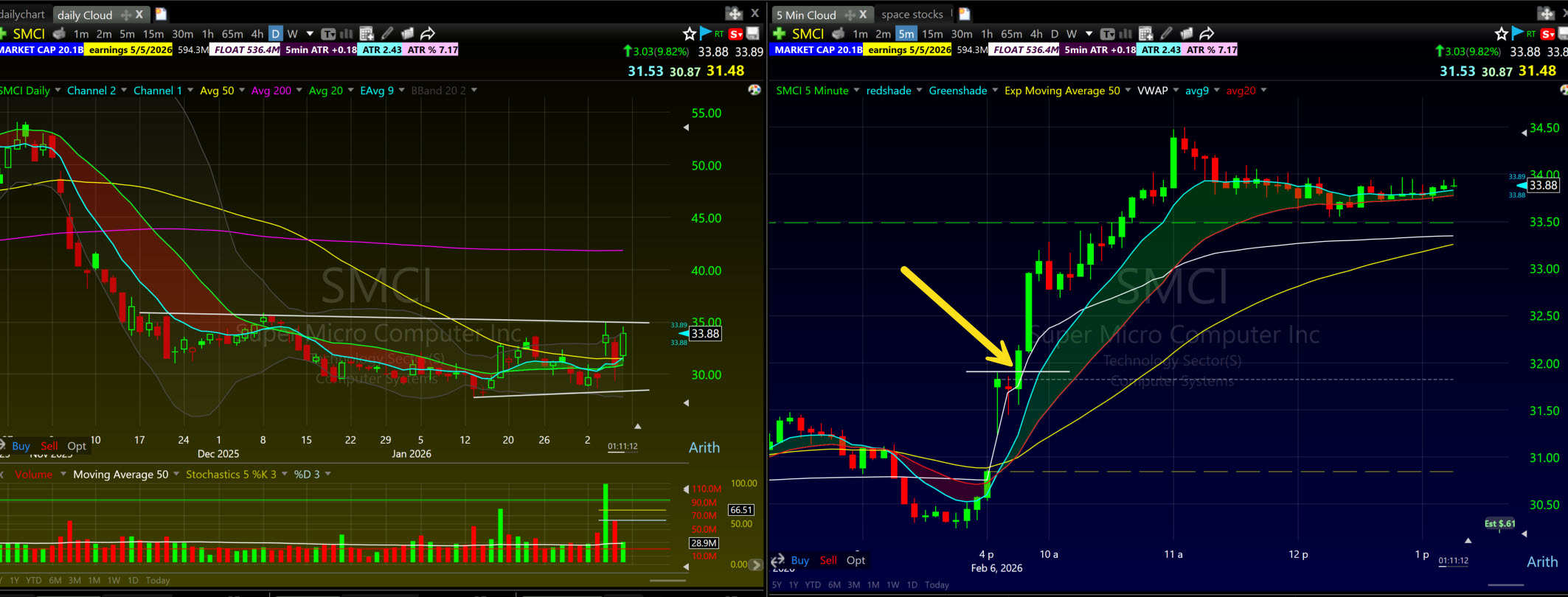
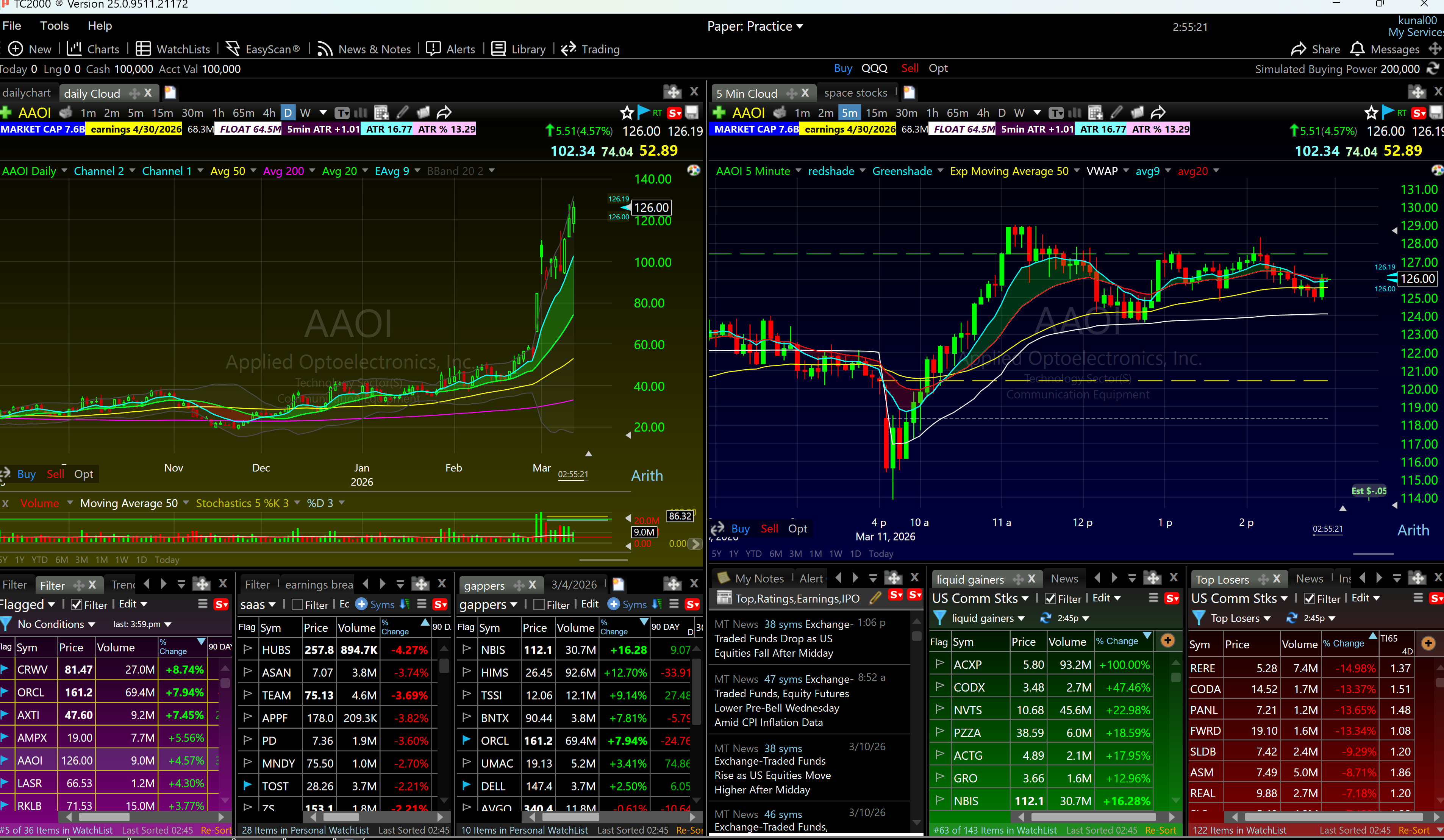
But if you’re trading ORBs in trending sectors—photonics or energy—they work because those sectors are actually trending. AAOI, LITE, the energy plays—those show up with momentum every day.
Here’s the brutal truth: You’re only as good as the stocks you trade. Wrong vehicle, and ORB won’t work. You need to scan for momentum stocks first. Then find ORBs on those stocks. Not the other way around. Build a repeatable scanning system with our day trading stock scanner guide.
Real-World ORB Examples: The Winners and the Losses
SOXL: Catching the Exact Bottom (April 24, 2025)
This is the trade that lives in my memory.
April 2025. Market in disarray. Tariff tantrum. Everything down. But I was looking at the daily chart of SOXL and saw something: a base was forming. The lows were holding. The chart was rounding.
I had SOXL on my watchlist.
Next morning, it gapped from $10.20 to $11. Perfect open for an ORB.
I watched the 5-minute. The spike was violent—the gap up had power. Then consolidation. Two, three, four sideways candles forming. The range was tight. VWAP was underneath the consolidation. The Bone Zone was forming. Volume was drying up.
Price broke above the consolidation range at $11.10. Volume expanded. I entered with a 10-cent stop under the consolidation low. That stop loss was tight but justified because the setup was clean.
The stock ran. Hit $11.50, then $12 the same day. I took my 2-3% and exited.
That was the exact bottom of SOXL. Not approximately. Exactly. The ETF ran to $70 from there. I didn’t hold for that—day traders don’t hold multi-month positions—but that trade taught me something: when the ORB setup is this clean, you’re not just catching a quick scalp. You’re catching the market bottom because the pattern is that precise.
That’s why I trade ORBs.
NVDA: The Failed ORB in a Range-Bound Stock (February 23, 2025)
Fast forward to February. NVDA looks good to everyone. The stock gapped up. The opening looked strong.
But here’s what I missed in the moment: NVDA is stuck in a big long range. The daily chart shows flattened moving averages. The stock is not trending. It’s trapped between $180 and $195 for months.
I took the ORB anyway. The consolidation looked fine. The break looked fine. But the context was wrong.
The ORB failed. The stock reversed. I hit my stop. Loss.
This is the lesson I learned the hard way: ORBs work on trending stocks in trending sectors. They fail on range-bound choppy stocks even when the setup looks perfect on the intraday.
You need to check the daily chart before you enter the 5-minute. Is this stock in a trend or a range? If it’s in a range, the ORB is a low-probability setup regardless of how clean it looks.

The ORB Breakdown: Short-Side Opening Range Breakouts
Everything I just covered about the ORB applies to the short side too. The Opening Range Breakdown is the same pattern in reverse—and it’s just as tradable when the setup is clean.
Here’s how it works: A stock gaps down at the open on bad news, weak earnings, a sector collapse, or a downgrade. The initial selling is violent—price drops 1-5% in the first 30-60 seconds. Then the selling pauses. Price consolidates sideways for 3+ candles below VWAP. The 9 EMA and 20 EMA converge above price. Volume dries up during the pause. The Bone Zone forms—but this time it’s overhead resistance, not support.
Then the breakdown. Price takes out the low of the consolidation range on expanding volume. You short right there. Your stop goes above the first consolidation candle high. Your target is 1-2 ATR below your entry, trailing with the 9 EMA—when price touches the 9 EMA from below, you cover.
The rules are identical:
Three sideways candles minimum. Tight to VWAP (below it, not above). Volume declining during consolidation, expanding on the break. 1% account risk. First hour only—9:30 to 11:00 AM.
The only difference: instead of buying the break of the range high, you’re shorting the break of the range low. Everything else—the three-candle rule, the VWAP proximity, the volume confirmation, the position sizing—stays exactly the same.
Take Scotts Miracle-Gro (SMG) on July 30, 2025. The daily chart showed a clear downtrend—lower highs, lower lows, moving averages sloping down. That’s the first thing you check. The stock gapped down at the open. Violent selling in the first minute. Then it paused. Three tight candles below VWAP. Volume dried up. Classic Bone Zone—but inverted.
The stock broke the consolidation low on volume. That’s your short entry. Stop above the first consolidation candle. The stock continued lower because the daily trend was already pointing down. The ORB Breakdown just gave you the precise entry point into a move that was already happening on the bigger timeframe.

Here’s the key insight most traders miss: ORB Breakdowns work best on stocks that are already in a downtrend on the daily chart. Just like ORBs to the upside work best on trending stocks, the short-side version needs a stock that’s already weak. If the daily shows flattened moving averages—like NVDA in my earlier example—the breakdown will fail just as easily as the upside ORB fails. The daily trend is your filter. Always.
One more thing: shorting is faster. Stocks fall faster than they rise. The panic selling accelerates the move. This means your profit target gets hit quicker, but it also means the move can reverse violently if you’re wrong. Keep your stops tight and don’t get greedy. Take the 1-2% and cover.
The Tools You Need: 5-Minute Charts and Indicator Standardization
The 5-Minute Chart Is Your Universe
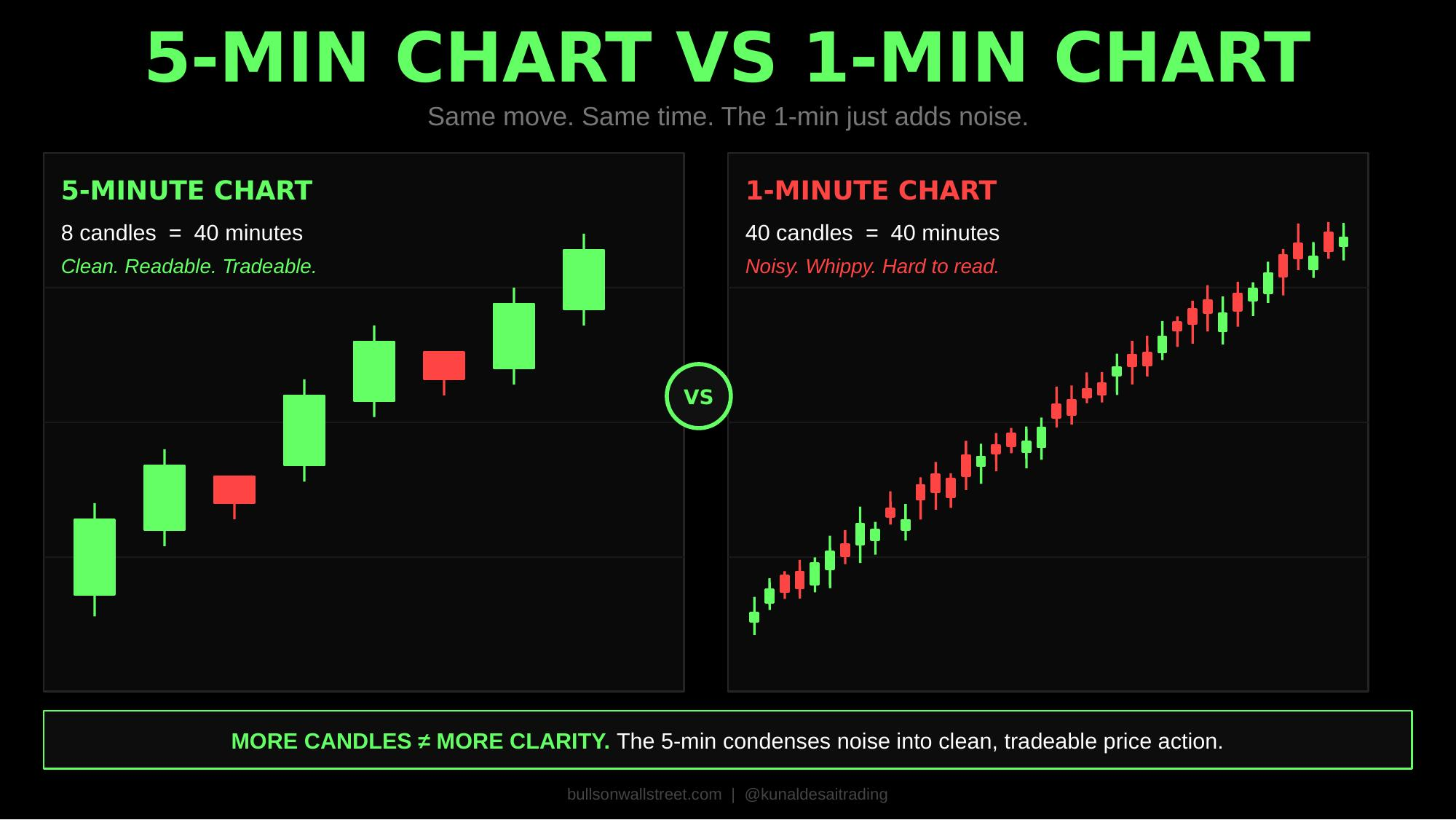
The ORB pattern exists only on the 5-minute chart. Not 1-minute. Not 15-minute. Five-minute.
The 1-minute is too noisy. Every tick, every order, every algorithm shows up. You get false consolidations and false breaks constantly. You can’t see the real pattern through the noise.
The 15-minute is too slow. By the time you see the consolidation, you’ve already missed the best entry.
The 5-minute is the Goldilocks zone. It’s smooth enough to show real patterns. It’s fast enough to catch the moves. It’s where the ORB pattern actually exists and is tradable.
When you’re learning, set your default chart to 5-minute. Open the market at 9:30. Watch the first 30 minutes on 5-minute candles. That’s your training ground.
Indicator Standardization: The Overlooked Edge
Here’s something most traders ignore that costs them thousands: standardized indicator colors and sizes across all platforms.
I use: 9 EMA (light blue), 20 EMA (darker blue), VWAP (white). Those are my colors. Same colors on TC2000, same colors on my broker charts, same colors everywhere.
Why does this matter? Because when you’re rapidly scanning eye-to-eye, monitor-to-monitor, different colors trip you up. Your brain expects to see white VWAP and gets thrown off when it’s gray on another chart. You hesitate. You miss the entry. Or worse, you make a mistake.
Also standardize: candle colors, chart width, candle width, background color. Everything.
Your broker charts might look very different from TC2000. You need to standardize or you’ll make mistakes when you’re staring at four different monitors during market open.
Spend one hour setting up your charts identically across platforms. It’s the difference between executing cleanly and fumbling when speed matters.

The 9 EMA and 20 EMA
The 9-period EMA and 20-period EMA are your consolidation signal and your trend filter.
On a 5-minute chart:
- When the 9 EMA is above the 20 EMA, the stock is in an uptrend (green bone zone)
- When the 9 EMA is below the 20 EMA, the stock is in a downtrend (red shaded bone zone)
- When they’re converged (Bone Zone), the stock is consolidating
During the ORB consolidation, these EMAs should be close together. Converged. This is your signal that consolidation is real and the breakout is coming.
The 9 EMA is your trail stop. Once the ORB breaks and price runs, the 9 EMA curves up. You trail your stop under it. When price touches it, you’re out.
VWAP: The Most Important Line on Your Chart
I keep VWAP white and thick so it stands out. It’s that important.
VWAP tells you whether the stock is trading above fair value (bullish) or below fair value (bearish). It resets daily at 9:30 AM.
The tighter the consolidation is to VWAP, the tighter the ORB and the higher the probability. The looser it is, the weaker the ORB.
During consolidation, if price is trading within 10-15 cents of VWAP on a $50+ stock, it’s tight. If price is $0.50+ away, it’s loose. Skip it.
You can also use VWAP as a stop-loss line. If the stock is trading $0.15 above VWAP and that’s tighter than the first consolidation candle low, your stop goes under VWAP.
Master VWAP, and you’ve mastered 80% of what makes an ORB work.
ATR: Your Guide to Move Potential
ATR measures the average daily range of a stock. It tells you how far a stock is likely to move before it runs out of fuel.
If NVIDIA has a 14-period ATR of $9, you can expect the 5-minute ORB to move between $4-$9 (half to full ATR) before hitting resistance.
Don’t calculate manually. Every charting platform includes it. Set it to 14-period ATR (standard). It updates in real-time.
Use it as a guide for when to expect the run to fade. When the stock has moved 1-2 ATRs from your entry, start looking to exit. You’re not catching the top. You’re catching the bulk.
The Only Platform Built for This: TC2000
For ORB trading, you need TC2000. It has all the tools built-in: 5-minute charts, multiple EMAs, VWAP, ATR, real-time alerts, trade simulator, and backtesting.
I use TC2000 because it was built for this. I can set up a 5-minute ORB scan in five minutes. The charting is clean. The data is live. The speed is there.
If you’re serious about ORB trading, TC2000 is your platform: https://www.tc2000.com/pricing/Bulls
The Origin of My ORB Rules: Learning from Steven
I didn’t invent the ORB. I learned it from my friend Steven—TraderMarket247 on Twitter.
We met on Twitter in 2008. Small, tight community back then. We’d sit on Gmail chat talking trades for hours. I was more of a dip buyer at that time. Steven was the momentum trader. He was watching opening range breakouts while I was fighting with the market.
Steven hammered home one concept that changed everything: you need three sideways candles and take out the range. That’s it. Three candles. Not two. Not a guess. Three. Then buy the break.
That consistency—that rule—is what shifted my win rate from 52% to 63%. Steven taught me that structure beats intuition every single time.
I’ve learned a lot from different traders, but Steven’s three-candle rule is the foundation of my entire ORB system.
The Brutal Truth: First Hour Profits vs. Midday Donations
Here’s the data from my TradeZella journal across tens of thousands of trades:
Over 50% of my monthly profits come from the first hour of trading (9:30-10:30 AM).
75% of my profits come from the first 90 minutes (9:30-11:00 AM).
I actually lose money in the midday window (11:30 AM-1:00 PM). Consistently. Across years of data.
That midday window is just a donation.
I’m a momentum trader with fast reflexes. I shine when momentum is violent and clear. When momentum slows around 11 AM, I force momentum patterns where there’s none. I chase setups that aren’t there. I lose.
Now I have a hard rule: I generally walk away after 90 minutes. Sometimes I stay trading small to teach in my chatroom, but I’m not sizing for profit. I’m demonstrating patterns.
The smart money made their month’s profit by 11 AM. They’re gone by noon. Retail traders are left fighting each other for crumbs. The risk-reward is awful.
If you’re a day trader, your focus is crystal clear: be sharp for the first 90 minutes, then be done.
FAQ: Opening Range Breakout Trading Questions
Q1: What’s the difference between an ORB and a First Pullback Buy?
The ORB is the spike followed by consolidation and breakout. You’re buying fresh momentum off the open.
The First Pullback Buy is when a stock spikes, pulls back to the 9 EMA, holds a green candle there, then resumes upward. You’re buying the retracement, not the spike.
ORB is faster. First Pullback has tighter stops and potentially larger moves because you’re entering deeper into the trend.
Both work in the 9:30-11:00 AM window. ORB is more common. First Pullback is higher probability on extended spikes. Learn both. Use both.
Q2: What if the consolidation is very tight (tiny candles)?
Tight consolidation is good. It means price is locked in a narrow band tight to VWAP. The breakout will be more reliable.
The risk is: if the range is too tight—just pennies—the break might be too small to profit from after slippage and commissions. You need at least $0.20-$0.30 of potential profit to make the trade worth the risk.
Q3: Should I scale into ORB positions or go all-in on the break?
Go all-in on the break. The pattern is short-duration. You’re in and out in 5-15 minutes. There’s no time to scale gradually. Now when i say all in in mean as 1 buy not your whole account!
Advanced traders sometimes add to a winner if the stock keeps running, but this is optional and increases risk. For most traders, one entry, one exit.
Q4: How do I know if the consolidation is real or just a fake pause?
Real consolidation has noticeably decreasing volume. The volume bars get progressively shorter. The bid-ask spread tightens. The candles are small and tight.
A pause that isn’t real consolidation will have volume bars that are unpredictable or expanding sideways. These are fakes. Skip them.
Watch the volume bars on your 5-minute chart. That’s your confirmation. Sharpening your ability to read candlestick chart patterns will help you spot real consolidation faster.
Q5: What if the stock consolidates but never breaks the range?
It happens. Maybe 20% of consolidations never break. Price just rolls back down into the range and drops further.
This is fine. You didn’t take the trade because the break never happened. You didn’t risk money. No harm, no foul.
The goal is to only trade actual breaks. If there’s no break, there’s no trade.
Q6: Can you short ORBs?
Yes. On a stock that gaps down and consolidates below VWAP, you short the break of the consolidation low. The rules are identical, just inverted.
Shorting gaps down is often less profitable than shorting gaps up because the initial selling pressure is exhausted quickly. But it’s tradable if the setup is clean.
Q7: What about ORBs on stocks with earnings-driven gaps?
News stocks have larger spikes and larger consolidations. The patterns are bigger. The risk is also bigger because the emotional component is stronger and the moves can reverse violently.
ORBs work on earnings stocks, but you need to be more selective. Only take the tightest setups. Skip anything loose from VWAP. For a complete playbook on trading around catalysts, read our guide on how to trade earnings season.
Q8: How do I know when an ORB has failed?
The clearest signal: price closes back below the consolidation range within 2-3 candles of your entry.
If you’re in at $20.50, the consolidation was $20.25-$20.50, and the stock closes at $20.30 on the second candle, the pattern has failed. Exit. Don’t wait for a reversal. or if it breaks under the vwap.
Q9: Is ORB trading affected by overall market conditions?
Absolutely. ORBs work best in bull markets where there’s positive sentiment. In bear markets, gaps down and ORBs are more frequent, but they’re shorter and less profitable.
Check the overall market bias before trading ORBs. If the S&P 500 is down 2%, ORB setups are less reliable. If it’s up 1%, they’re more reliable.
Look at the daily chart of the broad market. Are stocks trending up or down? That tells you if ORB is in season.
Q10: How much should I risk per trade on ORBs?
1% of your account per trade. If you have a $50,000 account, your maximum loss is $500 per trade.
This is the standard risk management rule for all day trading patterns. It keeps your loss small enough that one bad day doesn’t wreck your month.
Q11: What charting software do you use for ORB trading?
TC2000. It has all the tools built-in: 5-minute charts, multiple EMAs, VWAP, ATR, real-time alerts.
If you want to trade ORBs like I do, TC2000 is your platform: https://www.tc2000.com/pricing/Bulls
Q12: Can you trade ORBs in a cash account or does it require margin?
You can trade ORBs in either. The only difference: in a margin account, you can leverage. In a cash account, you can only trade what you have.
Most ORB traders use margin so they can size larger positions. But the pattern works in both.
Note: If you’re trading with margin and your account is under $25,000, you’re subject to pattern day trader (PDT) rules set by FINRA. Know the rules before you trade.
Q13: What’s your actual win rate on ORB trades?
Overall, 63% on ORBs in the first hour of trading.
This means for every 100 ORBs I take, 63 are winners and 37 are losers.
The average winner is 2.2x the average loser. So even with 37% losses, I’m still profitable.
These numbers come from my TradeZilla trade journal. They’re real. They’re repeatable. They’re tracked daily since I switched from TradingView.
Q14: How should I track my ORB performance?
Use TradeZella. Log every trade there. It has easy logging, market replay function at faster speeds, and backtesting tools. I switched from TradingView to TradeZilla specifically for the logging simplicity and the replay function.
When you log every single trade, you stop lying to yourself about your win rate. The data is there. You can’t deny it. You adjust based on reality, not memory.
Why This Pattern Works: The Structure of Opening Momentum
The ORB works because it exploits the structure of opening momentum itself.
Every trading day at 9:30 AM, there’s an explosion of information: earnings, news, analyst upgrades, sector rotations, gap moves. All of it hits at once. Big money positions first. Retail panics. The first 30-60 seconds are chaotic.
Then the market needs a moment to digest. Price pulls back and consolidates. This is not weakness. This is a pause. The consolidation tells you the initial move was real, not a flash pump.
Then the breakout. Price takes out the range on volume. This is fresh momentum confirming the original move was legit. The follow-through is real.
This structure repeats every single trading day. It’s consistent. It’s tradable. It’s why ORBs have worked for decades and will work for decades more.
The only variable is your execution. Are you patient with the three-candle rule? Are you checking VWAP before you enter? Are you using tight stops? Are you exiting after 90 minutes?
These are discipline questions, not genius questions.
Resources for Deeper Learning
Regulatory Information
For deeper understanding of how the markets you’re trading operate:
SEC Day Trading Guidance — Comprehensive guidance on day trading rules and restrictions
FINRA Pattern Day Trader Rule — Important rules about day trading and account sizing under $25,000
CBOE Educational Resources — Free educational resources on volatility measurement and directional trading
Know these rules. Respect them. Trade within them.
Learn ORB Trading Live: The 60-Day Live Trading Bootcamp
If you want hands-on instruction in ORB trading and the other morning patterns, the 60-Day Live Trading Bootcamp is where you learn.
This is not a course you watch on your own time. It’s not a webinar you skip through. It’s live trading with me at 9:30 AM every single trading day for 60 consecutive days.
We open the market together. I show you the setups as they form. You execute on your broker in real time. I give you real-time feedback on your entries, your stops, your exits. We scale in and out of positions together. You see exactly how ORBs play out in real time, not in hindsight-biased historical examples.
You’ll trade at least 60 ORB setups live with direct instruction. You’ll see failures and wins. You’ll see the mistakes that cost money and the execution that makes it. You’ll internalize the pattern. By day 60, you won’t need to think about the rules. They’ll be automatic.
Most importantly, you’ll build confidence. You’ll know that when you see spike-consolidation-breakout on the 5-minute chart, you know exactly how to trade it.
The Bootcamp is where students go from learning to earning.
Limited spots available each session. Class sizes are kept small to ensure live feedback on your setups.
Watch Live Trading Every Morning
I trade every morning at 9:30 AM EST. I share live analysis, real-time entry and exit commentary, and direct feedback on all the patterns including ORB on the Bulls On Wall Street YouTube channel.
Subscribe and turn on notifications so you see the live stream the moment we go live: https://youtube.com/@kunaldesaitrading
Watching live trading is not the same as executing it, but it’s the next best thing. You see the patterns in real time. You see what works and what doesn’t. You build intuition before you risk real money.
Author Bio
This strategy is part of our complete day trading strategies guide covering the setups professional traders use every single day.
Kunal Desai is the founder and CEO of Bulls On Wall Street. He has been trading professionally since 1999 and went full-time in 2007. Since founding BOWS in 2008, Kunal has trained over 7,000 students through the 60-Day Live Trading Bootcamp and continues to trade daily momentum stocks using TC2000. His opening range breakout wins are tracked in his personal TradeZella trade journal, where his 63% win rate on first-hour ORBs is logged daily. Kunal’s work has been featured in Forbes, Fortune, and Inc. He shares live trade analysis and real-time pattern execution on the Bulls On Wall Street YouTube channel (https://youtube.com/@kunaldesaitrading).