


Updated July 2026
Yes, you can day trade while traveling. I have done it for 15 years, and here is the part nobody expects: I have traditionally made more money trading from the road than I have at home in front of all my fancy monitors. This post covers exactly how I do it. The schedule, the gear, the risk system, and a real trade from Switzerland where I made $5,190 on 2,000 shares of RKLB from a rental with one laptop and two portable monitors.
I am Kunal Desai, founder of Bulls on Wall Street. I have been trading since 1999, full time since 2007, and I have taught over 7,000 students through our 60-Day Trading Bootcamp. For the last 15 years I have traveled a good chunk of every year, and lately my family and I spend entire summers in Europe. Last summer we started in Madrid, moved to Lake Annecy in France, then finished with more than a month in Switzerland. I traded the whole time.
The Facts on Trading While Traveling
- US market hours from Western Europe run roughly 3:30pm to 10:00pm local time. You sightsee all day, trade the open, and still make dinner.
- I trade the same setups on the road that I trade at home: opening range breakouts and first pullbacks on momentum stocks, charted on TC2000.
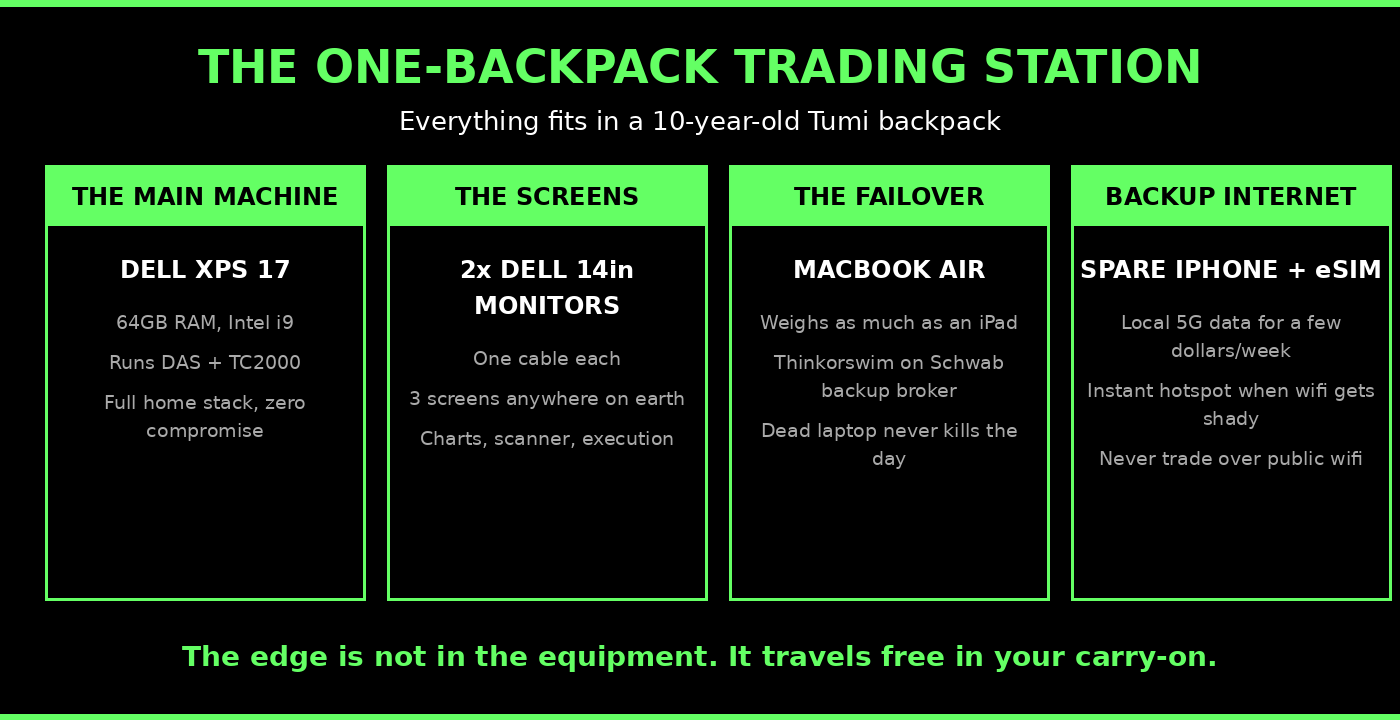
- My entire trading station fits in one backpack: a Dell XPS 17, two 14-inch Dell USB portable monitors, a MacBook Air as backup, and a spare iPhone running a local eSIM as a mobile hotspot.
- When internet is questionable, I do not trade smaller on my main account. I switch to a backup account funded with far less capital. Willpower is not a risk management system. Account size is.
- On the road I cap my sessions at two to three hours instead of trading to the close.
Why Europe Is a Day Trading Cheat Code
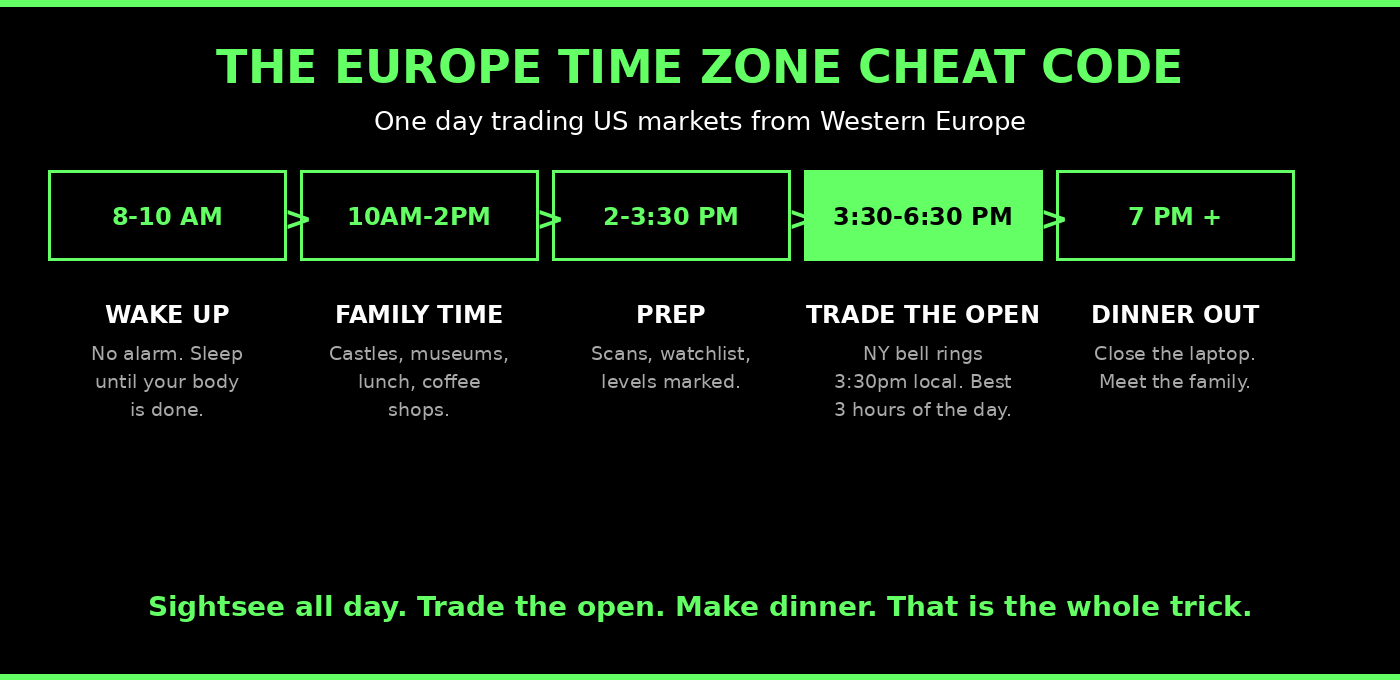
The New York open is 3:30pm in Madrid, Annecy, and Zurich. That one fact changes everything.
At home in Florida I am up at 5:00am to prepare for the open. Even with a full night of sleep, 5:00am is 5:00am. In Europe I wake up whenever my body wants. Sometimes 8:00am. Sometimes 10:00am. Then the whole day belongs to my family. We see a castle, hit a museum, get lunch, sit at a coffee shop. Around 2:00pm I head back, run my scans, build my watchlist, and I am at my screens when the bell rings at 3:30pm local.
I trade the open and the first few hours, which is where most of my edge lives anyway. By 6:30pm or 7:00pm I am done, and it is dinner time in Europe. I close the laptop and go meet my wife and son at a restaurant. It is lovely. I get the best trading hours of the day and I lose almost nothing.
There is a bonus nobody talks about. If you go out for a big dinner and end up at a bar until late, the market does not open until 3:30pm the next day. You have all morning to recover. Try doing that in the US where the bell rings a few hours after the nightclub closes.
The Counterintuitive Part: I Trade Better on the Road
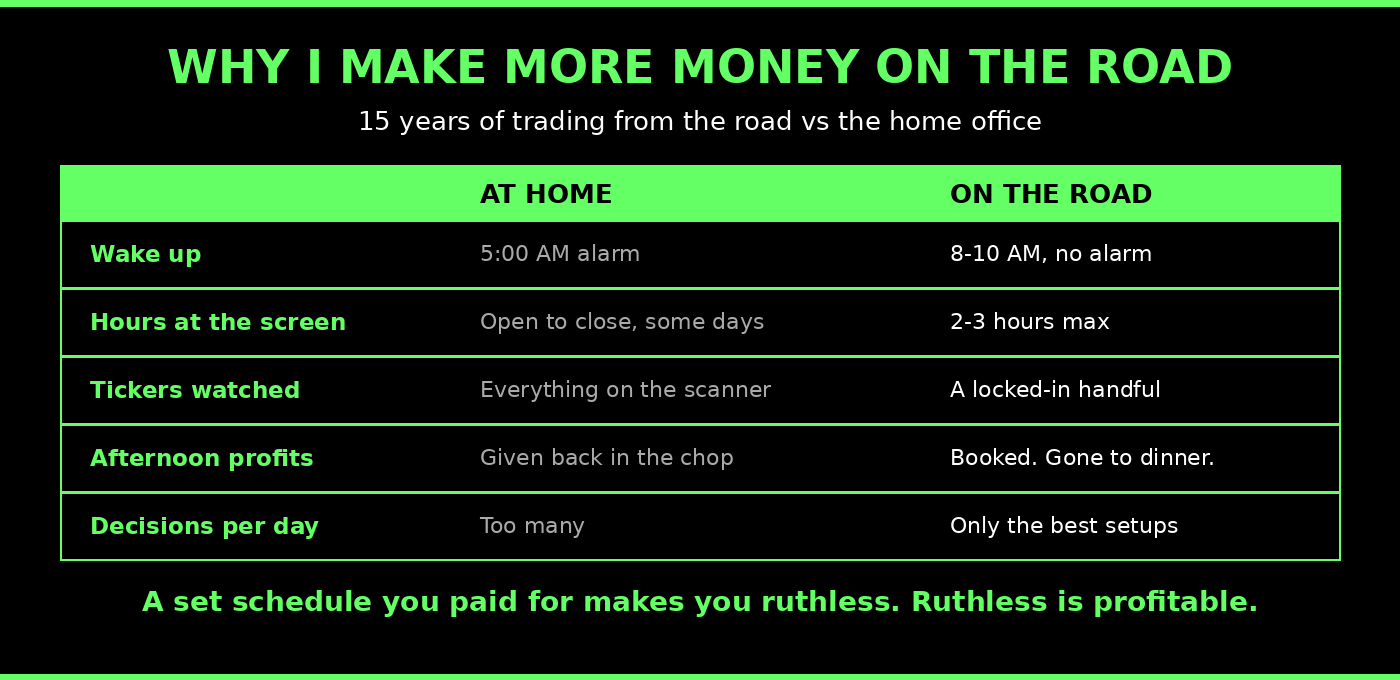
It took me years to figure out why my P&L on the road kept beating my P&L at home. The answer is structure.
On vacation you have a set schedule and you do not want to waste time you paid for. So you get ruthless. I lock in on a handful of tickers instead of chasing everything on the scanner. I take my gains instead of sitting there giving back profits into the afternoon chop, which has always been a personal crux of mine at home. Fewer hours forces fewer decisions, and fewer decisions means only the best setups get my capital.
Meanwhile the trader with six monitors and all day to burn ends up overtrading. I know because I have been that trader. A lot of people get so comfortable with the big monitors and the fancy toys that they never leave the house. For me trading is about making money. It is my life passion. But I also want to live my life and show my son and my wife the world. Getting out there makes me feel alive, I come back refreshed, and the numbers say I trade better because of it.

A Real Trade From Switzerland: RKLB, +$5,190
Last summer the market was heating up as we came out of the tariff tantrum and pushed into full bull market territory. I was in Switzerland, trading two to three hours a day off the portable setup, and I went on one of the best runs of my year.
One of my favorite trades from that stretch was RKLB. It was an opening range breakout, the same setup I teach in my ORB guide. I took 2,000 shares and made $5,190 on the trade. No trading desk. No monitor wall. One laptop, two USB screens, and a setup I have traded thousands of times.
That is the real lesson. The edge is not in the equipment. The edge is in the setup recognition and the discipline, and both of those travel free in your carry-on.
My Exact Travel Trading Setup
Everything fits in a Tumi backpack I bought at an outlet mall almost 10 years ago. Here is what goes in it.
The main machine: Dell XPS 17. 64GB of RAM, Intel i9. Nothing exotic. A standard, powerful Windows laptop that runs my full stack: DAS for execution and TC2000 for charting and scanning, the same tools I use at home.
Two 14-inch Dell USB portable monitors. These things are sturdy. I have had them for years and they plug straight into the XPS with a single cable each. Laptop screen plus two portables gives me three screens anywhere in the world. That is charts, scanner, and execution window covered.
MacBook Air as the backup. It weighs about as much as an iPad. It cannot run my main Windows programs and you cannot drive multiple monitors from it, but that is not its job. Its job is keeping me in the game when Windows decides it is update day or I am stuck on hold with customer service. We have all been there. On the Mac I run Thinkorswim through my Schwab account, one of my secondary brokers, so a dead laptop never means a dead trading day.
A spare iPhone with a travel eSIM. This is the biggest travel upgrade of the last few years. You can buy an eSIM with 5G data for the country you are in for a handful of dollars a week, downloaded straight from the App Store in minutes. My old iPhone becomes a dedicated mobile hotspot. If the rental wifi gets shady, I am back online in thirty seconds on cellular. The federal cybersecurity agency CISA also recommends avoiding public wifi for sensitive accounts while traveling, and a personal hotspot solves that problem too. I do not run six figure orders through cafe wifi. Ever.
An iPad for reading. Not trading gear, but there is something about sitting in lush Swiss grass with a great book that resets your brain better than any screen.
A DJI Osmo Pocket 3 for content. I used to lug a big DSLR that needed its own backpack. The Osmo fits in a side pocket, comes with a solid lapel mic, and gets me 95 percent of my studio camera setup for YouTube lessons and breakdowns.
For a deeper dive on trading hardware, my full trading equipment guide covers the home setup too.
The Risk System That Makes This Work
Here is where most travel trading advice falls apart. Generic articles tell you to trade smaller on the road. That advice fails for one simple reason: if the money is in the account, you are going to use it. I know myself. You can mentally commit to cutting size, and then a perfect setup rips and the commitment evaporates.
So I do not rely on willpower. I built a system.
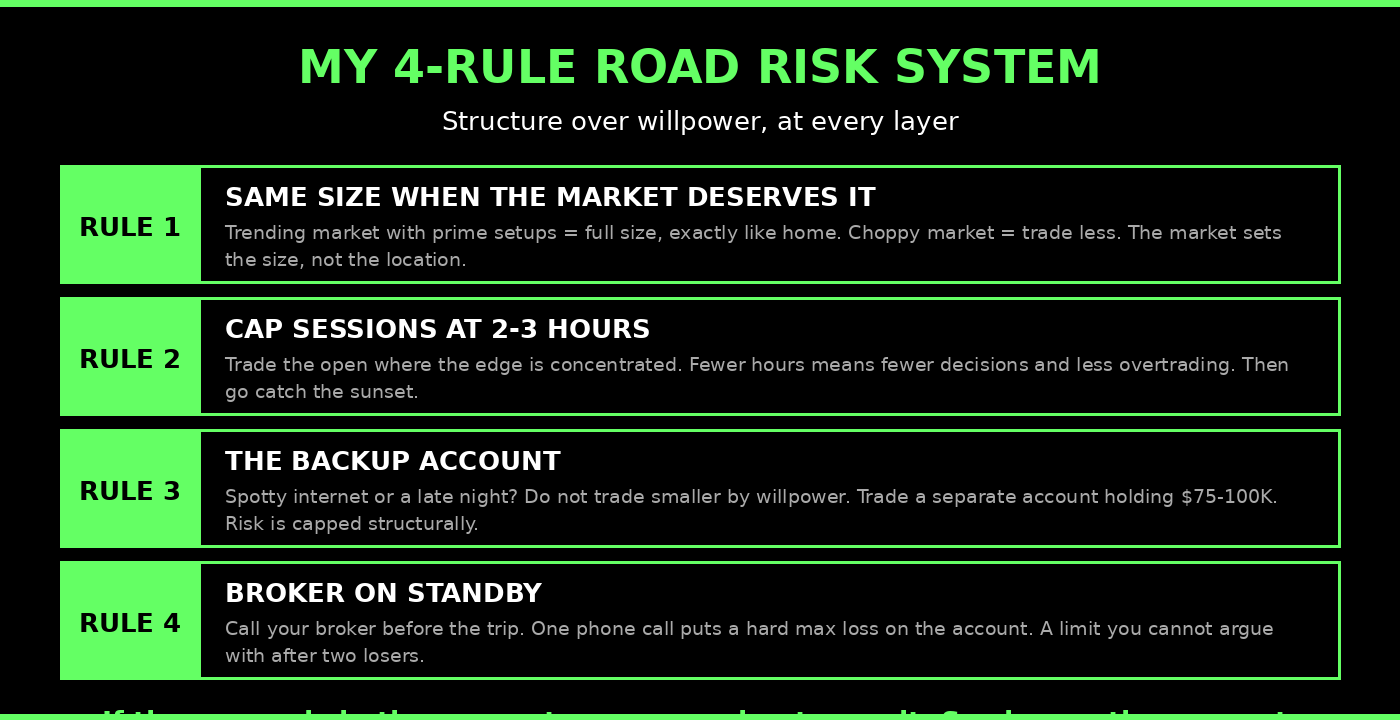
Rule 1: Same size when conditions deserve it. If we are in a trending market serving up prime setups, I trade full size from the road, exactly like I would at home. A trend is a paycheck and I am not leaving money on the table because I happen to be in France. If the market is choppy, I trade less. Same as home. The location does not change the risk framework. The market does.
Rule 2: Shorter sessions. In Europe or Asia I cap trading at two to three hours, mainly around the open where my edge is concentrated. At home I might occasionally trade to the close. On the road, fewer hours means catching sunset with my family and it doubles as a risk limiter. Less screen time, less overtrading. The academic evidence on day trader performance is brutal about how few sustain profits over time, and cutting your hours is the simplest way to cut your exposure.
Rule 3: The backup account. This is the one to steal. If the internet is spotty, or if last night involved a long dinner and a few bottles of wine, I do not trade my main account at all. I trade a backup account funded with $75,000 to $100,000, dramatically less than my main account. Now my maximum damage is structurally capped no matter what my discipline is doing that day. The 1% Rule still applies inside that account, so the risk per trade shrinks automatically with the account.
Rule 4: My broker on standby. Before a trip I call my broker and let him know I am on the road. If the market turns choppy or I am not trading well, one phone call puts a hard max loss on my account at the broker level. That is a limit I cannot argue with at 4:00pm in Zurich after two losers.
That is the whole system. Structure over willpower, at every layer.
The Honest Downsides
I am not going to sell you a fantasy, because the fantasy version of this lifestyle blows up accounts.
Do not learn to trade while traveling. This lifestyle is a reward for skill you already built, not a shortcut to it. FINRA is blunt that day trading requires deep market knowledge and that you should be prepared to lose all the funds you use for day trading. If you are not already consistently profitable at home, the road will only add variables. Learn first. I tell every day one bootcamp student they will not be profitable in 30 days, and that is true whether your desk is in Ohio or Lisbon. If you are still building the skill, the Double Dip approach of keeping your job while you learn beats any beach.
Asia flips the math. Everything I love about Europe reverses in Asia, where the New York open lands somewhere between 9:30pm and 10:30pm local. I have traded those hours. It is a grind. If you are heading east, plan to trade only the open or take a real break.
Internet is a when, not an if. Most of the world has internet good enough for day trading. You do not need lightning speed. But connections drop, and a drop with full size on is how a good month dies. That is exactly what the backup account and the hotspot are for. Know your broker's phone desk number before you need it.
Transit days are off days. I do not hold day trading positions from a train or an airport. If I cannot sit at my screens for the session, I do not trade the session. The market will be there tomorrow.

The Lifestyle Is the Point
One last thing that surprised me. I am healthier on the road. In Europe I walk everywhere, the food is real, and I end up losing weight every summer even while enjoying incredible wine and cheese daily. I sleep until my body is done sleeping. I show up to the 3:30pm open genuinely rested, which almost never happens at a 5:00am alarm.
Better sleep, better food, more movement, fewer hours at the screen, and a hard structural cap on risk. It is not a coincidence that my trading improves. If you build the skill first and copy the system above, trading does not chain you to a desk. It buys you the world.
Want to see how I actually trade these setups every morning? I trade live every session in the Bulls on Wall Street chatroom, and a full-access 7-day trial costs $7. And if you want the complete education, from setups like the ORB and first pullback to the risk systems in this post, that is exactly what we build over 60 days in the Trading Bootcamp. It starts with chart reading, and you can grab my free candlestick patterns PDF right now to start there.
FAQ: Day Trading While Traveling
Can you day trade while traveling internationally?
Yes. US brokers and platforms work from almost anywhere with a stable internet connection. I have day traded US stocks from Spain, France, Switzerland, and across Asia. The market does not know or care where your laptop is. Your skill level matters far more than your location.
What is the best time zone for day trading US stocks abroad?
Western Europe. The New York open is 3:30pm local, so you get full mornings free and finish by dinner. Asia is the hardest, with the open landing between roughly 9:30pm and 10:30pm local time.
What internet speed do you need to day trade while traveling?
Less than people think. Ordinary rental or hotel broadband handles a trading platform fine in most of the world. The real requirement is reliability, which is why I carry a spare iPhone with a local eSIM as a hotspot and cut my size to a backup account whenever the connection is questionable.
What laptop setup do you need to day trade while traveling?
One strong Windows laptop and one or two USB portable monitors covers it. I run a Dell XPS 17 with two 14-inch Dell portable screens, plus a MacBook Air running Thinkorswim as a backup machine on a secondary broker.
Should you trade smaller position sizes while traveling?
Only when conditions demand it, and never by willpower. In a trending market I trade full size from the road. When internet is spotty or I am not at my best, I switch to a separate backup account holding far less capital, which caps my risk structurally instead of mentally.
What happens if your internet dies during a trade?
Your first line is a cellular hotspot, which restores you in seconds. Your second line is your broker's phone desk, which can flatten a position for you. Save that number in your phone before you travel, and keep size modest whenever your connection is unproven.
Can you day trade from just a phone while traveling?
You can manage or exit a position from a phone, but I would not initiate day trades from one. Momentum trading requires reading charts, tape, and your scanner at once. If I cannot open the laptop, I skip the session.
Is day trading while traveling riskier than trading at home?
It carries extra failure points, mainly connectivity and routine disruption. My experience is that the forced structure of travel actually improved my results, because shorter sessions and fewer tickers cut overtrading. But that only holds for traders who are already consistently profitable at home.
Do you need a VPN to trade while traveling?
Check with your broker, since policies differ. What matters most is never entering your brokerage credentials over public wifi. Use your own cellular hotspot or a secured private connection for anything involving your accounts.
About the Author
Kunal Desai is the CEO and founder of Bulls on Wall Street. A professional trader since 2007, he has navigated every major market cycle -- from the 2008 financial crisis to today's high-volatility environments. Having mentored 7,000+ students through his live trading bootcamps, Kunal trades live every morning in the Bulls on Wall Street Trading Chatroom, where a full-access 7-day trial costs $7. He is dedicated to teaching real-world execution and high-probability strategies. Based in Miramar Beach, Florida.
Connect with Kunal: Read his full story | Instagram | YouTube