

Markets rarely move on what is happening today. They move on what investors think is going to happen tomorrow.
That is why stocks rally on bad news and sell off on good news. The headline does not matter. What matters is whether that headline landed better or worse than what the market was already expecting.
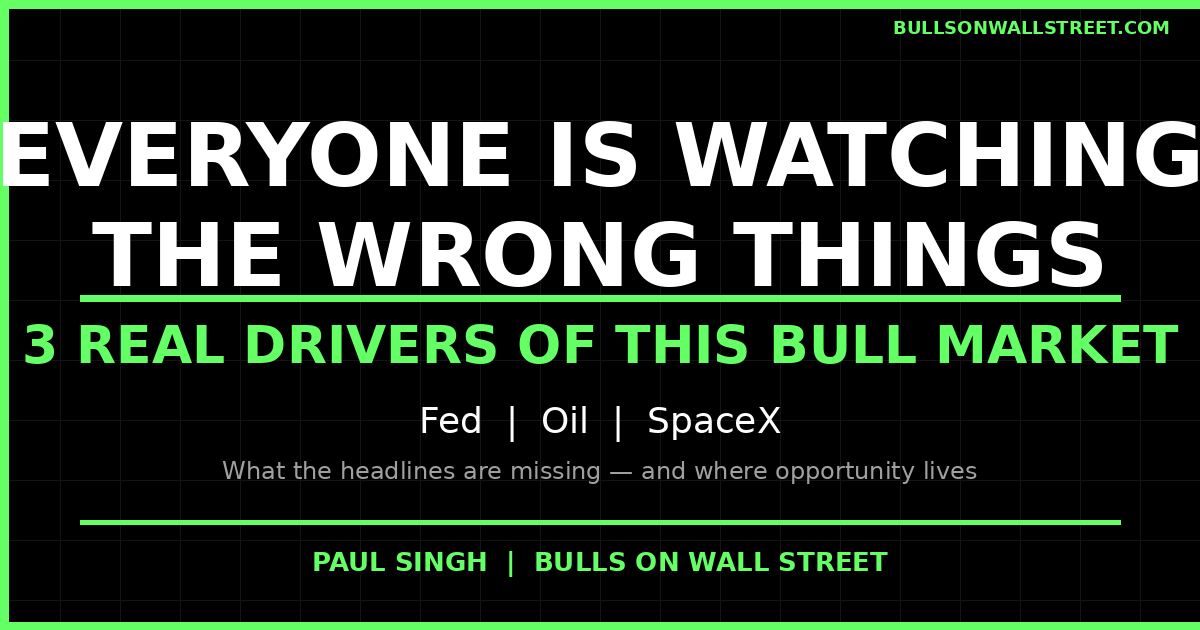
Right now I see three themes driving almost everything beneath the surface. The first is the Federal Reserve and how dramatically the conversation has shifted over the last few months. The second is oil and what falling energy prices mean for equities across multiple sectors. The third is SpaceX, which has become one of the most influential stocks in the market despite the fact that we still know very little about it as a public company.
Understanding these themes will not tell you exactly what happens next. But they can help explain why the market is behaving the way it is and where the best opportunities may appear going forward.
This is the kind of macro awareness I bring into our BullsVision chatroom every morning alongside Kunal. The context matters as much as the setup.
The Fed Did Not Change Rates. It Changed the Conversation.
Most traders focus on the wrong part of a Federal Reserve meeting.
They watch for whether rates were raised, lowered, or held. That matters, sure. But the bigger story is almost always buried beneath the headline.
This most recent meeting is a perfect example.
On the surface, nothing dramatic happened. Rates held. The market shrugged. If you were only reading headlines, you would call it a non-event.
Dig into the statement and the messaging coming out of that meeting and a different picture emerges.
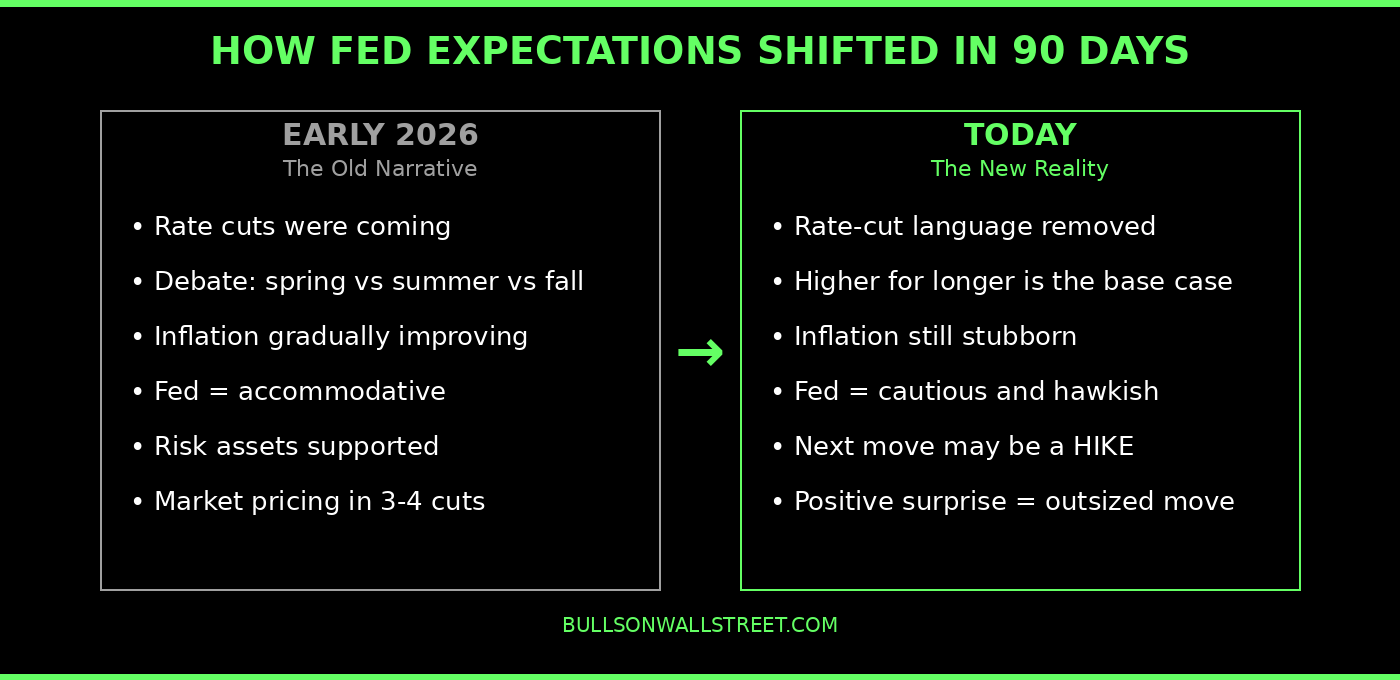
Earlier this year the dominant narrative was that inflation was gradually coming under control and that rate cuts were somewhere down the road. Spring, summer, fall -- the timing was debated but most investors agreed cuts were coming. That expectation underpinned stock prices because lower rates create a more favorable environment for risk assets.
Today that narrative looks completely different.
The Fed removed rate-cut language from its statement. The market has gradually moved from debating how many cuts we might get to debating whether the next move could actually be a hike. Just a few months ago a hike was not even part of the conversation.
That does not mean a hike is inevitable. It means expectations have shifted. And as traders, that distinction is everything. Markets respond to surprises. Right now expectations are already fairly pessimistic. Investors know inflation has stayed stubborn. They know the Fed has become more cautious. They know rate cuts are no longer the base case.
Another mediocre CPI print probably does not move the market much. Investors are already positioned for it.
What would move the market is a positive surprise.
If upcoming CPI or PPI numbers come in cooler than expected, the reaction could be much larger than what we saw earlier this year. Back then, improving inflation was already priced in. Today it is not. A favorable surprise forces investors to reprice their assumptions fast. That is when you get the strongest moves.
Stop focusing on whether the news is good or bad. Focus on whether it is better or worse than what the market expects. That single reframe changes how you read every data release.
For more on how macroeconomic context fits into a complete risk framework, the risk management pillar at Bulls on Wall Street is worth bookmarking.
Why Oil May Matter More Than the Fed Right Now
While everyone is talking about interest rates, there is another chart I keep coming back to.
Oil.
Most people think about gas prices when they think about oil. Understandable. It is the most visible number in our daily lives. But oil reaches further than the pump.
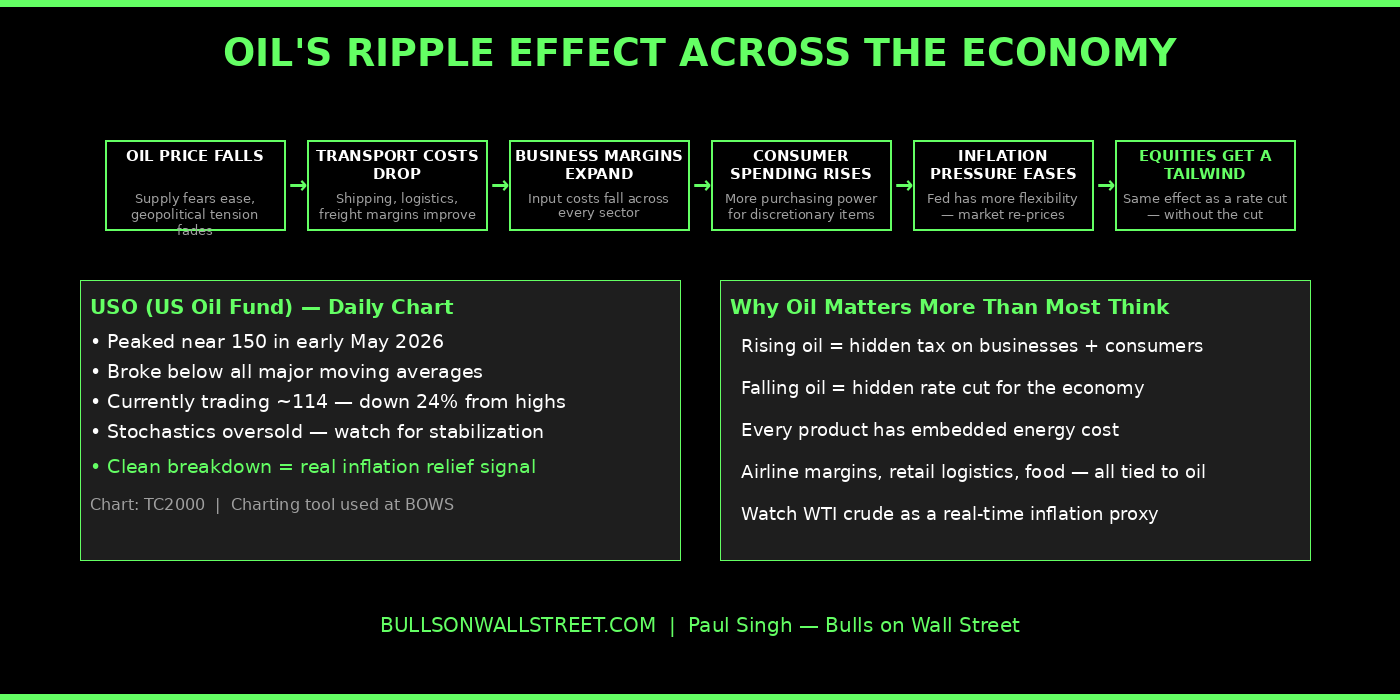
Oil influences transportation costs, shipping costs, manufacturing costs, agricultural inputs, airline margins, and the cost of doing business across the entire economy. Every product that lands on a store shelf got there through a logistics chain that runs on energy. Every retailer, every manufacturer, every distributor carries oil as an embedded cost.
Large moves in oil prices create ripple effects throughout the market. The U.S. Energy Information Administration tracks this relationship extensively and the historical data is clear.
When Middle East tensions escalated, oil surged. Supply disruption fears, rerouted shipping lanes, inflation risk. Prices climbed to levels we had not seen in years. The market did not like it.
Rising oil historically acts as a tax on both consumers and businesses. Consumers spend more on necessities and pull back on discretionary. Businesses face margin compression as input costs climb. Growth slows as capital gets diverted toward energy expenses.
That narrative has started to reverse.
As fears around supply disruptions have eased and optimism around shipping route stability has grown, oil has pulled back sharply. USO -- the US Oil Fund -- peaked near 150 in early May 2026 and has broken down hard through all major moving averages to around 114. That is a 24% decline. It may be more important than most investors realize.
Lower oil reduces pressure across the economy. It lowers transportation costs. It helps retailers. It gives consumers more purchasing power. It makes inflation easier to manage. In many ways falling oil provides some of the same tailwind that investors hope to get from lower interest rates.
This may be part of why the market has stayed more resilient than expected despite persistent inflation concerns.
Oil remains one of the most important charts I have on my screen. If the trend continues lower it provides another tailwind for equities. If it reverses and starts climbing again the conversation changes quickly.
I use TC2000 to track oil alongside equities every morning. If you want the same setup, you can access it through our referral link here.
SpaceX Has Become the Market's New Obsession
Every cycle produces a stock that captures the market's imagination.
In 2024 it was Nvidia.
At one point Nvidia carried so much influence it almost functioned like a market index. Nvidia up, everything rallied. Nvidia down, traders got nervous about the whole tape. One stock, outsized control over sentiment.
Today SpaceX is starting to feel similar.
The difference is that SpaceX remains a mystery.
We are still early in its life as a public company. The quiet period is in effect. That means no analyst research, no price targets, no institutional coverage providing the usual framework investors rely on. Traders are operating with very limited information.
Right now SpaceX is primarily a trading vehicle, not an investment vehicle. That begins to change as the quiet period expires and research starts flowing. Once analysts can publish we will finally have the information needed to evaluate the company more objectively.
The next major milestone is earnings.
That first report gives investors their first real look at revenue growth, profitability trends, spending patterns, guidance, and future expectations. Those details will likely determine whether SpaceX develops into a genuine leadership stock or goes through the kind of post-IPO struggles that catch high-profile companies off guard.
The IPO Lesson Most Traders Ignore
Every hot IPO creates the same emotional response.
Fear of missing out.
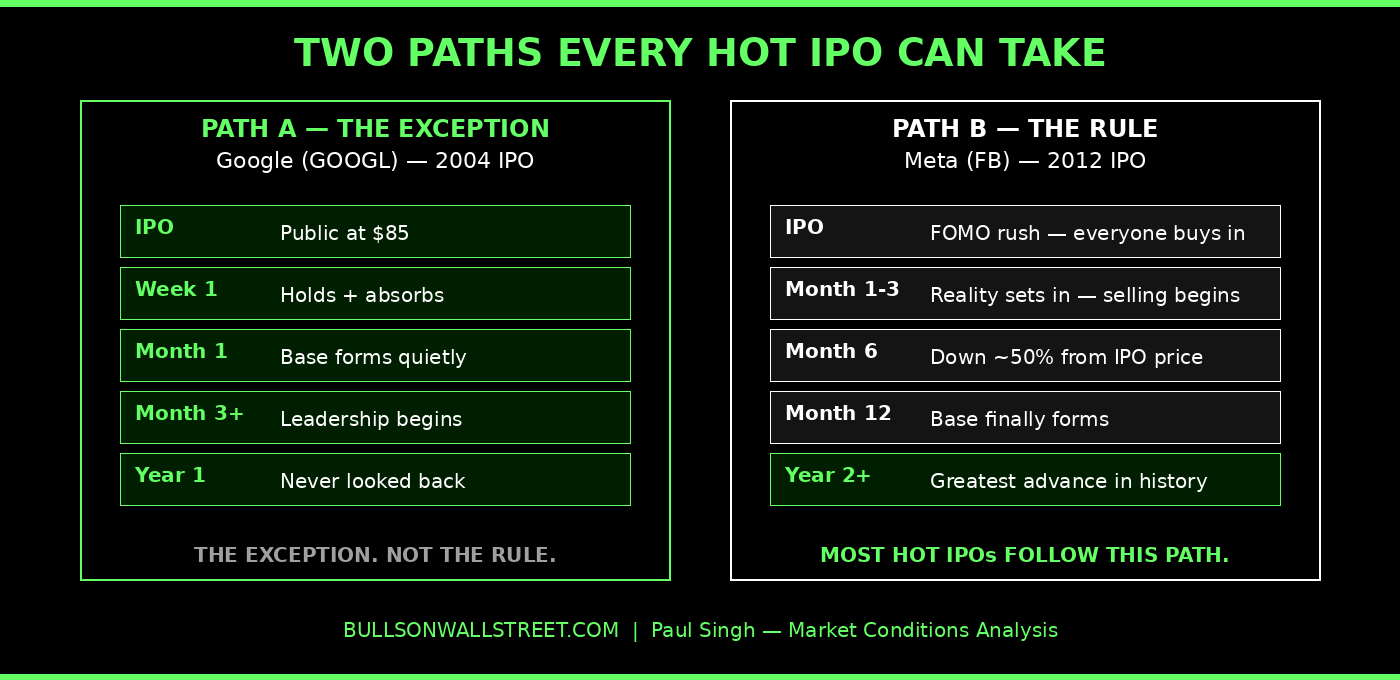
Investors convince themselves that buying immediately is the only way to not miss the next Google. History says otherwise.
Most IPOs do not behave like Google. They behave more like Meta.
When Meta came public the enthusiasm was enormous. Investors flooded in. Expectations were sky-high. Then reality set in. The stock lost roughly half its value before eventually finding a bottom and staging one of the greatest recoveries in market history.
That pattern repeats constantly. Many great companies go through a significant post-IPO correction before becoming long-term leaders. The strongest entries often come months after the IPO when excitement has cooled and a proper base has formed.
Google was the exception. It went public and essentially never looked back. That happens. It is just not the rule.
Could SpaceX become another Google? Absolutely.
Could it become another Meta? Absolutely.
Nobody knows yet because we do not have enough information.
The Hidden Risk Traders Need to Watch
Lockup expiration.
This is when insiders become eligible to sell shares. SpaceX has taken a staggered approach, releasing shares gradually over multiple periods rather than all at once. That may reduce the shock of a single expiration date but it does not eliminate the risk entirely.
Many of those insiders acquired shares at dramatically lower prices. If the stock has appreciated significantly some of them will choose to lock in gains. Additional supply entering the market creates selling pressure, especially if enthusiasm starts to fade.
Watch these dates. Lockup expirations are not guaranteed bearish events but they are catalysts that deserve attention. The SEC's guidance on lockup agreements is a useful reference for understanding how these work.
AI, Semiconductors, and Data Centers Still Lead
Despite everything happening with the Fed, oil, and SpaceX, the dominant trend in this market has not changed.
Artificial intelligence is still driving leadership.
Data center stocks, semiconductor companies, and power infrastructure names remain some of the strongest groups in the market. Many have pulled back recently. Those pullbacks look healthy, not destructive.
The key question when evaluating a correction is simple: are you looking at a topping pattern or a pause within a larger uptrend?
Right now the evidence still favors the latter.
No widespread distribution. No major support levels breaking. No institutional selling of the kind that typically precedes major tops. Instead we are seeing strong stocks pull into logical support, stabilize, and begin finding buyers again.
That is exactly what healthy leadership does.
If you want to understand how to identify institutional accumulation versus distribution in real time, the day trading strategies section at Bulls on Wall Street breaks down the setups we use to trade it.
Retail and Housing Are Quietly Recovering
Beneath the surface something interesting is developing in groups most investors had written off.
Retail is beginning to recover. Housing stocks are starting to build constructive bases.
Housing is particularly notable. In a higher rate environment these stocks should theoretically struggle. Yet several homebuilders have begun to outperform, which tells you investors are finding value in the sector despite the macro headwinds.
Markets bottom long before the headlines improve.
The strongest opportunities frequently emerge when expectations are at rock bottom and sentiment is overwhelmingly negative. That is why I keep watching these groups closely. They may not be leading today but they have the setup to become important when conditions shift.
Why Apple and Google Have My Attention Right Now
Most traders buy options at exactly the wrong time.
They get excited after the stock has already made its move. Implied volatility is elevated. Premiums are expensive. Risk-reward has deteriorated.
The real opportunities in options tend to appear when quality stocks are pulling back into support while implied volatility remains subdued.
Apple and Google have my attention for exactly that reason.
GOOGL ran from the 240s to a high near 415 and has since pulled back to the 350 area -- a clean horizontal support level visible on the daily chart. It is currently trading around 368, with stochastics starting to curl back up. Not chasing. Watching for confirmation.
AAPL made a similar move -- low 200s all the way to 315 -- and has pulled back to the 285 support zone. Trading near 298 now. Earnings are July 30. The setup into that report is exactly the kind of low-implied-volatility pullback into support where options risk-reward improves.
Could they fail? Every trade can fail. That is why position sizing and risk management are not negotiable regardless of how clean the setup looks. For pattern recognition on the price action, start with the candlestick chart patterns guide.
But from a risk-reward standpoint these are the kinds of situations where I get interested. The downside is relatively defined. The upside remains open.
We discuss setups like these in detail inside the BullsVision chatroom. Kunal runs the day trading side every morning live. I cover swing setups and options. One room, both timeframes, full access for $7 the first week.
Final Thoughts
The market keeps climbing despite inflation concerns, geopolitical uncertainty, and a Fed that has become noticeably more cautious. That resilience is telling you something.
Buyers are still active.
Our job as traders is not to predict the future. It is to identify the themes that matter, understand where expectations are positioned, and align ourselves with the strongest opportunities.
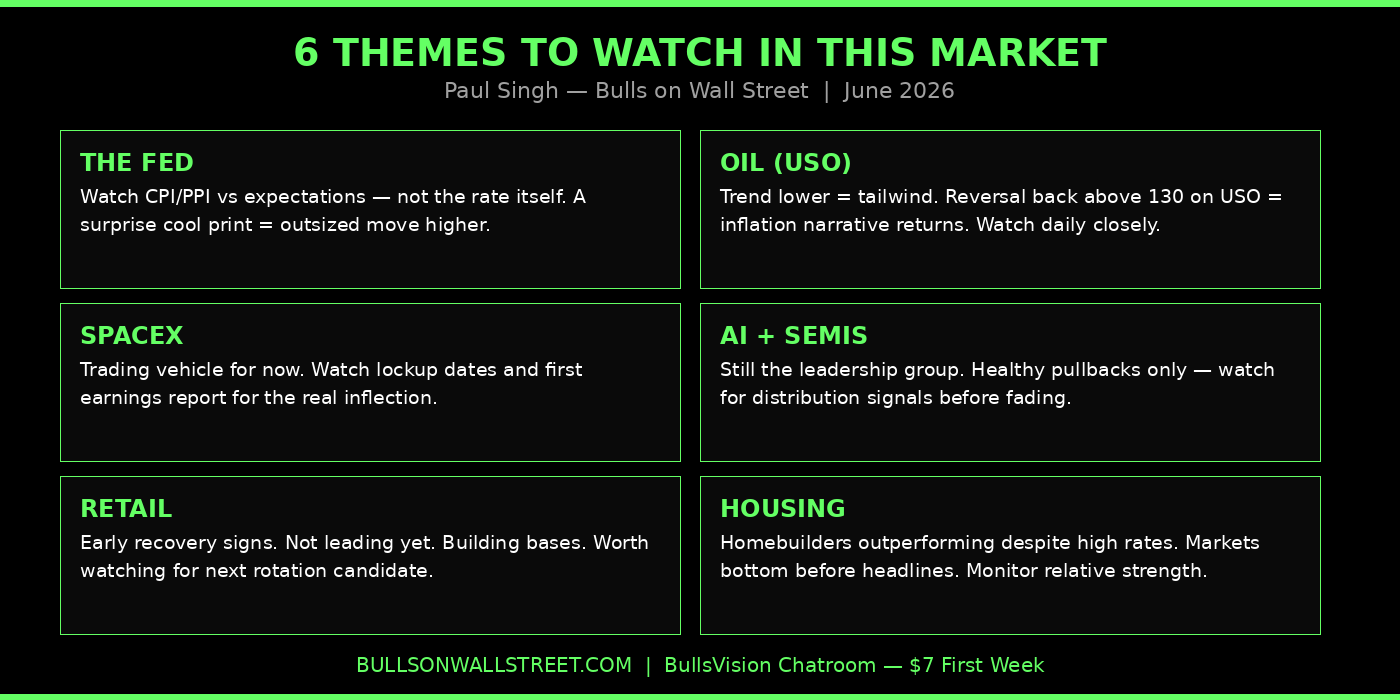
Right now that means watching the Fed conversation, not just the rate decision. Watching oil as a real-time inflation proxy. Watching SpaceX and understanding what stage of its lifecycle it is actually in. Monitoring AI and semiconductor leadership for healthy pullbacks versus distribution. And paying attention to early signs of life in retail and housing.
The theme clarity is there. Now it is about execution.
Frequently Asked Questions About Current Market Conditions
What does it mean when the Fed removes rate-cut language from its statement?
When the Fed removes rate-cut language it signals that policymakers are no longer signaling future rate reductions as a base case. This shifts market expectations from a loosening cycle to a hold-or-tighten posture, which tends to increase uncertainty for risk assets and raises the bar for positive surprises in economic data.
Why do stocks sometimes rally on bad news?
Because markets price in expectations, not just events. If the market has already priced in bad news and the actual report is less bad than feared, investors who were positioned defensively will cover and rotate into risk assets. The market responds to the gap between reality and expectations, not the reality itself.
How does falling oil affect the stock market?
Falling oil lowers input and transportation costs across the economy, which improves margins for businesses, increases consumer purchasing power, and reduces inflationary pressure. It can provide a similar economic effect to lower interest rates, which is why oil is one of the most important macro charts traders track alongside the Fed.
What is a lockup expiration and why does it matter for IPO stocks?
A lockup expiration is the date when insiders who received shares before or during an IPO become eligible to sell. If the stock has appreciated significantly since those shares were acquired, some insiders will sell to realize gains, adding supply to the market. This is an important risk date to track for any newly public company.
What is the difference between a topping pattern and a healthy pullback?
A topping pattern typically involves widespread distribution across leading stocks, major support levels breaking, and signs of institutional selling. A healthy pullback shows leading stocks declining on lower volume, holding key support zones, and finding buyers relatively quickly. The absence of distribution is one of the most important things to look for.
Why do the strongest IPO opportunities often appear months after the IPO itself?
At the time of an IPO, sentiment and implied volatility are typically elevated as investors fear missing out. After the initial enthusiasm fades, the stock often forms a proper technical base. Waiting for that base to develop allows traders to enter with a cleaner risk-reward setup and a more defined downside.
What does implied volatility have to do with options entry timing?
Implied volatility is the market forward-looking estimate of how much a stock will move. High implied volatility means options premiums are expensive relative to expected moves. Buying options when IV is elevated means paying a premium for uncertainty. The best options entries often come during low-IV pullbacks into support, where you are getting leverage at a relative discount.
How should traders think about sector rotation in a market like this?
Sector rotation follows capital as it flows out of extended leaders and into undervalued or lagging groups. Right now AI and semiconductors remain the primary leadership, but early signs of recovery in retail and housing suggest capital is beginning to probe new areas. Watching which groups are building constructive bases while leadership consolidates can reveal the next rotation before it becomes obvious.
About the Author
Paul Singh is a professional swing trader and options specialist at Bulls on Wall Street. He is Kunal Desai's original trading mentor, having trained Kunal through late-night AOL Instant Messenger sessions in 2006 before BOWS existed. Paul leads the swing trading and options track inside the BullsVision chatroom, where a full-access 7-day trial costs $7.