

Most traders walk into the market with the same broken belief: trading is about winning. They count wins, chase green, and measure themselves against a mythical 70% win rate they read about on Reddit. That belief is the single fastest path to a blown account.
Professional traders think differently. They've internalized something counterintuitive but mathematically provable: you don't need to win most of your trades to make money. You need to survive long enough to catch the trades that matter. The professional trader mindset isn't built around being right. It's built around staying in the game.
After 17 years of trading and coaching thousands of students at Bulls on Wall Street, this is the lesson that separates the traders who make it from the ones who flame out in six months.
Trading Is a Survival Business, Not a Winning Business
Amateur traders think like gamblers. They want to win the hand in front of them. Professional traders think like casino operators. The house doesn't win every hand — it wins enough hands over enough volume to guarantee profitability because the math is in their favor.
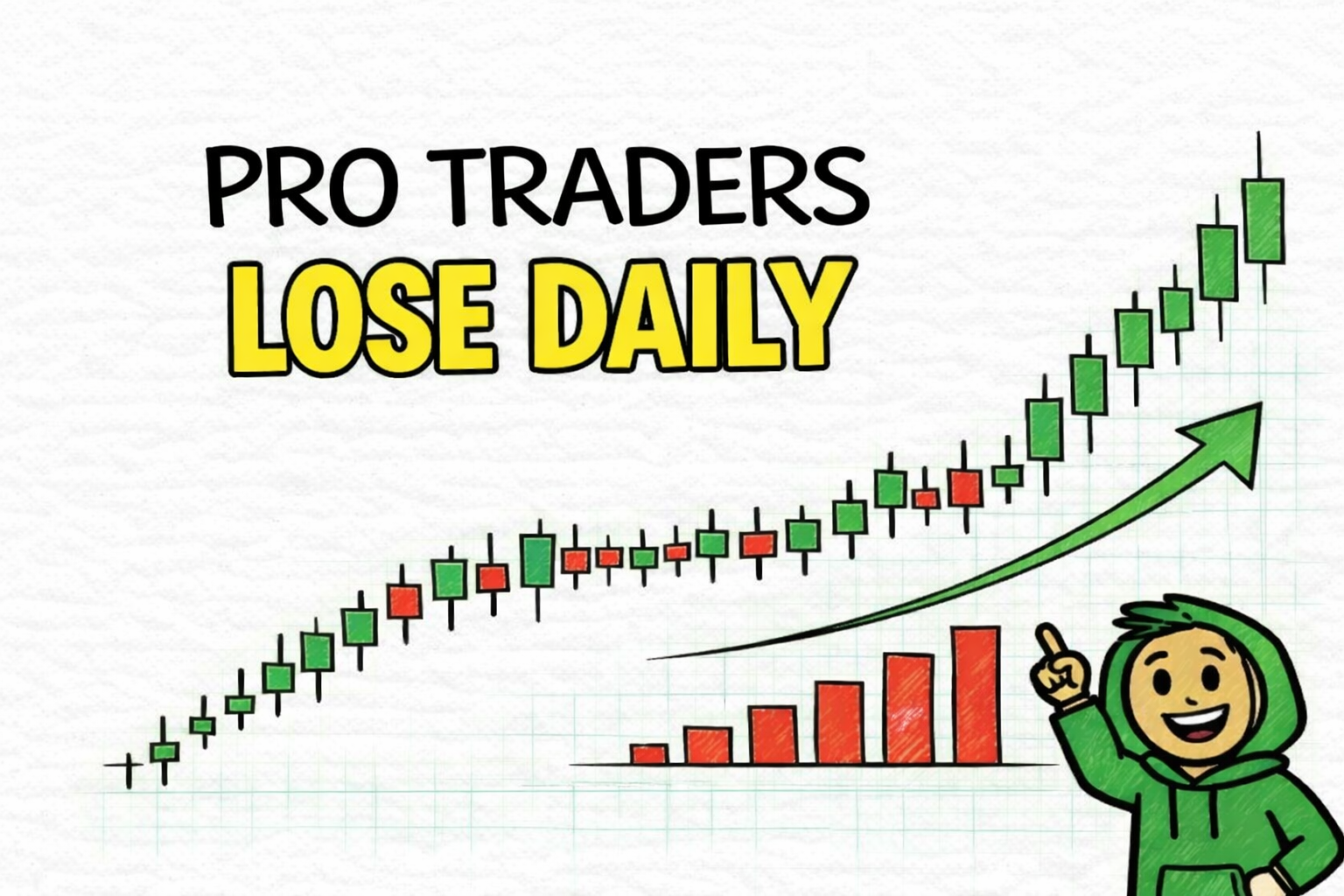
Here's the math professionals actually use: you only need to be right 35–40% of the time to be consistently profitable, as long as your winners are significantly larger than your losers. A trader who wins 40% of their trades but keeps losses at -$50 and lets winners run to +$200 is printing money. A trader who wins 65% of their trades but takes -$500 losses and cuts +$80 winners is slowly dying.
The ratio is everything. Amateurs do it backwards — they hold losers hoping they'll recover and cut winners early to lock in a little green. The result is a portfolio of big losses and small wins. Professionals flip this. They take small losses all day long. It's boring. It's repetitive. And when the right setup appears, they let it run. That one trade covers a month of small losses and then some.
This is why professional traders talk about losses as a business expense rather than a failure. You wouldn't call rent a failure. You wouldn't call payroll a loss. Losses are the cost of being in the business of trading.
Why Traders Blow Up — and It's Not Bad Setups
Here's what nobody tells beginners: accounts don't die from bad entries. They die from bad behavior.
The three behaviors that destroy accounts are revenge trading, refusing to cut losses, and oversizing positions on substandard setups. And they almost always happen together, in sequence. You take a loss. Your ego reacts. You size up on the next trade to get it back. That trade also loses, now bigger. You hold it because you can't face being wrong again. The trade gets worse. You're now down significantly and emotionally unable to cut. That's how a manageable down day becomes a catastrophic week.
The irony is that the cure is simple, even if it isn't easy. Learning to cut losses early builds the habit that keeps you away from catastrophic losses. When you're used to cutting stocks for minus 10 or 20 cents without hesitation, being wrong stops hurting. And when being wrong stops hurting emotionally, you stop doing all the things that blow accounts up.
Size Kills: The Most Important Lesson in Trading
If there is one principle that every professional trader agrees on across every style and every market, it's this: oversizing kills accounts. Not bad setups. Not bad timing. Oversize.
When you are all-in on a trade, the smallest move against you creates an outsized emotional reaction. That reaction is what causes you to hold a loser when you should cut it. That reaction is what causes you to average down into a collapsing position. That reaction is what turns a routine losing trade into an account-defining disaster.
Trading small changes everything. When your position size is appropriate, you can think clearly. You can let the trade develop without watching every tick. You can actually apply your system instead of reacting to your P&L. Proper position sizing is not timid trading — it's the foundation that makes good trading possible.
The test is straightforward: if the stock stops out on its predetermined stop loss, do you care? If the answer is yes, you are trading too big. No single trade should ruin your day. Ever.
This is especially critical during drawdowns. When retail traders hit a losing streak, their instinct is to increase size, add leverage, or jump into higher-volatility instruments like options or small caps trying to recover losses quickly. Every one of those moves makes the drawdown worse. Professionals do the exact opposite — they cut size during losing streaks, trade their best setups only, and grind their way back with discipline rather than desperation. Managing risk during volatile conditions is a learned skill, not a natural instinct.
Your Edge Is Not Your Entries
This is the part most trading education completely ignores. Retail traders spend enormous amounts of time looking for better entries, better indicators, better scanners, better systems. They read about setups obsessively. Meanwhile, profitable traders will tell you that entries are almost secondary.
Your real edge is your discipline and consistency. Do you prepare every single day? Do you manage risk on every trade without exception? Do you have the psychological fortitude to follow your plan when the market is moving fast and your emotions are screaming at you to do something irrational?
Trading psychology is the biggest obstacle every trader faces at every stage of their career. It's not a beginner problem that goes away with experience. It's the ongoing work of the profession. The market doesn't care about your feelings. It doesn't care that you need to make rent. It doesn't care that you just had a bad week. It will expose every psychological weakness you have, and it will do it consistently.
Building real edge means building three pillars simultaneously: consistency in your daily process (scanning, preparation, routine), disciplined risk control (pre-planned stops on every trade, position sizes that don't compromise your thinking), and the mindset to execute your plan every day regardless of recent results.
The Three Pillars of Professional Trading
Professional trading is not complicated, but it requires relentless execution of simple principles.
Consistency in routine means going through charts systematically every single day — not when you feel like it, not when the market looks interesting, but every day. The traders who find the best setups aren't the smartest. They're the most consistent in their preparation. A daily scan of hundreds of charts builds pattern recognition that cannot be shortcut. Over time, the setups jump out at you because you've seen so many.
Pre-planned risk control means knowing your stop before you enter every trade and treating it as non-negotiable. Not a guideline. Not a zone. A line. If the stock hits your stop, you cut it. Full stop. This is the habit that makes everything else work. Once you remove the decision-making process around exits — once cutting losses becomes automatic — you eliminate the emotional spiral that destroys accounts. You can also study managing a small account to understand how these principles apply at every account level.
Attacking mindset focused on process means understanding that results are a lagging indicator of process quality. You cannot plan for your next trade to be a winner. But if you run the right process every single day — preparation, risk control, patience, discipline — the wins will accumulate over time. Process is the only variable you control. Results will follow.
When the Big Trade Comes
Professional traders rarely talk about their big winners. What they actually talk about is showing up every day, cutting losses quickly, keeping size appropriate, and staying in the game through the inevitable drawdowns. The big winners are a byproduct of the process, not the goal.
The market will always eventually give you that outsized setup — the perfect stock with the right catalyst, the ideal chart structure, the stars aligned in the right configuration. The only question is whether you'll be there when it happens. If you've blown up your account chasing revenge trades and oversizing losers, you won't be. If you've stayed disciplined, kept losses small, and preserved your capital and your mental energy, you will.
The traders who win in the long run aren't the ones who found the best setups. They're the ones who survived long enough to be in the right position when the market gave them a gift.
You will lose tomorrow. You will lose next week. The only question is whether it hurts you. If you manage risk correctly, it won't. And that's when the business of trading actually becomes sustainable.
About Kunal Desai
Kunal Desai is the CEO and founder of Bulls on Wall Street. A professional trader since 2008, he has navigated every major market cycle—from the 2008 financial crisis to today’s high-volatility environments. Having mentored thousands of students through over 79 intensive trading bootcamps, Kunal is dedicated to teaching real-world execution and high-probability strategies. Based in Miramar Beach, Florida, he balances the intensity of the trading desk with a focus on fitness, family, and performance cars.
Connect with Kunal: Read his full story here | Instagram | YouTube