A market order fills immediately at the best available price. A limit order fills only at your specified price or better. That one sentence is the textbook answer. Here is the real answer: choosing wrong costs you real money, and the mistake almost always comes down to position size and spread.
I have been trading stocks full-time since 2007 and have trained 7,000+ students through the 60-Day Trading Bootcamp at Bulls on Wall Street. Order execution is one of those topics that sounds simple until you are holding 1,500 shares of a volatile name at the open and the spread just blew out to a dollar. Then it gets very real, very fast.
This is what I have learned the hard way.
Bulls on Wall Street was founded in 2008 by Kunal Desai, a professional trader since 2007. The company has trained 7,000+ students through its 60-Day Trading Bootcamp and runs BullsVision, a live trading chatroom covering day trading, swing trading, and options. Featured in Forbes, Fortune, and Inc. Kunal trades live every market morning.
TL;DR
Use a market order when speed matters more than price -- tight spread, small size, or an urgent exit.
Use a limit order by default. It controls your fill price and forces discipline on your entry level. If the stock does not come to you, you miss the trade -- and a missed trade is not a loss.
The decision is not a preference. It is a math problem: position size times spread equals the instant cost of a market order. Run it before every fill.
On wide-spread, fast-moving momentum stocks like NBIS or AAOI -- stocks I trade regularly -- a market order at the wrong moment can put you in a hole before the trade even starts. Plan your order type in your morning game plan, not in the heat of the move.
Stop losses on fast day trades: market order. Swing trade entries when you are away from the desk: limit order.
What Is a Market Order
A market order is an instruction to buy or sell a stock immediately at whatever price the market is currently offering. You are not specifying a price. You are saying: fill me now, at whatever the best bid or ask is on the Level 2.
If you are buying, you get filled at the lowest ask. If you are selling, you get filled at the highest bid. On a liquid stock with a $0.01 spread, you will barely notice the difference from your intended price. On a volatile small-float name moving fast, you can get filled $2, $3, even $5 away from where you expected.
That gap between expected price and actual fill price is called slippage. The SEC's Office of Investor Education and Advocacy defines a market order as one that executes at the best price currently available, with no price guarantee -- which is exactly the risk you are taking on when you use one.
What Is a Limit Order
A limit order is an instruction to buy or sell a stock at a specific price or better. If you set a buy limit at $25.50, you will only get filled at $25.50 or lower. If you set a sell limit at $30.00, you will only get filled at $30.00 or higher.
The tradeoff is straightforward: you get price control, but you give up guaranteed execution. The stock may never come back to your level. You may sit there watching it rip $5 without you.
Both outcomes are valid. The skill is knowing which trade calls for which order.
The Real Decision: Size Times Spread
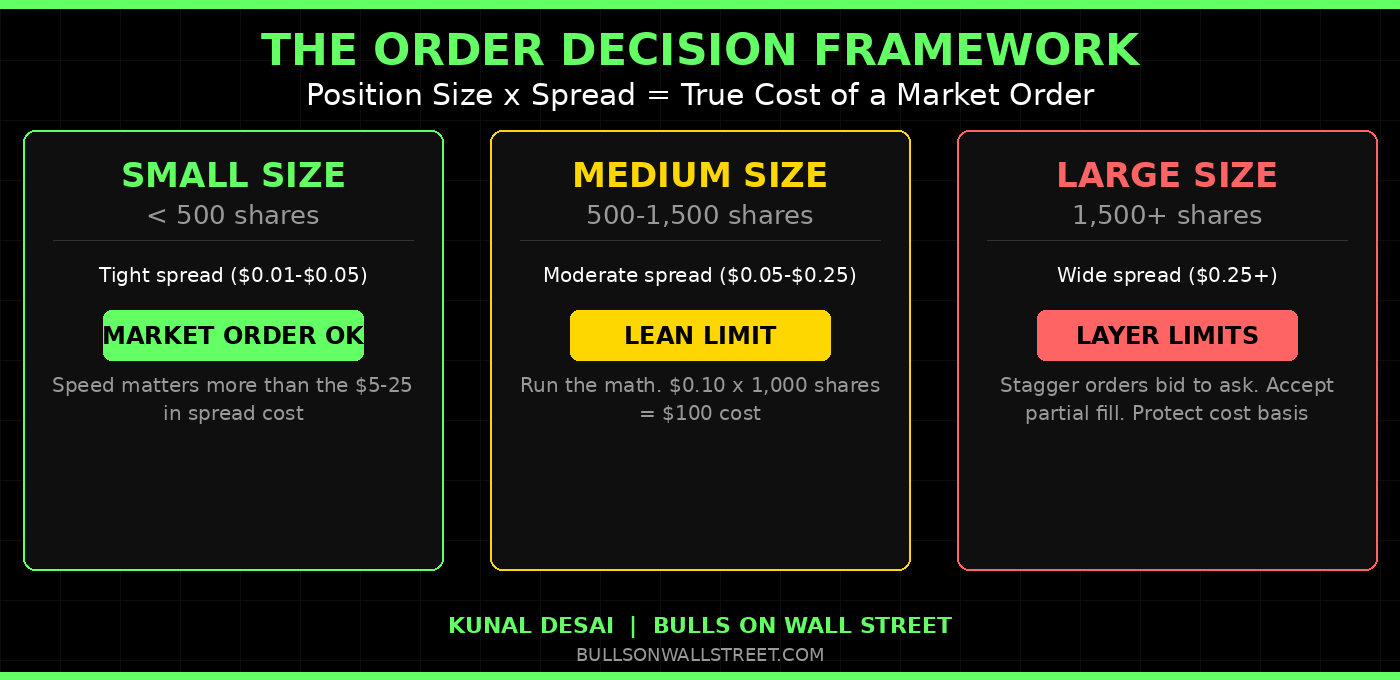
Here is how I actually think about this. The decision is not market vs. limit. The decision is: what is my position size multiplied by the spread?
If I am doing 200 shares on a stock with a $0.01 spread and it is breaking out right now, I have no problem using a market order. I am paying up $2 total to guarantee my fill on a trade I am going for $1 or more. That math works. Speed is worth more than the $2.
But if I am trying to buy 5,000 shares and the spread is $0.10, that market order is immediately costing me $500. Multiply that across every trade I make in a day, across a year, and we are talking about tens of thousands of dollars in unnecessary friction. On those larger positions I will layer the order. I will stagger my limit prices -- some closer to the ask where they will fill easily, some closer to the bid where they may or may not fill. I accept that I might not get my full size. That is better than eating a $500 spread on every trade.
For stocks scanning well and sizing up your positions, I use TC2000 -- the platform shows spread data directly in the Level 2 window so you can see the exact cost of a market order before you send it.
When to Use a Market Order
Use a market order when speed of execution is worth more than price precision. Three specific situations:
First, you are trading a highly liquid large-cap with a tight spread. Apple, Microsoft, NVDA when it is running on heavy volume. The spread is $0.01 and you are doing a reasonable size. Market order is fine. You are not giving up anything meaningful to guarantee your fill.
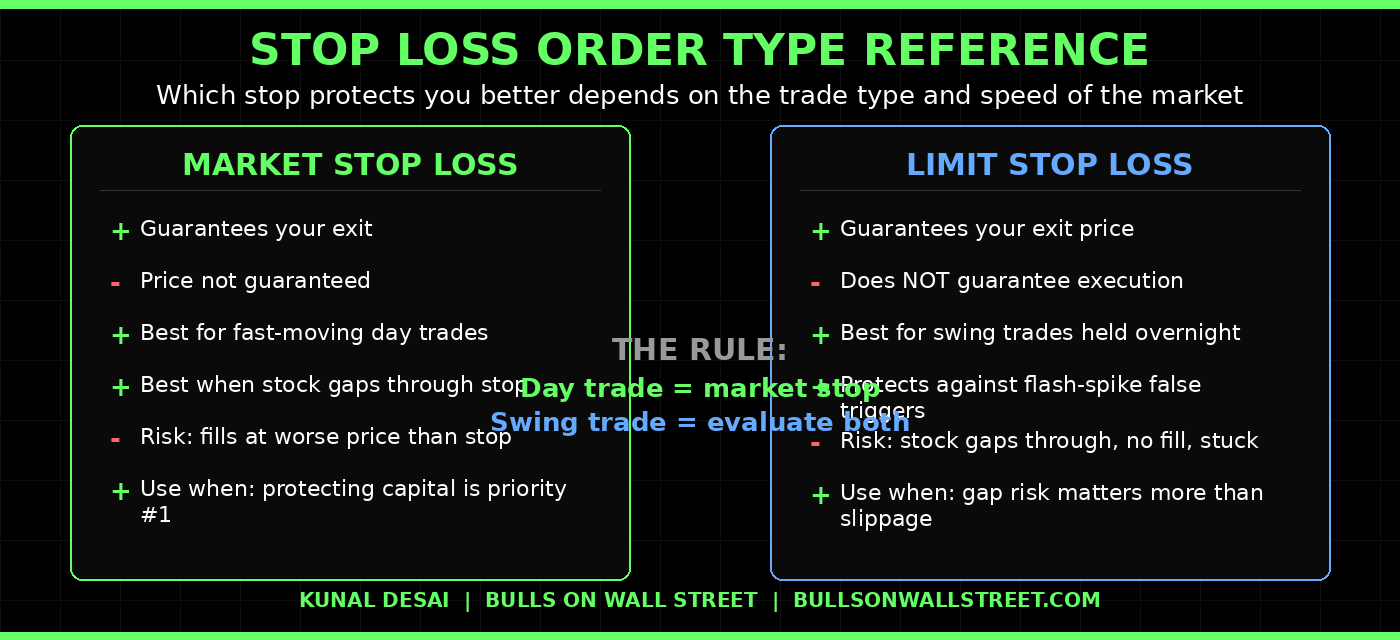
Second, you need to get out of a position immediately. Stop loss triggered, stock is rolling over, you need to be flat right now. A limit stop that does not fill because the stock moved through your price is worse than a market order that gets you out at a slightly worse price. On swing trades especially, where you are not watching every tick, a market stop loss is the right tool. It guarantees exit. It protects you from a limit stop leaving you long into a bigger move against you.
Third, your size is small relative to the spread. At 200 shares with a $0.01 spread, the cost of a market order is negligible. Do not overthink it.
When to Use a Limit Order
Limit orders are the default for most setups. Especially on momentum stocks with wide spreads.
Use a limit order when you have a specific entry level in mind and you can afford to miss the trade if it does not come to you. Pullback setups, first candle to make a new high, Bone Zone entries on the 5-minute chart -- all of these have natural entry points where a limit order makes sense because the setup is only valid at that level anyway. If the stock does not come to you, the setup has changed.
Use limit orders when the spread is wide. Wide spread stocks -- anything with more than $0.05 between bid and ask during your intended entry window -- should almost always be entered with a limit. You need to decide upfront where you are willing to buy, place the order there, and accept that you might not get filled.
Use limit orders on swing trade entries when you are not at the desk. If you want to buy a stock on a dip to $80 for a multi-day hold, set a buy limit at $80 and walk away. You will get filled if the stock comes to you. If it does not, you did not overpay chasing it.

The NBIS Lesson: When FOMO Overrides Your Plan
On June 16, 2026, NBIS was my number one idea going into the open. The plan was to buy the red-to-green off the open -- catch it coming off a dip to $254 and wait for confirmation. I wrote in my morning game plan not to use a market order because NBIS regularly trades with a spread close to a dollar at the open, and when it moves it skips prices fast.
I lost focus for a second. The stock dipped to $254, started ripping, and by the time I saw the red-to-green trigger, it had already moved $7 off the opening tick. I hit it with a market order right at the confirmation candle -- the exact spot everyone else is also watching. The stock was moving fast, skipping prices, and my market order chased it up. Horrific fill.
The right play on a stock like that: get in on the initial dip lower, closer to the bid, before the confirmation. Then scale in smaller on the red-to-green trigger with a limit. You preempt the entry instead of chasing the breakout. That is thinking three-dimensionally about your order execution, not just your setup.
NBIS has a 5-minute ATR over $2. On a stock like that, a $1 spread at the open is not unusual. Market ordering it at a crowded confirmation point is the most expensive mistake you can make.

The AAOI Lesson: When You Have to Let the Trade Go
AAOI is a stock that has cost me thousands of dollars in spread damage over the years. Float under 80 million shares, ATR over 16%, and the spread at certain points in the day is a dollar or more. When it moves, it moves fast and it skips prices.
June 16 was a short setup on AAOI. My level was $191. I wrote it in my game plan that morning: do not market order this name. The spread risk is too high. So I put in limit orders, scaled across a range, waiting for the short to trigger.
The stock broke down through my level so fast my limits never filled. By the time I would have been able to adjust, the move was already significantly in progress.
I let it go.
That is the discipline limit orders require. A missed trade is not a loss. A missed trade is a trade you had a thesis on that did not execute on your terms. Chasing it with a market order into a fast-moving name with a wide spread is how you turn a missed opportunity into an actual loss. The SEC has specifically warned about the risks of short-term trading in volatile, fast-moving stocks -- and execution quality is a big part of why those risks are real.
A missed trade feels bad for about two minutes. A bad fill on a wide-spread stock moving fast feels bad for the rest of the day.
Stop Loss Orders: Market or Limit
For stop losses, I default to market orders on volatile day trades. Here is why: if my stop is at $50 and the stock drops through $50 to $48 in two candles, a limit stop at $50 may not get filled. Now I am long a stock $2 below my stop, watching it go against me further, waiting for a fill that may never come.
A market stop gets me out. It might be at $49.80 instead of $50. That extra $0.20 of slippage is vastly better than riding it to $47. The investor.gov bulletin on stop orders makes this point explicitly: when stop price is reached, a stop order becomes a market order, meaning execution is guaranteed but price is not -- and that is the right tradeoff when protecting against a larger loss.
Swing trades are the exception. If you are not watching the tape and you are holding overnight, a limit stop adds a layer of protection against a flash move that triggers and reverses immediately. But even then, understand the risk: if the stock gaps through your limit at the open, you have no exit.
The Spread Cheat Sheet
Before every trade, run this quick check:
What is the current spread? Divide that by the stock price to get the spread percentage. A $0.50 spread on a $100 stock is 0.5% -- meaningful but manageable on a $2+ target. A $0.50 spread on a $10 stock is 5% -- that is your entire R if you are going for $0.50. Never use a market order on a stock where the spread percentage eats significantly into your expected profit.
The size math: take your share count, multiply by the spread. That is what a market order costs you in gross slippage right off the fill. On 1,000 shares with a $0.25 spread, that is $250 before the stock moves a single tick. Is your conviction worth $250 before you even start? If yes, market order. If not, layer limits or skip the trade.
How I Use Limit Orders on Large Positions
When I am building a larger position on a volatile name, I do not send one big limit order. I stagger. Here is the framework:
Say I want 2,000 shares of a stock at around $50. Current ask is $50.10, bid is $49.90. Instead of one market order for 2,000 shares that eats through the ask, I might layer: 500 shares at $50.05 (likely to fill quickly), 500 shares at $50.00 (fills if it dips slightly), 500 shares at $49.95 (fills on a small pullback), 500 shares at $49.85 (may or may not fill). I might only get 1,000 or 1,500 shares. That is fine. My average cost is better than a single market order, and I did not telegraph my full size to the market at once.
Some platforms also offer midpoint routing -- an order type that tries to execute at the midpoint between bid and ask. On liquid names I will use this when I want close to market execution without paying the full spread.
For learning how to read a Level 2 window and set up these order types in a live environment, the BOWS BullsVision trading chatroom -- $7 for the first week -- is where I walk through order execution in real-time every morning during market hours. You see exactly how I enter, size, and exit live positions.
Common Order Execution Mistakes
Using market orders on premarket gappers at the open. Spreads are widest in the first 30 seconds to 2 minutes. Stocks are moving fast. A market order into that environment on a low-float name is asking for a terrible fill. Wait for the spread to tighten or use a limit.
Using limit orders so far from the current price that you never get filled, then chasing with a market order when FOMO hits. You lose the discipline benefit of the limit and still take slippage. Pick your limit price as if you are willing to miss the trade at that level.
Forgetting that a stop-loss limit order is not guaranteed. You set a stop-limit at $48 on a stock trading $50. The stock drops to $46 in one candle. Your stop triggered but your limit never filled. Now you are stuck. Market stops solve this problem.
Ignoring position sizing. The order type decision is inseparable from size. What works for 200 shares does not work for 2,000. Scale the math accordingly.
For a full framework on how to size positions so that order execution decisions stay manageable, see my risk management hub where I break down the 1% Rule and position sizing in detail.
Frequently Asked Questions About Market Orders vs Limit Orders
What is the difference between a market order and a limit order?
A market order fills immediately at the best available price, guaranteeing execution but not price. A limit order fills only at your specified price or better, guaranteeing price but not execution. The choice depends on your position size, the stock's spread, and how much you need to guarantee a fill vs. protect your entry cost.
Which order type should beginners use?
Limit orders for most situations. They force you to pick a specific entry price, which builds discipline and prevents you from chasing breakouts into bad fills. Market orders are fine for liquid large-caps with tight spreads, but on volatile momentum stocks -- the kind that move $5 in 10 minutes -- a market order at the wrong moment can put you in an immediate hole.
When is a market order a better choice than a limit order?
When speed of execution is worth more than saving a few cents on the fill, you are trading a liquid name with a tight spread, your position size is small, or you need to exit a losing position immediately. Stop losses on day trades are often best executed as market orders to guarantee you get out.
What is slippage in trading?
Slippage is the difference between the price you expected to get and the price you actually got filled at. It is most common on market orders during fast-moving periods -- open of market, earnings reactions, news catalysts. On a stock with a wide spread moving quickly, slippage can be $1, $2, or more per share. On 1,000 shares that is $1,000 to $2,000 in execution cost before your trade even starts.
Can you use a limit order as a stop loss?
Yes, but be careful. A stop-limit order only executes at your limit price or better. If a stock gaps through your stop price, the order may never fill, leaving you stuck in the position. For day trades where you need guaranteed exits, a market stop is safer. For swing trades where you want to avoid stop-hunts and flash spikes, a stop-limit adds protection against false triggers.
What is a good spread to use a market order on?
The calculation is: spread divided by stock price. Under 0.1% and your size is under 500 shares, market orders are generally fine. Over 0.5% spread, especially at the open or on a fast-moving name, use limits. The absolute dollar amount matters too -- a $0.50 spread on 1,000 shares is $500 out of your pocket immediately.
Do professional traders use market orders?
Yes, selectively. For small size on liquid names, for urgent exits when a trade goes against you, and for stop losses where getting out matters more than price. For larger positions or wide-spread stocks, limit orders and layered entries are standard practice. The goal is always to minimize execution cost relative to your expected profit on the trade.
What happens if a limit order does not get filled?
Nothing, unless you do something about it. Your order sits open until it fills, you cancel it, or it expires (day orders expire at market close, GTC orders stay open until canceled). If the stock never comes to your price, you miss the trade. That is not a loss -- that is a trade that did not meet your terms. Chasing it with a market order after the fact is often worse than missing it clean.
How does order type affect my trading strategy?
Order type is part of your execution plan, not separate from it. Every setup has a natural entry mechanism. Breakouts that need speed -- lean toward market or near-ask limits. Pullbacks into support where you have time -- use limit orders at your level. Momentum stocks with wide spreads -- always limit, always sized for the spread, never market unless exiting to protect capital. See how this works alongside technical setups in the day trading strategies hub.
Should I use market orders for earnings plays?
Almost never. Spreads explode around earnings announcements and at the open after a gap. The difference between bid and ask can be multiple dollars on a single stock. Market orders in this environment are giving away money. Use limits, size down significantly, and be prepared to miss the trade if it moves too fast for your limit to fill.
The Bottom Line
Market order vs. limit order is not a binary preference. It is a calculation you run on every trade based on size, spread, speed of the move, and whether you need guaranteed execution or guaranteed price.
Default to limit orders for most entries. Use market orders when speed is critical and spread cost is negligible. Use market stops to guarantee exits on fast day trades. And on volatile, wide-spread momentum names -- write in your game plan before the open exactly how you are going to enter, because if the stock starts moving and FOMO kicks in, you will reach for the market order button and pay the price.
I have done it on NBIS. I have done it on AAOI. The only way to stop doing it is to build the rule before the trade, not during it.
If you want to see order execution in real time on live positions, join me in the BullsVision trading chatroom for $7 this week. Every morning I am walking through order entry, position sizing, and live trade management on the same stocks you are watching.
And if you want to build this into a complete execution system -- entries, stops, sizing, and the mental framework behind all of it -- the candlestick pattern PDF and the risk management hub are the places to start. Order type is one lever. The system is what makes it repeatable.
About the Author
Kunal Desai is the CEO and founder of Bulls on Wall Street. A professional trader since 2007, he has navigated every major market cycle -- from the 2008 financial crisis to today's high-volatility environments. Having mentored 7,000+ students through his live trading bootcamps, Kunal trades live every morning in the Bulls on Wall Street Trading Chatroom, where a full-access 7-day trial costs $7. He is dedicated to teaching real-world execution and high-probability strategies. Based in Miramar Beach, Florida.
Connect with Kunal: Read his full story | Instagram | YouTube
Apply for the 60-Day Trading Bootcamp
If you are serious about learning to execute like a professional, the 60-Day Trading Bootcamp is where it starts. You will learn the complete execution framework -- order types, position sizing, stop placement, scaling in and out -- through live instruction and real market practice. 7,000+ students have gone through the program. Apply below to see if you qualify.