

Live Trading Room vs Recorded Courses: The Answer Nobody in This Industry Wants to Give You
A live trading room and a recorded course are not competing options. Traders who try to choose between them are asking the wrong question — and that question is costing them years.
After 17 years of professional trading and training 7,000+ students through the 60-Day Live Trading Bootcamp, the data is unambiguous. Students who try to pick one or the other consistently underperform students who have both. Not because more is better. Because trading is a skill that requires two completely different types of learning — and each format delivers exactly one of them.
What a Recorded Course Gets Right (And Where It Falls Apart)
A recorded course gives you structure. Framework. The ability to rewatch a concept five times at midnight until it clicks. That matters. If you do not understand what a bull flag is, why the 9 EMA acts as support, or how to calculate position size before you risk a dollar, you are going to lose money fast.
But here is the problem nobody talks about: every trading book and recorded course cherry-picks its examples. The author shows you the cleanest flag patterns. The most textbook bounce off the 9 EMA. The prettiest setup that perfectly illustrates the point. That is not dishonest — it is natural. But it produces a student who knows what a perfect pattern looks like in hindsight and has no idea what it looks like forming in real time, when volume is ambiguous and the market is choppy and you have three seconds to decide whether to take the trade or pass.
Static candles cannot teach you speed or reflexes. They cannot show you how a professional reads pre-market news, scans the indices, and narrows 200 tickers to three setups before 9:30 AM. That entire preparation process is invisible in any recorded course. Book knowledge alone produces people who can describe trading. That is not the same thing as trading.
What a Live Trading Room Gets Right (And Where It Falls Apart)
A live trading room puts you in the room with someone who actually trades. You see real-time decision-making. You see what a clean setup looks like versus a sloppy one. You see how a professional handles a trade that immediately goes against them.
That is legitimate and powerful. Observation is how surgeons are trained, how elite athletes develop, how high-performance skill transfers from expert to student.
The problem is observation without a framework produces confusion, not competence. If you sit in a live trading room on day one with zero background, you watch someone call out ticker symbols, entry prices, and stop levels in real time with no idea what criteria selected that stock over the fifty others moving that morning. You are copying, not learning. Copying produces one outcome: dependency. You need the room to tell you what to trade because you never built the internal framework to decide yourself.
The SEC investor alert on day trading specifically flags the danger of imitation-based learning without foundational understanding. When the model you are copying is unavailable, the edge disappears entirely.
The Head-to-Head: What Each Model Actually Delivers
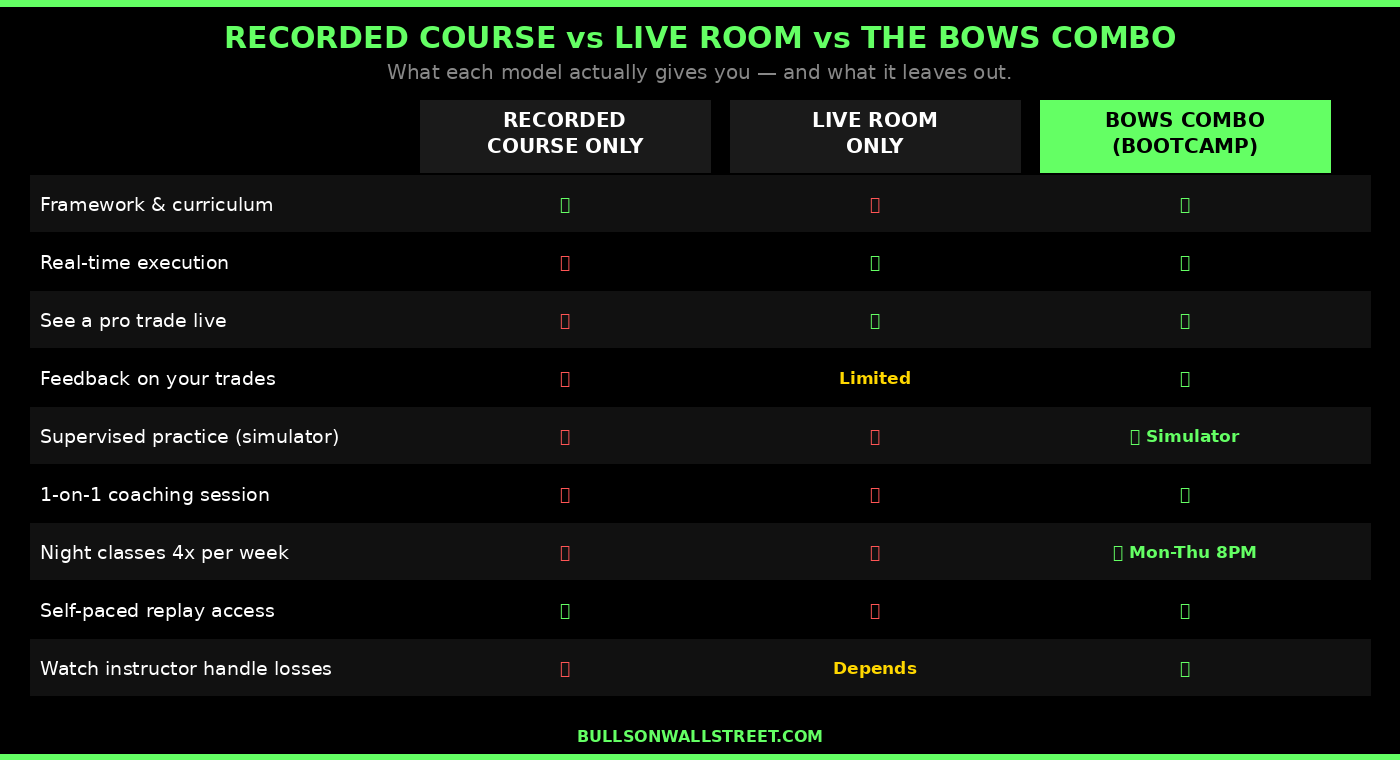
The comparison above is not theoretical. It is what 17 years of running both a live trading room and a structured curriculum simultaneously has shown in real student outcomes. Students who skip the framework and go straight to the live room stay dependent. Students who finish the curriculum but never watch live trading can describe patterns but cannot execute them under pressure. Students who have both — and then practice on a simulator before going live — are the ones who become self-sufficient traders.
Who Each Format Is Actually Best For

Most people who buy a recorded course are not yet ready to benefit from a live trading room. And most people who join a live trading room have not done enough foundational work to understand what they are watching. Both groups are wasting money — not because the product is bad, but because they chose the wrong sequence or skipped a critical phase entirely.
If you have zero foundation, start with structured curriculum. Build the framework first. If you have a proven framework and simulator track record, a live trading room will accelerate your development faster than anything else. If you are serious about becoming self-sufficient in the fastest legitimate timeframe, you need both simultaneously — plus supervised practice and feedback on top of that.
The Model That Actually Works: What Elite Performers Know
A surgical resident does not walk into an operating room on day one and start cutting. Years of medical school come first. Then they observe senior surgeons in real procedures. Then they practice on simulators. Then — only then — they operate on real patients, with an attending physician still in the room.
Elite athletes work identically. Study the playbook. Watch film of professionals executing. Practice in training before the game counts. I built BOWS around this model. Not because I read about it. Because I experienced what happens when you skip steps.
Paul Singh and I built my entire early trading education over AOL Instant Messenger. No Zoom. No screenshare. No video. He would type the setup, I would pull up the chart, type back what I was seeing, and he would correct me. It forced a level of focus I have never replicated since. But even that had a ceiling. Paul could describe a pattern in text. What he could not transmit over AIM was the speed. The reflexes. The feel of watching a 5-minute candle form in real time when the setup is on. That experience cannot be typed. It can only be witnessed live. That is the core reason I built the live component the moment I had the ability to.
The BOWS System: Four Phases, No Shortcuts
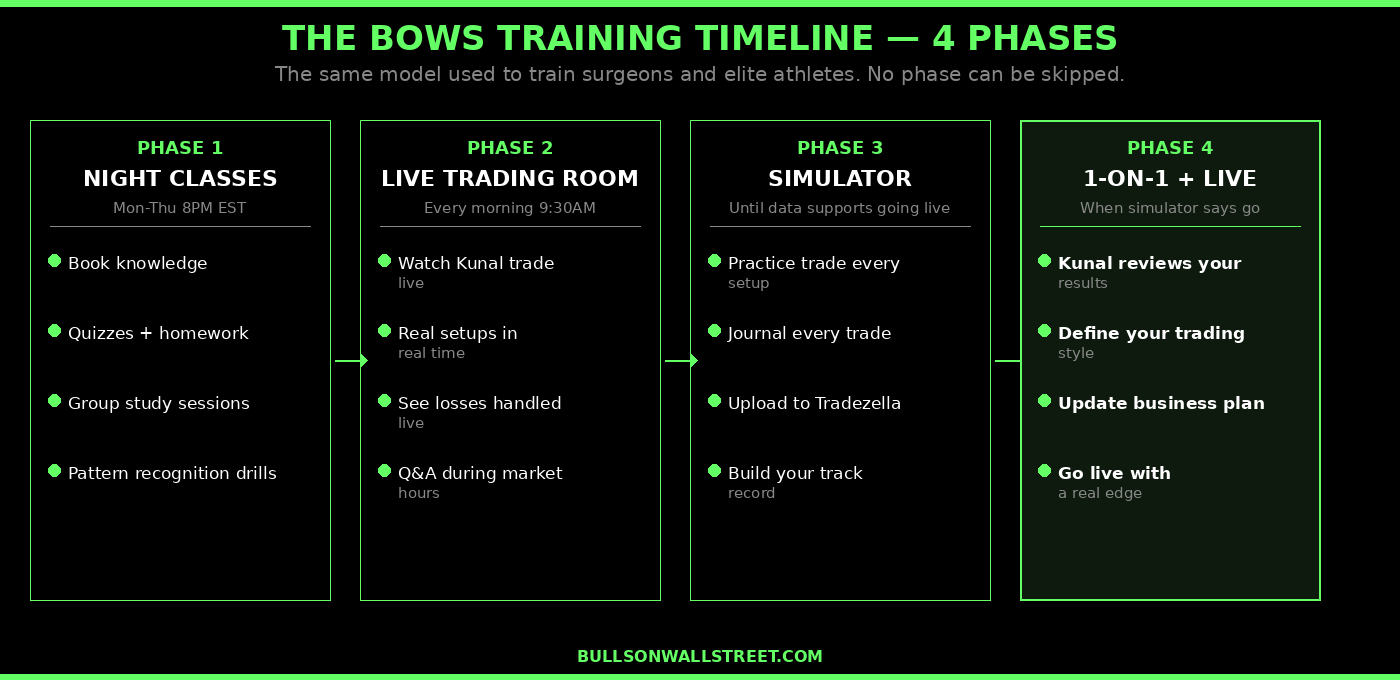
Four nights a week — Monday through Thursday — at 8 PM Eastern, we run live classes. Not recorded modules. Live sessions covering curriculum, with real-time Q&A, quizzes, homework, and group study sessions. You are not passively watching videos. You are being tested on whether you absorbed the material.
Every morning at market open, students are in the Bulls on Wall Street Trading Chatroom watching live trading on real money. I call out what I am watching, why I am watching it, where the entry is, where the stop goes. The night class and the morning trading room are intentionally synchronized — one reinforces the other every single day.
My camera is on. Students are not just watching TC2000. They see me doing shoulder band work between trades to prevent rounded shoulders. They see the hand grippers I use to keep my fingers strong — we have a running joke in the room that I have the fastest fingers in the west. They see the physical discipline that goes into sitting at a screen for six hours a day without destroying your body.
More importantly, they see how I handle a loss. Every course shows you the winning trades. What makes or breaks a trader is the moment right after a stop-out. The emotional pull to re-enter immediately. The frustration that wants to become aggression. My students watch me go through that in real time and maintain what I call the cool and collected face — the professional composure that does not let a bad trade bleed into the next decision. That is something you cannot learn from a video library.
When the classroom curriculum wraps, students move to the simulator. Every trade gets journaled in Tradezella and uploaded for review. You build a real track record that tells you — with data, not opinion — which setups you execute well and which you consistently misread before any real capital is at risk.
Then the 1-on-1. I sit down with each student, review their simulator results, discuss what style of trading fits their life — day trading, swing, or both — and we build out a real trading business plan together. Not a template. A specific plan for their schedule, account size, risk tolerance, and goals.
The Bureau of Labor Statistics documents that financial services roles consistently require supervised practice before independent operation. Trading operates by the same principle. The progression is not optional — it is the mechanism.
The Verdict
A recorded course without live trading produces traders who understand patterns but freeze when it counts. A live trading room without a curriculum produces traders who copy entries and never develop independent judgment. Neither alone produces a consistently profitable, self-sufficient trader — and the industry knows it, which is why so many programs collect monthly subscriptions from people who never make real progress.
The question is not live room versus recorded course. The question is whether your trading education gives you framework, live observation, supervised practice, and a feedback mechanism. If any one of those four is missing, you have a gap. That gap will cost you more than any subscription fee.
Seven years. That is how long it took me to become consistently profitable trading alone. When I founded BOWS in 2008, I built it to collapse that timeline. The students who engage with all four phases do not take seven years. The ones who treat it as a menu instead of a system take longer than they need to. Do not pick between a live room and a course. Demand both. And demand practice, feedback, and a coach on top of that.
Frequently Asked Questions
Is a live trading room better than a recorded course?
Neither is better in isolation. A recorded course builds the framework you need to understand what you are watching. A live trading room provides real-time observation that a course cannot replicate. The most effective trading education combines both — curriculum first, then live observation, then supervised practice. Trying to choose one is the wrong question.
What is a live trading room?
A live trading room is a virtual environment where a professional trader executes real trades in real time while students watch via screenshare. Students see the entry, stop placement, and reasoning behind each trade as it happens. The best live rooms include a chatroom where students ask questions and get real-time answers during the session.
Are live trading rooms worth the monthly cost?
A live trading room is worth the cost if you already have a foundational understanding of the setups being traded. Without that foundation, you risk copying trades without understanding why — which builds dependency rather than skill. Build the framework first. If you have simulator data showing you understand your setups, a live room accelerates development significantly.
How does the BOWS night class and live trading room combo work?
Night classes run Monday through Thursday at 8 PM Eastern covering BOWS curriculum with live instruction, Q&A, quizzes, and homework. The next morning at market open, students watch those exact setups traded live in the chatroom. The night class and the morning room are intentionally synchronized so each session reinforces the other every day.
Can I join just the live trading room without the bootcamp?
Yes. The Bulls on Wall Street Trading Chatroom is available as a standalone membership at $7 for the first week through BullsVision. It includes live day trading, swing trading, and options coverage. Students who want the full curriculum with night classes, simulator training, and 1-on-1 mentorship enroll in the 60-Day Live Trading Bootcamp.
What do students practice on in the simulator phase?
Students practice trade using TC2000 for charting and scanning, and journal every trade in Tradezella. The goal is to build a real track record — with data, not opinion — that tells you which setups you execute well and which you are consistently getting wrong before real capital goes to work.
Why does the BOWS bootcamp run night classes four nights per week?
Because watching execution without understanding it produces dependency, not skill. The night classes build the internal framework that makes the live trading room useful. Without knowing what a first pullback is, why the Bone Zone matters, and how to calculate position size, a student watching live trading is just copying entries. Four nights per week ensures genuine understanding is building alongside live observation.
How long does it take to become profitable with the BOWS model?
There is no guaranteed timeline. What the data from 7,000+ students shows is that students who engage with all four phases — curriculum, live observation, simulator, 1-on-1 — and who journal consistently reach consistent profitability significantly faster than those who pick and choose which components to engage with. The system works as a system. Removing any phase slows the process.
Start With Live. Learn Live.
The fastest way to understand what the BOWS model looks like in practice is to be in it.
The Bulls on Wall Street Trading Chatroom is $7 for the first week. Every morning at market open, you are watching live trading in real market conditions alongside the curriculum students are working through at night.
If you want the full system — night classes, live room, simulator, 1-on-1 — the 60-Day Live Trading Bootcamp is where it all comes together. The next cohort is forming now.
Kunal Desai is the CEO and founder of Bulls on Wall Street. A professional trader since 2007, he has navigated every major market cycle -- from the 2008 financial crisis to today's high-volatility environments. Having mentored 7,000+ students through his live trading bootcamps, Kunal trades live every morning in the Bulls on Wall Street Trading Chatroom and is dedicated to teaching real-world execution and high-probability strategies. Based in Miramar Beach, Florida.
Connect with Kunal: Read his full story | Instagram | YouTube